
 Add us as a preferred source on Google
SRE vs DevOps is arguably the most talked-about concept in the modern world of software development. This is particularly true as organizations attempt to deliver faster release cycles without compromising the reliability of the systems involved. To achieve the desired balance between the two concepts in the modern world of cloud computing, it is critical to understand the concept of SRE vs DevOps.
According to the 2026 State of DevOps Report, 70% of organizations acknowledged that the maturity of DevOps had a considerable influence on the success of their artificial intelligence projects. This indicates the critical role that the concept of DevOps plays in the modern world of software development.
In this blog, we will discuss what is SRE vs DevOps, the main areas of focus for these concepts, the difference between them, roles and responsibilities, and when to apply them individually or collectively.
DevOps vs SRE: What Do They Mean?
Site Reliability Engineering (SRE) is the application of software engineering practices to solve infrastructure and operational problems. It mainly focuses on the automation of various tasks, such as system management, to increase reliability. One of the main concepts of SRE is the utilization of Service Level Objectives (SLOs) and error budgets for the launch of new feature sets.
DevOps is a collection of practices that brings development and operations teams together to improve collaboration, automation, and software delivery. It plays a key role in modern software and web development by helping teams release applications faster, more efficiently, and with greater reliability.
DevOps vs SRE: The Core Differences Explained
Recognizing the fundamental difference between SRE vs DevOps enables organizations to maximize the speed, reliability, and performance of their systems. Moving on, it is time to explore the fundamental difference between DevOps and SRE. Let’s find out what makes each practice contribute to software reliability.
| Category | DevOps | SRE |
| Primary Focus | DevOps is all about collaboration and automation to deliver software that is both rapid and reliable. | SRE is all about the application of engineering principles to make sure that the systems we deploy to the world are reliable, scalable, and resilient. |
| Key Metrics | Deployment frequency, lead time for changes, change failure rates, mean time to recovery, cycle time, and throughput are the measures for delivery speed and stability. | Latency, traffic, errors, saturation, and mean time to detect, resolution, and service objectives, and errors are the service level indicators. |
| Approach | DevOps is a more open-ended concept as a cultural and collaborative approach to bring together development and operations teams. | SRE is the application of software principles and operations in terms of reliability. |
| Team Structure | DevOps teams consist of developers, quality assurance engineers, operations engineers, and release managers who work together to develop, test, deploy, and maintain the software, encouraging automation, shared responsibility, and continuous delivery. | SRE teams are engineers with development and operations skills who are focused on building and improving system reliability, automation, and performance to ensure system performance and scalability in production environments. |
| Origin | Launched as a grassroots movement in 2007-2009 to improve collaboration and reduce frustration between the software development and IT operations teams. | Launched in 2003 at Google to help scale systems from the perspective of a software engineer. |
| Tooling Examples | Version Control: GitHub, Git, Bitbucket
Infrastructure as Code (IaC): Terraform, Puppet, Ansible, AWS CloudFormation Logging & Monitoring: Datadog, Grafana, ELK Stack |
Performance Testing: k6, JMeter
Log Aggregation & Analysis: ELK Stack, Splunk Incident Management: VictorOps, PagerDuty, Opsgenie |
Why Many Companies Use DevOps and SRE Together
DevOps and SRE are often used together to improve software development speed, operational efficiency, and system reliability. Together, they help organizations deliver high-quality software products faster while maintaining stability and performance.
Automation
In SRE and DevOps, the most important factor is automation, and it is used for achieving efficiency in the system, along with the reduction of errors in software systems by efficiently delivering high-quality products using automated repetitive tasks like testing, deployment, etc.
Continuous Improvement
Continuous improvement is the lifeblood of SRE and DevOps. Both practices continuously strive for perfection in the processes and workflows they use.
Focus on Collaboration
Collaboration is the core of SRE and DevOps. Both practices involve the joint effort of the development and operations teams. They share the responsibility for the system’s performance and ensure that the processes for both teams function seamlessly. They work together to form a single process for software delivery.
Monitoring and Observability
In monitoring and observability, it is possible to find possible issues in the system before they occur. In this regard, both are essential in SRE and DevOps, as they utilize the data they collect in real-time to keep the system healthy and stable.
Scalability and Reliability
Both SRE and DevOps aim to build a scalable and reliable system. They aim to give the end-users the experience of uninterrupted services.
SRE vs DevOps Roles and Responsibilities
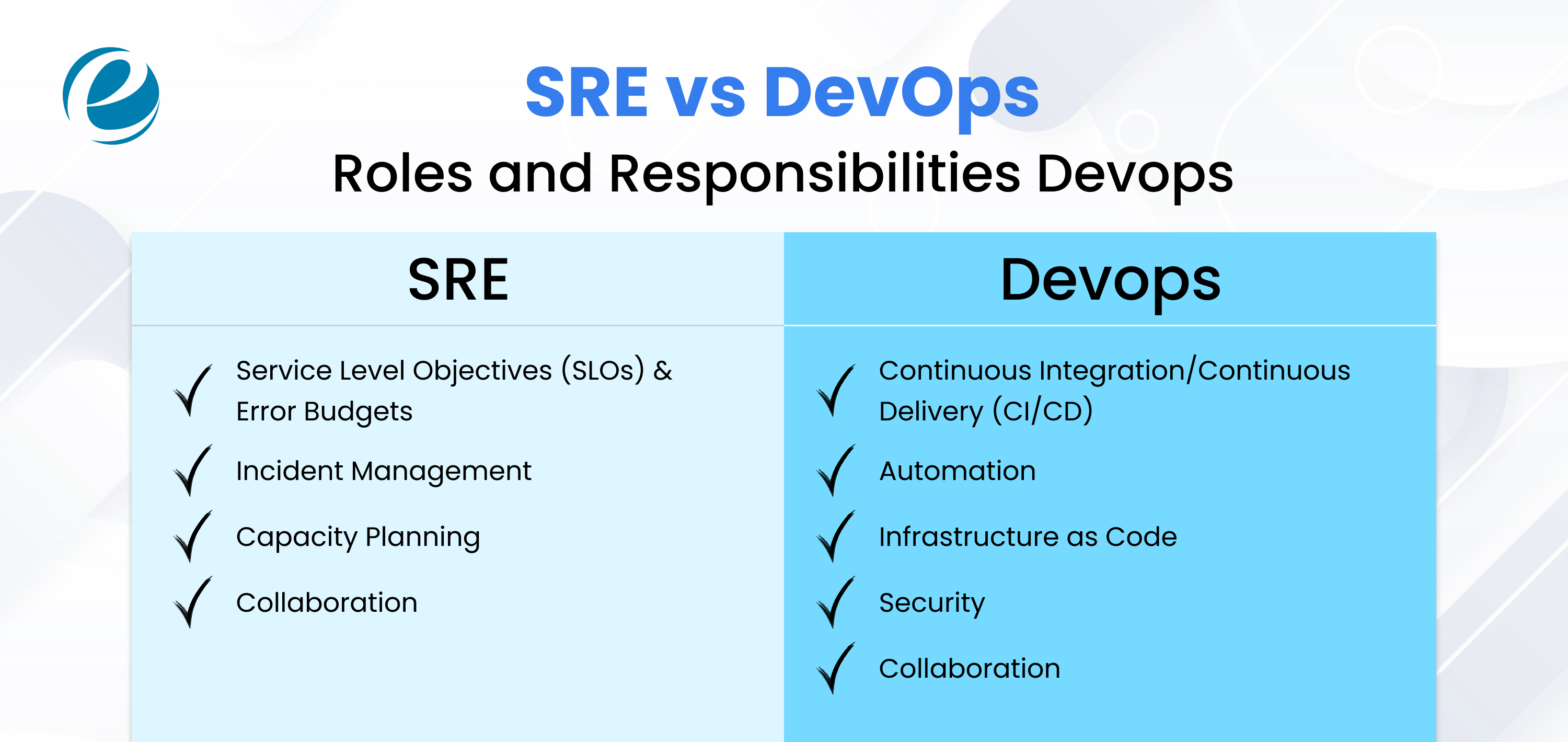
Understanding the different functions and responsibilities of a DevOps engineer vs SRE is essential to recognizing how they each contribute to the improvement of software delivery and system reliability.
Devops
- Continuous Integration/Continuous Delivery (CI/CD): It is your responsibility to design and manage CI/CD pipelines, which are utilized for the automatic integration, testing, and deployment of code.
- Automation: You are required to design and develop automation scripts, tools, and solutions that can be used to automate repetitive tasks such as deployment, testing, and monitoring.
- Infrastructure as Code: You are required to design and implement infrastructure using code, using tools such as Terraform and Ansible, to ensure the deployment, management, and provisioning of cloud infrastructure.
- Security: You are required to incorporate security practices in the DevOps process, ensuring that applications are secure, comply with security standards, and are not vulnerable to any security threats.
- Collaboration: You are required to work closely with development, testing, and operations teams to ensure effective integration, communication, and delivery of software throughout the development process, where DevOps consulting services enable streamlined coordination and enhance overall delivery efficiency.
SRE
- Service Level Objectives (SLOs) & Error Budgets: You manage Service Level Objectives and error budgets to balance system reliability and feature releases so your services are reliable and feature-rich.
- Incident Management: You create systems for quickly detecting, responding to, and analyzing incidents in your systems to ensure minimal downtime and improve their reliability.
- Capacity Planning: You monitor your systems’ usage and forecast their future requirements to ensure they are capable of meeting current and future demands.
- Collaboration: You work with your development and operations teams to ensure that your systems’ reliability is considered at all stages of your software development lifecycle.
When Should Businesses Choose DevOps or SRE?
Businesses don’t have to take an either/or approach with SRE and DevOps; instead, they can take a best-of-both approach and implement a DevOps culture and team and utilize SRE to fix operational problems. The connection between the two makes them incredibly effective when they are used in unison. Let’s examine this in the following section:
When to Choose DevOps
DevOps works best in the following scenarios:
- Your organization needs cultural change more than engineering practices
- You are a company with a dev group and an ops group that need better collaboration
- Speed of delivery is your top concern
- You are creating new products/services from scratch
- You are a small group wearing multiple hats
However, if deployments and system reliability issues are affecting your business, there is the provision of DevOps-managed services that can help improve efficiency, automation, and collaboration to improve results.
When to Choose SRE
SRE makes sense when:
- You already have a strong engineering culture, but you need to codify your reliability efforts.
- You need extremely high availability in your service, meaning 99.9% or better.
- You have complex systems, meaning you need a dedicated reliability expert.
- You are able to staff specialized SRE roles.
- You need metrics and accountability in your systems.
Conclusion
In the ongoing SRE vs DevOps debate, it’s important to remember that both practices aim to promote business innovation while ensuring system stability. While DevOps seeks this through the promotion of culture and the streamlining of the delivery pipeline, SRE seeks this through the promotion of engineering within the business.
However, in the contemporary business environment, many businesses have chosen to adopt the best of both worlds in the promotion of the stability of the system. For this reason, many businesses have chosen to hire DevOps engineers in the promotion of the goals of DevOps in the contemporary business environment.
FAQs
How is SRE Similar to DevOps?
SRE and DevOps are similar in that both emphasize the importance of automation, CI/CD, and collaboration, thus helping break the silos and provide quality software at a faster rate.
How Does SRE Support DevOps?
SRE supports DevOps in that SRE helps set SLAs, SLIs, and SLOs, thus ensuring that the system is reliable and performs well, thus facilitating the speed at which software is delivered.
What Are the Four Pillars of SRE?
The "4 pillars of SRE" are often an abbreviation for the following: monitoring, observability, incident response, automation, capacity planning, and performance.
How Does SRE Differ From DevOps?
SRE and DevOps cannot be equated or used interchangeably because they support each other in a way. DevOps is more about the culture & collaboration aspects, while SRE is more about the practices and application of DevOps principles.
Can an Organization Combine DevOps and SRE for Better Results?
Yes! Organizations often adopt a DevOps culture in 2026 and incorporate SRE to improve the reliability and scalability of the system. DevOps is responsible for workflow, CI/CD pipelines, and collaboration, whereas SRE is responsible for high availability, automation, and reliability.



 +1 (989) 535-9295
 info@emizentech.com
 emizentech


