
 Add us as a preferred source on Google
 Key Takeaways:
- Staff augmentation adds people to your team under your management; outsourcing hands the whole project to a vendor’s management.
- Staff augmentation vs software outsourcing usually comes down to whether you already have internal technical leadership to direct the work.
- Cost per hour tends to run lower with staff augmentation; cost predictability tends to be higher with outsourcing.
- Plenty of companies use both outsourcing for one-off, non-core work and staff augmentation for anything tied to their core product.
- The decision isn’t permanent. Most businesses shift between the two as internal capability grows.
Every growing tech team eventually faces the same challenge. The solution usually comes down to two options: adding more people to your team or outsourcing the entire job. That’s the core of the staff augmentation vs outsourcing decision, and honestly, it’s not a small one. Choose the wrong path, and you risk either overpaying for unnecessary control or losing control you couldn’t afford to give up.
The choice usually comes down to a few things: most companies never sit down and weigh internal technical leadership, how stable your requirements are, how much oversight you can realistically provide, and what happens to the knowledge once the work wraps up. In this blog, you will learn how each model actually works, what they cost in 2026, who should use which, and how to combine them without turning into a management headache.
Staff Augmentation Explained: How Does It Work?
Staff augmentation means hiring individual developers, testers, or designers from an external company and slotting them directly into your in-house team under your management, using your tools, and following your process.
The augmented staff report to your project manager, join your daily meetings, and work within your existing workflow. It’s the fastest way to close a skill gap or absorb a workload spike without running a six-week hiring process. Companies usually go this route when they already have a product roadmap and internal leadership but need extra React developers, a DevOps engineer, or a QA specialist for a defined stretch.
Key traits of staff augmentation:
- You manage the day-to-day work; the developers manage payroll, HR, and compliance.
- Talent integrates into your existing tech stack and sprint cycles.
- Engagements scale up or down with a short notice period.
- Best suited when internal expertise already exists but capacity doesn’t.
Most vendors offer three sub-models, which are described below:
1. Commodity: You specify the tech stack, and the vendor fills the seat fast.
2. Skill-based: You need something specific and scarce, like blockchain or AR/VR expertise.
3. Highly Skilled: Senior architects or leads who shape technical decisions, not just clear tickets.
Picking the wrong sub-model is the most common reason companies feel staff augmentation isn’t working for their project needs.
Pro tip: Before signing a staff augmentation contract, check out IP rights, notice periods for scaling down, and whether the development team allows a trial period. These three clauses cause most of the disputes that surface later.
Outsourcing Explained: How Does the Model Work?
Outsourcing means handing an entire project, or a defined chunk of one, to an external company that owns delivery planning, execution, quality, and often the technical decisions, so you don’t have to micromanage the process.
The project manager, architects, and developers on the development team figure out how to get it done. This approach is the model founders reach for when they don’t have in-house technical leadership, or when a project sits outside their core business and building a team around it just doesn’t make sense.
Key traits of outsourcing:
- The vendor owns project management, architecture, and delivery timelines.
- You get a fixed deliverable, often under a fixed-scope or milestone-based contract.
- Less day-to-day involvement is required from your side.
- This approach is best suited for work that is self-contained or outside your core competency.
Outsourcing itself splits into a few types worth knowing before you sign anything.
- Project-based: One deliverable, one contract, and one end date.
- Dedicated Team: A full external team assigned exclusively to you, but managed by the vendor.
- Offshore Development Centers: A semi-permanent external unit for long-term, ongoing work.
When people frame this as staff augmentation vs project outsourcing specifically, they usually mean the first flavor: a single, scoped deliverable with a fixed end point, not an open-ended resource engagement.
Pro tip: Ask any outsourcing vendor for a sample of their change-request process before signing. That one document tells you more about how painful scope changes will be than the entire sales pitch.
Staff Augmentation vs Outsourcing: Key Differences
Here’s the fastest way to see the split: a side-by-side look at how staff augmentation vs software outsourcing actually differ on the factors that matter.
| Factor | Staff Augmentation | Outsourcing |
| Management | Your internal project manager | Development team’s project manager and delivery team |
| Ownership of outcome | You | The development team |
| Focus | Adding specific skills to an existing team | Delivering a complete end-to-end project |
| Best For | Skills gaps and capacity spikes | Full projects, non-core initiatives |
| Pricing mode | Time-based (hourly/monthly) | Fixed price or milestone-based |
| Flexibility | High resource level | Lower scope changes need renegotiation. |
| Onboarding Speed | Days to a couple of weeks | Weeks, depending on the discovery phase |
| Ideal team maturity | You already have technical leadership. | You lack internal technical leadership. |
So, with the help of this table, you can easily understand the difference between both hiring models. Now, let’s learn how much it costs when you hire developers or a team through this model.
How Does the Cost Compare?
Staff augmentation is usually billed hourly or monthly per resource, so total spend tracks almost exactly with hours worked. Outsourcing is usually priced against the whole project, so the number is fixed upfront but padded to absorb the vendor’s risk.
Staff Augmentation Pricing
IT staff augmentation costs typically run on hourly rates that vary by region and seniority. Here is a general breakdown of the costs based on the region:
| Region | Hourly Rates |
| Onshore (US / Western Europe) | $100 to $250 |
| Nearshore (Latin America / Eastern Europe) | $35 to $95 |
| Offshore (Asia / Africa) | $20 to $60 |
There’s no markup for project management overhead, because you’re participating yourself. That makes staff augmentation the cheaper option per hour, but only if your internal team has the bandwidth to manage the extra people well.
Outsourcing Pricing
Outsourcing pricing works differently. Vendors quote against outsourcing pricing models like hourly rate, dedicated full-time & project-based, or dedicated-team retainers. Here is a general breakdown:
Outsourcing pricing works differently. Vendors quote against outsourcing pricing models like hourly rate, dedicated full-time & project-based, or dedicated-team retainers. Here is a general breakdown:
| Pricing Models | Approximate Rates |
| Hourly Rate | $15 to $50 per hour |
| Dedicated Full-time | $800 to $1,500 per month |
| Project-Based | $10,000 |
So, these are the outsourcing prices on the basis of the pricing models. Now let’s look at the regional rate differences between staff augmentation vs outsourcing.
Regional Rate Differences
A staff augmentation vs software outsourcing comparison in the US market looks nothing like the same comparison in South Asia or Eastern Europe. Hourly rates for staff augmentation in the US can run $80 to $150/hour for senior talent, while nearshore or offshore vendors deliver similar seniority for a third of that. Outsourcing pricing models follow the same logic: an offshore fixed-price quote for a mid-sized web app might land 40–60% below an onshore agency’s quote for identical scope, mostly because labor cost, not project management maturity, is the biggest line item in most software budgets.
Hidden Costs
Don’t forget the costs that don’t show up on the invoice. Staff augmentation carries onboarding time, internal tooling access setup, and the management hours your PM spends coordinating. work. Outsourcing carries handoff costs at the end of knowledge transfer sessions, documentation review, and the ramp-up time for whoever maintains the product afterward.
So, this is a clean staff augmentation vs. software outsourcing cost comparison that shows they differ in many factors you choose based on your budget and needs.
Which Gives You More Control?
Staff augmentation gives you significantly more control. You decide the tools, sprint cadence, code review standards, and daily priorities, since the augmented developers work within your existing framework.
Outsourcing hands most of that control to the vendor. You set requirements and review milestones, but day-to-day technical decisions, architecture choices, task sequencing, and even which developer works on what sit with the outsourcing partner’s project lead. That’s not really a downside; it’s the whole point of the model if you don’t want to manage those decisions yourself.
If control is your top priority, you might be building a core product feature that shapes your competitive edge. Retaining architectural and process control matters more than offloading management. Teams that want full oversight while still filling technical roles quickly often look at options to hire dedicated developers who work exclusively on their roadmap under their direction.
Staff Augmentation vs Outsourcing: Which Model Scales Faster?
At this point, you understand that both models can help you scale, but they work differently. The better option depends on how quickly you need people, how much control you want, and whether your needs are temporary or long-term.

Expanding Teams
Staff augmentation usually makes it easier to add developers quickly when your existing team needs extra support. Outsourcing can also scale, but adding resources may depend on the vendor’s team and project setup.
Adding or Removing Developers
With staff augmentation, you can usually add or reduce developers as your workload changes. This makes it useful when you need specific skills for a particular stage of development.
Short-Term Needs
Staff augmentation works well for short-term requirements, such as filling a skill gap, meeting a deadline, or supporting a busy development period without making permanent hires.
Long-Term Needs
For long-term projects, a dedicated development team or outsourcing model can provide consistent resources. This can be useful when you need ongoing development without building the entire team in-house.
Product Launches
Product launches often require extra developers for a limited period. Staff augmentation can quickly increase development capacity, while outsourcing is a good option when an external team is managing the launch.
Fluctuating Workloads
If workloads regularly go up and down, staff augmentation gives you more flexibility to adjust the team size. Outsourcing can be a better fit when the workload is predictable and the vendor can manage the work independently.
If you need to hire developers quickly and adjust your team as the needs change, staff augmentation offers more flexibility. When you want an external team to take responsibility for a larger project, outsourcing is the better option.
Staff Augmentation vs Outsourcing: Data Security & Risk
Data security is a crucial factor when choosing between staff augmentation and outsourcing. With staff augmentation, the external developers work within your existing team and security setup. You own the project because you decide what code and data they can access, making it easier to keep access limited.
By contrast, in the outsourcing model, security considerations can be broader because the vendor may manage the entire project and need access to source code, infrastructure, or other business data. This doesn’t necessarily make outsourcing unsafe, but it does mean you need to be more careful about who you work with and what access they receive.
So, the main things to consider in both models are clear contracts, NDAs, access controls, and defined security needs, which can help protect your data. For businesses handling sensitive data, it is also worth checking a provider’s security practices and certifications before starting an engagement.
Pros and Cons
Neither model is strictly better; each trades one thing for another. Here’s the honest list, without the sales spin that either side usually puts on it. Teams tend to fixate on the pros of whichever model they’ve already half-decided on, so it’s worth reading both con lists slowly before you commit.
Staff Augmentation
Here are some of the benefits and drawbacks that you should know if you are choosing staff augmentation for your project:
Pros
- Full control over process, priorities, and code quality
- Faster onboarding since developers plug into existing workflows
- Cost scales precisely with actual hours used
- Keeps institutional knowledge inside your organization
Cons
- Requires internal project management capacity
- You’re responsible for coordinating multiple contractors/vendors if scaling fast
- Less useful if you lack technical leadership to direct the work
Outsourcing
In the section below you will see some pros and cons of the outsourcing model that can impact your budget and project outcome:
Pros
- Minimal management burden on your internal team
- Vendor brings its own PM, QA, and delivery process
- Good for one-off projects outside your core focus
- Predictable, milestone-based cost structure
Cons
- Less day-to-day visibility and control
- Scope changes can be slow and costly to negotiate
- Knowledge stays largely with the vendor after project handoff
You all know that the positive perks almost always balance out with specific negative risks. So, let’s understand when to choose each hiring model for successful project delivery.
Staff Augmentation vs Outsourcing: What Are the Risks?
Both staff augmentation and outsourcing can be useful, but they can also create challenges if not managed properly. Here are the common risks and some simple ways to avoid them:

Communication Gaps
When internal and external teams don’t communicate clearly, tasks and requirements can easily be misunderstood. This can lead to mistakes, repeated work, missed updates, and delays that affect the project timeline.
Solution: Keep communication simple and regular by assigning clear responsibilities, holding regular meetings, and using project management tools.
Quality Control
External developers may follow different coding, testing, or review standards than your internal team. Without clear expectations and regular checks, the work can have bugs or inconsistencies that affect the final product.
Solution: Set clear quality standards and use regular code reviews and testing so you can check the work thoroughly.
Knowledge Transfer
When an external developer leaves the project, they may lose important knowledge if they do not properly document their work. New developers may then struggle to understand the code, decisions, and processes behind the project.
Solution: Keep project documents updated and have developers share important information with the rest of the team regularly.
Security Risks
External developers may need access to your code, systems, tools, or business data to do their work. If access isn’t managed properly, sensitive information could be exposed, misused, or accidentally shared.
Solution: Use NDAs, limit access to sensitive information, and follow strong security practices on a weekly basis.
Vendor Dependency
If you depend too much on one vendor, it can make it harder to change providers or bring the work back in-house. Moving the project may take more time, effort, and money than expected.
Solution: Keep ownership of your code and documents, and include clear exit terms in the contract.
Team Integration
External developers may need some time to get familiar with your team’s tools, workflows, communication style, and company culture. Without proper onboarding, working together smoothly can take longer.
Solution: Provide proper onboarding and include them in relevant meetings and team activities to help them feel involved.
Project Delays
Projects can fall behind because of unclear requirements, slow communication, technical issues, or unexpected team changes. Without proper planning and regular progress checks, small problems can turn into bigger delays.
Solution: Set clear deadlines and milestones, track progress regularly, and solve problems as soon as they appear.
IP and Confidentiality
Working with an external team may involve sharing source code, business ideas, customer information, or other sensitive data. Without clear agreements, such actions can raise concerns about ownership, privacy, and confidentiality.
Solution: Clearly define IP ownership and confidentiality in the contract, and provide access only to the information they need.
When Should You Choose Staff Augmentation?
Choose staff augmentation when you already have a product vision and internal technical leadership, but you’re short on hands or a specific skill set. Here are some other factors that you can consider when choosing:
- Your in-house team is strong on the backend but needs a Flutter developer for three months.
- You’re scaling a SaaS product and need to temporarily double sprint velocity.
- You need a specialized, hard-to-hire skill: a Web3 engineer or an AI/ML developer that doesn’t justify a full-time seat.
- Every product cycle leaves your QA team underwater in the final two weeks, and you’d rather rotate people in and out than hire permanently.
In every one of these, a staff augmentation team slots in alongside your existing developers, works your sprints, and reports to your lead, so knowledge stays in-house even after the engagement ends. If you’re unsure how to source and vet this kind of talent remotely, this guide on hiring remote developers walks through vetting and onboarding.
Recurring, predictable capacity gaps are a good tell, too. A rotating staff augmentation team that scales in for a crunch and back out afterward tends to be cheaper than either a permanent hire or repeating the same outsourcing engagement every cycle.
When Should You Choose Outsourcing?
Choose outsourcing when the project sits outside your core business, you lack in-house technical leadership, or you need a complete product built from scratch without hiring a permanent team. Here are some other aspects to consider:
- You’re a founder launching an MVP with no internal CTO.
- You’re an enterprise spinning up a side initiative, an internal tool, or a one-time migration that doesn’t warrant a dedicated team.
- You want a fixed price and a fixed date for a self-contained deliverable.
- Compliance or security rules require a vendor to take formal, contractual responsibility for the outcome.
Comparing staff augmentation vs project outsourcing here, outsourcing wins when the project has clear, stable requirements; ambiguous or fast-changing requirements tend to punish fixed-scope contracts with expensive change orders. It’s also worth remembering that speed to a working deliverable, not building lasting internal capability, is usually the point of choosing this route in the first place.
Staff Augmentation vs Outsourcing: Which Model Is Better for Startups?
For early-stage startups without a technical co-founder, outsourcing is usually the safer starting point; you get a working product without building an engineering org from zero. Once a startup has technical leadership in place, they can go with staff augmentation, since it’s cheaper per hour and keeps product knowledge inside the company as it scales. A common pattern: outsource the MVP build, then shift to staff augmentation once the product has traction. Investors are likely to see a planned transition toward in-house ownership as a stronger signal than a startup that plans to outsource indefinitely.
Which Model Is Better for Enterprise Projects?
Enterprises typically run both models at once: staff augmentation to extend established internal teams on core products and outsourcing for isolated, non-core initiatives. With PMs, architects, and QA leads already in place, staff augmentation lets large organizations plug in specialized skills without disrupting governance.
Outsourcing gets reserved for work that doesn’t touch the core product dashboards, one-off integrations where a vendor can own the whole thing without deep access to enterprise systems. Procurement and vendor-risk teams also tend to prefer outsourcing for anything touching third-party data, since a single contract is easier to audit than a dozen individually managed contractors.
However, the market data backs this up: around 74% of enterprises now use staff augmentation services to overcome talent shortages, according to a 2026 IT staff augmentation market report. Enterprises have already voted with their budgets.
Can You Combine Staff Augmentation and Outsourcing?
Yes, plenty of businesses run a hybrid: outsource the initial build of a product, then switch to staff augmentation to maintain and scale it once it’s live. It’s a far more common pattern than most first-time buyers expect going in. This works well because the outsourcing partner already understands the codebase, so converting a couple of their developers into an augmented extension of your team avoids a costly handoff.
It’s also common to run both in parallel, with an outsourced team building a secondary feature while an augmented team handles core product development under your direct management. If you’re at the stage of formalizing this into a long-term setup, then you should know how to build a dedicated software team that doesn’t collapse under unclear ownership.
The one rule that keeps hybrid setups from falling apart is to clearly define who owns which repository, feature, or module. An augmented contractor quietly taking on architecture decisions, or an outsourcing vendor’s developer getting pulled into your daily stand-ups without a contract change, can make accountability unclear fast.
Staff Augmentation vs Outsourcing vs Managed Services: What’s the Difference?
Staff augmentation and outsourcing are usually time-bound; managed services run indefinitely, renewing on a subscription basis until you decide to bring the function back in-house. So basically, in managed services, a development team takes on ongoing responsibilities for a specific technology function, such as infrastructure, application maintenance, cloud management, or IT support.
With the help of the table below, you will understand the difference more clearly:
| Feature | Staff Augmentation | Outsourcing | Managed Services |
| Core Focus | Hiring extra developers | Building a specific project | Owning an ongoing function |
| Control | High | Partial | Low |
| Accountability | You own the final result. | The development team owns the project scope. | Vendors own the metrics & SLA. |
| Pricing Model | Hourly or daily rates | Fixed price | Monthly retainer or subscription |
| Best Used For | Short-term skill gaps | Defined deliverables | Continuous maintenance & support |
However, cost structure follows the same split between staff augmentation vs software outsourcing. Both usually get priced per hour or per project, while managed services get priced per outcome or subscription, a flat monthly fee regardless of how many hours it actually takes the vendor.
How to Choose Between Staff Augmentation and Outsourcing
The detailed information might be confusing when you are choosing between staff augmentation vs outsourcing, so to help you clarify which approach fits your current goals, here is a detailed breakdown of the decision process.
When to Choose Staff Augmentation:
1. Strong Management: Your internal team has the time and experience to manage developers and guide their daily work.
2. Changing Scope: Your project management may change, so you need the flexibility to adjust tasks and priorities quickly.
3. Core Control: You want to keep control of your product, process, company culture, and important technical decisions.
4. Skills Gaps: You need specific technical skills for a short period without the cost and commitment of hiring permanent employees.
When to Choose Outsourcing:
1. Limited Capacity: Your team lacks the time, expertise, or leadership needed to manage the entire project internally.
2. Fixed Scope: Your project has clear requirements, deadlines, milestones, and deliverables that are unlikely to change.
3. Hands-Off: You want an external team to manage development and take responsibility for delivering the final product.
4. Non-core Work: The project is outside your main business focus, so outsourcing lets your internal team focus on more important priorities.
So, these are some important factors that can help you choose the most suitable hiring model based on your project and team.
Staff Augmentation vs Outsourcing: Decision Checklist
Run through this checklist before concluding anything. Answer each question honestly based on your current capacity. These are some of the guidelines that you should follow:
- Do you have a technical lead who can manage day-to-day work? – Leans staff augmentation
- Is this project core to your product roadmap? – Leans staff augmentation
- Are requirements likely to change mid-project? – Leans staff augmentation
- Is this an independent project to be delivered? – Leans outsourcing
- Do you need a fixed price and fixed date? – Leans outsourcing
- Do you lack the bandwidth to manage external developers at all? – Leans outsourcing
- Will you need this capability again after the project ends? – Leans staff augmentation
If the majority of checks result on one side, that’s your answer. A near-even split usually means a hybrid setup. It’s a more honest fit than forcing everything into one model to keep the project budget-friendly.
From Skill Gaps to Scalable Teams: The EmizenTech Approach
EmizenTech works on both sides of this trade-off, supplying vetted developers for staff augmentation engagements and running full-cycle outsourced builds for teams that need a complete product delivered. Here are some of the key aspects that set us apart:
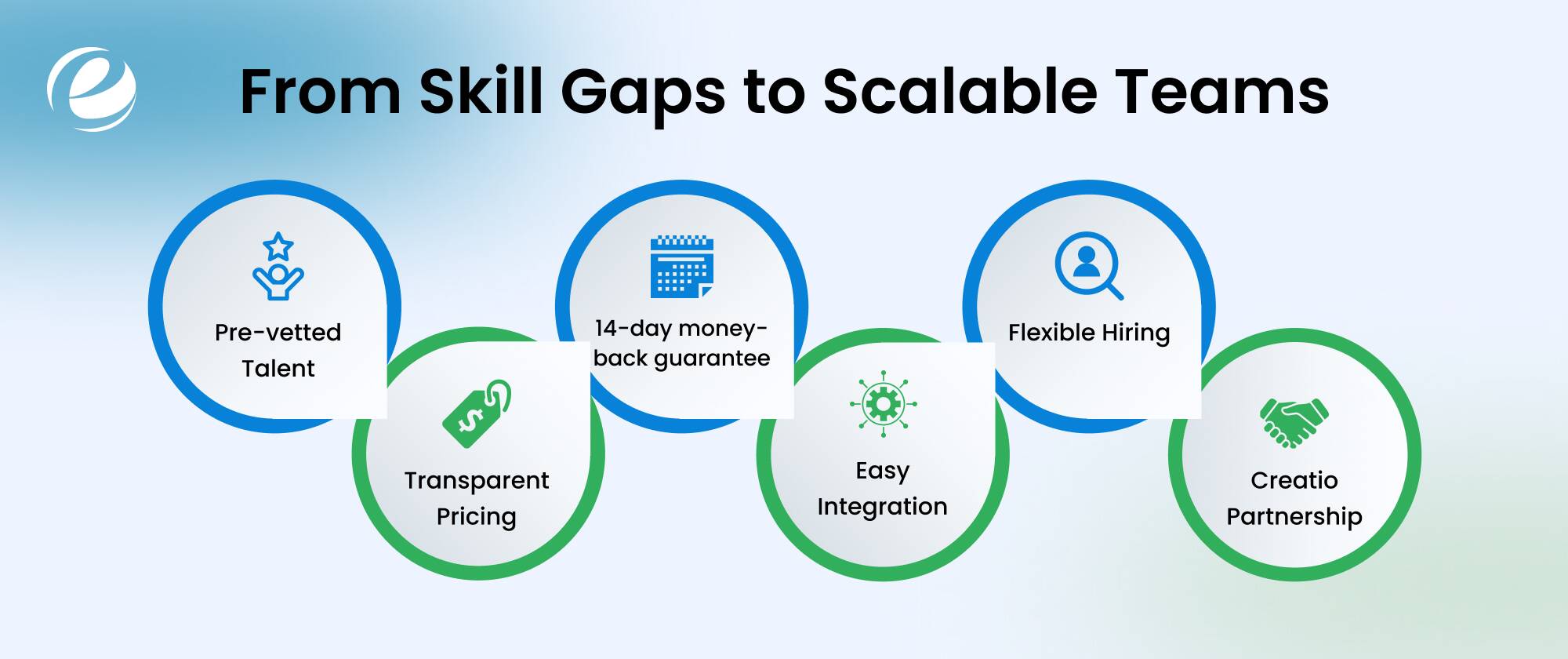
- Pre-vetted Talent: You get access to skilled developers with experience across web, mobile, AI/ML, cloud, QA, and other technology trends.
- 14-day money-back guarantee: Our Clutch-backed guarantee gives clients added peace of mind for a full refund if they are not satisfied with the developers.
- Flexible Hiring: You can easily choose full-time, part-time, hourly, or dedicated team models on the basis of your project requirements.
- Transparent Pricing: We offer three pricing models with options that can scale as project needs change.
- Easy Integration: The developers can easily adapt to your existing tools, workflows, communication, and development processes.
- Creatio Partnership: As a trusted Creatio partner, we deliver no-code CRM, automation, integration, and business transformation solutions.
Overall, Emizentech gives businesses the flexibility to hire dedicated developers, build expert teams, or scale development support as their needs evolve by hiring part-time or hourly developers.
Final Thoughts
After knowing all the things in-depth, you may have understood that the debate between staff augmentation vs outsourcing is valid because each offers distinct advantages that you should know about before choosing a hiring model. On the one hand, staff augmentation gives companies more control and access to specialized skills, while outsourcing is useful when companies want a complete solution without managing everything internally.
Ultimately, the right choice depends on a company’s needs, budget, and internal capabilities for micromanagement. Many companies may find that a mix of both models works best, allowing them to stay flexible and choose the right approach for each project.
Frequently Asked Questions
What is staff augmentation and outsourcing?
Staff augmentation is a hiring model where you add external professionals to your current team on a temporary basis. Outsourcing means hiring an outside company to take total charge of a specific project from start to finish.
What is the difference between staff augmentation and outsourcing?
Staff augmentation vs. outsourcing differs in control and ownership: augmentation keeps management with you, while outsourcing transfers project ownership, planning, and execution entirely to external teams.
Which Model Is Better for Startups?
Pre-technical startup leadership usually benefits more from outsourcing an MVP build. It saves upfront money, speeds up product launch, and grants immediate access to a skilled senior developer without the high cost of hiring in-house staff.
Which Is More Flexible: Staff Augmentation or Outsourcing?
Staff augmentation is more flexible; you can scale team size up or down based on your needs. Outsourcing contracts are typically fixed-scope, so changes require formal renegotiation and added cost.
What Factors Should You Consider Before Choosing a Model?
Before choosing a model, assess your data type and size, the problem's complexity, required interpretability, and available computational resources.



 +1 (989) 535-9295
 info@emizentech.com
 emizentech


