
 Add us as a preferred source on Google
 A job post for a senior developer goes live on Monday. Six weeks later, the role is still open, two candidates went quiet after the first call, and the roadmap is already behind schedule. Sound familiar? This is exactly why so many founders and CTOs turn to a dedicated software team instead of waiting out another slow hiring cycle.
Good engineers are challenging to find, and the wait keeps getting extended as demand for skilled developers keeps rising. In the US alone, employment of software developers is projected to grow 17.9% from 2023 to 2033, adding around 303,700 new jobs. That means more companies competing for the same talent every year. Add higher salaries, longer onboarding, and the daily work of managing full-time staff, and it makes sense why a dedicated software development team has become the easier path for companies that want to build fast without growing payroll.
This guide covers what a dedicated software team really is, how it compares to staff augmentation and outsourcing, the roles a solid team needs, the steps to build one, and what it actually costs. It also covers the real challenges of managing a remote team, because those challenges are worth knowing before doing anything.
What Is a Dedicated Software Team? (And How Does It Work?)
Before jumping into comparisons and cost breakdowns, it helps to nail down what this model actually means in practice, since the term gets used informally in company proposals. Once the mechanics are clear, the rest of the decisions around structure, hiring, and management become much easier to make.
A dedicated software team is a group of developers, testers, and specialists who work specifically on one client’s project, functioning as an extension of that company’s internal team rather than as outside contractors managing five other clients. The engineers show up every day for one product, one roadmap, and one set of priorities set by the client, not a vendor’s project waiting list. Some people search for this exact setup as a software dedicated team, and it means the same thing: one group, one project, and no split attention.
What is a dedicated software team? It’s a full-time, long-term engineering unit assigned to a single company, managed collaboratively with that company’s leadership, and built to function like an in-house department without the overhead of payroll, benefits, or office space.
So what actually makes this different from putting together a few freelancers for a project? A handful of things, really:
- These developers work full-time on one project, not compressed in between three other clients
- The relationship is built for the long duration, tied to the product itself rather than one ticket or task
- The client calls the shots on priorities, quick planning, and daily direction
- Communication runs through proper channels like Slack, Jira, and regular video calls
- The team can grow or shrink as the roadmap changes; no issues involved
On a day-to-day basis, it usually starts with the company and client sitting down to map out what needs building. From there, the right engineers get assigned to the project based on the tech stack and the domain. Next is onboarding, making sure everyone is comfortable with the codebase and how the business works. From there, it’s sprint after sprint, with the team getting a little sharper each cycle through regular reviews.
Startups building an MVP with a small budget use this model all the time, because hiring five full-time engineers before proving the idea works is a quick way to run out of money. Enterprises modernizing legacy systems rely on it too, since internal teams are often stretched thin maintaining what already exists. Companies facing regional hiring limits, where the local talent pool simply doesn’t have enough senior engineers, also turn to a dedicated development team to fill the gap without relocating anyone.
One clarification worth making early: companies that outsource dedicated software development teams aren’t doing the same thing as traditional outsourcing, even though people mix the two up constantly. Traditional outsourcing usually hands over project requirements and waits for a delivered product with limited visibility along the way. A dedicated team model keeps ownership, communication, and daily transparency with the client, which is a meaningfully different relationship.
Dedicated Software Team vs. Other Engagement Models
Selecting the right engagement model matters more than most companies realize going in, because the wrong choice usually shows up six months later as a budget excess or a team that doesn’t fit the actual work. Here’s how the main options stack up against each other.
| Model | Best For | Control | Scalability | Cost Structure |
| In-house team | Long-term internal capability | Highest | Slow | Fixed salaries |
| Staff augmentation | Filling skill gaps | Medium | Fast | Hour/resource-based |
| Freelancers | Short-term tasks | Low-medium | Medium | Project-based |
| Dedicated software team | Long-term product development | High | High | Monthly/team model |
Dedicated software team vs in-house development team: In-house hiring gives the deepest customs alignment and the most direct control, no argument there. But it’s slow, expensive, and limited to whatever talent happens to live nearby or agree to relocate. A dedicated software engineering team gets around that by taking advantage of global talent pools, shortened recruitment timelines from months to weeks, and reduced operational overhead like office space and benefits. The compromise is that communication needs more purposeful structure, and company selection actually matters, since a badly evaluated partner can wipe out all the cost savings.
Dedicated software team vs staff augmentation: These two get confused a lot, and the confusion leads to real budgeting mistakes. Staff augmentation adds individual specialists to fill a skill gap on an existing team; think one extra React developer for three months. A dedicated team, by contrast, provides a complete delivery capability: project managers, QA, design, and engineers working together as a unit toward a shared goal. Anyone deciding between the two should read this breakdown of staff augmentation before locking in a contract, because the pricing models and commitment levels differ quite a bit.
Dedicated software team vs outsourcing: Outsourcing carries a credibility problem, and honestly, some of it is earned. IP protection concerns, unclear communication, and inconsistent quality governance have burned enough companies that the word itself makes some CFOs nervous. A properly structured dedicated team addresses those exact concerns through NDAs, defined ownership clauses, and daily visibility into progress. For a fuller picture of what can go wrong with outsourcing partnerships gone bad, it’s worth reading through these risks of IT outsourcing before signing anything.
Core Roles Inside a Dedicated Software Team Structure
Team structure isn’t one-size-fits-all, and any organization offering an equivalent team list for a five-person startup and a hundred-person enterprise probably hasn’t thought it through. The right structure depends on product complexity, timeline, and what’s already been built.
| Role | Responsibility |
| Project Manager | Planning, communication, delivery tracking |
| Software Engineers | Frontend/backend development |
| QA Engineers | Testing and quality assurance |
| UI/UX Designer | User experience design |
| DevOps Engineer | Deployment and infrastructure |
| Solution Architect | Technical direction |
| Business Analyst | Requirement analysis |
| Data/AI Specialist | Data-driven solutions |
A startup team usually stays relatively small and lean. One project manager, a couple of developers, a QA person, and someone handling both UI and UX at once. Nothing special, but it gets an MVP out the door, and at that stage speed beats specialization every time.
Once a company grows into enterprise areas, the team fills out fast. There’s a solution architect providing the technical direction, several developers split between frontend and backend, a QA automation engineer catching bugs before they ship, a DevOps person keeping the pipelines running, and a product manager managing stakeholders across departments. More moving parts in the product means more people needed to keep it all moving.
At the end of the day, a dedicated software engineering team is really just a group of specialists pulling in one direction for one company. No one is sharing their attention among five unrelated clients. Everybody’s working toward the same roadmap, which is the whole reason this model works as well as it does.
How to Build a Dedicated Software Team in 5 Steps
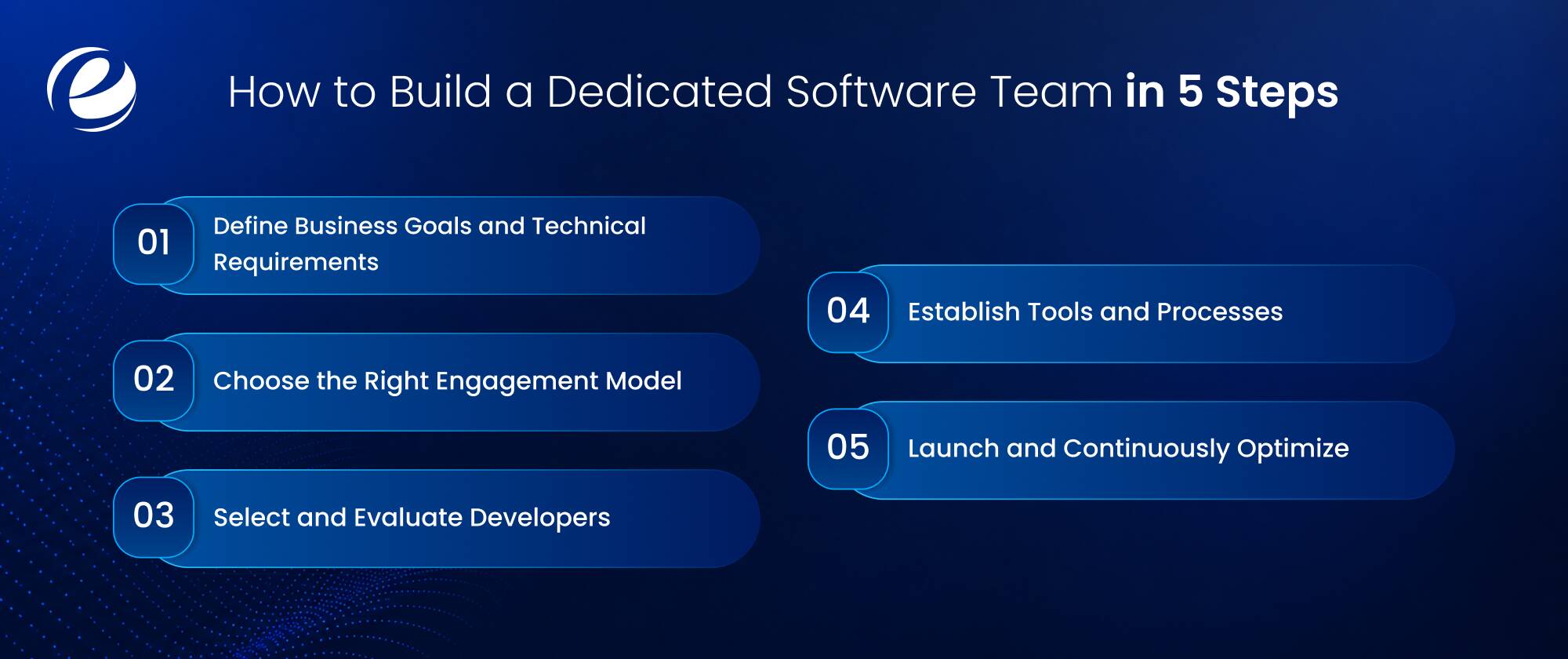
Building the right team isn’t as simple as picking names from a company’s roster and expecting the best. Companies that want to hire dedicated software development teams without the usual trial and error should follow these five steps closely, since skipping one tends to backfire later.
Step 1: Define Business Goals and Technical Requirements
When you reach out to anyone, be specific about the product goals, the technology stack, the timeline, and the exact expertise you need. If the requirements are vague, the hiring decisions will be vague.
Step 2: Choose the Right Engagement Model
There are different challenges with time zone overlap, cost, and cultural alignment with offshore/nearshore or a hybrid mix. Companies that decide to hire offshore dedicated software development team should weigh those benefits against nearby regional talent, and this comparison of onshore vs offshore software development breaks it down before committing to one direction.
Step 3: Select and Evaluate Developers
Technical skill matters, obviously, but previous project history, communication ability, and domain expertise matter just as much. A brilliant engineer who can’t explain a blocker clearly during a standup creates friction that compounds over months.
Step 4: Establish Tools and Processes
Nobody gets excited talking about Jira boards and CI/CD pipelines, but this is the part that actually holds everything together. Jira keeps tasks from falling through the cracks, GitHub handles version control, Slack carries the daily discussion, and a solid CI/CD pipeline gets code out the door without drama. Skip this setup, and miscommunication can bury a team that looked great on paper by week two.
Step 5: Launch and Continuously Optimize
Onboarding, sprint planning, regular performance reviews, and the flexibility to scale the team as the roadmap shifts. A team-dedicated software development effort should never feel static; it needs to connect with the product.
Before signing anyone to hire remote dedicated software development teams, run through this checklist:
- Is the tech stack expertise confirmed through actual project samples, not just a resume claim?
- Does the vendor offer transparent communication and daily standup access?
- Are IP ownership and security clauses spelled out in the contract?
- Is there a clear exit or scaling plan if priorities shift?
Companies looking to skip the guesswork can go directly to a vendor built for this and hire dedicated developers already screened for technical depth and communication skills.
How to Manage a Dedicated Software Team for Maximum Velocity
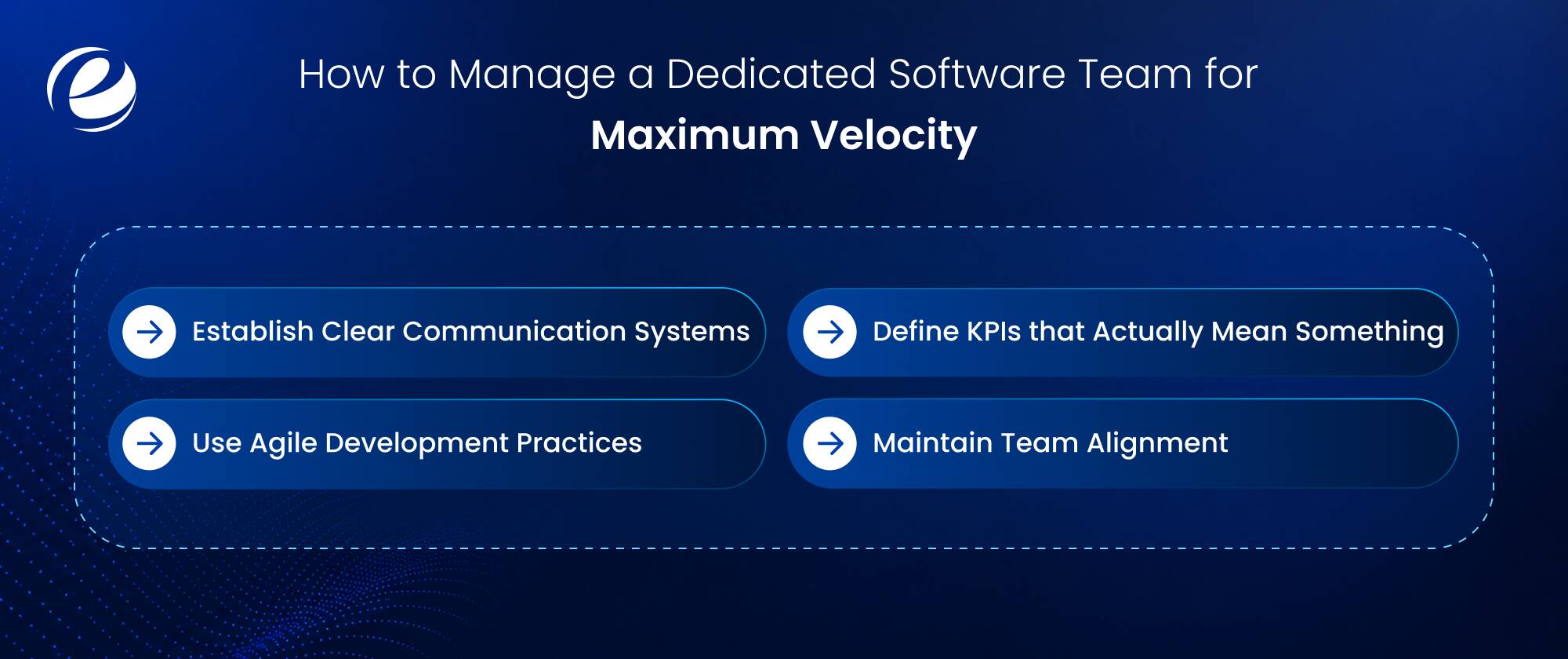
Building the team is only part of the challenge, and it’s often the easier part. Managing a remote team well is where most of the actual value gets created or lost, and it’s the part vendors talk about the least in their sales pitches.
Establish Clear Communication Systems
Daily standups to keep everyone informed about blockers. Sprint reviews build in accountability at the end of each sprint. Shared docs and recorded updates allow for asynchronous communication, so you can catch up when time zones don’t align perfectly.
Use Agile Development Practices
Scrum works effectively for teams that require structured sprints and predictable delivery timelines. Kanban suits teams managing continuous, less predictable workflows. Either way, sprint planning sessions keep the whole group rowing toward the same achievement.
Define KPIs that Actually Mean Something
Engineering KPIs like deployment frequency, cycle time, and defect rate tell the real story of team health, not vanity metrics. Business KPIs, speed-to-market, product adoption, and cost efficiency—tie the engineering work back to what leadership actually cares about.
Maintain Team Alignment
Documentation stops knowledge from living only in one person’s head. Knowledge sharing sessions keep the whole group current on architecture decisions. And giving engineers real ownership over their piece of the product appears to produce better work than micromanaging every decision.
Cost to Build a Dedicated Software Team
Money questions come up early in almost every conversation about this model, and fair enough, since budgets don’t extend infinitely. Pricing for a software development dedicated team depends on more variables than most people expect going in, and the right pricing model matters just as much as the raw number.
What actually moves the cost:
- Location of the team (offshore rates run lower than onshore, and this is exactly the tradeoff companies weigh when deciding between a dedicated team and a full offshore development center)
- Developer seniority (junior vs senior vs architect-level)
- Technology stack (specialized frameworks and AI or cloud skills cost more)
- Team size and composition
- Pricing model chosen (fixed-cost, time and materials, or dedicated team)
| Factor | Impact |
| Junior developers | Lower cost |
| Senior engineers | Higher cost but more expertise |
| AI/cloud specialists | Premium pricing |
| Offshore teams | Cost efficiency |
Dedicated team vs in-house cost comparison: In-house hiring carries hidden costs that never show up in a simple salary comparison: recruitment fees, benefits, payroll taxes, office infrastructure, and the ongoing cost of employee retention. The Society for Human Resource Management has noted that replacing an employee can cost a meaningful percentage of that role’s annual salary once recruiting, onboarding, and lost productivity are factored in. That number alone changes the math for a lot of CFOs comparing models side by side.
Emizentech pricing models: Not every project needs the same commitment, which is why the pricing here splits into three clear options instead of forcing everyone into one box.
- Fixed-Cost Model, starting at $2,500 per project. Built for projects with a clear scope and a set timeline. The price is locked in upfront, so there are no billing surprises halfway through.
- Time Model, starting at $20 per hour. This model is a better fit for projects where requirements keep changing. Payment covers actual hours and resources used, which keeps the work flexible without locking anyone into a fixed scope too early.
- Dedicated Team Model, starting at $3,000 per month per developer. The right choice for long-term, scalable work. A full-time team stays focused exclusively on one company’s goals, which keeps output consistent and quality maintained over the life of the project.
All three come with transparent billing and zero hidden fees, and resources can scale up or down as the project changes. For most companies planning a long-term product rather than a one-off task, the dedicated team model still ends up cheaper than an equivalent in-house senior hire once benefits and overhead are added into the comparison.
Common Challenges When Managing a Dedicated Software Team
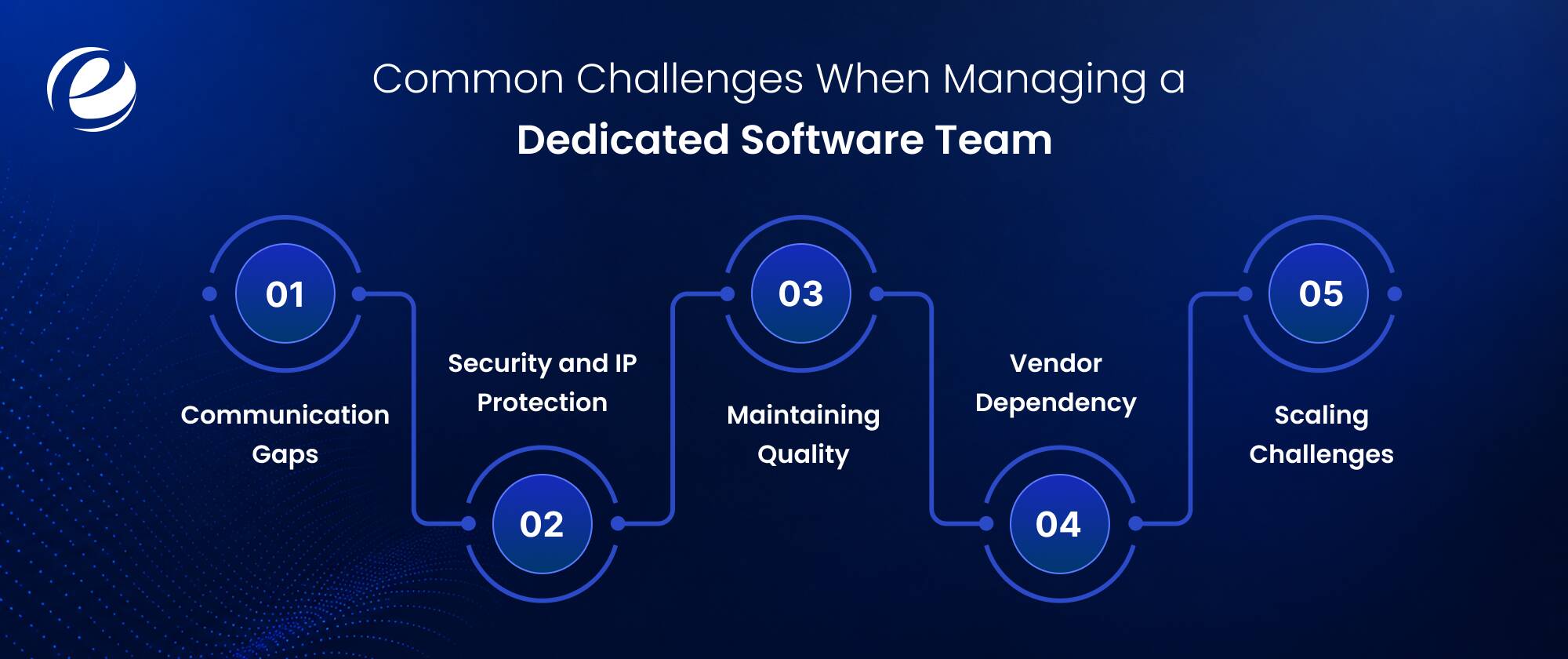
No partnership model is problem-free, and anyone claiming otherwise is probably selling something. That’s especially true for distributed software teams, where research shows that higher levels of team virtualization can create communication and coordination challenges if they’re not managed intentionally. Here’s what actually goes wrong and how experienced teams handle it.
Communication Gaps: Overlapping working hours, thorough documentation, and regular video meetings close most of the distance here. Time zone differences don’t disappear, but they stop being a daily issue with the right rhythm in place.
Security and IP Protection: This is about trust, but trust that is supported by paperwork. NDAs, tight control over who can touch the repositories, and ownership clauses spelled out clearly in the contract all protect both sides. If a vendor hesitates to put any of these terms in writing, that’s all the more reason to walk away.
Maintaining Quality: Code reviews, automated tests, and a proper CI/CD pipeline catch the unorganized information before it ever reaches users. Here, taking shortcuts to save a few days almost always ends up costing weeks later as you try to find bugs that should have been discovered earlier.
Vendor Dependency: Nobody wants a setup where only the vendor understands how the product actually works. Solid documentation and real knowledge transfer sessions prevent that from happening, and sharing ownership of architecture decisions keeps the client informed even when the vendor handles the daily tasks.
Scaling Challenges: Roadmaps change more often than anyone likes to admit, priorities change, and budgets change. A good dedicated software developer setup should be able to be flexible with all of that, scaling the team up or down without every change requiring a negotiation problem.
Why Tech Leaders Choose Emizentech for Dedicated Software Teams
Many companies are selling the same proposal, so it’s helpful to be specific about what really differentiates a good partner from a mediocre one on paper.
Experienced Dedicated Developers: Over 100 experienced team members, more than a decade of industry experience, over 150 certified professionals, and work spanning 30-plus industries. That range matters when a project needs domain-specific knowledge, not just generic coding skill.
Flexible Hiring Models: We offer dedicated developers, fully dedicated teams, and hourly developers. Build-operate-transfer model for companies that plan to eventually bring the team in-house. The advantage here is that it doesn’t have a fixed contract; not all companies need the same level of commitment.
Technology Expertise Across the Stack: Frontend work spans React, Angular, and Vue. Backend covers Node.js, Python, Java, and .NET. Mobile development runs through Flutter and React Native. Companies looking to hire web developers or hire mobile app developers get access to specialists across whichever stack the product actually needs.
Proven Delivery Approach: Agile workflows keep sprints predictable, transparent reporting keeps stakeholders in the loop, and IP protection paired with secure infrastructure keeps the legal and security side handled properly rather than as an add-on.
Conclusion
A dedicated software team gives companies a real shortcut around the slowest, most expensive parts of traditional hiring. Global talent access replaces months of local recruiting. Faster hiring cycles replace stalled job postings. Scalable engineering capacity replaces the rigid headcount limits that come with a fixed payroll. And through all of it, the client keeps control over priorities, direction, and product decisions.
Instead of using a generic staffing structure, you can work with Emizentech to create a specialized software development team that is suited to your real business goals if you’re prepared to overcome the hiring barrier.
FAQs
What is the difference between a dedicated software team and staff augmentation?
Staff augmentation is like borrowing an extra pair of hands for an existing team. A dedicated software team is a whole crew built around one project, complete with its project manager, QA, and engineers, all working toward the same goal instead of plugging a single gap.
How do I maintain code security with a dedicated software team?
The answer comes down to the basics done properly. A signed NDA, clear paperwork spelling out who owns the code, tight control over who can access the repositories, and following recognized security practices. None of it is attractive, but skip any one of these, and it becomes the weak connection.
How fast can Emizentech build a dedicated software team?
Most teams come together within a few weeks. It starts with figuring out exactly what the project needs, then picking the right people, and then getting them familiar with the codebase and tools. The timeline shifts a bit depending on team size and how specialized the skill set has to be.
Who manages a dedicated software team day-to-day?
The client always sets the priorities and direction. On the ground, though, a project manager keeps the daily work moving, and technical leads make the engineering calls, so nothing gets stuck waiting on decisions.




 +1 (989) 535-9295
 info@emizentech.com
 emizentech


