
 Add us as a preferred source on Google
 Uber is a household name when it comes to on-demand ride-hailing services. So, what made it popular worldwide? No doubt, the powerful Uber tech stack and Software architecture have played a pivotal role in its success.
With years of development focused on optimizing their services, Uber has created a platform that is not only user-friendly but also highly efficient. Their systems have complex architecture, and there are a lot of components that are joined together internally to provide smooth riding services worldwide, not only for riders but also for drivers.
In 2023, Uber generated over $37.2 billion in revenue, showing its resilience and ability to thrive amidst challenges. The company has set a benchmark for startups and existing taxi services, inspiring the organization worldwide to replicate Uber’s success by offering quick and reliable ride-hailing services.
How Uber was built has been a fascinating question among entrepreneurs for quite a long time. With this blog, we will explore Uber’s tech stack and software architecture and guide you through the process of building the next Uber-like app. So Let’s go!
From Rides To Revolution: Uber’s Journey
Uber has made its name from ground zero, so how does Uber still maintaining its status as a ‘Popular ride-hailing service’ in 2024?
To understand this, we have to go back to 2009, the foundation year of Uber. Garrett Camp and Travis Kalanick proposed this idea while attending a tech conference in Paris.
They want to revolutionize the traditional way of ride-hailing services by introducing more efficient and convenient ways of commuting by leveraging technology to provide the safest and most convenient way for passengers.
Not just for passengers, they provide drivers with part-time gigs or full-time jobs. Uber’s success story is rooted in its innovative approach to transportation, underpinned by a robust Uber tech stack and efficient software architecture.
UberCab is what they called their first version, which was officially launched in 2010. This concept has quickly spread to U.S. cities and then worldwide.
Despite facing challenges from existing competitors, whether it’s about safety or regulatory compliance. Uber has managed to reach tremendous growth over the years and successfully generated gross bookings of 37.58 billion U.S. dollars worldwide in the fourth quarter of 2023.
| “The company transformed the way people think about ridesharing and urban mobility, making it a household name worldwide. “ |
Building A Real-Time App like Uber: Explore Uber’s Current Tech Stack
To build a real-time app like Uber, you must first understand Uber’s software architecture, which comprises primary components- mobile applications, the web, and the marketplace.
1. Uber’s Mobile Applications
Uber’s popularity is due to its seriousness towards mobile application development as a primary approach. It has four different versions of its mobile apps, two driver apps, and two user apps for iOS and Android. When it comes to Uber’s tech stack for the iOS platform, developers used Swift and Objective-C, whereas, for Android, they used Java.
2. Uber’s Web Application
In response to the growing demand for their web-based app for transportation, Uber developers made a significant shift in 2019.
They transitioned from Node.Js to Fusion.js, a modular JavaScript framework created by Uber that enhances React applications with a flexible plugin system.
To support their client-side app, Uber utilizes Browseify, an open-source tool that allows developers to create Node.Js modules optimized for browser use. Additionally, they rely on a web server called Bedrock, which is built on the popular Express.js framework.
3. Uber’s Marketplace
The marketplace connects the two applications, the Passenger app and the Driver app. It carries out the most complicated tasks that involve matching the passengers with the drivers and handling payments.
So, if you wish to create an app like Uber, you will require three different panels. The first panel will enable passengers to book a cab, and the second panel will allow the drivers to accept ride requests. And finally, a third panel will receive requests from the first two and manage all online operations.
Also Read: Taxi Booking App Development
How Does The Uber App Technically Work?

The Uber app processes a vast amount of data leveraging the ML and data analytics platforms that are developed in-house. When a passenger requests a cab, a lot of data is generated. For instance, the app receives data about the passenger, his location, credit card info, ride cost, nearby taxi drivers, etc. And gradually, all this information travels across the entire system. Let’s see how.
Once a ride is requested, the platform:
- Saves all the ride information on the database
- Processes the ride request with the passenger’s geolocation
- Sends all the processed data to the matching algorithm powered by ML
- Looks for information about drivers present nearby in the database
Requirements For Uber-Like Projects
Uber was launched in 2009, and for the longest time, the platform had a backend with a monolithic architecture.
In other words, the app used a single database along with several app servers to manage all online requests. For the initial period, this worked just fine.
However, as the platform grew, the need for new features also surged. To integrate new features, the development team had to deploy all the code at once. This affected the app’s speed and made the process of introducing new features extremely risky and time-consuming.
This is because every integration could potentially bring the entire system down. This led to the adoption of microservices architecture.
1. Microservices

In 2014, Uber adopted the microservices architecture to ensure better speed and performance. Essentially, this architecture includes a group of services targeted to one another’s functionality. Thus, the development team can easily deploy new code independently with the microservices architecture, ensuring complete system scaling.
2. DOMA (Domain-Oriented System Architecture)
Although microservices architecture was a huge upgrade to the monolithic architecture, the development team at Uber didn’t stop there. They adopted a new approach called DOMA- Domain-Oriented System Architecture with time.
According to this approach, the developers orient their design around collections of related microservices. These collections are called domains. Furthermore, the domains are also classified into different collections called layers. The specific layer that each domain belongs to establishes the dependencies the microservices within that domain can take on. This is called layer design.
The developers then make every domain independent from the others by using Gateway API. Thus, every domain has its own logic and is not related to the other domains inside the same layer.
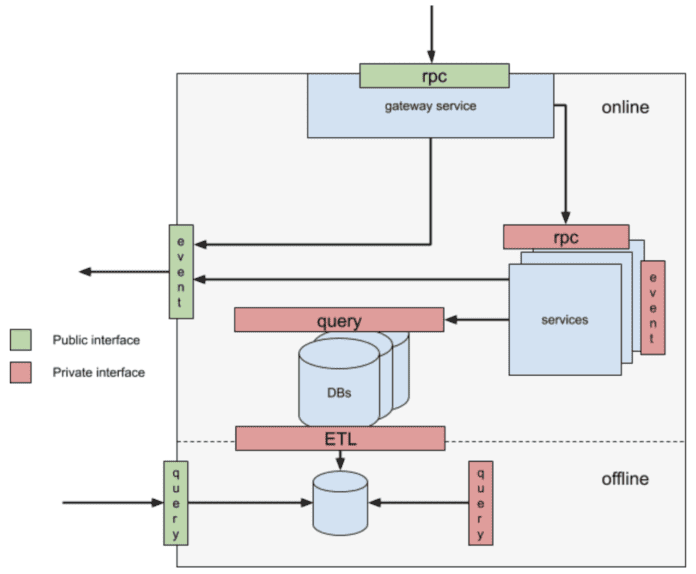
In simple words, by providing an organized architecture, predefined extension points, and domain gateways, DOMA transforms the microservices architecture from something complicated to something that is easily comprehensible.
How To Build The Next Uber?
Uber is a highly successful taxi-hailing service that offers ultimate convenience to passengers. Developing an app like Uber may involve a significant amount of money and a competent app development team.
Apart from that, there are a few other things to consider while developing an app like Uber.
1. Check Out Your Competitors
It is a great idea to search for apps that are currently attempting to solve the same problem you seek to address with your app. Looking at these apps will help you gather an idea about their features, functionalities, as well as target audiences.
Additionally, a thorough look at the competitive landscape will help you understand how your competitors operate. For instance, checking their social media will enable you to gather insights about their marketing strategy, product evolution, and customer satisfaction ratings. All this will go a long way in helping you launch a successful app.
2. Know Your Potential Users
Before jumping into app development, you need to know who will use your app. Only if you know your target audience will you be able to communicate with them properly.
Gather demographic data, such as age, location, gender, behaviors, and preferences. Engaging with potential users through surveys or interviews can provide deeper insights into their expectations and pain points.
3. Stay Focused On User Experience
User experience is one of the critical aspects of a successful app. People want to use apps that offer a simple yet intuitive UI and UX.
So, which UI framework does Uber use?
Uber’s design team focuses on constantly upgrading the app’s design by adding new features. However, this is a time-consuming process. So, to streamline the design team’s efforts, they have created a React UI framework called Base.
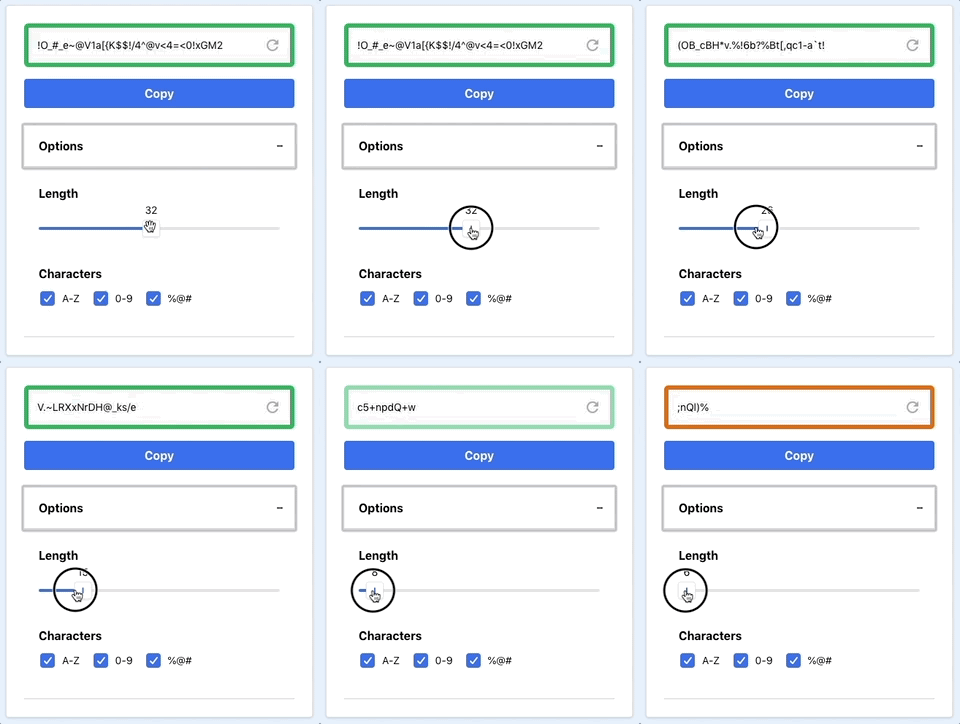
The base includes pre-designed Uber app elements, such as colors, grids, typography, lists, buttons, and iconography. The framework has enabled the design team to create designs at a faster pace while maintaining high UI/UX standards and consistency.
You can gather all demographic data of your potential users, such as age, location, gender, behaviors, preferences, etc. Once done, you can discuss your app’s idea with those people you think highly of.
A stunning UI offers a seamless navigation experience, and an intuitive UX ensures ease of use. Providing a good user experience leads to better user acquisition and more excellent downloads.
4. Test With An MVP
A minimum viable product (MVP) is the first basic version of the product that supports minimal yet crucial features. Creating an MVP before developing a full-fledged app is advisable as it enables faster time to market, attracts early adopters, and accomplishes a product-market fit from early on.
Once the MVP is released to the users, their initial feedback is obtained. Based on this feedback, you can reiterate, fix bugs, and introduce new features that will provide your product with a competitive advantage.
5. Implement Robust Security Measures
Security is paramount when you develop Uber-like apps because users share their sensitive information. To secure their information, implement robust security protocols, including data encryption, secure payment gateways, and user authentication methods.
Making sure to do regular security audits and comply with data protection regulations will help build trust with your users.
6. Choose The Suitable Technology Stack
It’s crucial to select the appropriate tech stack for the performance and scalability of your app. Consider using frameworks and languages that align with your app’s requirements.
For instance, using a combination of React for the front end and Node.js for the back end can provide a responsive and efficient application.
7. Plan For Scalability
When your user base grows, your app must be able to handle increased traffic and demand. So, you have to design your architecture carefully with scalability in mind.
Ensure that it can accommodate future growth without compromising performance, and cloud services can be beneficial for scaling resources dynamically based on user demand.
8. Develop App’s Features
Now, develop the app’s features, including user registration, location tracking, payment processing, and ride request. These features are essential for transportation apps like Uber.
Utilizing WebSockets or similar technologies to enhance the responsiveness of your app.
9. Plan Marketing Strategy
Once your app is ready, plan a strong marketing strategy to attract users. You can leverage social media, content marketing, and paid advertising to reach your target audience.
Moreover, you can collaborate with influencers or build partnerships with local businesses to help you expand your brand visibility.
10. Continuous Improvement
It’s crucial to gather user feedback and analyze app performance after launching your app. The regular updates and improvements will help you stay competitive and meet the evolving needs of users.

What Is The Tech Stack Behind The Food Delivery App Uber?
In 2014, Uber’s backend included languages like Python, Mongo, and MySQL. On the other hand, the dispatch system used Node.js and Redis, whereas Java and Objective-C powered the mobile apps. However, as the requirements evolved, developers changed almost all of the platform’s components.
Marketplace Technologies Stack
Uber’s marketplace is an important aspect that manages all data streaming and data analytics. The Uber tech stack used for building this marketplace includes languages like Python, Go, Java, and Node. Now let’s have a look at this marketplace technologies stack in detail:
1. The trip execution engine
Since the trip execution engine is an integral part of the marketplace, it was originally written in Node.js, which was preferred for its asynchronous, simple, and single-threaded processing. Node.js also allowed the Uber team to manage large quantities of concurrent connections. However, the company has now created new services in Go, which are known for their efficiency, concurrency, and type-safe operations.
2. The frontline API
The frontline API directs requests from the driver and passenger mobile devices to other APIs and services. This is written in Node.js, except at the edge. It uses NGINX for the front end and performs SSL termination and some authentication.
3. Real-time connection
To seamlessly support the highest availability demands, the marketplace stack must receive information in real time. Thus, the developers use Ringpop, a library for erecting cooperative distributed systems. Owing to this library, the developers get a highly available connection with distributed databases such as Riak and DynamoDB.
4. The matching logic
The matching algorithm, i.e., the system that manages alerts from drivers and riders in real-time and then matches them, is written in Go and Node.js. Riak is their distributed database, whereas Redis offers caching.
5. Dynamic pricing optimization
The marketplace team at Uber manages optimization and balance through dynamic pricing, intelligent matching, and supply positioning. Earlier, most parts of this stack were built using Python with Flask and uWSGI. However, developers are now replacing most of Python with Go to achieve greater performance.
6. Data streaming and machine learning
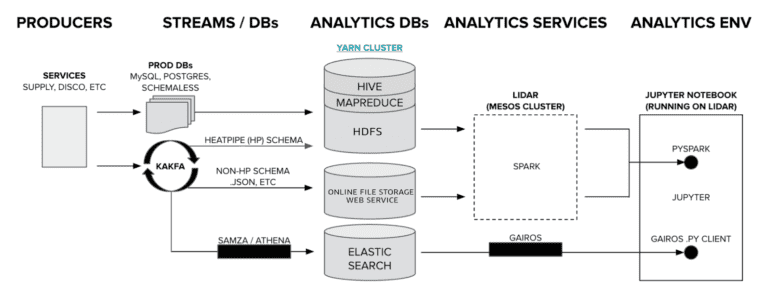
Uber uses Kafka and its production databases for data streaming. And data storage depends on Hive, HDFS, Elasticsearch, MapReduce, and file storage web services. The company has also developed its own LIDAR that ensures internal sharing. The LIDAR runs Jupyter and JupyterHub, which are integrated with Apache Spark and their data platform.
Moving on, it is noteworthy to note that Uber has its own ML platform. In 2015, the company decided to scale ML in order to standardize tools and workflows and avoid ML anti-patterns. Consequently, they developed Michelangelo in 2017.
Michelangelo is an AI and ML-powered platform that helps to manage data, evaluate and deploy models, make trend forecasts, and monitor prognosis. The ML platform comprises a mix of open-source systems and in-house components such as:
- HDFS
- Samza
- Spark
- MLLib
- TensorFlow
- Cassandra
- XGBoost
Stack Technologies Of A Web Application
For the web-based app, the Uber developers use Node.js, an open-source platform with a huge community of web engineers. Node.js also enables the developers to share JavaScript code between the server and client to create universal web applications. Lastly, they use Browserify for all client-side bundling as it comes with Node. Js-based module requirements.
Uber’s web server Bedrock is built on Express.js, a popular web framework that offers complete security and internalization. Their in-house service communication layer, known as Atreyu, manages all communication with backend services and integrates with Bedrock. This communication layer also enables the company to make requests to their SOA service APIs easily and quickly.
Uber uses standard Flux and React.js for application rendering and state handling. The build system, Core Tasks, is a pre-defined group of scripts to compile and version frontend assets that are built on Gulp.js.
Stack Technologies of A Mobile Application
To develop an app like Uber, you need to create four different mobile apps: Android passenger, Android driver, iOS passenger, and iOS driver. Developers create IOS apps using Objective-C and Swift programming languages, whereas Android apps are developed using Java. Apart from these, developers also use a few other technologies. These include:
| Android App Tech Stack | iOS App Tech Stack |
|---|---|
| Gradle | Buck |
| OkHttp/Gson/Retrofit | Masonry/ SnapKit |
| Butter Knife | KSCrash |
| Dagger | OCMock |
| Espresso | – |
| Picasso | – |
| RxJava | – |
| Timber | – |
What Programming Languages Can Be Used To Create A Food Delivery App Like Uber?
If you want to develop an app like Uber, you can opt to integrate the following technologies:
| Category | Description |
|---|---|
| Node.JS | for Marketplace web app |
| Python | for web-based booking app |
| Go- | for improved performance and speed |
| Browserify | for client-side bundling |
| Java | for third-party service integrations |
| Apache Hive data warehouse | for analytics and data query |
| Elk | for storing logs, processing, and shipping |
| Apache Cassandra | for managing vast volumes of data |
| MySQL Database Service- | for relational database management |
| Docker | for data center infrastructure |
| HAProxy | for proxy server and load balancer |
This is a quick roundup of Uber’s technology stack. However, simply copying this tech stack without doing your own research can be detrimental to your business model. Also, applying the same technologies will not guarantee success for your cab-hailing business.
So, it is advisable to build your app with as few technologies as possible. Gradually, as your business expands, you can keep on adding newer features by leveraging newer technologies. You must only use Uber’s tech stack as a source of inspiration to get started.
Future Of Ride-sharing: What’s Next For Uber-Like Apps
With technological advancement, the ride-sharing industry continues to evolve and meet the changing consumer needs. As companies like Uber and Lyft expand their services, several trends are shaping the future of ride-sharing.
One of the most significant developments in the ride-sharing industry is that it is focusing on inclusivity. Companies are working on empowering riders with disabilities by enhancing accessibility features in their apps and vehicles.
Riders can now self-identify as deaf/hard of hearing or blind/ low vision and customize their communication preferences with drivers.
Another game-changer factor is the rise of autonomous vehicles (AVs). As self-driving technology matures, ride-sharing companies are investing in AVs to reduce operational costs.
However, safety remains a top concern, and future apps are expected to incorporate real-time tracking and emergency response features, further boosting user confidence.
Challenges And Consideration To Build An App Like Uber
When you build an app like Uber, it comes with several challenges and complexities. The market is highly competitive, and to build a successful app is no small feat.
So, it’s crucial to work with technical experts who have years of experience in building ride-hailing apps. However, it’s critical to understand the challenges that occur in ride-hailing app development. Take a look.
1. Technological Sophistication
Developing an app like Uber requires an advanced Uber tech stack that includes real-time GPS tracking, seamless payment processing, and an intuitive user interface.
Therefore, the development team must have expertise in Uber software architecture and expertise in integrating all the correct set of tech stacks into the app.
2. Mandatory Scalability
As user demand increases, the app must handle higher traffic volumes without compromising performance. Designing a scalable architecture from the outset is critical for accommodating future growth.
However, Uber’s scalability is achieved through its sophisticated cloud computing solutions and real-time data processing capabilities.
3. Compliance With Regulations
Navigating local laws and regulations is essential for any ride-hailing service with different rules and regulations in different jurisdictions.
This includes adhering to licensing requirements, insurance mandates, and safety standards, which can vary significantly by region.
4. Safety And Security
The safety and security of riders and drivers are the top priority when it comes to ride-hailing services.
It’s important to implement robust security measures, such as background checks and secure payment methods, for user safety and to build trust in the platform.
5. Saturated Market
The ride-hailing market is crowded with established players. To succeed, new apps must offer unique features or superior services to differentiate themselves from competitors.
Therefore, creating an app like Uber requires a deep understanding of the market so you can differentiate your app from the established players.
6. Expensive Endeavour
The cost factor is the biggest challenge when it comes to developing a high-quality ride-hailing app because budgeting for development, marketing, and ongoing maintenance is critical for long-term sustainability.
So, it is crucial to consult with an experienced mobile app development company that understands your project requirements and works accordingly.
How Much Does It Cost To Build An App Like Uber?
The cost of building an app like Uber ranges from $20,000 to $300,000 or more, depending on several factors, such as the complexity of the platform, features and functionality, and the developer’s location.
However, if you want to build a basic app with essential features and functionality, it would cost you less compared to intermediate and advanced apps. The final prices depend on how complex you want your app concept to be.
It is recommended to consult with an experienced taxi app development company before investing in this landscape.
How Can We Help You To Create An App Like Uber?
Uber’s Journey from a simple idea to a global phenomenon wasn’t built overnight. It has evolved throughout the years, and you can also embark on this journey by partnering with an experienced on-demand taxi app development company.
EmizenTech is a leading mobile app development company that understands every project is unique and that creating a successful ride-sharing platform requires more than just coding.
It demands a deep understanding of complex architectures, scalable solutions, and user-centric design principles that Uber has masterfully implemented.
Whether you’re an entrepreneur looking to enter the market or an established business seeking digital transformation, our mobile app developers are equipped with the expertise to build your next-generation ride-sharing solution.
From implementing robust microservices architecture to ensuring real-time tracking capabilities, we can help you navigate the technical complexities while maintaining focus on your unique business requirements.
Why Choose Our Mobile App Development Services:
– Proven track record in developing successful mobile apps in different domains
– Customizable solutions to match your business model
– Scalable architecture for future growth
– Advanced security implementations
– 24/7 technical support
– Cost-effective development solutions
Ready to build your own ride-sharing empire? Let our expert guide you through every step of the journey, from concept to launch and beyond. Contact us today to turn your vision into reality.
Key Takeaways: Uber’s Tech Stack and Software Architecture
Uber’s tech stack and software architecture are the major factors behind its success. It reflects on how innovative technology can revolutionize traditional industries.
Understanding Uber’s technical architecture and development choices provides invaluable insights for anyone looking to venture into the ride-sharing market.
From its sophisticated microservices architecture to real-time data processing capabilities, each component plays a crucial role in delivering a seamless user experience.
The ride-sharing market continues to grow and evolve, with AI technologies like machine learning presenting opportunities for innovative solutions that go beyond basic transportation services.
Whether you’re targeting a local market or dreaming of global expansion, the foundation lies in building a robust, scalable, and user-friendly platform.
The future of urban mobility is being shaped today. With the right approach, technology stack, and development partner, your ride-sharing vision can become the next success story in this ever-evolving industry.



 +1 (989) 535-9295
 info@emizentech.com
 emizentech


