
 Add us as a preferred source on Google
Just imagine it – you can purchase all your groceries, pay your rent, or split a dinner bill with just a few clicks on your phone. This is what you can do using UPI (Unified Payments Interface), where you can completely transform the way you send and receive money in India. What was only an idea of the National Payments Corporation of India (NPCI) is now the biggest breakthrough in the history of digital payments. Thus, India has become a country where cashless transactions are most commonly used.
In 2024, UPI recorded a staggering number of over 120 billion transactions that proved its exceptional growth. Industry experts predict that by 2026, India’s digital payment market will showcase a colossal $10 trillion turnover, and UPI will be a key element in this trend. Considering that there is an increase in smartphone usage and internet access, this number will rise even higher in upcoming years.
If you are a developer who has decided to launch the best UPI payment app, then without a doubt, this is the best economic perspective. This manual will guide you through everything – from the UPI mechanism and the important features that should be integrated into the technology stack and compliance requirements when going for UPI payment app development. No matter if you are a start-up, a fintech company, or an enterprise, this UPI app development guide will be beneficial in developing a safe, flexible, and user-friendly UPI app that reaches the future of digital and banking finance.
What is UPI and How Does It Work?
UPI, i.e., Unified Payments Interface, is an instant payment system designed by the National Payments Corporation of India (NPCI). It enables people to immediately transfer money from one bank account to another bank account by using a mobile phone. You can make a payment to the other person even if you don’t know his bank details – just a UPI ID, phone number, or QR code will be enough for you to make the payment.
Let’s consider UPI as a digital wallet of the future instead of an ordinary wallet. Digital wallets are the zones where first, you have to upload the amount, and then only you can use them, unlike this with UPI where money is connected directly to your bank account, hence every transaction directly goes from your bank to the receiver’s bank—quick, safe, and without any steps of the bill involving.
How Does UPI Work?
Here’s a quick step-by-step of how UPI works:
1. User Registers on a UPI App: Begin by saving a UPI-supported app on your mobile, e.g., Google Pay, PhonePe, Paytm, or your bank’s app. The registration process is performed by entering the mobile number linked to your bank account.
2. Create a UPI ID and Set a PIN: Create a UPI ID (e.g., yourname@bank) and set a strong and secure four or 6-digit UPI PIN for transactions. Don’t reveal your PIN to anyone.
3. Connect Your Bank Account: Select your bank from the list, and the rest is taken care of by the app that picks up your bank details if they are linked to your phone number and adds the account for you.
4. Send or Receive Money:
- As the sender, you only have to enter the UPI ID or scan the QR code, type in the amount, and key in the UPI code.
- To get money, you can give the UPI ID to another person or send him a request to pay the amount.
5. Expeditious Clearance: The fund is transmitted on time, 24/7, and even on holiday.
Why Is UPI So Popular?
- Instant Transfers
- Available 24×7
- No Need for Bank Details
- Safe and Secure with Two-Factor Authentication
- Works Across All Major Banks and Apps
Key Features to Include in a UPI Payment App
To create the best UPI payment app that will be a success, you should offer easy, secure, and useful features for the users. Below are the features that every UPI app should consider:
1. User Registration and Authentication
- One-tap registration with a mobile number (which should be the one linked to the bank account)
- Verification of login via OTP for safety
Why it’s so important: First impressions are everything. A quick, safe, and secure sign-up process lets users make the first steps without any hassle or confusion.
2. Bank Account Linking
- Bank account auto-detection through phone number
- Option to have multiple accounts and transfer money between them
Why it’s essential: People need to be able to easily connect one or rather multiple bank accounts with the app; thus, when making any payment, they can switch freely.
3. Create and Manage UPI ID
- The UPI ID can be an auto-generated or modified version (e.g., john@bank)
- Choice of adding various UPI IDs
Why it’s so significant: UPI ID is the user’s identity. If users have more options, they will find the app more user-friendly.
4. Send and Receive Money Instantly
- Use UPI ID, mobile number, QR code, or bank details to pay
- Call up the money request feature
Why it counts: The primary function of a UPI app is to make money transfers quickly and without any trouble. Hence, it must be smooth and dependable.
5. Transaction History and Tracking
- See the previous transactions along with the filters
- Check for unpaid or failed money transfers
Why it matters: Users are supposed to keep track of all transactions and see which ones have been completed.
6. In-app QR Code Scanner
- QR scanner located within the app to use at stores and also send cash
- User’s personal QR code creator solution
Why it matters: QR codes have become the common means of digital payments. The use of QR codes is ideal for creating fast payments and is extremely helpful for businesses and vendors.
7. Push Notifications
- Notifications of money sent, received, or requested
- Payment notifications of upcoming payments plus offers
Why it’s crucial: Push notifications help customers to be continuously in the loop and to be informed right away.
8. Security Features
- Two-factor authentication (UBI company identification + equipment block)
- Biometric login (fingerprint/face recognition)
Why it matters: It is money we are dealing with and strong safety features, that build trust and prevent fraud.
9. Spending Analytics
- Monthly spending or payment summary
- Categories of spending (e.g., food, shopping, bills)
Why it’s so significant: The integration of basic analytics makes it possible to manage money for the user in addition to the app’s value.
10. Customer Support
- In-app help center or chatbot
- Quick links for failed or disputed transactions
Why it counts: Problems can occur. Fast and efficient support keeps users satisfied and loyal.
Top 10 UPI Payment Apps in 2025

By 2025, UPI payment apps will continue to be the order of the day in terms of digital payments in India, making transactions easier, faster, and safer through the cashless route. With the market including new entrants and the incumbents ‘upping the ante’ with their offerings, users have many apps to choose from.
Whether it’s user-friendliness, incentives, or a wide range of merchants – each app provides a feature that is different from the others. The following is a full-length research paper for the top 10 UPI payment apps in 2025 to help you in the conclusion the app you should use is considered the right one.
| App Name | Founded Year | Google Play Rating | User Usability | App Size | Last Updated |
| PhonePe | 2015 | 4.4★ | Very Easy | ~25 MB | Mar 2025 |
| Google Pay | 2017 | 4.2★ | Simple & Clean | ~20 MB | Mar 2025 |
| Paytm | 2010 | 4.3★ | Feature-Rich | ~55 MB | Apr 2025 |
| Amazon Pay | 2016 | 4.1★ | Easy for Amazon users | Built-in | Mar 2025 |
| BHIM | 2016 | 4.0★ | Very Simple & Secure | ~6 MB | Mar 2025 |
| Cred | 2018 | 4.4★ | Modern & User-Friendly | ~35 MB | Mar 2025 |
| Mobikwik | 2009 | 4.1★ | Medium | ~30 MB | Mar 2025 |
| Tata Neu | 2022 | 4.0★ | Medium | ~45 MB | Apr 2025 |
| Jio Pay | 2020 | 4.3★ | Smooth UI, Young Users | ~40 MB | Mar 2025 |
| WhatsApp Pay | 2020 | 4.2★ | Very Easy (Chat-based) | Built-in | Apr 2025 |
1.PhonePe – One of the UPI apps most commonly used by Indians, with its simple UI, quicker transactions, and bill payment options.
2. Google Pay (GPay) – The GPay is the first choice for UPI customers to want quick, personalized offers and deep integration with Google services.
3. Paytm – A one-stop destination for the users for all that they require – UPI payments, recharge, shopping, and wallet services.
4. Amazon Pay – It is connected with the Amazon system and is known not only for cashback, UPI payments, and bill payment features but also for paying for deliveries, etc.
5. BHIM UPI – NPCI’s official UPI app is primarily based on its clean design and the fact that it is the only one that is promoted directly by government banks.
6. Cred – Initially, it was more popular among credit card users, but it has become a UPI payments facilitator, offering a good number of rewards and payment reminders as well.
7. Mobikwik – In addition to having UPI and a wallet, this platform has other features such as credit and BNPL, and also has an easy-to-use interface and widest service support.
8. Tata Neu – This is the super app of the Tata group, and it has added UPI payments to its features along with shopping, food delivery, and so on.
9. JioPay (within MyJio App) – Jio has integrated its own UPI service, which is called JioPay, into the MyJio app, which is slowly but steadily becoming a trend among Jio users.
10. WhatsApp Pay – The payment app, which you can find in WhatsApp, is the most convenient as it allows direct peer-to-peer UPI payments to be done within the chat.
Tech Stack for UPI Payment App Development
| Layer | Technology / Tools |
| Frontend (Mobile App) | Flutter / React Native / Kotlin / Swift |
| Backend | Node.js / Java / Python / .NET |
| Database | PostgreSQL / MongoDB / MySQL |
| Payment Integration | NPCI UPI SDK / BHIM UPI API / PSP Bank APIs |
| Authentication | OAuth 2.0 / JWT / Firebase Authentication |
| Cloud Hosting | AWS / Google Cloud / Microsoft Azure |
| Push Notifications | Firebase Cloud Messaging (FCM) / OneSignal |
| QR Code Functionality | Zebra Crossing / ZXing / Google ML Kit |
| Security | SSL/TLS Encryption / AES / RSA |
| Biometric Authentication | Android Biometric API / Apple Face ID & Touch ID |
| Analytics | Firebase Analytics / Mixpanel / Google Analytics |
| Crash Reporting & Logs | Sentry / Firebase Crashlytics / LogRocket |
| CI/CD | Jenkins / GitHub Actions / Bitrise |
| Customer Support | Zendesk / Freshdesk / Intercom / Chatbot SDKs |
Step-by-Step Guide to UPI Payment App Development
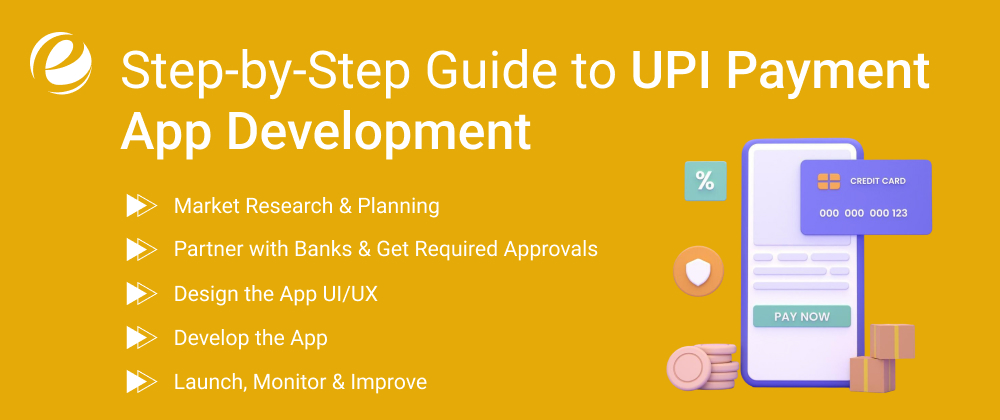
Step 1: Market Research & Planning
- Understand the market demand sufficiently, be it end-users, business customers, or small businesses.
- Scan the major competitors like Google Pay, PhonePe, Paytm
- Make app objectives, features, and platform (Android, iOS, or both) decisions
- Prepare a budget, development timeline, and a scheme for the app to earn money
Tip: Study the application market for unmet needs like better user interface, the speed of payments, or extra features like (bill reminders and spending tracker).
Step 2: Partner with Banks & Get Required Approvals
- Apply for a Third-Party App Provider (TPAP) to NPCI
- Become a partner with a PSP (Payment Service Provider) Bank
- Follow the rules and regulations of RBI and NPCI for privacy and payments
- Receive the approval and certification to use UPI APIs
Tip: Find a PSP bank that is reliable and has a strong UPI infrastructure along with the necessary support.
Step 3: Design the App UI/UX
- Develop the application with simple, neat, and intuitive designs
- Pay attention to the menu of commands and make it as simple as possible for a person to send and receive money
- Have a scanner of QR codes, history of transactions, and pay in an easy way all at the same time as features
- Set an interface that users can work with or without any problems, which can be understood not only by those who are tech-savvy but also just by anyone
Tip: Work with wireframes and mockups before you truly enter into the UPI payment app development. This way, you won’t waste your time later.
Step 4: Develop the App
- Implement UPI features such as account linking, PIN verification, and real-time transfers.
- Conduct performance, bugs, and security issues testing.
Tip: NPCI’s sandbox environments are the best choice for your first testing.
Step 5: Launch, Monitor & Improve
- Deploy the app on both Play Store and App Store
- Market it via digital marketing and partnerships
- Utilize analytics tools to oversee app performance
- Regularly update the app with new features and listen to user feedback
Tip: Incorporate early adoption boosting features, such as loyalty programs, cashback offers, or referrals.
Note: If you want to develop a secure mobile banking app, then consider this step-by-step guide.
Regulatory Compliance and Certifications
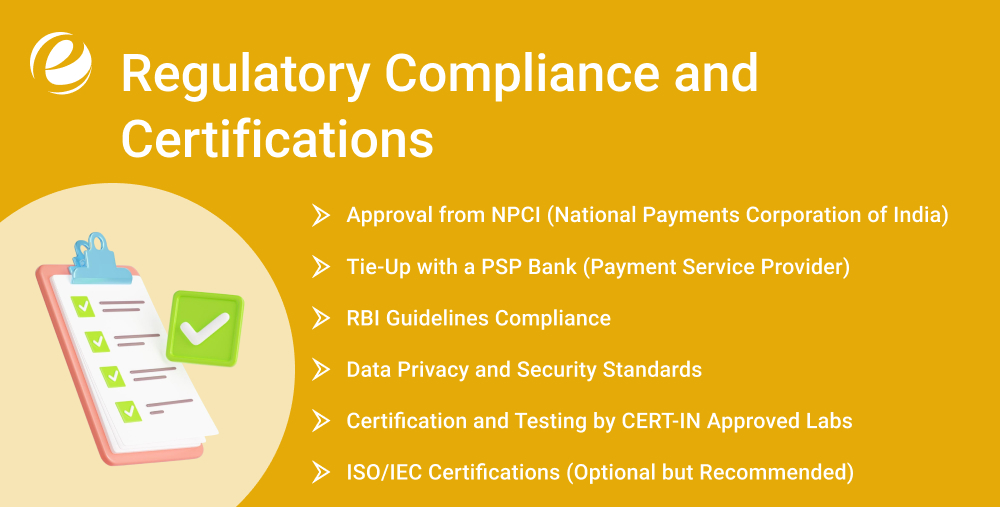
The best UPI payment apps need more than a user-friendly design and great features; it needs to be developed in echo with regulatory guidelines. This measure is designed to safeguard the users and their financial resources. Here you will find a list of the main requirements and approval you need to have a UPI app that is legally working in India:
1. Approval from NPCI (National Payments Corporation of India)
Before the middle of a UPI app, you have to acquire permission from NPCI-the organization that runs the show of UPI in India.
Explanation: NPCI is working as a set-up that is responsible for UPI integration. To get permission for the app, this app provider has to satisfy some criteria and needs to be in partnership with a recognized bank, called a PSP bank. NPCI makes sure that your app is following UPI rules, permits real-time transactions, and is compliant with technical and operational guidelines.
2. Tie-Up with a PSP Bank (Payment Service Provider)
Every UPI app has to tie up with a bank that is a licensee of RBI and authorized by NPCI as PSP.
Explanation: PSP banks are the intermediaries between the UPI app and the UPI ecosystem; they take care of the backend of the transaction routing, user authentication, and bank account management. Using the API of UPI, you will not access or run the payment processing software in the absence of a PSP partner.
3. RBI Guidelines Compliance
The app must comply with all the regulatory guidelines as stipulated by the Reserve Bank of India (RBI), especially those related to digital payments and customer data.
Explanation: RBI not only ensures the security of digital apps but also that these adhere to the norms. Examples are regulation of transaction limits, KYC (Know Your Customer), data privacy, and customer resentment redressal systems. The case of not following RBI rules is serious and can result in massive penalties or even app suspension.
4. Data Privacy and Security Standards
User data security is a must; a technique of storing and transferring information in codes and safeguarding it from unauthorized access are the steps to follow.
Explanation: Given that UPI apps process and store crucial financial details of the user, it is a requirement at UPI app development cost to securely handle the data. This involves biometric options, tokenization, end-to-end encryption, and also adherence to the Indian Data Protection Bill. The purpose here is to guard against fraud, illegal access, and hacking.
5. Certification and Testing by CERT-IN Approved Labs
A CERT-IN-approved lab has to test and certify your app.
Explanation: Your UPI app has to first get probes like vulnerability assessments and penetration tests, also known as VAPT, done to ensure it is safe before it can be launched. These official labs make sure that no sensitive data is at risk; thus, the app becomes a secure one. NPCI and the banks, together with the approved agency, issue the security certificate.
6. ISO/IEC Certifications (Optional but Recommended)
You can also try an ISO/IEC 27001 Information Security Management certification for better reliability.
Explanation: If it is still not compulsory, the ISO certificates will be physical proof of your determination to ensure the safety of your business data and general efficiency. They will raise confidence among the public, banks, or even partners, and if you are interested in serving to scale or to get support as a leading entity, they will be of great help.
Estimation for UPI Payment App Development Cost
| Role / Task | Basic App ($5K–$15K) | Advanced App ($15K–$40K) | Complex App ($40K–$100K+) |
| Project Planning & Research | $500 – $1,000 | $1,000 – $3,000 | $3,000 – $6,000 |
| UI/UX Design | $1,000 – $2,000 | $2,000 – $5,000 | $5,000 – $10,000 |
| Frontend Development | $2,000 – $4,000 | $4,000 – $10,000 | $10,000 – $20,000 |
| Backend Development | $2,000 – $4,000 | $5,000 – $12,000 | $12,000 – $25,000 |
| UPI & Bank Integration | $500 – $1,000 | $1,500 – $4,000 | $4,000 – $8,000 |
| Security Implementation | $500 – $1,500 | $1,500 – $3,000 | $3,000 – $6,000 |
| Admin Dashboard | Not included | $2,000 – $5,000 | $5,000 – $10,000 |
| Third-Party Integrations | Limited or none | $1,000 – $2,500 | $2,500 – $6,000 |
| Testing & QA | $500 – $1,000 | $1,500 – $3,000 | $3,000 – $5,000 |
| Deployment & Launch | $500 – $1,000 | $1,000 – $2,000 | $2,000 – $4,000 |
| Maintenance & Updates (Annual) | $1,000 – $2,000 | $2,000 – $5,000 | $5,000 – $10,000 |
UPI App Development Cost Categories Explained:
- Basic App: Consists of major functionalities like registration, UPI payments, and transaction history.
- Advanced App: Includes QR payments, bill payments, notifications, as well as spending analytics.
- Complex App: Contains high-end features such as AI insights, multi-bank support, cashback system, biometric login, and enterprise-grade security.
Note: These are rough estimates. The final UPI app development cost relies on the location of the team, app complexity, and third-party tools used.
Future Trends in UPI Payment App Development
1. Voice-Enabled Payments
Most of the UPI apps will change things up and start giving the vocal-based feature, which is backed by AI.
Explanation: The emergence of voice-based transactions in digital payment will accelerate the pace of the flow of transactions as it is the primary and favorable mode for people not conversant with keyboard typing or mobile apps used in cities and rural areas. To illustrate, users will just say, “Send ₹500 to Raj,” and then they will use voice PIN confirmation to complete the transaction.
2. AI & Machine Learning Integration
AI is going to be the driving force of user-friendly UPI apps that are more aware of the customer’s demands and behavior.
Explanation: The machine learning algorithms are capable of tracking transactions, detecting fraud, suggesting budget tips, and financial analysis. Moreover, they can also implement a virtual agent or a chatbot for prompt customer service within the application.
3. Cross-Border UPI Payments
UPI has started to enlarge its network to serve international transactions.
Explanation: Indians and the authorities from other countries such as Singapore and UAE are adapting UPI for cross-border transactions. Soon enough, you will utilize the UPI applications to carry out cross-border transactions and receive international payments besides the money you have in your account without having to exchange the currency through the exchanger or bank cards.
4. Wearable UPI Payments
There is a noticeable increase in the number of payments through smartwatches and fitness bands nowadays.
Explanation: The near future will witness people having the ability to pay via UPI with their smartwatch. This fashionable feature not only accelerates transactions but also has the extra benefit of tech-savvy people’s time.
5. Advanced Biometric Security
UPI apps will use fingerprint and face recognition as the de facto security standard.
Explanation: With this change, authors of applications opt for biometric verification to protect the login and transaction processes. This not only adds an extra layer of security but also prevents the app from being used or accessed by any unauthorized person.
6. UPI for Credit and BNPL (Buy Now, Pay Later)
It means that UPI is not only (on the way to becoming) associated with a bank account or a debit card but also with a credit (card).
Explanation: When we say that UPI users can link their credit cards or pay later, we refer to the instance when UPI users can pay when their account does not have an adequate balance or using a ‘Buy Now, Pay Later‘ service. Also, this will facilitate the use of UPI for various transactions.
7. Smarter Bill & Subscription Management
UPI apps are users’ servants that do all the work related to bill & subscription management automatically.
Explanation: UPI apps will be so helpful that electricity, as well as Netflix, etc., UPI apps of the future will not only be able to remind users to pay their bills and subscriptions but also they will be able to automatically deduct the payments from users’ accounts and give an overview of all the activities happening in that month–the financial management will be a piece of cake!
8. Integration with IoT Devices
Payments through connected devices will be made possible through UPI.
Explanation: A case in the former involves an intelligent refrigerator that can replenish the stock of the household using UPI as a mediator for paying at the grocery store. In an instance from the latter, the UPI service is directly linked, and the toll plaza is synchronized with the moving vehicle to deduct the toll while the car is in the queue. The interconnection of UPI with IoT is expected to revolutionize life in many aspects.
Why Choose Emizentech for UPI Payment App Development?
Diving into the UPI payment app development not only requires you to possess technical skills but also a very deep understanding of financial systems, user security, and compliance with Indian regulations. This is what sets Emizentech apart. They have a lot of experience in making the fintech app safe, easy to scale, and user-friendly.
Emizentech is a well-known name in the mobile app development industry because they are very reliable. Following are the main reasons why collaborating with Emizentech would be the perfect decision for your UPI payment apps project:
- Emizentech has created several fintech and payment-based apps that have been successfully launched in the market. Their talented and skilled working team knows the complete process of API banking, Reserve Bank of India/National Payment Corporation of India (RBI/NPCI) guidelines, circulars, and the establishment of digital wallets.
- Emizentech takes care of everything from research and design to development, testing, and even post-launch support. It will be one vendor who will handle your entire project, and you will not need to engage with several teams or vendors at the same time.
- The following security and compliance guidelines are strictly adhered to by the UPI payment app development team. The practices of the development team, including the use of data encryption, secure API integration, and user authentication, ensure that your app meets all the RBI, NPCI, and data privacy standards.
- Should your needs fall in the range of wanting a simple UPI app for small businesses or a more advanced version like Google Pay or PhonePe, Emizentech is the team that will make it happen according to your specifications and human-centric design.
- By establishing transparent pricing models and linking them with several key delivery times, Emizentech ensures that you are regularly updated throughout the process. In addition to this, you can be sure of receiving your app on time and without hidden UPI app development costs or delays.
Conclusion
The UPI payment platforms have been a game-changer in all systems of money transfers. And, as the trend of digital transactions continues to gain traction, startups and businesses would do well to develop a UPI app that is safe and easy to use. In this manual, we have tried to cover almost everything—from what UPI is and its key features to the tech stack, the steps of UPI payment app development, expenses, regulations, and future trends.
When deciding between a less complex or a more detailed UPI app, the option to go for an ideal development partner is extremely crucial. If you choose to join hands with Emizentech, a reliable and scalable UPI app that will enter the market in the future can be built fast and, easily and surely endorsed by the users of India.
This is the right time for your UPI app idea to be transformed into a new UPI mobile application that supports its digital payment revolution.
Let’s join hands and contribute to a greener future with UPI payment app development.
FAQs
What is the best UPI payment app?
The UPI payment apps are basically for users who want to send and receive money right away by just using their mobile phones. The above-mentioned service is strongly integrated with their bank accounts and is open round the clock without the necessity of a debit/credit card.
How much does it cost to develop a UPI app?
The UPI app development cost depends on its features and complexity. An easy UPI app can be made by investing $5,000–$15,000, whereas a multifunctional application can go beyond $100,000 if desired.
How long does it take to build UPI payment apps?
On average, it may take 3 to 6 months to develop a UPI app and put it on the market. Nonessential, the time can vary greatly if the app has many features, goes through a compliance process, and is developed with the help of a large team.
What features should a UPI app have?
Some of the essential features are: Linking the bank account QR code scanner Sending or receiving money Transaction history Bill payments PIN authentication Customer support
Is it safe to build and use a UPI payment app?
Yes, the creation as well as use is safe, provided that the app has correct data encryption, implements biometric/PIN security, and is in adherence to compliance rules. Besides, if the app undergoes regular tests, it will remain safe.
Can I integrate UPI with an existing app?
Yes, you can add UPI to your app (an eCommerce or wallet app, etc.) via APIs taken from a PSP bank and as per NPCI norms. Thus, the existing app can become more function-rich, and the users can pay easily and quickly.


 +1 (989) 535-9295
 info@emizentech.com
 emizentech


