
 Add us as a preferred source on Google
Is your organization honestly ready for the next attack from the cyber realm? In today’s world, reacting is no longer sufficient; organizations require a cyber security strategist who works proactively to build resilient defenses, align security to business objectives, and anticipate evolving risks.
A cyber security strategist differs from a cyber security specialist or an information security analyst, who primarily works in the execution phase, set after risks are assumed. A strategist will anticipate risk, create structures from relevant sector-based trends in cybersecurity, and work with the organization to ensure long-term resilience to cybersecurity-based risks.
In this blog, we will cover the critical role of the cybersecurity strategist, how they differ from the IT teams, and the various challenges they break down, and the innovation whereby Generative AI in Cybersecurity and AI Chatbot Development are taken to. I’d like to examine the various key layers of “defense”. So we can help you build a future-ready security posture.
Cybersecurity Market Outlook 2025–2030: Key Growth Trends
As per the Markets & Markets, the global cybersecurity market is projected to grow rapidly from USD 227.59 billion in 2025 to USD 351.92 billion in 2030 at a CAGR of 9.1% (MarketsandMarkets), even a much more aggressive projection according to Grand View Research, which anticipates overshooting USD 500.70 billion by the end of 2030 with a CAGR of 12.9% from 2025. 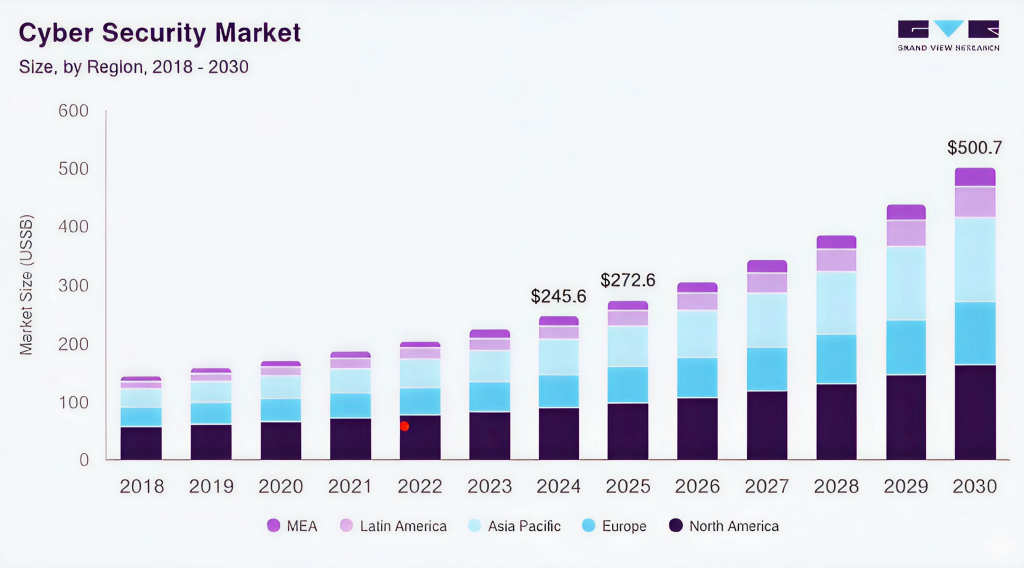
The greater contributors to this explosive marketplace growth would be increases in cybercrime, the use of cloud, and interest in Generative AI applications in Cybersecurity. Among the various categories of the Security Industry experiencing Cybersecurity growth, the largest segments include IAM (Identity and Access Management) and Cloud security, whereas the Asia Pacific remains the fastest-growing region. In 2025, it is expected that there will be 3.5 million open Cybersecurity positions, further establishing the need for trained cyber security strategist.
What is Cybersecurity and Why Does Your Organization Need It?
Cybersecurity encompasses the measures taken to safeguard organizations’ systems, networks, and data from digital threats, while also ensuring the confidentiality, integrity, and availability of information. As the nature and execution of cyberattacks become an increasingly complex problem for organizations to address, organizations tend to onboard a cyber security strategist tasked with the responsibility of developing proactive defense models that align with the business’s goals. This role encapsulates elements of the information security analyst and cyber security specialist roles to address risks from threats such as ransomware, phishing, and data breaches.
As the top cybersecurity trends shift towards Zero Trust and cloud security, the requirements to obtain the appropriate level of strategic planning become essential. Emerging aspects of the natural language programming model, such as Generative AI in Cybersecurity, observe the capabilities to enhance threat detection, and AI Chatbot Development enables automated incident response with the appropriate validations. A cybersecurity framework blends people, processes, and technology to protect critical infrastructure and improve resilience against dynamic threats. Use cases serve to allow organizations to utilize their layered approach to cybersecurity.
Key Highlights:
- Protection of systems, networks, and sensitive data from cyber threats
- A risk-driven approach that is founded on strategic planning
- Integration of cyber security strategist, information security analyst, and cyber security specialist roles
- Advancing responsibility based on Generative AI in Cybersecurity and AI Chatbot Development
- Alignment of trends in Zero Trust and cloud security.
Why a Cyber Security Strategist Is Important for Organizations?

A cyber security strategist is a significant position for companies that are willing and able to take a proactive approach to prepare to defend against a changing cyber threat landscape, as well as ensuring viability for the long term. They will align security initiatives to business objectives, care about the health of the organization’s data, and ensure compliance efforts as the world of the digital threat landscape is getting larger.
Strategic Threat Anticipation
A cybersecurity strategist will be able to identify the risk and mitigate threats before their impacts are felt in the organization, utilizing complex analytics and an evaluation of existing threat intelligence. Unlike a cyber security specialist, the cybersecurity strategist is more of a long-term planner, but they also need to ensure that the organization is positioned in front of the emerging risks from ransomware to zero-day vulnerabilities.
Regulatory Compliance and Risk Management
Today’s organizations have to ensure that they are compliant with regulations like the GDPR or HIPAA, and will then reduce their potential for legal risk fines and breaches. The cyber security strategist will create a structured framework to ensure compliance with regulatory accountability. Also, this role would work in an oversight position with an Information Security Analyst role to ensure the integrity of the data and to maintain control or access.
Business Continuity and Resilience
Cyberattacks can interrupt operations; however, a cybersecurity strategist develops a response plan and recovery plans designed to minimize downtime. An organization is able to remain operational when fully prepared, and this is beneficial for the organization’s customers and client confidence for revenue and customer value during a security event.
Integration of Emerging Technologies
A top trend in cybersecurity includes AI-driven defense, and the cybersecurity strategist utilizes Generative AI in Cybersecurity for predictive threat modeling and shares expert knowledge for learning through supervised practices. They also supervise and manage the development of AI Chatbots for automating human responses and human activity, automating and improving efficiency for security operations.
Cross-Functional Security Leadership
Cyber security strategists work with other disciplines like IT and legal teams, HR personnel, to design, enact, and enforce organizational policy and training, etc. This security leadership model creates a holistic organizational culture of security, and minimizes human error- the top cause cited for intrusive breaches by hackers.
What Does a Cyber Security Strategist Actually Do?
A cyber security strategist develops and implements protective countermeasures for the long term in accordance with stated company direction and in consideration of risks associated with shifts in threats. This role requires high-level planning along the way, which involves taking the strategic process and synthesizing the tactical knowledge of information security analysts and cyber security specialists into one action plan.
- Develops security policies that align across the entire organizational spectrum, seamlessly matching business needs.
- Identifies and remediates cybersecurity risks based on emerging data analytics.
- Guides the adoption of top cybersecurity trends and cutting-edge technologies.
- Coordinates incident response and disaster recovery initiatives.
- Leads teams and educates staff on security best practices.
By leveraging advancements in Cybersecurity, such as Generative AI and AI Chatbot Development, the strategist acts to position the organization for the problems presented by changing cyberspace.
Key Benefits of Having a Cybersecurity Strategist for Your Business
A cyber security strategist strengthens the organization’s resilience by intertwining security initiatives with the organization’s business goals. The strategic perspective enables proactive defense, regulatory compliance, and long-term risk mitigation in a world of cyber threats and continual cyber-attacks.
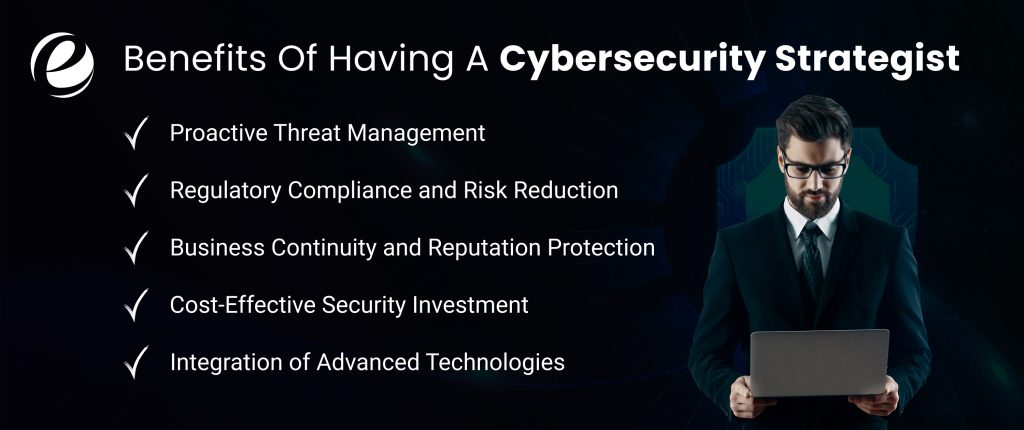
Proactive Threat Management
A cyber security strategist identifies and disrupts threats before they impact operations. Utilizing the new cybersecurity paradigms, like AI-enabled analytics, evolves their threat intelligence and breach risk capabilities. The role goes beyond what is traditionally a reactive role of working for a cyber security specialist.
Regulatory Compliance and Risk Reduction
The cybersecurity strategist safeguards the organization against legal responsibilities through adherence to frameworks such as GDPR, HIPAA, etc. Beyond that, this role combines the forensic capabilities of an information security analyst with auditing systems to ensure compliance with data protection policy.
Business Continuity and Reputation Protection
Through the establishment and advising of incident response and recovery plans, the cybersecurity strategist de-escalates operational disruption and protects brand trust. An effective cybersecurity practice provides checks to mitigate reputational damage after a breach occurs and maintains customer trust.
Cost-Effective Security Investment
A cyber security specialist mitigates long-term financial risks from data breaches by acting as a safeguard against costly attacks and providing a clear return on investment through upheld fines and operational costs from avoided disruptions.
Integration of Advanced Technologies
They initiate using new technologies within the cybersecurity process, such as Generative AI in Cyber Security for predictive modeling and AI Chatbot Development for automating responses to threats, keeping up with new attack vectors.
Challenges Organizations Face Without a Cybersecurity Strategist
Organizations are at an ever-increasing risk of digitization due to having limited preparedness and a strategy without a cyber security strategist. In this case, there is a lack of expert guidance that would address critical gaps in prevention, detection, and long-term resiliency planning.
Inadequate Threat Detection
Not having a cybersecurity strategist often means an organization does not recognize that a risk exists, and therefore also does not address a risk with the advanced malware infection and/or attack that compromises systems or data. A cyber security specialist would have proactively addressed the risks as they became apparent.
Poor Incident Response
The absence of structured policies and action plans greatly impacts the organization’s capability to contain and recover quickly and effectively from a breach. Hence, organizations can experience long downtimes, which negatively affect recovery, and/or losses can be greater.
Regulatory Non-Compliance
The absence of compliance oversight increases the risk of legal and financial penalties, as the organization has either difficulty or will not keep up with new standards that are measured by an information security analyst.
Fragmented Security Investments
Having security spending that is random or reactive and not planned strategically or proactively allows organizations to miss threats that are at the top of experienced cybersecurity trend lists. The entity then wastes resources while at the same time creating or re-creating a continuous loop of experiencing vulnerabilities.
Failure to Adopt New Technologies
Organizations do not often fully leverage the value of Generative AI in Cybersecurity and AI Chatbot Development, which reduces their ability to effectively defend against contemporary automated threats.
How a Cybersecurity Strategist Resolves Key Challenges?
A cyber security strategist assists organizations in addressing critical security vulnerabilities to support operational resiliency and compliance in the digital threat environment. They facilitate the establishment of new holistic solutions and operationalize standards, processes, and controls, thwarting threats and improving overall risk management and future defense strategies.
Enhanced Threat Detection
A cybersecurity strategist executes proactive strategies that utilize both sophisticated cybersecurity trends and advanced analytics to anticipate risks or threats. Their services trump basic strategies or reactive measures often taken by entry-level positions, e.g., information security analyst.
Faster Incident Response
When you have established strong protocols for strategy, a cyber security strategist allows your organization to contain and recover quickly, resulting in less downtime than other general roles, e.g., cyber security specialist, etc.
Regulatory Compliance
In the evolving regulatory landscape, a cybersecurity strategist ensures that your organization has perpetual contact with compliance, e.g., GDPR, PCI DSS, HIPAA, by proactively maintaining and updating compliance verification and application of regulations through audits.
Improved Technology Adoption
A cybersecurity strategist enables organizations to adopt the latest advancements in the industry, e.g., Generative AI in Cybersecurity, AI Chatbot Developer, etc., while keeping the organization at the forefront of automating required operational processes and predictive defense.
Minimized Financial Impact
They create effective strategies to ultimately reduce breach costs through prevention, preparation, and optimized security “stack” investments, while protecting long-term business success.
Difference Between a Cyber Security Strategist and an IT Security Team?
A cyber security strategist deals with the security of an organization in a very general way, creating security frameworks that last long and aligning them with business objectives. The strategist is the one who predicts possible future threats and pushes the company to the tech side, while the tech team just puts in place the security measures and keeps an eye on them.
Focus and Scope
The cyber security strategist concentrates on the positive side of the scale, predicting and hence managing risks, and making policies that are in line with corporate goals, while at the same time, the security team is performing operational duties involved in showing that the system is secure, such as managing firewalls, applying patches, and controlling access.
Approach to Threats
In dealing with threats, the strategist uses predictive analytics and cybersecurity trends to anticipate and cut down on threats even before they happen. On the other hand, the IT group normally operates through alerts and incidents, often following set protocols rather than employing the element of strategy and foresight.
Technology Integration
The visionaries are the ones in charge of the introduction of innovations, such as Generative AI in Cybersecurity and AI Chatbot Development for Automated Threat Detection and Response. The technologists, on the other hand, may put these tools into practice but normally do not influence their strategic integration.
Compliance and Governance
In the area of compliance and governance, the security expert is the one who checks that the regulations set are adhered to by performing top-level audits and policy making, just like the information security analyst. The tech team prevents breaches of the regulations through technical means but has no input in their creation.
Leadership and Collaboration
Cyber security strategists collaborate within the IT security, legal, and HR departments to develop a new culture for security awareness. The IT security team is focused internally and does not often lead cross-functional initiatives, nor does it plan at the executive level.
| Aspect | Cyber Security Strategist | IT Security Team |
| Primary Role | Develop long-term security strategy & overall risk-based frameworks | Lead short-term operational & technical security controls |
| Focus | Anticipating threats and aligning with the business proactively | Practices reactivity & preventative measures to ensure systems operate efficiently |
| Key Responsibilities | Develop security policy frameworks, compliance, strategic planning, and threat intelligence. | Execute user access, firewall management, patching, & incident response |
| Technology Use | Lead implementation of Generative AI in Cybersecurity & develop an AI chatbot | Implement tools, manage security, and administer updates |
| Reporting & Leadership | Provide advice to Executive leadership and collaborate functionally | Reports to IT leadership and develops relationships across technical aspects. |
How Can Businesses Build a Robust Cybersecurity Strategy?
Organizations can develop reliable cybersecurity strategies that secure digital assets, adhere to compliance requirements, and include progressive technologies for future-proof cyber protection. Our developers’ capabilities, optimized for any size company or organization, cover strategic planning and development, as well as leveraging Generative AI in Cybersecurity, to enhance Organizations’ threat intelligence.
Customized Security Frameworks
We creates custom strategies, based on seasoned cybersecurity professionals and information security analysts, that incorporate specific needs from each cybersecurity standard or industry.
Advanced AI-Driven Solutions
Our experts leverage the use of Generative AI in Cybersecurity and predictive analytics, which, as “predictive risk management,” is critical to enable threat and incident detection and rapid response.
Regulatory Compliance Management
We provide end-to-end support to help ensure start-up to scale policy adherence and continuous adherence to global data protection standards and requirements.
Scalable Technology Integration
EmizenTech uses “best-in-class” cybersecurity approaches/products and integrates the latest top-level technology, including AI Chatbot Development that supports automated cyber defense.
Continuous Support & Training
Through continuous expert support and security-awareness training programs, resilience is maintained, and teams are empowered in dynamic threat environments.

Why Hiring a Cyber Security Strategist Is Essential?
To be effective with ever-evolving threats, an organization must incorporate a cyber security strategist. The strategist will develop active defenses and manage threats before they become crises. Unlike a cyber security specialist who often functions in the reactive space of cybersecurity, their role aligns security practices with business objectives. They are well-versed with leading practices and trends in cybersecurity, such as Zero Trust and Artificial Intelligence (AI) enabled analytics.
With an impact on their overall Generative AI in Cybersecurity, threat detection and response are prepared, as well as AI Chatbot Development for better incident management and automated real-time responses. As a long-term engagement with resilience focus in mind, the strategist complements the focus and engagement of the information security analyst, who is typically linked to technical oversight.
In 2025, with cyber threats becoming more sophisticated and significant and complex events also occurring prior to this, the consideration of appointing a cyber security strategist is not optional; they are strategically important in defending data, reputational risks, and business processes.
Frequently Asked Questions
What does a cyber security strategist do?
A cybersecurity strategist develops long-term security plans, anticipates threats, and aligns security with organizational goals beyond technical duties.
How is a cyber security specialist different from an IT security team?
The tech team handles daily operations, while a cybersecurity strategist analyze risks, policies, and strategic decision-making for risk management.
Why is a cyber security strategist important in 2025?
Given increased and evolving cyber threats, cyber threats driven by AI, for example, they're going to need to ensure organizations are ever vigilant and resilient using their tools and prescient judgment.
Can Generative AI in Cybersecurity improve defense?
Yes, generative AI in cybersecurity will help to expand threat detection and response, as well as attack simulations - all of which benefit the strategist to proactively defend before the hacker attempts to attack.
How does AI Chatbot Development support security?
Yes, AI Chatbot development adds to security value via real-time alerts, guiding incident response, and limiting human error, all of which increase the strength of your security operation.



 +1 (989) 535-9295
 info@emizentech.com
 emizentech


