
$5M of Server Hardware on the Shelf, and a Store That Finally Knew It
Fornida’s IT hardware shop: a headless BigCommerce build that sells enterprise servers, storage and network parts by OEM part number, straight out of a Texas warehouse. Delivered by our BigCommerce development team.
Overview
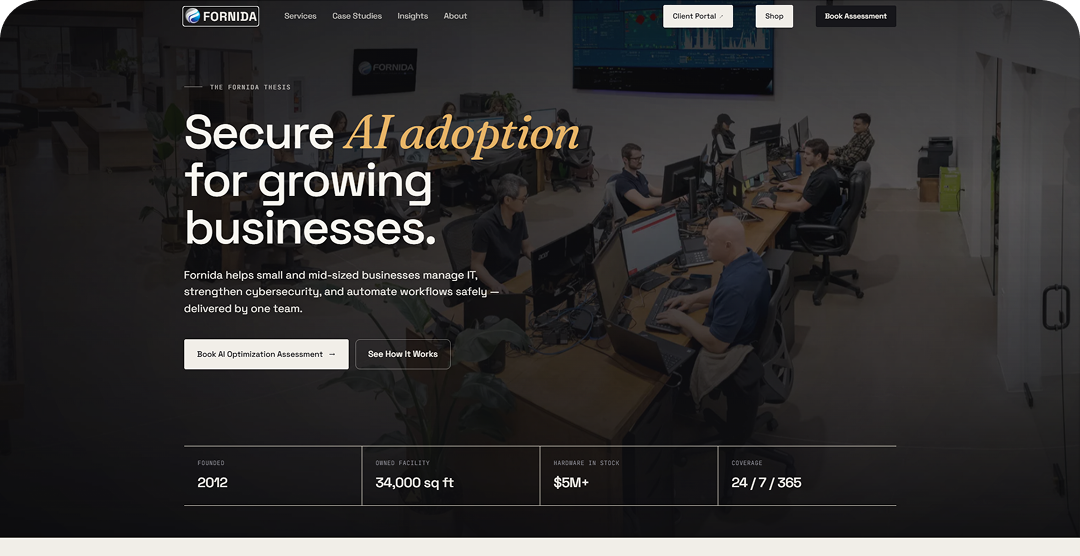
Fornida has been in enterprise infrastructure since 2012. They started out building datacenter and network backbone for national telecoms, T-Mobile among them, and today they run as a managed-services partner for small and mid-sized businesses out of an owned 34,000 sq ft facility in Plano. Inside that building there’s a staffed NOC, a burn-in lab, and more than $5M of hardware sitting in pallet racking.
That last part is what this project was about.
The inventory was real, and it was valuable. Dell, HPE, Lenovo, Ubiquiti. Server memory kits, Smart Array controllers, FlexFabric adapters, hot-plug power supplies, drive blanks that cost three dollars and RAM kits that cost four figures. But almost none of it was buyable online in any way a sysadmin would actually use. Selling it meant a phone call, an email thread, somebody checking a spreadsheet, and a quote typed up by hand.
Fornida asked us to turn that warehouse into a store. Not a brochure with a cart bolted on; a proper IT hardware ecommerce channel where an engineer can paste a part number, see a price and stock level, and check out in a couple of minutes. We built it on BigCommerce, running headless behind Fornida’s own site, so the shop feels like part of the company and not a separate storefront someone set up on the side.
The Challenge
Four problems, and every one of them came from the product itself rather than from the platform.
Buyers search by part number, not by product name
Nobody types “nice network card” into a server parts store. They type 652503-B21, because that’s what’s printed on the failed unit or listed in the HPE QuickSpecs. A storefront built around pretty category pages and fuzzy keyword search would have been useless to the exact people Fornida sells to. The part number had to be the product’s identity everywhere: title, URL logic, search, feeds.
One SKU, three conditions, wildly different prices
The same HPE memory kit can be new, refurbished, or Dell Certified Refurbished on the Dell side, and the price gap between them is huge. A 64GB LRDIMM lists north of $4,000 and sells for under $1,000. Customers need the list price and the Fornida price side by side, otherwise the discount looks like a typo, and the catalog needs condition handled cleanly without spawning duplicate products that cannibalise each other in search.
The warehouse moves faster than any manual catalog
This is live stock that gets pulled for client incidents at 2 AM. If the store says “in stock” and the unit already went out on a dispatch, Fornida eats a refund and an annoyed customer. Stock had to come from where the stock actually lives, not from someone remembering to update a spreadsheet.
The shop had to belong to a services company
Fornida is a managed-services firm first. Their main site sells help desk, cybersecurity and AI work. A standard themed store on a separate domain would have looked like a different business, split their SEO, and broken the path from “I bought a server” to “maybe these people should manage it too.” The store had to live at fornida.com/shop and look like it belonged there.
Our Approach
We started with the catalog, not the design.
That’s not the usual order, and honestly it made the first couple of weeks look slow from the outside. But with IT hardware the data model is the product. Get the part-number structure, condition handling and attribute sets right, and the storefront mostly falls into place. Get them wrong and you’re patching search for the next two years.
So the first phase was a full catalog audit: how Fornida identified parts internally, which OEM attributes actually mattered to buyers (form factor, interface, speed, rank, wattage, compatible server generation), and how to map all of it into BigCommerce product options, custom fields and categories without creating a mess. Only after that schema was signed off did our UI/UX designers start on the shop screens, matched to Fornida’s existing dark, technical brand.
The second call was going headless. BigCommerce handles the parts it’s genuinely good at (catalog, pricing, cart, checkout, payments, order management) while a Next.js front end renders the shop inside Fornida’s main site. One domain, one design system, one set of analytics. We’ll argue for this setup with most B2B sellers who already have a strong services site; the extra build effort is real, but so is the cost of running two disconnected web presences.
Fornida worked with us through a dedicated team model rather than a fixed-scope contract: a project manager, a designer, React developers on the storefront, Node.js developers on the integration layer, and a QA engineer. Six people, six two-week sprints. That matters on a catalog project in particular, because the edge cases only show up once real SKUs start flowing in, and you want the same engineers still around when they do. It’s also the main reason clients bring us in as a full BigCommerce team instead of buying a template install.
Solution Delivered

Part numbers are the front door.
Every product title leads with the OEM part number, then the plain-English description: “652503-B21 – HP Ethernet 10Gb 2-port 530SFP Adapter”. Search indexes the part number exactly and also catches the common variations people paste in (with and without the -B21 suffix, spare part numbers, lowercase). An engineer with a dead NIC in hand gets to the right listing in one search, which is pretty much the whole job of a parts store.

List price next to Fornida price, every time.
We used BigCommerce’s retail price and sale price fields properly instead of hard-coding discounts into descriptions. The storefront shows both, so a $699 list against a $325 Fornida price reads as the deal it is. It sounds small. On a catalog where the gap is often 50 to 75 percent, it’s the single biggest trust signal on the page.

Condition handled without duplicate-product chaos.
New, refurbished and Dell Certified Refurbished stock is separated through categories and product attributes rather than by cloning listings. Dell Certified Refurbished gets its own category because buyers specifically go looking for it (the certification carries real weight with procurement teams).

Stock that reflects the actual racking.
Inventory levels sync into BigCommerce through the Catalog API from Fornida’s own inventory records, on a schedule plus on change. In practice the gap between a unit leaving the rack and the store showing it is a few minutes. When a unit gets pulled for a client dispatch, the store catches up without anybody touching the admin panel. Out-of-stock items stay visible, clearly flagged, because a sysadmin who finds the part number still wants to know Fornida carries it.

A headless storefront that lives inside fornida.com.
The shop is a Next.js front end rendering product and category data from the BigCommerce GraphQL Storefront API, server-side, so pages arrive with content already in the HTML. That’s good for crawlers and it’s quick for people on bad hotel Wi-Fi in a server room. Cart and checkout run through BigCommerce, so PCI scope and payment handling stay on a platform built for it. Headless isn’t always the right call, mind you; for plenty of stores a well-built Stencil theme is faster and cheaper. Here it earned its place.

Category structure built for how IT teams shop.
Systems, Network Adapters, Laptops, Notebooks & Accessories, Solutions, Dell Certified Refurbished. Under those, filters work on the attributes that decide compatibility: interface, port count and speed for adapters; capacity, rank and DDR generation for memory; wattage and slot type for power supplies. No “shop by mood” nonsense.

Catalog onboarding that doesn’t need a developer.
Fornida’s team adds new stock through structured imports mapped to the attribute sets we defined in phase one. The full in-stock catalog went live on launch day, every item searchable by part number. Adding a new pallet of HPE Gen10 parts is a spreadsheet and an upload, not a ticket to us.
Three Things Nobody Screenshots
The parts that never make the portfolio slide but decide whether the store keeps working after we hand it over.
Redirect and URL hygiene.
Part-number catalogs churn. Items get discontinued, merged, re-listed under a refurb SKU. We set up a redirect process so retired product URLs point somewhere useful instead of throwing 404s, which protects whatever search equity those pages have built and stops ad clicks dying on an error page. It’s the same redirect discipline our ecommerce development team applies on every platform migration: map it before anything moves.
Structured data on every product.
Product schema with price, availability, brand and MPN (the part number again) is generated from BigCommerce data on render. Google Shopping and the organic results both lean heavily on MPN for parts, so this is one of those small technical jobs that quietly moves traffic.
An order handoff the ops team actually uses.
BigCommerce orders flow to Fornida’s fulfilment process with the details the warehouse needs to pick from racking: part number, condition, quantity, ship method. The goal was simple: the dispatch line in Plano shouldn’t have to re-key anything. It’s the same thinking we bring to any ecommerce ERP integration; the store is only as good as what happens after the order email.
Key Features

Part-number-first search
Paste an OEM part number, land on the exact listing. Suffix and case variations handled.

List vs. Fornida pricing
Retail and sale price shown side by side on every product and listing card.

Condition-aware catalog
New, refurbished and Dell Certified Refurbished separated cleanly, no duplicate listings.

Warehouse-synced stock
Inventory updates from Fornida’s own records via the BigCommerce Catalog API.

Headless Next.js storefront
Shop renders inside fornida.com with server-side pages and one shared design system.

Compatibility filters
Filter by interface, speed, capacity, rank, wattage and server generation.

Native BigCommerce checkout
Cart, payments and PCI handling stay on BigCommerce.

Bulk catalog imports
New stock goes live through mapped spreadsheet uploads, no developer needed.

Product schema with MPN
Price, availability, brand and part number marked up for Google on every product page.

Order handoff to ops
Orders reach the dispatch team with everything needed to pick from racking.
Results & Outcomes
12 weeks
Kickoff to launch of fornida.com/shop, across six two-week sprints.
$5M+
Warehouse inventory now sellable online, searchable by OEM part number.
1 domain
Services and hardware under fornida.com, one design system, one analytics setup.
Zero re-keying
Stock and orders move between BigCommerce and the ops team without manual data entry.
Alongside: one domain for services and hardware instead of two, stock levels that track the warehouse without manual edits, and a catalog Fornida’s own team extends without opening a ticket. Every release went through our software testing and QA process, with checkout, price display and inventory sync covered as critical paths. Two months of hypercare shipped with the handover.
The less measurable win, and probably the one Fornida cares about most: a customer who buys a replacement controller from the shop is now one click away from the managed IT pages. Hardware buyers are exactly the people who end up needing someone to look after the hardware.
Technology Stack

Commerce engine
BigCommerce (catalog, pricing, cart, checkout, orders)


Storefront
Next.js (React), server-side rendering, headless


Commerce APIs
BigCommerce GraphQL Storefront API, Catalog REST API v3, webhooks

Integration layer
Node.js services for inventory sync and order handoff

Hosting
Vercel (storefront), BigCommerce SaaS (commerce)


SEO
Product structured data (schema.org), XML sitemaps, managed 301 redirects

Payments
BigCommerce native checkout with a PCI-compliant payment gateway


QA
Automated checks on checkout, pricing and sync, plus manual UAT
The Part People Underestimate: This Is a Data Project
Most people look at a store like this and see a design job. Pick a theme, upload products, connect a payment gateway, done. That works for a candle shop. It falls apart with IT hardware.
Strip out the storefront and what’s left at Fornida is a product information problem. Thousands of OEM part numbers, each with a handful of attributes that decide whether it fits a customer’s server or doesn’t. Three conditions. Two prices. Stock that moves every day. If those records are inconsistent, no amount of front-end polish saves the store, because the buyer can’t trust what they’re reading.
That’s why the catalog schema came before a single screen was designed, and it’s the advice we’d give anyone selling technical parts online, on BigCommerce or anywhere else. Platform choice matters less than people think. Data discipline matters more. It’s also why BigCommerce B2B projects tend to go best with a team that understands retail and distribution software, not just theme customisation.
And for what it’s worth, BigCommerce was a good fit here for a specific reason: its catalog APIs are generous, it doesn’t charge transaction fees on top of the payment gateway, and it’s comfortable running headless. For a high-SKU, thin-margin parts business, those three things add up quickly. We did look at the alternatives. Shopify Plus is excellent for DTC brands with tighter catalogs, and Adobe Commerce earns its keep when a business needs deep customisation and has the budget to run it. Neither matched a parts catalog this size as cleanly.
What’s Queued Next
The store launched with room left in it on purpose. On Fornida’s roadmap:
Request-a-quote for bulk and configured orders, because a 40-server refresh isn’t something anyone puts through a cart. Customer-group pricing and net terms for Fornida’s managed-services clients, using BigCommerce’s B2B features. A server configurator that checks memory, controller and drive compatibility before the build ships to the burn-in bench. Google Shopping and marketplace feeds driven off the same part-number data. Further down the line, AI-assisted search that understands “16GB RDIMM for a DL360 Gen9” without needing the exact part number.
None of that needs a rebuild. The catalog structure was designed to carry it.
Conclusion
Fornida already had the hard part: the inventory, the building, the people who know which controller goes in which chassis. What they didn’t have was a way to sell any of it online without a phone call in the middle.
Now they do. One headless BigCommerce store, sitting inside their own site, selling by part number with stock that reflects the racks in Plano. If we had to name why it worked, it would be three decisions: modelling the catalog before designing anything, keeping checkout on BigCommerce rather than reinventing it, and treating the part number as the product’s identity from the first day.
If you’re sitting on a warehouse of technical stock and a store that doesn’t reflect it, you can hire dedicated developers from us the way Fornida did. Bring on a single specialist, or hire BigCommerce developers as a full team with design, QA and project management that stays on the project from catalog schema through launch.
Selling technical products on a store that wasn’t built for them?
Let’s talk about your catalog first. The storefront is the easy part.
Schedule a Free Consultation

