A UK Room Rental Marketplace Where Two Strangers Have to Trust Each Other Before Anyone Moves In
Room for Rent -a Laravel marketplace connecting landlords and tenants directly, with paid listing packages, moderated adverts, geo search across the UK, and a messaging layer built to keep deposit scams out.
Overview
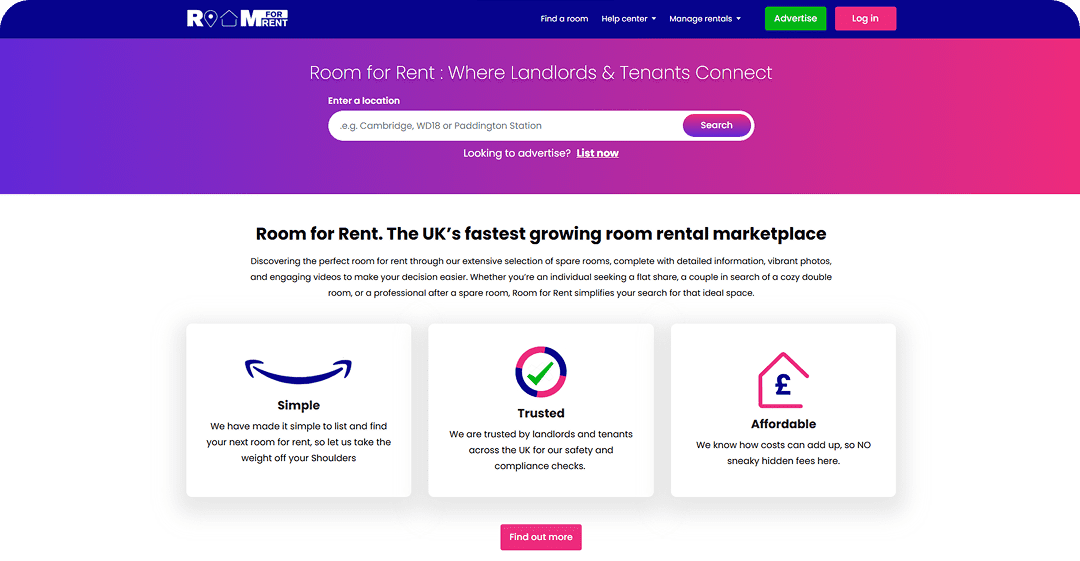
Room for Rent is a UK marketplace for spare rooms. Not whole flats, not commercial lets -rooms. Flatshares, house shares, HMOs, student rooms near universities, and the increasingly common case of someone letting the box room in their own house because the mortgage went up.
The company behind it is Ministryofrooms Property Group Ltd, registered in Shoreditch. Their pitch is simple and, honestly, fairly sharp: cut the letting agent out, charge the landlord a small flat fee instead of a percentage, let the two sides talk directly. Listings start at £21.95 for 60 days. Set that against agent fees on a room let and you can see why landlords bite.
“Let the two sides talk directly” is where the software gets hard, though. Room rentals in the UK sit in a corner of the market that attracts a lot of fraud -fake adverts, holding deposits taken for properties that don’t exist, overseas “landlords” who can’t show you round because they’re conveniently abroad. Anyone building here is building a trust product first and a search product second.
We took this on as a ground-up custom software development services rather than a template build, for reasons that become obvious about four paragraphs down. What follows is the honest version of how it went.
The Challenge
Some of this was technical. Some of it was awkward business logic that only surfaces once you’ve sat with actual landlords. The awkward stuff took longer.
Two user types who want opposite things from the same screen
A tenant wants everything visible: exact address, photos, who else lives there, whether the landlord seems like a decent person. A landlord wants control -no address until an enquiry looks serious, no phone number on a public page, no time wasted on people who’ll never turn up to a viewing.
Both sit on the same listing record. Getting the disclosure rules right -what’s public, what unlocks after registration, what only appears inside a conversation -took more iterations than the search engine did.
Scam prevention without turning the funnel into a checkpoint
Every friction point that stops a fraudster also stops a genuine landlord. We couldn’t demand documents up front; the whole promise is that listing takes minutes. So the controls had to sit where they don’t feel like controls -moderation before publication, pattern detection on messaging, and a hard rule that payments never touch the platform.
HMO listings don’t fit a normal property data model
An HMO isn’t one listing. It’s a house with five rooms, each with its own rent, availability date and occupant profile, sharing one kitchen, one address, one set of communal photos. Model it as five properties and the landlord re-uploads everything five times. Model it as one property with five rooms and every search result, URL and price filter has to know which level it’s working at.
We went with the second. Right call, and it made the first three months harder.
Location search that matches how British people actually search
“Reading”. “N4”. “near Nottingham Trent”. “Wembley”. Users type a mix of city names, postcodes, partial postcodes, station names and university names, then expect a sensible radius of results back. UK postcode data is its own small industry. Making autocomplete, geocoding and radius filtering feel instant across thousands of live adverts was real work.
Paid listings running on a 60-day clock
Money changes everything about a data model. A listing isn’t published or unpublished -it’s drafted, paid for, awaiting review, live, expiring, expired, renewed, or marked as let. Refunds. Failed cards. Someone whose room goes on day three who wants the remaining 57 days moved to a different room. Premium upgrades mid-cycle.
Migrating landlords off competitor platforms
The client wanted an advert transfer service -a landlord already listed elsewhere shouldn’t have to retype everything. That meant an assisted import flow, run with the landlord’s consent and involvement, plus a support process sitting behind it. Half software, half operations.
SEO, because a marketplace with no traffic is just a database
Room rental is a search-driven category. City and town pages had to rank. Clean URL structure, structured data on every listing, sitemaps that update as adverts come and go, and pages that survive Google’s opinion of thin content when a small town has four rooms available.
Our Approach
We started with the listing data model and the state machine, before anyone opened a design file. On marketplace projects this is the fork in the road -payments, search filters, the moderation queue, the SEO pages and the expiry logic all read from the same shape. Get the shape wrong and you’re refactoring eighteen months later with live money running through it.
Eloquent handles the property/room/amenity relationships cleanly
without dragging in something heavier
Queues and scheduling ship in the box
expiry warnings, email digests and image processing all run on Laravel workers
Auth, policies and gates map neatly
onto the landlord/tenant/agent/admin split
The client can hire for it
PHP talent is everywhere. If they ever want development in-house, they can. We say that to clients even though it works against us on paper
If you’re weighing frameworks for a property build, the trade-offs are laid out properly on our Laravel development services page, with the broader platform economics covered in our guide to real estate app development cost.
Two-week sprints throughout. The useful part wasn’t the ceremony -it was that the client kept bringing real landlords into review calls. A landlord telling you out loud that your availability date picker doesn’t work for how she staggers tenancies beats a month of analytics.
Solution Delivered
From the user’s side, all that underlying engineering disappears into five simple capabilities:

Property and room architecture
One property record, many room records. The property holds the address, coordinates, shared amenities and house rules. Each room carries its own rent, deposit, availability date, ensuite flag and photos. Search runs at room level but results present at property level, so a five-bed HMO doesn’t flood a page with near-identical cards. Landlords upload communal photos once. Adding room six takes about ninety seconds.

Geo search with autocomplete and radius
Location input runs through Google Places autocomplete, resolves to coordinates, and queries indexed lat/long on the property table. Radius filtering sits alongside price bands, availability date, ensuite, parking, internet, whether students are accepted, whether couples are, and whether the landlord lives in. Results cache at query level with short TTLs, because roughly twenty city searches account for most traffic. Nottingham at nine on a Sunday shouldn’t cost a database scan.

Listing lifecycle and payments
A proper state machine, not a status column with prayers attached. Draft, submitted, in moderation, live, expiring, expired, let, archived. Stripe handles checkout for the £21.95 sixty-day package and the premium tier, while scheduled jobs fire expiry warnings. Admins get paths for extending, transferring or refunding when support has to step in. Far more transactional logic here than a listings site usually implies.

Moderation queue
Every new advert lands in a review queue before it goes public. Admins see the listing next to automated flags: duplicate images across accounts, pricing that looks wrong for the postcode, addresses already listed by another user, accounts created and listing within minutes. Nothing is auto-rejected. A human decides. Slower, and correct for this category -a false rejection costs you a landlord, a false approval costs a tenant their deposit.

Direct messaging with guardrails
Landlords and tenants talk on-platform, messages routed through the application and mirrored by email so there’s a record. Contact details and outbound links get filtered in early exchanges. Rate limits on new accounts stop bulk-blasting. Reported threads reach admin with full history. This doesn’t eliminate fraud -nothing does -but it shifts the odds, keeps evidence, and lets us trace a reported scammer across their other adverts.

Landlord dashboard
Multiple listings on one screen: enquiry counts, view counts, days remaining, quick actions to mark a room let or extend a package. Letting agents running a dozen properties needed batch operations. Live-in landlords with one spare room needed an interface that doesn’t look like enterprise software. Both come off the same dashboard, built out through our web development services team.

Media pipeline
Multiple photos and a video per room. Uploads hit a queue for resizing, WebP conversion, thumbnail generation and EXIF stripping, then serve from CDN. That last step is a safety measure as much as a privacy one -GPS coordinates buried in a photo of someone’s bedroom have no business on a public page. Video carries size and duration limits to keep page weight sane.

Flatmate matching
Beyond the room itself, tenants filter on the household -interests, lifestyle, working patterns, whether it’s a quiet house or a social one. It’s a soft feature and it drives more engagement than the hard filters do, which mildly surprised us. People care who they’ll be sharing a fridge with. Matching logic stays deliberately simple; nobody wanted a dating algorithm bolted onto a rental site.

SEO and discovery layer
Slug-based listing URLs. Editable static landing pages for high-volume cities like London, Birmingham and Manchester, with query-driven search pages picking up the long tail. Structured data on every listing, sitemaps that regenerate as adverts come and go, canonical handling so search variants don’t compete. A blog on the same domain carries the guidance content landlords actually search for before they list.

Accounts and access control
Email registration plus social login through Google and Amazon, password policy enforced on client and server. Role separation between tenant, landlord, letting agent and admin runs through Laravel’s policy layer, so permissions live in one place rather than scattered across controllers. Boring work, and it’s the kind of boring that saves you when a new role gets added eighteen months later.
Key Features at a Glance

Property + room data model
One address, many rooms, independent pricing and availability

Geo search
Autocomplete, postcode and place resolution, radius filtering

Faceted filters
Price, date, ensuite, parking, internet, students, couples, live-in landlord

Paid listing packages
£21.95 / 60 days plus premium tier, Stripe checkout, renewals

Moderation queue
Human review with automated risk flags before publication

On-platform messaging
Filtered, rate-limited, logged, reportable

Landlord dashboard
Multi-listing management, enquiry and view metrics, quick status changes

Advert transfer service
Assisted migration for landlords listed on other platforms

Media handling
Multiple images and video per room, EXIF stripped, CDN delivered

Flatmate matching
Household lifestyle and preference filters

SEO architecture
City pages, slug URLs, structured data, dynamic sitemaps

Trust layer
Listing checks, reporting flows, no payments taken on-platform
Security, Trust and Compliance
Worth its own section, because in this category it is the product.
No deposits move through the platform
Deliberate. Holding-deposit fraud is the most common scam in UK room rentals, and a payment rail on the site would legitimise a request that should always look suspicious. The interface says so, repeatedly.
GDPR handled properly
Data export and erasure paths, consent management on cookies, retention rules on expired listings and closed accounts. Contact details never render on public pages.
Application-level hardening
CSRF protection throughout, prepared statements everywhere, rate limiting on auth and messaging endpoints, throttled password reset, locked-down session config. Uploads validated by type and content rather than extension.
EXIF stripping on every image
Small thing. Stops a landlord accidentally publishing the GPS coordinates of a property they didn’t want precisely located.
Results and Outcomes
Indicative figures from the build and ongoing operation. Replace with the client’s measured numbers before publishing.
Coverage
Live listings across London, Manchester, Birmingham, Leeds, Nottingham, Newcastle, Cambridge, Reading, Glasgow and Edinburgh
Listing cost
From £21.95 per 60 days vs. percentage-based agent fees
Time to publish
Minutes from signup to a submitted advert
Landlord feedback
Enquiries reported within a day of going live
Platform reviews
Publicly rated on Trustpilot
Uptime
Stable through seasonal student-let peaks
Technology Stack
Chosen for a two-sided marketplace that has to hold up under student season and keep growing after it.

Laravel (PHP)
Application framework -Eloquent relationships, queue workers, policy-based access control.

MySQL with spatial indexing
Property and room records, plus the geo queries behind radius search

Redis
Search result caching, background job queues, session store


Blade + JavaScript
Server-rendered pages for SEO, progressive enhancement on filters and messaging

Google Maps Platform
Places autocomplete, geocoding and coordinate resolution -the same geo layer behind our real estate app development work

Stripe
Checkout for listing packages, premium upgrades and renewals, built through our eCommerce development services


S3-compatible storage + CDN
Room photos and video, processed on upload and served from edge

Laravel auth + social login
Role separation across tenant, landlord, agent and admin, with Google and Amazon OAuth

GTM, GA and Meta Pixel
Acquisition tracking and funnel measurement, extended through data analytics services as reporting needs grow

AWS
Infrastructure that scales through the August and September peaks
Engagement Model: They Hired Our Developers, and Kept Them
Room for Rent didn’t want a build-and-vanish agency, and marketplaces don’t work that way anyway. Listings expire and renew, fraud patterns shift, Google changes its mind about something, a competitor drops their price and pricing logic needs rewriting by Friday.
So the client chose to hire dedicated developers from our side on an ongoing basis rather than close the project at launch. Same engineers who wrote the listing state machine are the ones still touching it. On a codebase with this many edge cases -expiry, refunds, partial transfers, moderation overrides -a fresh team would burn a month reading before they could safely change anything.
The paid listing and checkout side sits with people from our commerce practice. When the client needs work on packages, upgrades, promotions or renewal flows, they can hire eCommerce developers from the same pool without onboarding anyone new. Different skill set from marketplace CRUD work, and we don’t pretend otherwise.
Core platform work runs through dedicated Laravel developers and PHP developers. Frontend and integration work scales in via full stack developers when a sprint needs it.
Feature work

new filters, landing page templates, dashboard modules, pricing experiments
Trust and safety

tuning moderation flags as fraud patterns shift
SEO maintenance

technical fixes, structured data updates, page speed
Platform upkeep
Laravel version upgrades, dependency patching, security releases
Performance

query optimisation, cache tuning, uptime through peak season
Priority support

a defined response window on anything affecting payments, messaging or live listings
What We Learned, and What Comes Next
Five things worth naming -three we’d tell anyone building in this category, two still sitting on the roadmap.
01Model the money before you model the listing.
We knew this and still underestimated it. Every state a paid advert can occupy -including the ugly ones like part-refunded and transferred -needs to exist in your schema on day one.
02Your moderation queue is a product surface, not an admin afterthought.
It’s where trust actually gets manufactured. It deserves real UX effort, real tooling, and a human who’s good at it.
03Two-sided products need two roadmaps you’re permanently forced to reconcile.
Every landlord feature carries a tenant cost and the reverse. Pretending you have one roadmap is how marketplaces drift into serving only the louder side.
04Automated risk scoring on new listings is the next unlock.
The moderation queue works, but it scales linearly with volume, which is a bad property for a queue to have. Scoring adverts before they reach a human -image reuse, account age, price deviation, language patterns -would let reviewers spend their time on the twenty percent that’s genuinely ambiguous. That’s a job for AI software development services rather than more rules in PHP.
05Landlord-side reporting is the one after that.
Right now a landlord sees enquiry and view counts. They don’t see how their rent compares to eleven similar rooms within a mile, or why their advert stalled. It’s the feature most likely to raise listing quality across the whole platform, and listing quality is what a marketplace lives or dies on.
Conclusion
The interesting problem here was never search. Search is a solved problem, and anyone claiming their property search algorithm is the differentiator is selling something.
The real problem is that two strangers have to arrange for one of them to move into the other’s house, and every piece of software between them either builds confidence or quietly erodes it. The moderation queue, the message filtering, the decision to keep deposits off the platform entirely, the EXIF stripping nobody will ever notice -that’s the product. The listings are just the surface.
Room rental is also a category where the incumbent charges a lot, so the challenger has to be genuinely cheaper and genuinely safer at once. Hard brief. The kind we like.
If you’re building something two-sided where trust is the constraint rather than features, that’s an architecture conversation more than a design one, and it’s worth having early. Similar builds are written up across our software development case studies.


 Let’s build success Together