
 Add us as a preferred source on Google
 The average cost to build a real-estate app loaded with features and enterprise capabilities is $200,000. Businesses starting with an MVP spend about $40,000 for a streamlined solution. These real estate app development costs are just the crux. The most pressing question is, where is this money actually going? We have curated this article to answer exactly that.
The property market now lives in the palms of millions of people worldwide. Buyers expect to tour a villa in Dubai or a penthouse in London from the comfort of their home. According to Fortune Business Insights, the global PropTech market is estimated to grow from $44.59 billion in 2026 to $104.57 billion by 2034, indicating the aggressive implementation of AI, ML, and data analytics. After all, the architecture of a modern real estate platform should handle everything from personalized recommendations to AR-driven tours. This pushes businesses to do better and increases the bar for development costs.
This article breaks down the cost of building real estate apps in 2026, based on app type, functionality, and other factors. By the end of it, you should have a fair idea of what budget bracket you are tapping into.
What Is the Estimated Cost to Build a Real Estate App?
To calculate a realistic number, we have to first categorize the level of complexity an app development project involves. Here are the average costs based on this factor.
| App Complexity | Functionality | Cost |
| Basic Version | Lets users list properties, search with basic filters, and interact with real estate agents | $30,000 to $60,000 |
| Mid-Market Apps | Advanced map integration, integrated chats with agents, and basic AI-powered property recommendations | $60,000 to $120,000 |
| Advanced, Enterprise-Grade Platforms | AR home tours, blockchain-based smart contracts, and sophisticated predictive analytics | $150,000+ |
Key Features That Affect Real Estate App Development Cost
Features are one of the pillars of real estate app development costs. Each functionality uses a specific set of backend logic, APIs, engineering and design efforts, ultimately influencing the rates.
Advanced Search and Smart Filters
A simple search bar is inexpensive, but a truly functional real estate app requires “Smart Filters.” This includes search by school districts, commute times, neighborhood safety ratings, and even noise levels. Integrating these data points requires third-party API subscriptions, which add to the recurring operational costs.
Virtual Tours and AR
In 2026, static photos are rarely enough. Integrating 3D floor plans and 360-degree virtual tours has become a standard expectation. The cost here depends on whether you are using a third-party viewer or building a custom engine to render high-resolution property environments.
Geolocation and Map Integration
Mapping is the foundation of the real estate industry. Using Google Maps or Mapbox APIs involves more than just a pin on a screen. It includes custom overlays, heatmaps showing price trends, and “point of interest” data that tells a user how close the nearest grocery store is. This level of mobile app development demands precision in GPS synchronization.
Secure Payment Gateways and Document Management
Since real estate involves high-value transactions, security is paramount. Integrating escrow services, digital signature tools like DocuSign, and secure payment gateways for rent or deposits adds layers of encryption and compliance testing to the development timeline.
Real Estate App Development Cost Breakdown by Factors
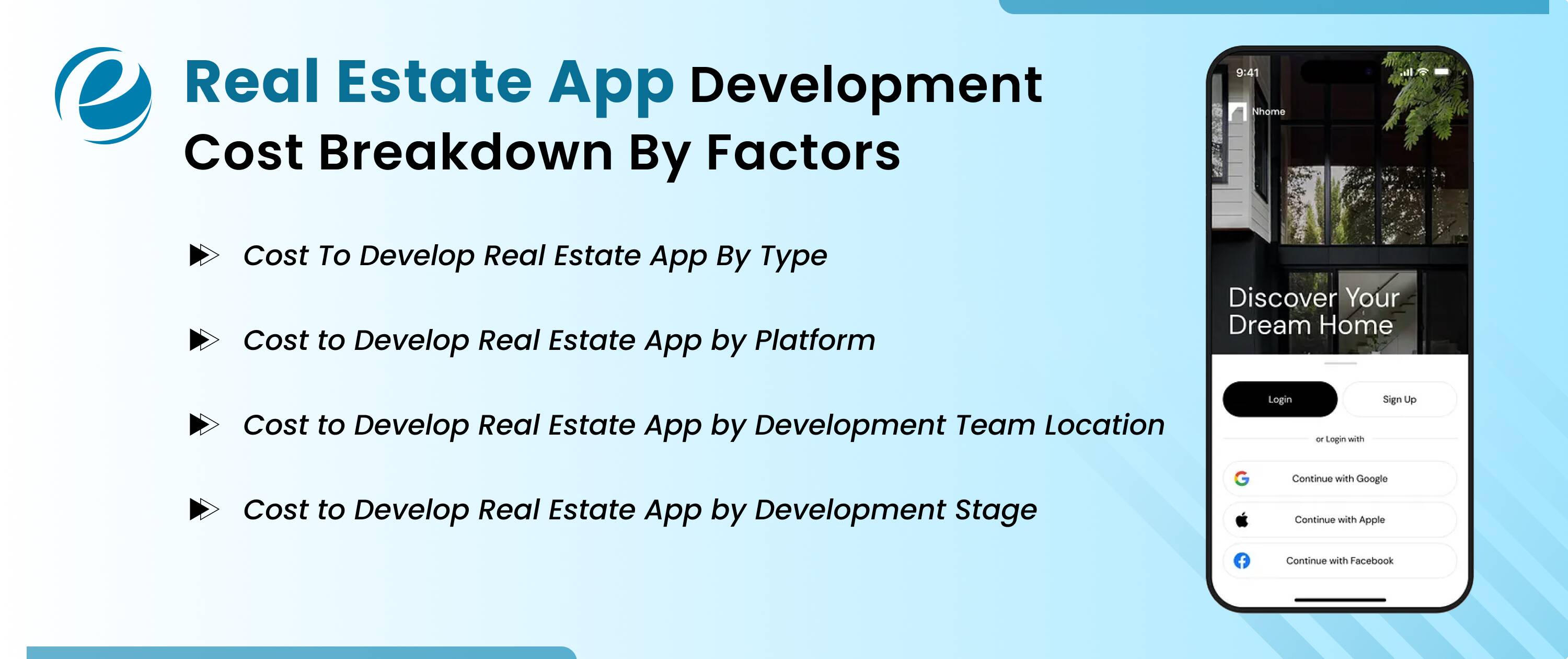
For budget allocation and preventing mid-project financial strain, you must focus on how the real estate app development cost breaks down. Typically, it is distributed across factors like app types, platform choice, and, not to forget, the location of the development team.
Cost to Develop Real Estate App by Type
| Type of Real Estate App | Focus | Cost |
| Property Management Apps | Landlord-tenant interactions, rent payment and collection, and maintenance requests | $40,000 to $90,000 |
| Buy/Sell Marketplaces | Heavy database management and complex lead generation features/tools | $90,000+ |
| Real Estate Investment Platforms | Portfolio tracking, financial regulations, and insights | $120,000+ |
Cost to Develop a Real Estate App by Platform
| Platform Approach | Focus | Cost |
| Native – iOS and Android | Specific expertise in Kotlin or Java; ideal for high-end functionalities like AR-guided tours and analytics | MVP – $20,000 – $50,000 Mid Level – $40,000-$150,000 Enterprise Level – Above $200,000 |
| Cross-Platform – Flutter or React Native | Reduces costs by 30% to 40%; ideal for apps with core and mid-range features like tenant-agent interactions, recommendations, etc. | MVP – $10,000-$30,000 Mid Level – $20,000-$150,000 Advanced Level – $150,000-$200,000 |
Cost to Develop Real Estate App by Development Team Location
| Platform Approach | Cost – Hourly |
| North America | $150 to $250 |
| Central Europe | $60 to $120 |
| India | $25 to $70 |
Cost to Develop Real Estate App by Development Stage
| Development Phase | Share of Budget (%) | Strategic Focus |
| Product Discovery and Strategy | 10 | Market analysis, product suitability, user persona research, trend analysis, and conceptualization |
| UI and UX | 15 | Frictionless journeys, wireframing, and visual identity creation |
| Backend and API Development | 50 | Coding for frontend and backend |
| QA and Security | 15 | Checking the app for bugs, feature performance, and journeys |
| Deployment and DevOps | 10 | App release, maintenance, updates, performance optimization, and issue resolution |
Hidden Costs of Real Estate App Development Most Businesses Ignore Initially
Most businesses don’t reflect on the aftermath of real estate app development. Even after covering the toughest part, certain costs persist in the long run. Here’s what you should add to your budget indicators list right away:
Maintenance
It’s not a one-time effort. Instead, it is one that needs constant attention and investment to maximize development benefits. When planning finances, budget 15% to 20% of the initial app development costs for updates, bug fixes, and server maintenance annually.
Security audits
This one’s a critical factor. Since real estate platforms manage sensitive personal and financial data, they are vulnerable to cyberattacks. Regular penetration testing and compliance updates for GDPR or CCPA are non-negotiable.
Third-party APIs
These are volume-based costs that depend more on the level of functions and integrations your app has. Monthly overheads grow as your user base increases.
Factors That Influence Real Estate App Development Cost
There’s no fixed price for building a real estate app. That’s because every app is unique. The cost depends on several factors, including what you’re building, how advanced you want it to be, and how many systems need to work together. Knowing what actually affects the budget helps you make smarter decisions early on.
App Features & Complexity
Adding features like listings, virtual tours, chat, or booking makes your real estate app more complex and takes longer to build and test. While simple or basic apps cost less, full feature-heavy applications naturally require a bigger investment.
Platform Choice (iOS, Android, or Both)
If you’re building a real estate app for just one platform, either Android or iOS, the cost will be lower. Going for both platforms or operating systems increases effort. However, choosing cross-platform technologies for creating apps can help balance cost and speed to some extent.
UI/UX Design Requirements
When it comes to deciding on the basis of UI/UX, basic designs are quicker to build. However, if you want something polished and tailored to your specific brand goals, it will take more time. A superior design improves user experience, but it also adds to the cost.
Backend Infrastructure
Behind every smooth mobile app is a strong backend and managing users, property listings, and real-time updates requires solid infrastructure. The more complex it will get, the more it will impact the budget.
Third-Party Integrations
Third-party features such as maps, payment gateways, or CRM integrations are crucial for real estate apps as they enhance the performance to a great extent. These features do not come ready-made and hence require proper integration, which takes effort. The more integrations your app will need, the higher the development cost will be.
Development Team & Location
In addition to the technical aspects, who you hire makes a difference in influencing the real estate app development cost. Experienced app development teams may cost more upfront, but they often save time, reduce issues, and offer ongoing post-launch support and maintenance. Hence, your investment will balance out in the long run.
Maintenance & Updates
App development doesn’t stop at launch. Apps need updates, bug fixes, and improvements over time and as they scale. Hence, ongoing support and maintenance are a significant part of the overall cost that you must take into consideration.
Security & Compliance Requirements
Real estate apps handle a good amount of user data. Hence, security matters a lot in these apps. Adding proper safety features and meeting industry compliance standards takes extra work. Hence, consider these factors carefully, as you cannot skip them when it comes to user data protection and loyalty.
How to Reduce Real Estate App Development Cost Without Compromising Quality?
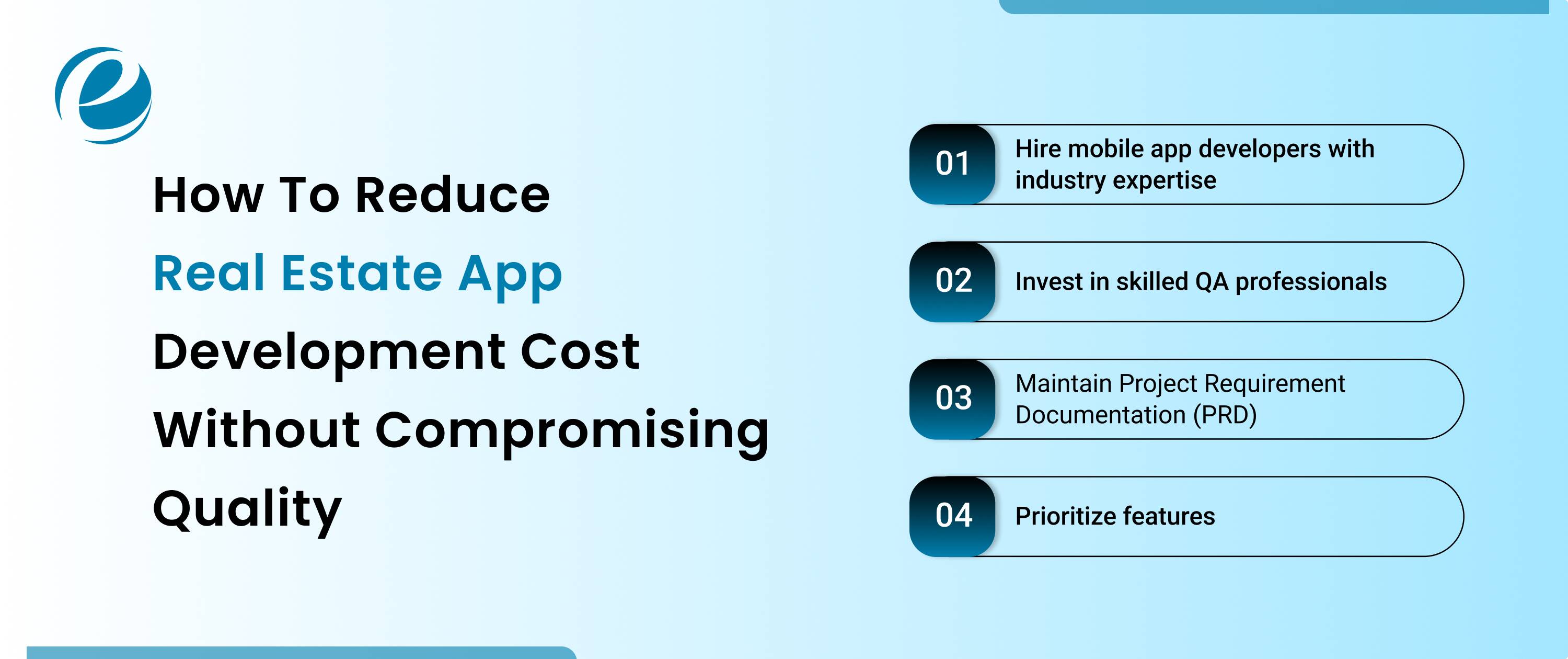
You can build a highly efficient app without exhausting your budget. All it takes is a strategic and thoughtful approach from the start. Our experts recommend these tips to optimize the cost of building a real estate app without compromising its value.
- Hire mobile app developers with industry expertise: They understand the industry nuances and thus build apps using experience in what works and what doesn’t. This keeps your app strong from day one, reducing technical problems in the future.
- Invest in skilled QA professionals: These experts implement agile testing techniques that integrate throughout the development cycle. This approach helps you identify technical challenges early on, ultimately saving you time and money with effective reworking.
- Maintain Project Requirement Documentation (PRD): A well-defined PRD keeps you on track with development requirements and scope. Take it as a reminder for what you need and what you don’t. This prevents budget overruns and scope creep.
- Prioritize features: Build an MVP if you may, but don’t stuff all features in one go. Go phase by phase. Add core features first. Check their performance over a few weeks or months. Continue adding a couple or more over time. This is one of the basic yet smartest ways to manage a budget.
How to Choose the Right Real Estate App Development Company?
The recent Home Buyer & Seller Profile Study from NAR highlights that 96% of homebuyers search properties using online tools. 60% of these homebuyers do all the searching on mobile devices.
This in itself is a huge chance for you to stand out. However, how you do it depends not only on your idea but also on the expert strategy, consulting, and execution.
That’s what makes selecting the best real estate app development company critical. Here’s what you should consider when choosing one:
- Check if they have a proven record in the PropTech industry. Go through case studies and portfolios.
- Understand their approach to integrations. Confirm if they provide integration support along with development.
- Look for an app development company with experience across diverse real estate solutions; this helps you get broader ideation support.
- Consider the location of the development team as you hire real estate app developers. The ones in India will cost less than the ones in the USA. All you have to do is balance services, experience, and cost.
- Ask about their post-development support. Do they offer launch assistance and maintenance? If yes, it makes things feasible for you.
- Check for pricing structure. See how they divide the rates between stages, functions, and integrations. Most of all, communicate the “hidden fees” factor before committing to the partnership.
Emizentech is a leading real estate app development company that accommodates a range of skilled mobile app developers with experience in the real estate industry. For over a decade, our developers have delivered high-performing apps to several businesses across the globe and is currently on
Summing Up: Cost to Build Real Estate Apps in 2026
The real estate app development cost is an investment that can offer immense results in the long run if built right. In a market where more than half of homebuyers explore properties on mobile devices, what matters is how you make this journey easier for them. The key is to balance strategy with a pragmatic development approach. This will help you build a solution that stands out in the competitive landscape.
FAQs
How much time does it take to build a real estate app?
It can take approximately 4 to 6 months to build an MVP, a basic app with core features that helps validate the idea in real-world scenarios. If you are planning to implement advanced integrations like AI, AR, and analytics, the time to develop real estate apps can go up to 12 months.
Should I build a native app or a cross-platform app?
It depends on your goals and budget. If your investment capacity is limited and you want to reach both iOS and Android users, choose cross-platform. However, building a high-end app with features like 3D tours and hyper-personalization requires native capabilities.
Can I integrate MLS listings into my app?
Of course you can. In fact, most real estate apps utilize IDX (Internet Data Exchange) or specialized APIs to fetch real-time data from MLS. This keeps the app always up-to-date with the most current property details.
What is the most expensive part of real estate app development?
The backend development and the integration of complex features like real-time synchronization and AI-based property matching usually consume the largest portion of the budget.
Do I need to build a separate app for agents and buyers?
You don’t necessarily have to build separate apps, but you can implement separate UI in one app. Most platforms run both sides of the business within one system. They have a dashboard that changes based on the user’s login credentials.



 +1 (989) 535-9295
 info@emizentech.com
 emizentech


