PayPal Agentic Commerce: How AI Is Revolutionizing Payments and Digital Transactions?

Artificial intelligence has long been the talk of the town, reshaping almost every aspect of how a business functions. Joining this new wave of technology, PayPal has reset the standards of digital commerce with agentic commerce PayPal, a concept/approach where AI agents carry out multi-step, complex tasks for both merchants and customers.
On the surface, it appears as automation (and it is). However, PayPal’s agentic commerce also projects a massive shift in how online payments and commerce operate. It is a step toward making transactions smarter, faster, and safer transactions.
What is Agentic Commerce?
To put it straightforwardly, agentic commerce is the new evolution in the world of e-commerce.
It is the next-gen concept in digital business (and is also known as a commerce model) where autonomous brands get intricate, multi-stage tasks done by autonomous AI agents. These are the tasks on both ends, merchants and consumers, and ultimately require minimal human intervention.
This means that customers no longer have to manually look out for a product, manage budgets, compare prices, or even complete transactions. AI agents can do all of these things on their behalf. These agents are humans’ smart digital assistants that can negotiate deals, complete payments securely, and even make decisions in real time.
While these personal assistants recommend the best products to customers based on their preferences, they also track pricing highs and lows, apply discounts, and manage payment preferences. And they do it without asking much for human effort or repeated prompting.
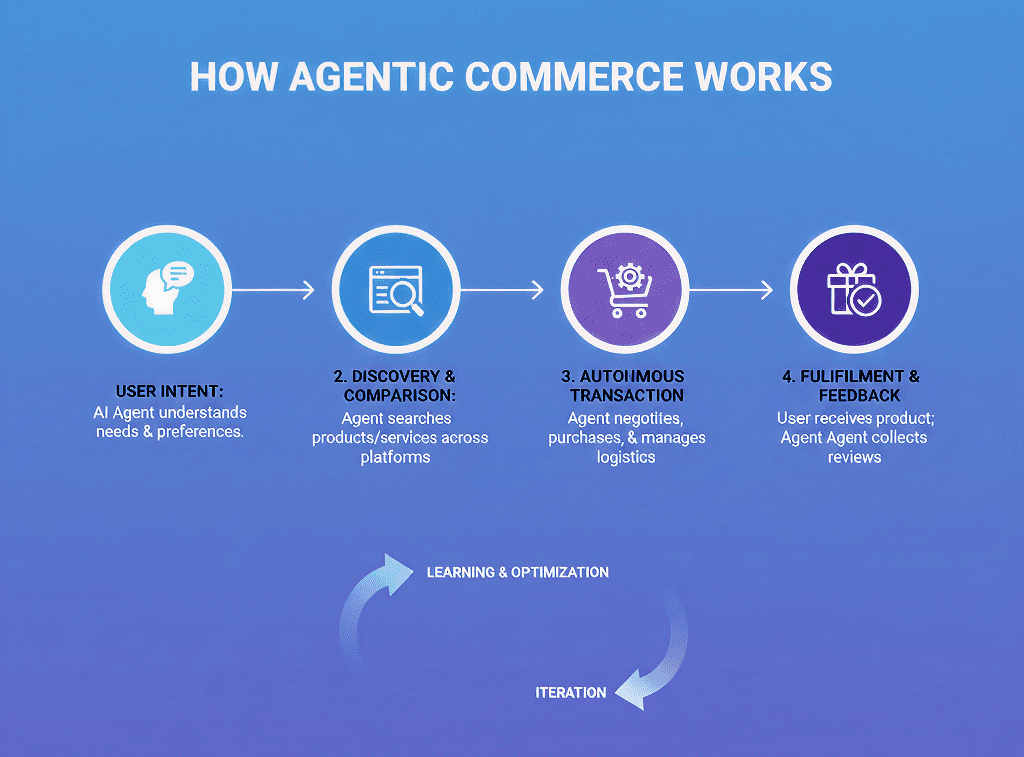
In PayPal’s words, this digital evolution is “commerce with autonomy” and it holds all the power to change consumer expectations, experience, and merchant efficiency, for better.
How is PayPal in for a Win?
PayPal’s double-sided network of trust cushions the brand’s success in the implementation of agentic commerce. As of 2025, the company caters to over 400 million active customer and merchant accounts globally, spanning over 200 markets.
This means billions of transactions in action annually. Its wide reach allows PayPal to scale at an unmatched level and confidence. What makes it a cakewalk is the fact that very few businesses in the world have this steady combination of reach, trust, and technology.
So, it is safe to say that with agentic commerce PayPal is not only creating tools for agentic commerce, it is redefining the approach to AI-powered transactions from ground zero.
AI Toolkit and Agentic Commerce
PayPal’s agentic commerce runs on cutting-edge automation, powered by its AI toolkit. Instead of going ahead with incremental steps, the company has taken a quantum leap in efficiency with this milestone, maximizing these capabilities:
Model Context Protocol (MCP):
Developers use MCP to create AI agents without needing intricate payment workflows. All they have to do is set an intent and that’s all, PayPal’s AI will take it from here, handling refunds, invoices, payments validation, conflict resolution, and well, what not. This is a dramatic change in how queries are tackled and an example of how brands can tap into the growth opportunities that they had no idea even existed.
Fraud and Threat Detection:
Autonomous transactions are on the rise. As great as this sounds, this “comforting” evolution brings its strong share of risks. PayPal uses AI models that recognize suspicious elements in real-time through decades of transaction data. While these adaptive systems not only block malicious activity, they continue to handle budding threats in the future.
Adaptive Transaction Processing:
AI agents have a dynamic approach to handling transaction flows. This means that when a preferred channel fails, they will reroute the payment, optimizing transaction timeline to save costs. Not to mention, this also highlights how these smart assistants anticipate customers’ needs/decisions before they even arise.
PayPal’s Value-Added Services (VAS) and Agentic Commerce
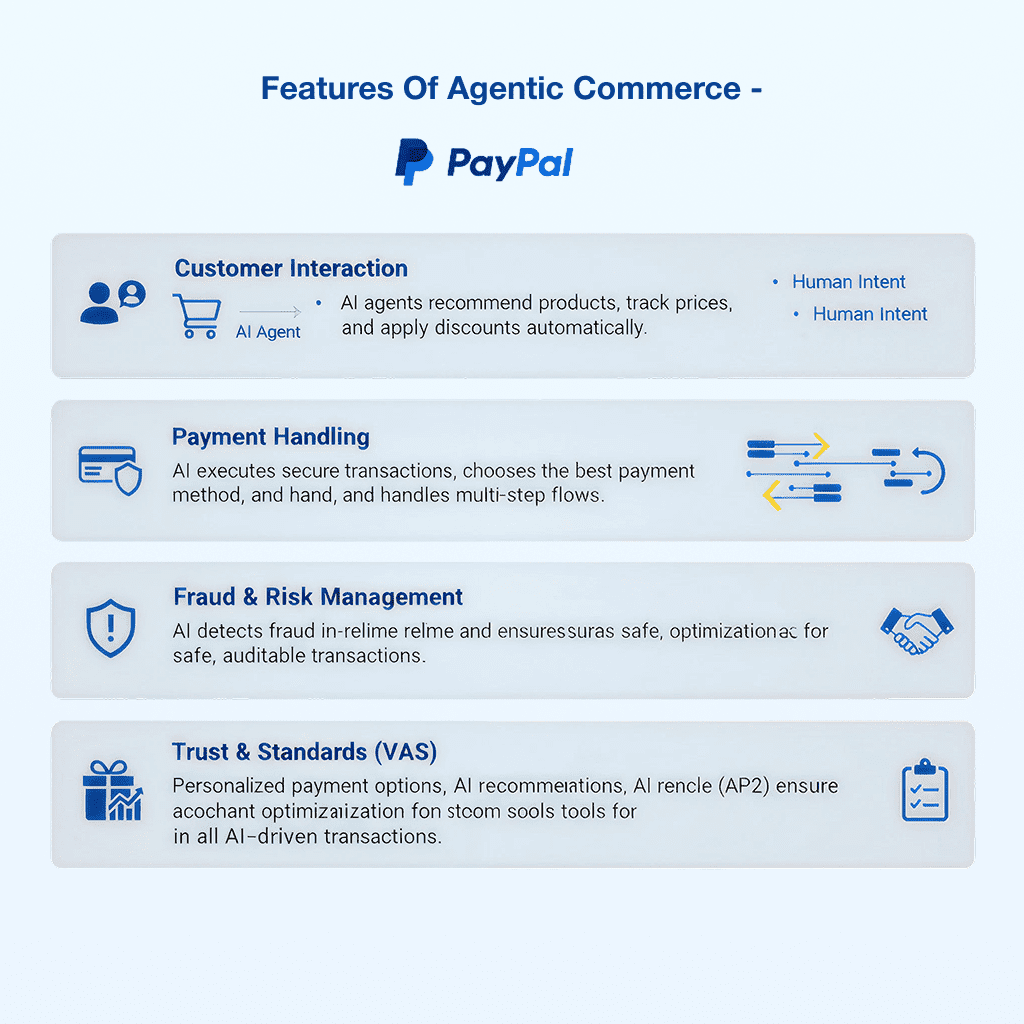
Agentic commerce is the best in effectiveness at Value-Added Services. These are services that compliment payment journeys and enrich customer experiences, through attention to detail.
Here’s how PayPal is making the most of it:
Personalized Payments
AI agents suggest the most relevant payment options based on users’ historical data, like preferences, and transactions. So, a credit card payment option that offers certain cashback might appear in one demographic, while another customer might be shown the “Buy Now, Pay Later” as the primary option. This leads to faster payments, higher conversions, and happy customers.
AI-Powered Recommendations
PayPal triggers hyper-personalized recommendations to users, thanks to its network-wide data that facilitates valuable insights. This means that a customer might receive a special discount based on their own shopping behavior. It is an effective recipe for both, not loyalty and repeat purchases.
Merchant Optimization Tools
AI-driven VAS offers businesses the gift of predictive analytics. With this capability, they can handle fraud risk assessments, payment approvals, demand anticipation, and more tasks smartly. This promotes proactive handling of cash flow, inventory, and more.
Strengthening Trust through Security and Standardization
As we just discussed above, autonomous systems are great; but what about the challenges it brings? Who ensures security as AI agents get the authority to make transactions? Why should they be trusted?
These are fair questions and PayPal is addressing them head-on.
The company has announced their support for industry-wide initiatives like Agent Payment Protocols (AP2), ensuring secure, auditable, and accountable transactions by AI agents. This framework is designed to safeguard user information, empower merchants, and build trust as the world moves towards autonomous commerce setting.
The Future of Agentic Commerce
One thing is clear: Using agentic commerce PayPal, the company is targeting a revolution beyond payments. The company is all set to create a future where customers and merchants enjoy smooth, personalized, and adaptive payments. To do this, it is combining AI automation and a set of value-added services.
As agentic commerce simplifies payments and makes it more convenient, it serves as a reimagined version of commerce experience. While it means comforting shopping for customers, merchants see it as a step forward to smarter operations. In fact, agentic AI developers can use this to innovate rapidly.



Related Articles

 Let’s build success Together