Spreedly Acquires Dodgeball: Unifying Payments Optimization and Fraud Prevention


Spreedly, a leading open payments platform, announced the Spreedly Dodgeball acquisition, a fast-growing fraud orchestration platform. The acquisition, which was made official on September 15, 2025, aims to combine payment optimization and fraud prevention capabilities within a unified system. This will create a smoother and far more secure experience for both consumers and merchants.
Through this step, Spreedly is moving beyond payment routing and tokenization into fraud decisioning and advanced intelligence, which reflects a broader industry shift toward integrated payment ecosystems.

Why Does This Deal Matter?
In the digital economy, merchants are often faced with a task to address two challenges:
- Fraud prevention: A set of technologies and processes that help detect and block suspicious/ fraudulent activities. It involves detecting malicious transactions, preventing account takeovers, distinguishing legitimate users from fraudsters.
- Payment optimization: A process focused on improving the efficiency and success rate of digital payments. It involves routing logic, choosing payment gateways, redundancy, and authorization success.
If we go a few years into the system, merchants used separate tools to tackle these problems. However, this was not sustainable as tying up multiple platforms ended up becoming inefficient and brittle.
To put in words of Justin Benson, CEO of Spreedly:
“You can’t optimize payments without addressing fraud, and you can’t fight fraud without understanding the payment flow.”
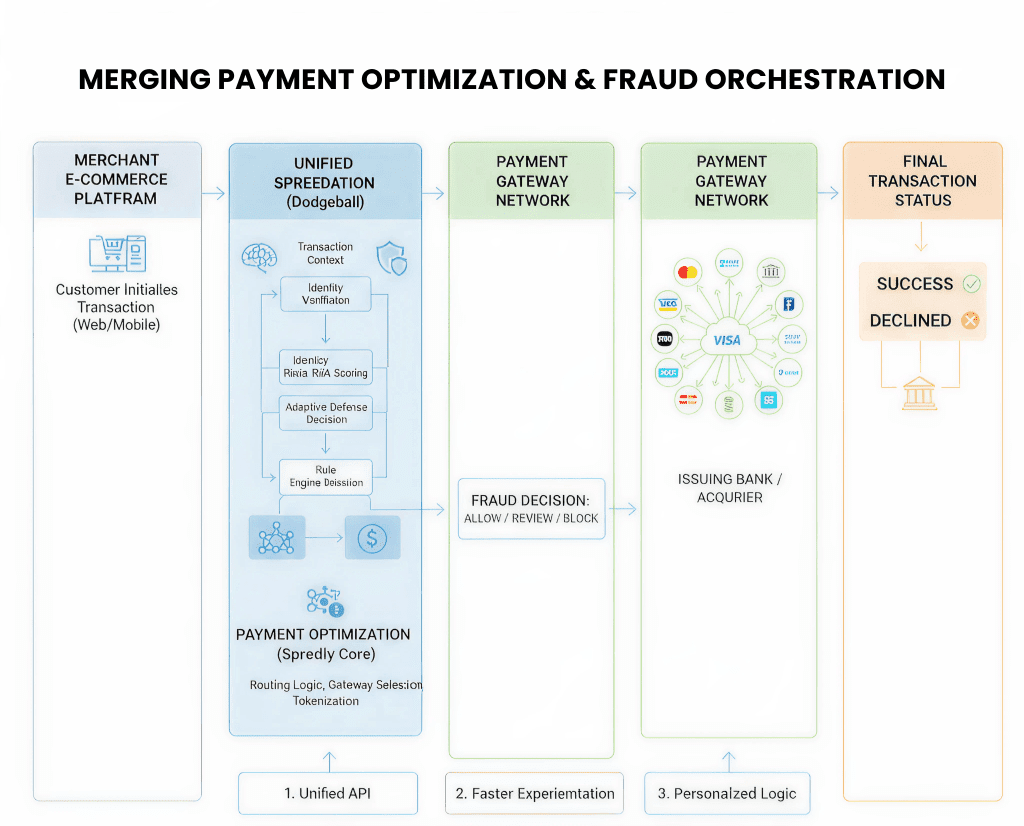
With Dodgeball integration, Spreedly aims to create a single space where merchants can handle both aspects seamlessly rather than just as disjointed parts.
What is Fraud Orchestration?
Gaining traction in the business world globally since the last few years, fraud orchestration refers to a concept that coordinates standalone tools (like rule engines, identity verification, or device risk scoring) in a dynamic workflow instead of deploying them in parallel. Here’s what happens:
- It sequences fraud verification and data checks based on transaction context.
- It invokes the right tool only when needed, thereby reducing friction.
- It minimizes false positives and keeps the customer experience hassle-free.
- It allows new fraud tools and rules to be plugged in easily.
Fraud techniques are evolving (like account takeover, bot attacks, and synthetic identities). A single engine is not enough to address such sophisticated threats with precision. Fraud orchestration helps create an adaptive defense to better manage these issues.
H2: Who Is Dodgeball and What Does It Bring to the Table?
Dodgeball is a fraud orchestrated platform that aims to help businesses globally streamline their online fraud detection and prevention operations. The platform connects a range of tools, including multi-factor authentication and identity verification, in one coordinated workflow, rather than just relying on one fraud engine.
The low-code setup of Dodgeball enables risk teams to create and adjust fraud strategies without requiring any extensive developer input. This makes the process faster and more efficient, helping them respond to threats quickly.
Furthermore, the platform makes sure that the security steps that are applied to each transaction are relevant. The purpose behind this is to keep the scope for false positives low and reduce customer friction. Through smart orchestration, Dodgeball aims to improve user experience while maintaining sturdy protection against account takeovers, synthetic identity fraud, and more such risks.
The flexibility, plug-and-play integrations, and transparency of the platform make it the right fit for Spreedly’s open payments ecosystem. As far as merchants are concerned, they gain more control over fraud management and risk optimization.
What Does This Mean for Merchants, Fintechs and E-Commerce Operators?
If you are running a payment-enabled business or are even considering scaling it, here’s what Speedly Dodgeball acquisition could change for you:
- You may now use a unified API for fraud and routing rather than managing both separately.
- You can now experiment a lot faster, testing new fraud tools or methods, or routing variations, all without rewiring everything.
- You can personalize fraud logic as per the product, region, and risk tier.
- As and when the co-pilot vision of Spredly matures, you might even get automated suggestions to optimize your flows.
- While using just one vendor, you will have to deal with less overhead of maintaining contracts, SLAs, and engineering effort across multiple providers.
While everything seems good, you should also evaluate whether this acquisition supports your local payment systems and fraud tools. Moreover, they should also check if it works with your existing fraud stack (if you already have some components). The migration path, costs, and tradeoffs should also be considered.
Final Thoughts
The Spreedly Dodgeball acquisition marks a strategic milestone to merge payments optimization and fraud orchestration into one platform. Using this, merchants have the potential to gain a unified system to detect and prevent fraud, route payments, and also, access valuable insights. To top that, they will be able to do all this while maintaining flexibility.
This development aligns with the expansive trends in the payments industry for the convergence of risk, routing, and intelligence. A direction also seen with the growing adoption of AI in banking to enhance fraud detection and transaction optimization. While integration and execution will be key, the deal positions Spreedly as a more comprehensive player in the global open payments space.



Related Articles



 Let’s build success Together