 Add us as a preferred source on Google
 Most recruiters already know there are two kinds of people they’re chasing: those who applied and those who didn’t. That’s really what the active vs passive candidates debate comes down to. It sounds like a simple distinction. In practice, it shapes everything: how you write outreach, how long hiring takes, how much you spend, and whether the person you eventually bring on was actively hunting for a new role or just couldn’t say no to a well-timed conversation.
Understanding the passive vs active candidates divide isn’t just useful for sourcing strategy. It changes your messaging, your timelines, your CRM requirements, and your entire sense of what “a good hire” actually means. This guide honestly breaks down both groups, compares them where it matters, and shows what it takes to run both pipelines without running your team into the ground.
What Are Active Candidates?
An active candidate is on the job market right now. They’ve updated their LinkedIn. They’re submitting applications. They take calls from recruiters and actually respond. When actively recruiting, this is the pool most hiring teams go to first because active candidates are looking for you too, which makes the entire process much simpler.
Active candidates are sometimes between jobs. When you’re weighing active vs passive candidates for something urgent, active professionals win on speed. That’s not a minor point. Two to four weeks to hire versus eight to sixteen is the difference between your team staying functional and everyone quietly covering a gap while slowly losing their minds.
Why Target Active Candidates (Pros)
- They move fast. Responding within an hour isn’t unusual. You’re not spending three weeks chasing a reply just to book an intro call.
- They’re available. No negotiating around a two-month notice period. Some can start almost immediately.
- Cheaper to find. A well-written job post brings them to you. That’s far simpler than months of cold outreach and relationship maintenance.
- Their intent is already there. You don’t have to talk them into leaving their current company; they’ve already made that decision.
- More volume, too. A bigger applicant pool means more options, even if sorting through it takes effort.
Challenges of Active Candidates (Cons)
- Quality is inconsistent. Active candidates apply widely. Not all of them are right for your role, and sifting through that takes real time.
- Good ones get picked up fast. If someone’s strong, you’re not the only one calling. A slow process loses strong candidates. That’s just how it goes.
- AI-generated resumes have made screening harder. A lot of what hits an ATS now looks polished and falls apart completely in a phone screen. The signal has gotten genuinely harder to read.
- Some candidates have been searching for a while, which isn’t automatically a red flag, but it’s worth understanding why.
What Are Passive Candidates?
Passive candidates are employed, not looking, and probably not thinking about your company at all. According to LinkedIn, roughly 70% of the global workforce sits in this category. Seventy percent. That number should make any recruiter reconsider whether a job posting alone is a serious strategy.
Passive candidates are proving themselves somewhere else right now, which is at least some evidence that they’re capable. Comparing passive candidates vs active candidates on raw quality, passive professionals tend to come out ahead, especially at senior levels.
Why Hire Passive Candidates (Pros)
- They have a track record. Being employed isn’t the only thing that matters, but it’s meaningful. They’ve been delivering somewhere.
- They’re not desperate, and that changes the dynamic. They’re evaluating you as much as you’re evaluating them. That tends to produce better hires.
- For senior and specialist roles, it’s often the only real path. The best people in any field aren’t reachable through a posting. Relationships are the channel.
- They tend to stay. Someone who was specifically recruited and chose you over staying put is usually more committed than someone who applied to thirty companies simultaneously.
Challenges of Passive Candidates (Cons)
- It takes forever. Realistically, weeks of warming up before a serious conversation even starts, and then a 4–8-week notice period on top of that. Passive sourcing is a long game, by definition.
- Cold outreach response rates are rough. Under 20% is typical. You send 50 personalized messages, and 10 people reply. That’s just the math.
- It costs more. Recruiter time, tools, and relationship maintenance: the cost per hire from passive sourcing is significantly higher than inbound applications.
- Counteroffers happen. You spend three months recruiting someone, they accept, and their current employer comes back with a raise and a promotion. It happens more often than anyone wants to admit.
Related Blog: Team Extension Model: How It Works, Benefits & When to Use
Active vs Passive Candidates: Key Differences
The active vs passive candidates question rarely has a single right answer. It depends on the role, the timeline, and how much pressure you’re under. Whether you’re running active sourcing for a junior opening or managing a long passive candidate pipeline for a leadership hire, the table below gives you the clearest side-by-side view. Use the passive vs active candidates breakdown as a reference whenever a new position opens up.
| Criteria | Active Candidates | Passive Candidates |
| Job Search Status | Actively applying and available now | Employed; not searching but open to opportunity |
| Response Rate | High (responds within hours) | Low (<20% on cold outreach) |
| Time-to-Hire | 2–4 weeks | 8–16 weeks (including engagement + notice) |
| Resume Availability | Updated and ready | Often outdated or unavailable |
| Intent to Move | Strong and immediate | Conditional and selective |
| Quality Signal | Variable; requires rigorous screening | Higher on average; proven employment track record |
| Sourcing Method | Job boards, career pages, inbound applications | LinkedIn, referrals, events, headhunting |
| Cost per Hire | Lower | Higher (relationship investment required) |
| Notice Period | 0–2 weeks | 4–8 weeks |
| Attrition Risk | Moderate–High | Lower when selectively recruited |
| Competition | High (multiple employers targeting them) | Low (you own the relationship) |
| Best Fit For | Urgent openings, high-volume hiring | Senior, niche, or leadership roles |
| Counteroffer Risk | Low | High (current employer may counter) |
| Cultural Fit Signal | Less clear upfront | Often stronger (they’re choosing you deliberately) |
How to Engage and Convert Passive Candidates
This is where things get difficult. Actively recruiting passive candidates isn’t just “send better InMails.” It’s a completely different motion from posting a job and reviewing applications. The active vs passive candidates divide shows up most sharply here because most of what works with active job seekers falls completely flat with someone who isn’t looking.
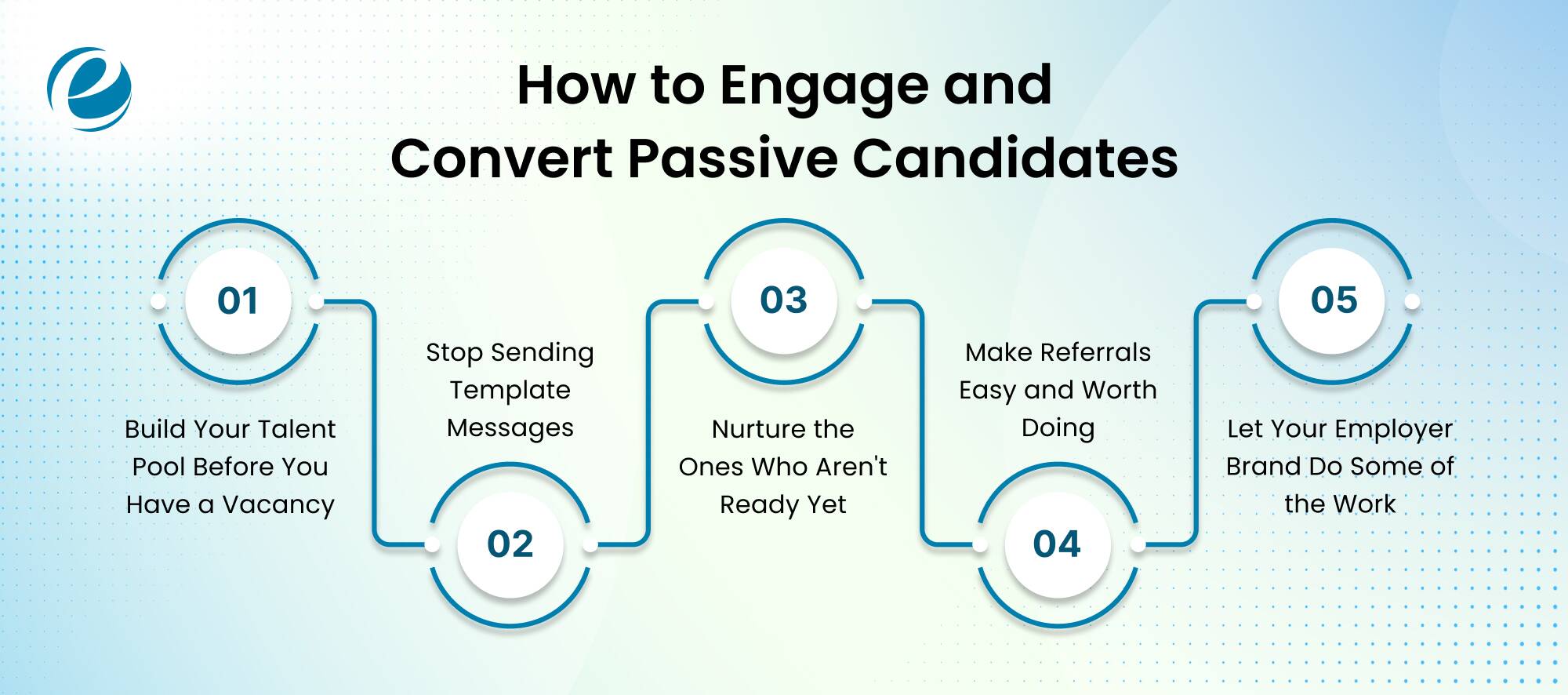
Build Your Talent Pool Before You Have a Vacancy
Most teams start looking for passive candidates the day a role opens. That’s already too late. Active sourcing through job postings is reactive; someone has to come to you. Passive candidate pipelines take weeks or months to develop, and you won’t have that time once there’s a seat to fill. Use LinkedIn Recruiter to identify people who match your target profile by skill, tenure, company type, and seniority before you need them. For technical roles, GitHub is worth your time. Look at who contributes to relevant open-source projects and who’s been consistently active. Log everyone in a CRM so that when a role opens, your first outreach goes out in hours, not weeks.
Stop Sending Template Messages
Your inbox is full of InMails that start with “I came across your profile, and I think you’d be a great fit.” Passive candidates get these constantly. They delete them constantly. The only first message worth sending is one that’s clearly about that specific person. Reference something real: a project they shipped, a talk they gave, something specific to their work. The goal is to feel found, not targeted. Two genuinely personalized sentences outperform five paragraphs of “exciting opportunity” language every time. That’s not an opinion; it’s just what the response rate data shows.
Nurture the Ones Who Aren’t Ready Yet
Not every passive candidate is moveable right now. Their situation might look completely different in six months. That’s fine, as long as you’re still on their radar when it does. Set up a simple sequence in your CRM: intro message, then something genuinely useful a few weeks later, then a lighter follow-up after that. The goal isn’t to sell them anything. It’s just to stay in their peripheral vision until they’re actually ready for a conversation.
Make Referrals Easy and Worth Doing
Your current employees have direct relationships with passive candidates you’ll never find through a LinkedIn search. That’s a better contact than anything a sourcing tool will surface. But most referral programs fail because the submission process is annoying or the reward isn’t actually motivating. Fix both. Make it as simple as a Slack message or a one-page form. Make the incentive proportional to the work; landing a senior hire takes months of effort. Referrals consistently produce candidates who onboard faster and stay longer. They’re worth building properly.
Let Your Employer Brand Do Some of the Work
Passive candidates don’t apply. But they do read engineering blogs. They follow practitioners on LinkedIn. They notice when a team is publishing real work, technical write-ups, honest post-mortems, open-source contributions. That builds recognition over time, quietly. It doesn’t replace outreach. But it means that when you do reach out, there’s already a baseline of familiarity. That changes how many people respond.
Read Also: How to Hire Offshore Development Team? A Complete Guide
Why Off-the-Shelf ATS Platforms Fail at Passive Candidate Management
Here’s the honest answer: ATS tools were not built for this. Greenhouse, Lever, Workday they’re solid at tracking people who have already applied. That’s exactly what they were designed to do. The moment you try to manage active vs passive candidates in the same system, the problems show up fast. An ATS is built around one trigger: the application. When a passive candidate enters your world, there is no application. There’s a connection request, a message, maybe a coffee chat, some emails over five weeks. None of that maps into a system built around applicant stages.
- No relationship stage. ATS tools have “screening,” “interview,” “offer.” Not “warming up, might be ready in Q3.”
- No engagement visibility. You can’t see that someone opened your last three messages without responding. That’s actually useful information when deciding what to do next.
- No outreach sequencing. Drip campaigns don’t exist in most ATS platforms. For serious passive sourcing, you’d need a completely separate tool running alongside it.
- No resurfacing. When a passive candidate declines today and re-enters the market eight months later, there’s no mechanism to flag them at the right moment. They’re just a closed record.
Building a Custom Recruitment CRM Engine to Manage Both Candidate Pipelines
The better setup is a CRM with two distinct tracks: one for people who’ve already raised their hand and one for people you’re still trying to convince. For companies that take active vs. passive candidates seriously as two genuinely different problems, this isn’t an optional upgrade. It’s the only architecture that actually reflects how hiring works.
Here’s the structure:
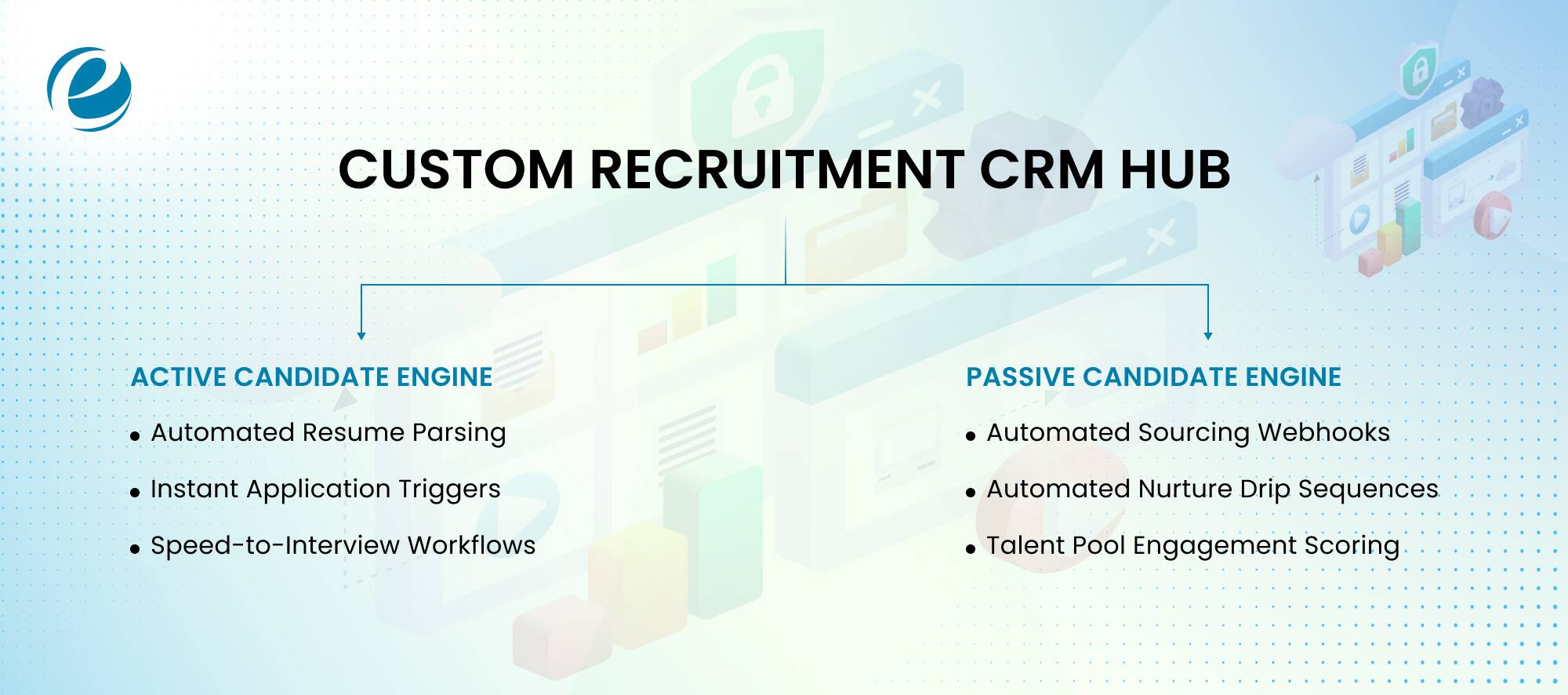
Active Candidate Engine
- Automated Resume Parsing: Pulls applications from job boards, parses skills and experience, and scores them against role criteria without a recruiter manually reviewing every submission.
- Instant Application Triggers: High-scoring applicants are routed to a recruiter queue immediately. Response lag drops to under two hours.
- Speed-to-Interview Workflows: Scheduling links are sent automatically, interview panels are assigned, and follow-up nudges fire before anyone falls through the cracks.
Passive Candidate Engine
- Automated Sourcing Webhooks: Connects to LinkedIn Recruiter, GitHub, and your referral form, pulling passive prospects directly into the CRM so nothing important lives in someone’s personal inbox or spreadsheet.
- Automated Nurture Drip Sequences: Multi-step outreach with personalization and send-time optimization. Sequences pause when someone responds, so you’re not accidentally continuing a campaign while a conversation is already in progress.
- Talent Pool Engagement Scoring: Every passive prospect gets scored on response rate, message opens, and conversation warmth. The warmest ones rise to the top for follow-up by recruiters. Everyone else stays filed until something changes.
Companies looking to hire full-stack developers across multiple teams see this clearly: some roles need to close within 2 weeks; others require months of relationship-building work. A single-track system can’t hold both realities at once.
Why Organizations Partner with Emizentech for Custom CRM Software Development
Knowing that the active vs passive candidates problem needs two different systems is one thing. Building it well is another. Off-the-shelf tools won’t get there; the configurations are too shallow, the integrations too generic, and the passive candidate workflows often don’t exist. Emizentech builds custom recruitment CRM platforms. Here’s what’s actually worth knowing about them: They understand recruiting, not just software. Emizentech’s engineers know the difference between an applicant stage and a nurture stage. That sounds like a basic thing. It isn’t; most dev shops don’t. It shows up in how the data model is structured.
How workflows are triggered, and why the active vs. passive candidate split becomes a core concept in the system rather than something you try to work around. Emizentech has built in real hiring environments, from eCommerce developer hiring to mobile app developer recruitment, so their team understands what these tools actually need to do, not just what looks good in a demo. The talent pool module is built specifically for passive candidates. Engagement scoring, relationship-aging alerts, and nurture sequence management. These aren’t add-ons; they’re there from the start.
Final verdict
To sum this up, the active vs passive candidates question doesn’t have a universal answer. It has a right answer for the specific role you’re filling right now. Need someone in three weeks? Passive candidates won’t save you. Need the best senior engineer in your market? A job posting won’t find them. The teams that hire well run both tracks. They’re actively recruiting from the active pool while running passive sourcing on people who haven’t started looking yet.
That requires different workflows, different messaging, and, if you’re doing it seriously, different tools. Not because it’s complicated for its own sake, but because the active vs passive candidates difference is real at every stage of the funnel, and pretending otherwise just means one of the tracks is being managed poorly.
Frequently Asked Questions
What is the main difference between active and passive candidates?
Active candidates are job hunting right now, submitting applications, responding to recruiters, and interviewing. Passive candidates are employed and not looking, though they might move for the right opportunity. Active candidates are faster to hire. Passive candidates typically require longer to court but often bring a stronger track record.
What percentage of the workforce are passive candidates?
LinkedIn research puts it at roughly 70% of the global workforce. Only about 30% are actively searching at any given time. That's why active sourcing alone isn't sufficient for serious hiring; you're limiting yourself to a fraction of available talent, and that fraction tends not to include your most experienced options.
What is a Recruitment CRM and how does it differ from an ATS?
Applicant Tracking System manages people who have already applied, tracking progress from application through to offer. A Recruitment CRM manages relationships, including with people who haven't applied and might not for months. The distinction between these tools is not academic; the wrong choice means one pipeline is managed poorly.
How does a custom CRM help recruit passive candidates?
It gives you the infrastructure that passive recruiting actually requires: outreach sequences, engagement scoring, talent pool organization, and connections to the platforms where passive candidates actually live: LinkedIn, GitHub, referral networks.


 +1 (989) 535-9295
 info@emizentech.com
 emizentech


