
 Add us as a preferred source on Google
 Building software today isn’t just about writing code; it’s about putting the right team together. And for many companies, that team doesn’t entirely sit in one office or even one country. That’s where the team extension model comes in. Whether you’re a startup rushing to ship your MVP, or an enterprise managing complex tech infrastructure, this model offers a smarter way to scale without the long, painful hiring cycles.
This guide breaks down what the model is, how it differs from outsourcing or staff augmentation, the real benefits, when it makes sense to use it and what pitfalls to watch for.
What Is a Team Extension Model?
The team extension model which is also known as staff augmentation, is a business outsourcing strategy where your organization hires an external tech talent from a service provider to integrate directly into your existing in-house team.
Unlike project outsourcing, where you hand over an entire project to an external agency, the team extension model allows you to maintain full control over project management, task assignment and code architecture while scaling your internal capabilities quickly.
How Does The Team Extension Model Work?
Here is the detailed breakdown of how the team extension model works:
- Direct integration: Extended team members work directly with your in-house staff, attend daily standups and use your company’s communication tools (like Slack, Jira or Teams).
- Client-led management: You maintain complete control over project management, the tech stack, and daily tasks. The external developers essentially become a seamless part of your workforce.
- Co-sourced HR: The vendor handles recruiting, payroll, benefits, and hardware procurement, while you handle day-to-day engineering leadership.
- Flexible scaling: You can easily add specialized skills for a specific phase of a project and scale the team back down once that phase is complete.
Team Extension vs. Outsourcing vs. Dedicated Team
When choosing an external development team extension model, the right choice depends primarily on who will manage the daily delivery and how long the collaboration will last. The table below provides a direct comparison of team extension vs. outsourcing vs. dedicated team:
| Metrics | Team Extension | Outsourcing (Project-based) | Dedicated Team |
| Primary Focus | Filling specific skill gaps or adding temporary capacity. | Delivering a specific, pre-defined scope or turn-key product. | Long-term product building, scaling and maintenance. |
| Management & Control | Direct client management; you can direct daily tasks. | Vendor-led management; minimal day-to-day client oversight. | Shared or collaborative; vendor provides a team lead/PM. |
| Flexibility & Scope | High; scale up or down quickly per sprint. | Low; scope changes require formal contract adjustments. | High; ideal for evolving roadmaps and changing priorities. |
| Integration & Culture | High; devs adopt your tools & internal processes. | Low; vendor works in a silo away from your internal culture. | Advanced; team operates as an exclusive extension of your company. |
| Pricing Structure | Hourly or monthly resource rate. | Fixed-price or milestone- or deliverable-based. | Monthly resource or team-based retainer. |
| Best Suited For | Existing engineering teams needing extra hands fast. | Clear, self-contained projects with strict end dates. | Ongoing product lifecycles lacking local talent. |
| Use Case | Adding specialized developers to an existing in-house product team. | Building a self-contained product or MVP from scratch by an agency. | Building a complex, flexible platform without hiring permanent staff. |
Key Benefits of the Team Extension Model
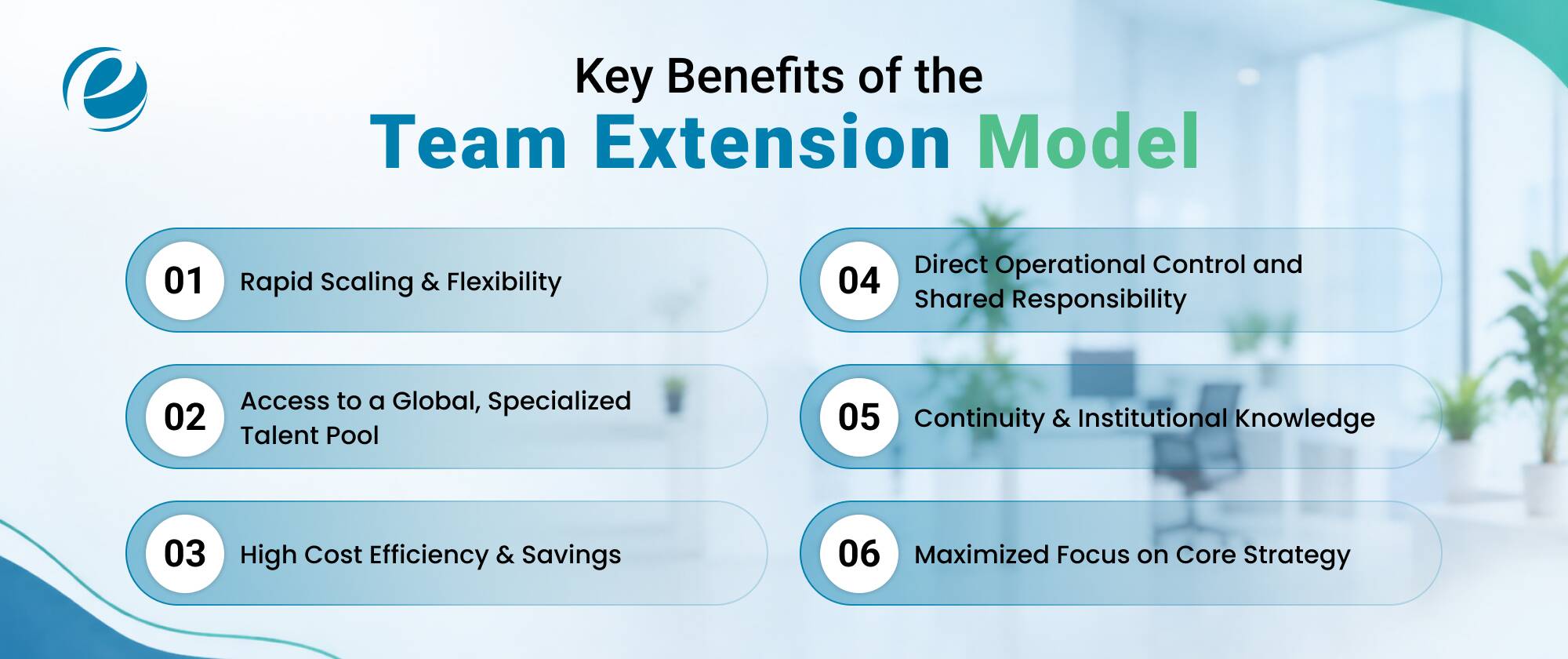
The primary benefits of implementing a team extension model include:
1. Rapid Scaling & Flexibility
Traditional recruitment can take months, and delaying the timelines of critical project. The team extension services allows you to onboard skilled professionals within weeks, that keeps fast-moving projects on track. It also offers the flexibility to scale the team up or down quickly as workloads fluctuate or even when seasonal demands shift, and this will help in avoiding financial burden of layoffs. The global IT service market is projected to surpass $1.83 trillion by 2030 which reflects just how widely businesses are adopting this model to stay competitive.
2. Access to a Global, Specialized Talent Pool
Hiring locally can be slow, expensive and limited by geographical constraints. The software team extension allows you to tap into a global network of developers, QA engineers and UI/UX designers with highly specific or rare skill sets such as SaaS, fintech, built-in software or cloud architecture and that too without the friction of traditional international recruitment.
3. High Cost Efficiency & Savings
Building an in-house team requires significant overhead, including salaries, recruitment fees, office space, legal onboarding and specialized equipment. Making use of an offshore or onshore development team extension allows you to achieve up to 50% cost savings compared to traditional full-time hiring while maintaining the exact same level of expertise and quality.
4. Direct Operational Control and Shared Responsibility
Because the external professionals blend entirely into your workflow, your internal managers maintain the full control over task assignment, priorities and performance monitoring. Outsourcing IT team extension
5. Continuity & Institutional Knowledge
While freelance models are transactional, software team extension promotes stable, and promotes long-term collaboration. External engineers can work alongside your staff for months or even years. This advanced integration helps keep your organizational knowledge within your workflow rather than losing it when a project milestone is completed.
6. Maximized Focus on Core Strategy
By offloading the administrative complexities of recruitment, and routine development to an expert, you reduce burnout for your in-house team. You can instead strictly focus on high-level strategic priorities, such as product vision, market expansion and customer relationship management.
When Should You Use Team Extension Model?
You should use the team extension model when you want to add working capacity or specialized technical skills to your workforce while maintaining total management control over your architecture, product development and workflows.
Here are some specific scenarios when you should choose this model:
- When you have strong internal (in-house) technical leadership where you must direct the daily work of the external engineers, such as engineering managers, CTOs or product owners.
- You focus on long-term, ongoing product engineering. Unlike short-term staff augmentation, you need long-term engineers to scale a continuous product roadmap and learn your complex codebase.
- When local hiring delays your roadmap, and you need to onboard vetted tech talent in 2 to 4 weeks rather than waiting months to recruit local full-time staff.
- Your project requires niche or rare technical expertise. You want access to specialized skills such as DevSecOps specialists or legacy system experts or you need to hire mobile app developers for a new iOS/Android platform, which eliminates the need to pay a permanent, premium salary for a skill you may not need for a long time.
- You require flexible, resizable development capacity. You want the ability to scale down your engineering team easily when a major phase ends, avoiding internal layoffs or severance costs.
Common Challenges of Software Team Extension Model (and How to Avoid Them)
The team extension model is a powerful way to expand your teams quickly, but it comes with distinct operational friction points. Below are the most common challenges you can face when using a software team extension model and how to avoid them.
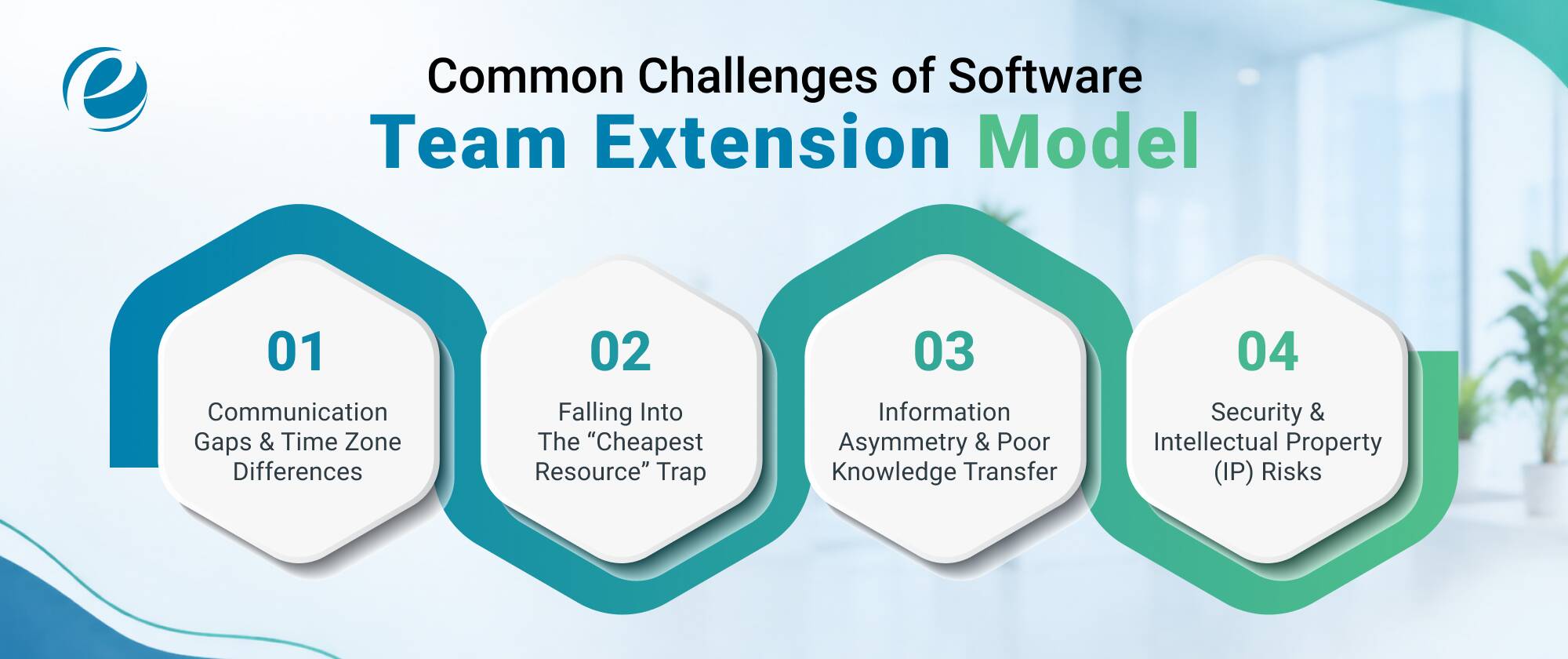
1. Communication Gaps & Time Zone Differences
Distributed teams often suffer from delayed responses, inconsistent communication and cultural misunderstandings that delay development team extension.
How to avoid: You can set up a shared digital workspace (ex. Jira, Slack or Teams), with strict communication protocols. Schedule a 2 to 3 hour daily overlap window for live syncs, standups, & unblocking critical tasks. You can often pair this internal structure with external software development services to guarantee reliable delivery pipelines across regions.
2. Falling Into The “Cheapest Resource” Trap
When you prioritize a vendor solely because of low hourly rates, this will often backfire and results in technical debt, cultural friction or poor code quality that costs more to fix later.
How to avoid: You must focus on long-term value & cultural fit rather than a short-term cost savings and evaluate your partner’s technical track record, industry experience, and recruitment vetting standards.
3. Haphazard Onboarding & Backlog Shortages
When you onboard external developers before you establish technical strategies and timelines or task backlogs you waste your money on unutilized engineering time.
How to avoid: Plan your development cycles before anyone logs on and assign a dedicated manager to assist during the initial 2 to 4 week onboarding window. Keep your product backlog stocked at least one full sprint ahead so external developers will never run dry.
4. Information Asymmetry & Poor Knowledge Transfer
The extended developers are frequently left out of critical product discussions that will lead to a lack of context, misaligned priorities and subpar code architecture.
How to avoid: You should treat extended developers, like internal staff. Maintain a centralized, up to date documentation database like Notion or Confluence. Assign an internal tech lead to own the onboarding process, and act as a dedicated knowledge connection. If your internal leadership lacks the capacity to guide this integration process, you can hire fractional CTOs to control the architecture, and align both teams.
5. Security & Intellectual Property (IP) Risks
Bringing external talent into your codebase, internal documentation tools and cloud infrastructure that naturally introduces compliance and data security risks.
How to avoid: You must use a strict role-based access controls (RBAC) so external engineers only see the systems they need. Make sure that everyone signs non-disclosure agreements (NDAs), and mandate adherence to global security frameworks, like GDPR or ISO standards through your vendor contract.
Why Should You Choose Emizentech as Your Team Extension Partner?
Finding a vendor who can deliver quality engineers quickly is one thing, but finding one who becomes a true extension of your team is another.
Emizentech has spent 12+ years helping product teams across the US, UK, and beyond without sacrificing quality or control. Whether you need to hire ecommerce developers to strengthen a high-traffic retail platform or hire web developers for a complex SaaS product, we provide pre-vetted engineers who integrate into your workflow within two to four weeks.
What sets us apart is our end-to-end accountability; we handle recruiting, payroll, HR and hardware, so your internal leads can stay focused on architecture, and delivery rather than administrative overhead. Our team does not just fill seats; they actively contribute to sprint goals, code reviews and long-term product thinking.
Emizentech holds a strong 4.9 rating on Clutch, a trusted B2B review platform, which reflects consistent client satisfaction across 30+ industries. If you want a development team extension partner who shows up prepared, and stays aligned, we have built our dedicated team to be exactly that.
Conclusion
The team extension model works best when you already have strong internal leadership and need skilled engineers who can plug in fast without disrupting your existing workflow. It gives you the flexibility to quickly scale, access of globally specialized talents and keep full control over your product direction all without the long-term overhead of permanent hiring. If your roadmap is growing faster than your team, this model gives you a practical, cost-effective path forward.
FAQs
Is team extension the same as staff augmentation?
Yes, both terms describe the same core model, bringing external developers into your in-house/internal team on a temporary basis. Team extension is simply the more modern, integration-focused term used across the industry today.
How is team extension different from outsourcing?
With team extension, you manage the developers directly and they work inside your workflow. With outsourcing, a vendor manages delivery independently and you receive the finished output with minimal day to day involvement.
How long does it take to onboard an extended team?
Most vendors, including Emizentech, can source, and onboard vetted engineers within two to four weeks, significantly faster than a traditional full-time hiring cycle, which often runs three to six months.
How much does a team extension model cost?
Costs vary based on skill level, location and engagement length, but businesses typically save up to 50% compared to full-time local hiring once you factor out salaries, benefits, and recruitment fees.



 +1 (989) 535-9295
 info@emizentech.com
 emizentech


