 Add us as a preferred source on Google
 Do you know about one-half of the world’s population works in agriculture? It is a major sector that is undergoing a transformative shift due to technological advancement
As our population continues to grow, food scarcity is becoming one of the biggest challenges we face. Fortunately, agritech startups came as a savior.
Farmers are slowly learning and adopting new technological solutions, such as Agritech mobile apps, that help them increase production while maintaining plant life in less time and at a lower cost.
Moreover, farmers can monitor their crops and get weather updates all in one place. If you are someone who wants to build an agritech mobile app, this blog will guide you through the entire agritech mobile app development process. So, without any further delay, let’s dive right into it!
What is the Agritech mobile app?
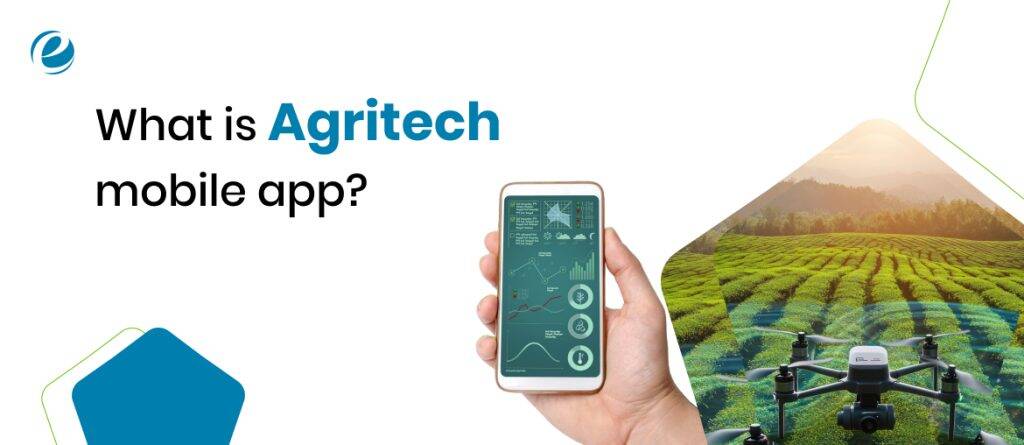
The agritech mobile app is a tool for seamlessly managing and improving agricultural processes. By leveraging the latest technology, these apps help farmers monitor their yields and provide information about soil and weather.
Additionally, with Agritech applications, farmers can connect with experts and seek guidance and recommendations. In this way, they can maintain healthy plants with less effort and time.
From weather to soil information, everything comes in handy with Agritech mobile apps. Therefore, agricultural app development not only saves resources but also increases crop production and reduces labor costs.
The agritech mobile app consists of several features, such as:
- Weather analysis
- GPS tracking and location-based services
- Crops and agriculture good listings
- Push notifications
- Management Scheduling
- Payment gateway integration
- Drone technology integration.
Now that we know, agriculture apps are quite useful for farmers. They help them optimize their resources and get real-time updates, helping them manage their overall farming operations. But the main question that comes here is, “How do they work?”
- First, they collect data about soil and weather conditions and crop management. Then, the collected data will be analyzed, and recommendations will be provided about when to plant, fertilize, plant, and harvest their crops.
- According to that, farmers can optimize their resources and make informed decisions.
- With real-time monitoring features, farmers can monitor their fields anytime, anywhere.
- The app lets farmers connect with other farmers or agriculture experts to learn about the latest trends and improve their practices.
Benefits of Agritech mobile app development
Agritech app development has become a necessity for farmers as it possesses multiple benefits, which we will discuss down below:
Canny efficiency: Agritech apps automate agriculture practices, saving time, energy, and money by reducing manual labor.
Market connectivity: These apps provide farmers with the latest updates on market trends, connect them with experts & suggest the best time to trade.
Timely intervention: By leveraging AI in agriculture, farmers can receive real-time updates, access farms remotely, monitor animal activities, and make informed decisions.
Resource utilization: The agri mobile app informs farmers about the resources needed for their farms and tells them where fertilizers and pesticides are needed, reducing resource wastage.
Sustainable monitoring: The agriculture mobile apps analyze farm historical data and provide recommendations on how they can improve their farming and adopt sustainable practices.
Types of Agritech mobile app
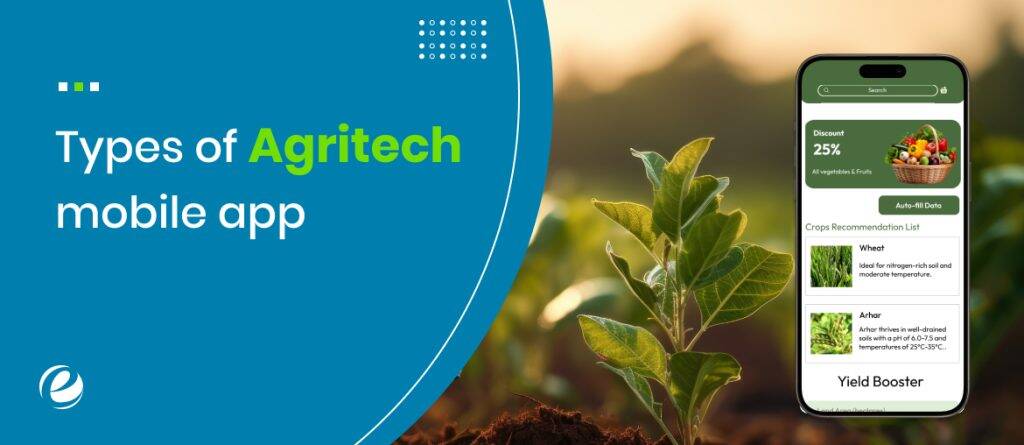
There are several types of agritech apps, ranging from crop monitoring to livestock management. If you are planning to invest in agricultural mobile app development, first understand their types.
1. Farm Management Apps
Farm management apps are the backbone of agriculture practices. With these apps, farmers can manage their daily activities, such as crop monitoring, crop production tracking, expense management, and stock-keeping.
2. Market Linkage Platforms
These types of apps connect producers, farmers, and consumers with markets to provide market information and facilitate trade. They can also help farming businesses and organizations connect with new markets.
3. Weather and Climate Apps
Weather and climate apps are specifically designed to predict weather or check climatic conditions. They provide real-time information about weather conditions and suggest the best time for farmers to sow crops and harvest.
4. Precision Agriculture Apps
These apps use the latest technologies to help farmers manage and monitor their crops. From weather prediction to soil and crop growth, farmers can use this data to make informed decisions about when to irrigate, fertilize, and harvest.
5. Supply Chain and Logistics Apps
These apps optimize supply chain processes, provide inventory insights, optimize routes, and suggest the best routes for shipments. They also automate manual tasks, streamline processes, allow communication with other stakeholders in the supply chain, and track shipments.
6. Agronomic Advisory Apps
Agronomic advisory apps provide farmers with crop-specific advice and help them to improve their farming practices. It also provides them with real-time prices for commodities and provides weather updates, along with two-way communication.
7. Financial and Insurance Apps
These apps provide farmers with financial advisory and insurance needs. With financial apps and investment apps, farmers can easily manage their finances, such as expense tracking, insurance, and lending, all in one place.
Why invest in Agriculture mobile app development?
Technology has replaced traditional farming practices and introduced agriculture mobile app solutions that make farming easier than before. When we look at the total global market size for agriculture technology, it is projected to exceed three billion U.S. dollars by 2025.
The major contributing factors behind this market growth are” how food is produced,” the increase in sustainable farming practices, and the increased adoption of mobile apps.
The global Agtech market is on the rise. By 2034, it will surpass $74 billion.
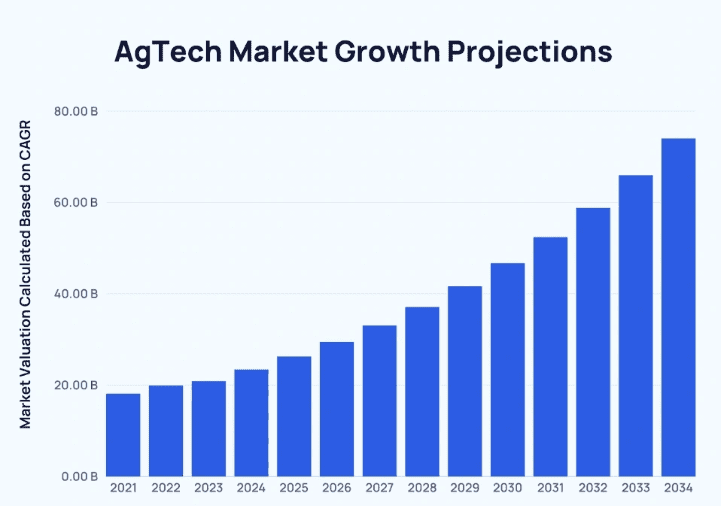
The changing consumer demands and technological innovation are opening new opportunities for entrepreneurs to invest in this particular segment. North America is said to be the fastest-growing country from 2024 to 2032, with a CAGR of 13%.
These Agritech apps help farmers increase yields and profit. Overall, the main objective of these apps is to increase production with less time and resources.
Investing in agritech app development services will be beneficial for you if you are interested in agricultural practices or the farming industry. With this being said, it’s time to explore the essential features of agriculture mobile apps.
Essential features of the Agriculture mobile app
There are essential features you must include to build a successful Agritech mobile app; we have created a list to take a look at.
| Feature | Description |
| Crop Management | This is an essential feature that provides tools for tracking crop growth, health, and yield predictions. |
| Weather Forecasting | With this feature, farmers can get real-time weather updates and forecasts to aid in planning and decision-making. |
| Market Access | With this feature, farmers can easily connect with buyers and markets to sell produce. |
| In-app support | Chatbot integration will help farmers get the latest updates about farming and solve their queries quickly. |
| Drone synchronization | This will allow farmers to look at the aerial view of their farm that needs attention. They can also control it remotely with a mobile app where they need to spray pesticides & fertilization. |
| Machine vision | Machine vision helps farmers analyze crop images and fields, helping them make decisions about planting and harvesting. |
| Payment gateway | Payment gateway integration is not much needed in farming apps, but when it is quite essential for ecommerce farming applications. |
| Pest and Disease Alerts | Farmers get easily notified about potential pest infestations or plant diseases. |
| Soil Analysis | With this feature, farmers get tools for analyzing soil health and making recommendations for improvement. |
| Irrigation Management | This feature monitors and manages irrigation schedules and water usage, reducing resource wastage. |
| Financial Management | This will provide budgeting tools for expense tracking and easy access to financial resources. |
| Community Forum | Community forums enable farmers to share experiences, advice, and best practices and connect with experts. |
| Educational Resources | With this feature, users can access articles, videos, and tutorials on best farming practices. |
| Supply Chain Tracking | This feature is essential for monitoring the supply chain from farm to market. |
Step-by-step process of Agritech app development
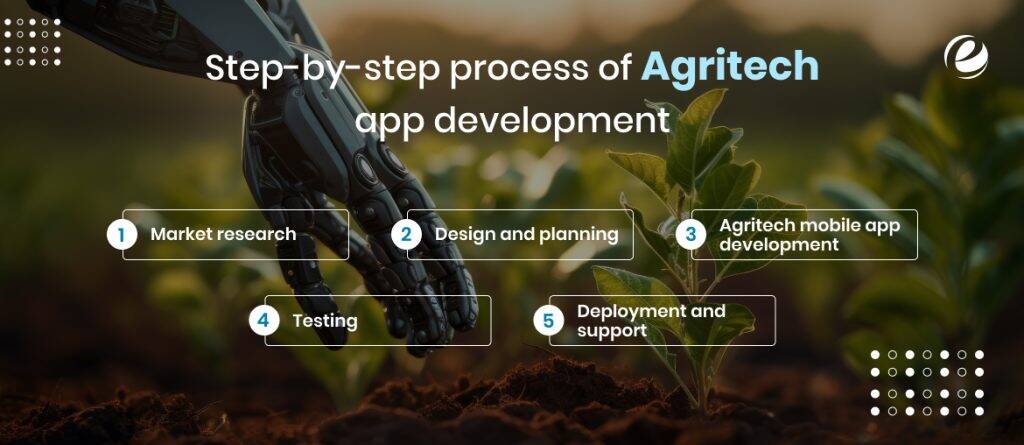
To start the Agritech development, you need a strategic plan and an experienced development company that understands your vision and works accordingly.
Let’s explore the step-by-step mobile app development process for the Agritech app.
#Step 1: Market research
Market research is an essential step in Agritech mobile app development. You need to conduct research about the latest trends in the agriculture industry, competitors, and user wants and needs. After gathering all the necessary information, analyze it and create a blueprint of what you want to achieve with this project, as well as features and budget.
#Step 2: Design and planning
Once you have decided on your app’s objectives, it’s time to start UI/UX design. Proceed with the app’s architecture feature and create a visually appealing interface that is easy to navigate. Creating mockups and wireframes helps you a lot. To create wireframes, read this guide on How to create wireframes for mobile apps.
#Step 3: Agritech mobile app development
With design in place, software developers write code for the app and give functionality to the design elements by using programming languages and frameworks. Developers will work closely with the design team to ensure that the app not only looks aesthetic but also operates seamlessly.
#Step 4: Testing
In this stage, a team of QA will perform various testing on the Agritech mobile app, such as functional, performance, compatibility, and security testing to find bugs and errors. If they find any, they will resolve it immediately, making the app ready for launch.
#Step 5: Deployment and support
After ensuring the app fully meets the needs, it’s time to deploy it. If necessary, the app company will train the client to use the app. Technical support and maintenance will also help address issues and increase the app’s longevity.
How much does it cost to build an agriculture app?
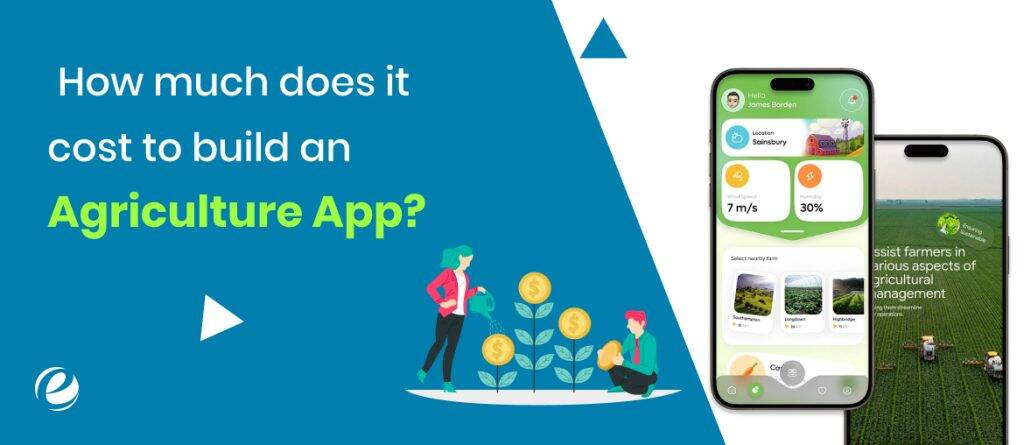
The cost of developing an agriculture mobile app ranges from $10,000 to $300,000, depending on various factors such as the app’s complexity, the technology used, the developer’s location, features, and functionality.
As we have discussed, the cost is defined by various factors, so there is no accurate cost to develop an Agritech app. For basic agritech mobile app development, the cost ranges from $10,000 to $50,000.
The cost of a moderate app with features such as monitoring crop and livestock management increases from $50,000 to $150,000. For advanced tech integration like drone synchronization, AI recommends increasing the cost to $300,000 or more.
However, the cost may vary from client to client, so the final cost depends on the client’s requirements. If you have any queries, feel free to connect with us and get the best quote for your project.
Develop Agritech app with EmizenTech
If you are looking to build an Agritech app, EmizenTech is a prominent mobile app development company that specializes in building Agritech mobile apps. Apart from mobile apps, we specialize in building software solutions for the agriculture industry as well as for various domains.
These apps can help farmers manage their crops, track weather patterns, and streamline their overall operation. Speaking of best, we can build custom mobile apps that meet your specific needs in the agriculture sector.
We understand the major challenges of the agriculture industry, so you don’t have to worry about the latest trends and market fluctuations. Using advanced tech, we create scalable, user-friendly apps that are easy to navigate and grow with your business.
Partner with us and develop the next Agritech app that solves agricultural challenges and helps increase yield production.
Key takeaways
- Agritech mobile apps are designed to streamline agricultural practices through technology.
- These apps have several benefits, such as improving yield production, resource utilization, and sustainable monitoring.
- Precision agriculture apps, supply chain and logistics apps, and financial and insurance apps are some of the types of Agritech apps.
- The cost of Agritech app development will range from $10,000 to $300,000 or more depending on various factors such as complexity, chosen tech, and developer’s location.
FAQ’s
What are the major challenges of the Agritech mobile app?
Some of the major challenges of Agritech mobile apps are connectivity issues, user adoption, data accuracy, and regulatory compliance.
What technology is used in the Agritech mobile app?
Cloud Computing: For data storage and processing.
IoT Devices: For real-time monitoring of crops and livestock.
AI & Machine Learning: For predictive analytics and recommendations.
How is the Agritech mobile app helpful for farmers?
Agritech mobile apps have plenty of benefits, such as:
Access to Information: Provides weather updates, market prices, and farming tips.
Resource Management: Helps in efficient use of water, fertilizers, and pesticides.
Financial Services: Offers access to loans and insurance.
Community Building: Connects farmers with peers and experts.
What are some popular Agritech apps?
Some of the popular Agritech mobile apps are FarmLogs, AgriApp, CropIn, and Kisan Network.




 +1 (989) 535-9295
 info@emizentech.com
 emizentech


