
 Add us as a preferred source on Google
 Maintaining an excellent customer experience isn’t a choice that businesses make; it is rather a recipe for long-term success that they should master. However, keeping pace with the market right and going is anything but a cakewalk, given that it is always buzzing with headline-making competitors, game-changing trends, and ever-evolving customer expectations. That’s where AI customer service agents are helping brands worldwide walk the space seamlessly and quite efficiently. In fact, 72% of the CX experts already call AI agents the extension of their brand’s identity.
The emergence of artificial intelligence technologies is visible to all, but the question is why and how you would leverage this to elevate customer engagement. Let’s discuss everything about the importance of an AI agent in customer service and how to implement it.
What is a Customer Service Agent and How Does It Work?

Visible on quite a lot of platforms nowadays, an AI customer service agent is the advanced version of customer support representatives. They are smarter, faster, and most importantly, available around the clock. They are not the same old bots sending away the scripted replies, but rather intelligent systems powered by artificial intelligence technologies (read: machine learning, natural language processing, and deep learning).
These AI-enabled agents are designed to read, understand, and respond to the queries raised by humans. The main purpose of deploying an AI agent in customer service is to attend to and manage a diverse range of queries. This means answering a fundamental question, addressing a complaint, providing resolutions, recommending products/services, and processing refunds.
That’s not all, these AI customer service agents, while they are not humans, can understand the emotion, intention, and context behind every interaction. They are capable of generating replies that are just as intuitive, contextual, and on-point as the ones written by humans. And the fact that they can do all of this without human intervention is what makes them one of the fundamental evolutions in the customer service world.
5 Ways AI is Setting New Benchmarks for Customer Support
We didn’t even realize that an AI agent in customer service accelerated the pace at which we would interact with a brand. A Zendesk report finds that 51% of consumers prefer talking to AI agents over human agents to get faster service. From being available all the time to slashing wait times like it’s magic, here’s how AI customer service agents are making things easier for both customers and brands:
Service that Never Sleeps
There was a time when customers were wired to wait for the clock to strike 9 in the morning to talk to a customer service representative. They would even wait 10-20 minutes more in the queue to finally share their query. Then AI customer service agents entered the scene, and things changed for the better.
Customers can reach out to a brand early in the morning or late at night, on weekdays or weekends, and can get their concerns addressed right away. These systems are designed and trained to manage hundreds of queries simultaneously. Unlike humans, they don’t feel fatigued or miss the beat under pressure. Integrated mainly with social media channels, CRMs, and e-commerce websites, they can help customers with password resetting, order tracking and cancellation, refunds, and more.
Smarter Escalations
So far, we’ve read how customer service AI agents can take over interactions effortlessly, all alone. But that doesn’t totally negate the importance of having human resources involved. It’s because not all queries are exact, and not all customers want to talk to bots. While automation is a blessing, an AI agent is still trained to hand off an interaction to a human when required. Here’s what usually happens:
- They sense frustration in customer interactions using sentiment analysis.
- They identify the hyper-technical, complex, and sensitive cases.
- They instantly transfer the chat to human representatives, with context and communication history intact.
The hybrid setup keeps the workflow balanced, wherein AI agents take care of basic, repetitive queries and humans handle the complex ones.
Hyper-Personalized Replies
One of the key aspects of an AI agent in customer service is that it gives every interaction a personal touch. And this has raised the bar for a good customer experience level. The AI models analyze and interpret customer behaviour on various touchpoints, like searching, purchasing, and previous interactions. That’s not all, they even analyze the location and the devices to tailor experiences for every customer.
AI agents identify different customer segments, offer personalized discounts and recommendations, and send alerts about events that are relevant to them. This sets up for proactive communication and leads to customer engagement. Not to mention, personalization is the new normal now.
Predictive Approach
Customer representatives no longer have to wait for a customer to flag an issue to start a conversation; with customer service AI agents, support just got an upgrade. These systems are designed to detect the red flag and prevent the issue before it worsens.
Here are some examples of how AI customer service agents prevent escalations:
- They alert customers about low account balances
- They flag suspicious transactions
- They suggest troubleshooting
And how are they able to manage this? They analyze operational data and customer behavioral patterns to save time and energy.
Constantly Getting Better
While AI agents are trained to tackle interactions the way a human would, they also keep learning and evolving with every interaction. From sharper responses to better phrasing to more intelligent recommendations, they keep getting better at everything. And over time, brands can expect AI agents in customer service to get well-versed with product knowledge, fluent in brand tone, and understanding of various layers of human interactions.
Examples of AI Agents Across Industries: Top Use Cases
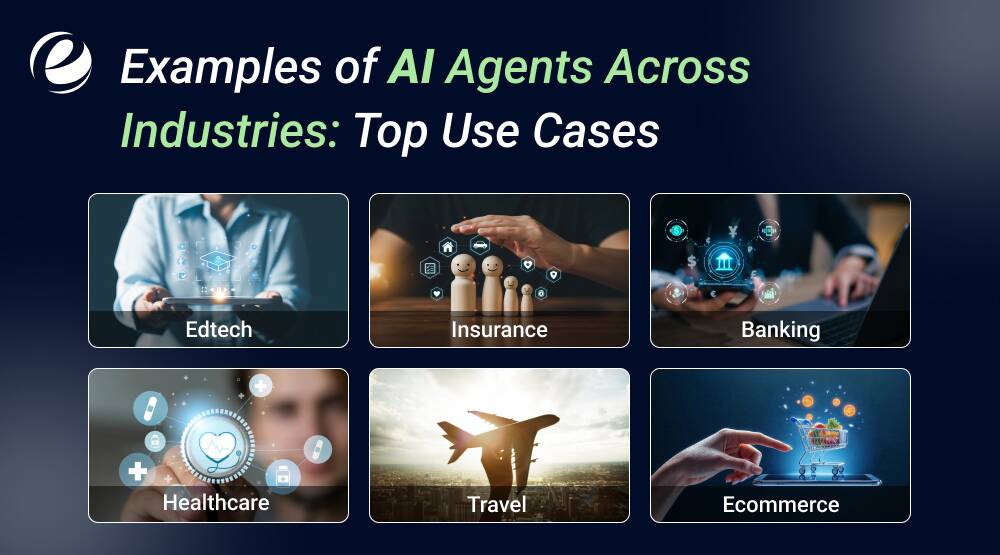
The thing about AI customer support agents is that they can fit into a lot of situations, platforms, and industries. From telling customers the status of their order to helping them schedule an appointment with a doctor, an AI agent in customer service is capable of managing various tasks across sectors. Below is a roundup of the top use cases.
Ecommerce
One of the most common examples of AI agents is the ecommerce and retail industry, where 80% of the businesses are either using AI chatbots or planning to do so soon. Firms in this sector benefit from AI systems to automate a range of tasks, including order tracking, personalized product recommendations, order cancellations, returns, and refunds. They can lend a hand to businesses in reducing the cart abandonment rate and increasing the retention rate.
Travel
A customer wants to modify their itinerary? Or do they want to book a hotel quickly? Consider it all done without any human intervention, with AI. In a study, 70% of customers find AI agents handy for booking flights, and 65% for booking stays at hotels and resorts. The leverage of AI agents in travel and hospitality can solve the challenges businesses face in terms of customer engagement, satisfaction, and employee productivity.
Healthcare
A study highlights that AI agents can lower the workload on healthcare providers by reducing 30% of administrative tasks. They help hospitals, healthtech startups, and of course, clinics streamline processes by taking up routine tasks like appointment scheduling, general queries, etc.
Banking
80% of the banks and financial institutions see AI agents as tools with the potential to recognize and combat potential threats. They also find that these systems can gain valuable insights into investments and enhance experience. The AI bots help banks manage queries related to balance checks, transactions, loan processing, accounts, and more. They can significantly reduce both operational costs and wait times.
Insurance
From speeding to claims processing to enhancing fraud detection, there are many reasons why insurance firms are rapidly shifting to automated customer service models. In a survey, 77% of the insurance companies stated that they are somewhere in the process of implementing AI agents. And this can simplify the experience for both customers and human agents.
Edtech
With AI customer service agents working on the floor, educators and edtech leaders can simplify the way interactions with students and parents are handled. From assisting with course information to sharing exam schedules, AI can seamlessly answer these types of queries. A report highlights that 83% of administrators are willing to adopt AI agents to help them with their work. Doing this is specifically beneficial during high-traffic seasons, like exams and admissions.

How to Develop an AI Agent in Customer Service: 7 Key Steps
AI customer service agent development is more than just about deciding on a plan and deploying a chatbot, with a set of canned replies it. Almost half of the businesses worldwide have chatbots handling routine customer interactions and you must decide how yours is going to solve the problem.
From ideation to deployment to more, here are the key steps involved in the process of building an AI agent for customer service.
Lay Out the Scope
A successful AI agent in customer service has a set foundation in role and use case. While you discuss tech stack and hire the best web and mobile app development company out there, the primary focus remains on defining the aspects of the project below:
- What are the core problems you are planning to solve with the help of customer service AI agents? Is this ticket volume? Or is this about reducing wait times? Or perhaps, just scalability?
- To what scale do you plan to leverage AI-powered capabilities to handle customer service tasks?
- What are the tasks that you’d like an AI system to manage?
Once you have gained clarity on such questions, you will already have half of the roadmap to a successful deployment set. The more precise the answers, the better your decision-making will be about integrations, budget, technology, and other such factors.
Design Data Flow
With different backend systems in the works, you can ensure that your AI agent is up to the game. To do that, integrate it with different systems to process, deliver, and retrieve data. Depending on your organizational workflows and technology infrastructure, this may mean integrations with:
- Order and ticketing platforms
- Company knowledge bases
- Inventory and logistics databases
- Customer Relationship Management
And more such platforms and processes. These integrations can be game-changing for the way your customer service operations work, making various tasks seamlessly manageable.
Choose Tech Stack
AI and NLP technologies are the lifeline of your AI agent, and thus, the tech stack has to be such that it accommodates its functionality, especially accuracy and contextual value. The system should be capable of understanding user intent and behavior, learning and adapting to different use cases. In order to streamline the workflow even more, you must choose the tech stack that aligns with the existing tools in your organization.
Create Conversational Flow
Here’s one of the most critical steps in the process of building customer support AI agents: Creating the interaction logic. At this stage, your team must define different aspects of customer interactions, including entities, user goals, and dialogues.
The goal of this phase is to ensure that your AI agent is capable of providing an accurate answer to every question, handling multi-turn situations, understanding variations, handling interruptions, tackling context switching, and more.
Design extensive user intent and fallback mechanisms to prepare the AI models to interact accurately with customers even when the query seems ambiguous or goes off topic. After all, that’s what will set it apart from the conventional scripted bots.
Train with Data
In order for it to be as functional as humans, the customer service AI agent needs to be trained by humans. From support tickets and help desk manuals to chat/call transcripts and logs, every nook and corner of information needs to be fed to the AI models. Ensure they learn everything under complete supervision. Gather user feedback, use error logs, and keep fine-tuning the overall performance. Note, this isn’t just a stage but a continuous process crucial for expanding the domain knowledge of the agent.
Test Before Final Launch
The testing phase is yet another non-negotiable stage in the development process where you ensure that your AI agent is actually ready to hit live. The quality assurance team runs a complete check on the AI agent, and the process typically involves:
- Load testing for concurrent interactions
- Sentiment analysis evaluation
- Test scripts for flows and accuracy
- Semantic accuracy
- Security and compliance check
- Performance across different channels
This stage is where you must validate the credibility, accuracy, and overall functionality of the AI agent.
Track and Optimize Performance
Now that the process has come to the wrap-up, this final step is the continuous phase that involves monitoring the system every step of the way. In order to make this work, use issue resolution rate, first-response rate, handoff rate, customer satisfaction scores, and other such vital metrics to understand how an AI agent is helping you. This process is also critical for training and optimizing the system to adapt to market changes, customer behavior trends, and updates in products and services.
Why Should Businesses Embrace AI Customer Support Agents?
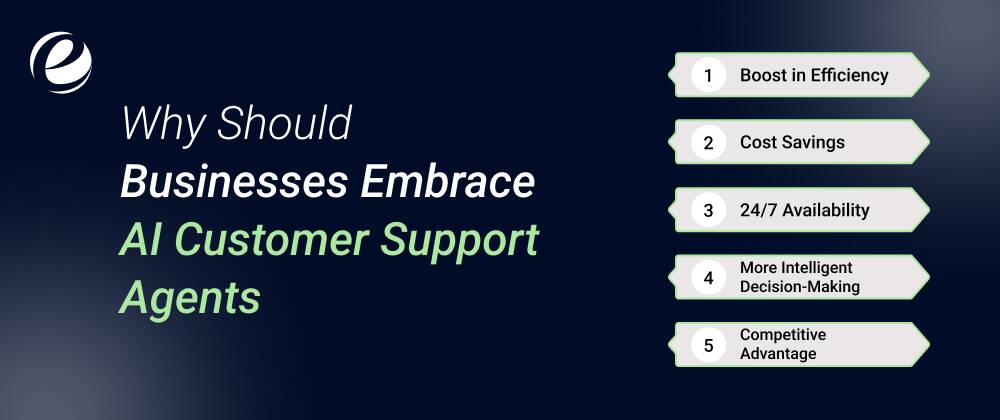
From productivity to cost savings, there are several perks of implementing AI agents in web and mobile app development. Let’s briefly discuss them.
Boost in Efficiency
At the end of the day, AI customer service agents are all about automation, a powerful force that can drive peak productivity. AI-powered customer service agents manage hundreds of queries simultaneously across channels, reducing the need for human agents to attend interactions. As a result, humans save a reasonable amount of time to carry out complex tasks, instead of getting overwhelmed and feeling burned out.
Cost Savings
Yes, it can be a costly deal to implement AI chatbots at first, but here’s the good part: These automated systems end up saving you a significant amount of money in the long run. Since they can handle a large number of queries and are available all the time, customer service AI agents reduce the need for businesses to hire human resources, especially during seasonal spikes. This alone minimizes the costs to a remarkable level.
24/7 Availability
75% of customers expect brands to be available 24/7. While it may not be feasible or budget-friendly to employ a team of human agents to do this, an AI agent in customer service definitely solves the problem. By implementing these systems, businesses can rest assured about the availability to check up on every customer query and provide instant support. This is also great for brands with global reach.
More Intelligent Decision-Making
While AI customer service agents themselves are trained on data, it’s valuable data they give in return. And the numbers can transform the way you think, decide, and plan. By analyzing interaction data on a deeper level, AI systems fetch valuable insights on what’s working and what needs tweaks. This can help you catch up on the performance of scripts, personalization strategies, marketing campaigns, customer pain points, and whatnot. And it all boils down to you making decisions number-by-number, not merely on assumptions or instincts.
Competitive Advantage
Well, it is one of the most apparent benefits of AI customer service agents. The earlier you adopt this revolution, the higher the chances of your brand taking the lead. Given the crowded space out there, customers tend towards brands that offer faster, on-point, and consistent service. And you can do this easily by building a solution of your own, unlocking doors to more customer engagement, delightful experiences, and retention.
What’s Next with AI in Customer Support: 5 Major Trends
AI for the customer service market is forecast to reach from $12.06 billion in 2024 to $47.82 billion by 2030. With the customer service scene already evolving into something completely new, it is exciting to watch what the future of AI in customer support will cook up next. And when you are planning to build an AI chatbot, understanding this becomes even more critical.
On that note, here’s a roundup of the future trends in AI customer service that are set to amp up interactions between customers and brands.
Advanced Personalization
The focus on context-aware and personalized communication will grow even stronger. AI customer service agents are expected to use behavioral patterns, historical customer data, and sentiment analysis even more aggressively to craft unique responses relevant to the customer’s personal requirements/query.
Autonomous Resolutions
AI agents in customer support save a good deal of time by taking care of repetitive queries. In the future, the same system will be handling even more complex interactions, without taking a hand from human agents. A Gartner report predicts that AI autonomous agents will resolve 80% of common queries without any human intervention by 2029. It is expected to manage the process on an end-to-end level, encompassing identification to refund processing and more.
Cross-Platform Conversations
As an AI agent in customer service emerges as one of the core components of a brand’s customer support process, it will extend to a unified approach. This means a single agent handling chat, voice, social media, and email with ease, while maintaining consistency, accuracy, memory, and brand tone.
Ethical AI and Compliance
With all the benefits of AI customer service agents and the exciting future trends we read about, there is just as much stress on the ethical use of the technology. These systems are expected to be operating on a more stringent compliance, ensuring data integrity and transparency at all levels.
Why Partner with Emizentech to Build an AI Customer Service Agent?

Implementing an AI customer service agent does not mean that you have to plug in a chatbot. If anything, bots have evolved a lot more than ever before. From a deep understanding of customer intent to no-hassle Integrations, there’s a list of things that you want to ensure when accelerating customer service with automation.
At Emizentech, we help you supercharge your customer support operations with end-to-end AI development services. Whether you aim to enhance employee productivity, minimize operational costs while scaling, or provide 24/7/365 support, we help you accomplish all these goals by building a tailored AI agent for customer service. With a track record of deploying advanced AI chatbots across industries, our services include:
- Custom AI agent development
- NLP integrations
- Backend integrations with a diverse range of tools in the ecosystem
- Omnichannel deployment
- Training and fine-tuning
Whether you want to upgrade an existing bot or start from scratch, get in touch with us to take the next step towards an AI system that helps you scale smartly.
Wrapping Up!
The adoption of an AI agent in customer service is pretty evident. This is mainly because this model is deployed to tackle everyday work, instantly solving the problem hundreds of customers may be facing or answering generic questions. This in itself is a reason big enough for AI customer service agents to grow and become more prevalent. Whether you are a startup or an enterprise operating in retail, logistics, or any other sector, now is the time to adopt AI to convert your goals, like cost efficiency, productivity, or customer retention, into reality.
FAQs
How does AI help customer service?
AI improves customer engagement and experience by handling routine queries, speeding up resolutions, and providing around-the-clock support, while maintaining consistency and accuracy on multiple channels.
What is the future of AI in customer service?
Future AI trends in customer service include increased focus on predictive assistance, hyper-personalization, and autonomous responses. With aggressively growing AI adoption, ethical considerations will also be in the light.
How much will AI agents cost?
The cost of an AI customer service agent depends mainly on the extent to which you plan to implement it. While a basic solution may cost around $1,000 to $2,000 per month, building a custom AI support agent can cost several thousand dollars.
What are the benefits of AI as a service?
AI as a Service is focused on providing scalable, cost-effective AI capabilities without spending on extensive infrastructure. It ensures seamless integrations, fast deployment, and consistent maintenance.



 +1 (989) 535-9295
 info@emizentech.com
 emizentech


