
 Add us as a preferred source on Google
 Have your business or designers encountered traditional designing challenges like complexity, time constraints, and personalization? If yes, then you will get an ultimate resolution here.
Today, AI is not just a buzzword but a powerful tool that is transforming every industry, including creative design. AI holds the potential to transform and enhance creative design. And designers should be keen to explore its prospects.
| According to a recent report by Canva, around 75% of global marketing and creative leaders acknowledge AI as the most significant part of their design toolkit. Also, 69% of them witnessed improvement in their team’s creativity by leveraging AI. |
Artificial intelligence in creative design has the power to automate tasks, relieving designers of repetitive work and allowing them to focus on more creative aspects.
What are you waiting for? If you are a business owner looking to maximize AI in creative design to emerge with personalized designs for your diverse target audience, kickstart now!
This blog post will discuss how to harness the power of AI in creative design to emerge with personalized designs for your diverse target audience. Also, we will unveil the role of AI in creative design, benefits, use cases, the AI integration process, steps for AI creative design app development, and more.
Let’s get started!
What Is Artificial Intelligence (AI) In Creative Design?
Artificial intelligence (AI) in creative design is the application of innovative AI technologies that automate varied aspects of the creative process. It includes the usage of algorithms and machine learning models that analyze data, emerge with ideas, and provide creative outputs.
AI in creative design empowers designers by offering them new tools and capabilities. This empowerment allows them to work more efficiently, explore new creative horizons, and create more engaging and personalized experiences. This way, it instills a sense of power and confidence in their work.
AI And Human Creativity: Can AI Replace Human Designers?
Can AI replace human designers? Well, the topic can convert the discussion into a debate. But, we will put apt facts before you explain the entire scenario to you.
AI doubtlessly impacts creative fields. But it’s not designed to replace human designers. Alternatively, AI arrived as a robust tool that can boost human creativity and efficiency.
Let’s uncover the reasons behind:
1. Emotional Intelligence
Humans can understand and respond to emotions, but AI lacks them here.
On the contrary, designers can harness their emotional intelligence to craft designs that can bring out expected feelings and experiences.
2. Ethical Considerations
Human designers have the brainpower to supervise creative operations and ensure the follow-up of ethical and responsible design practices.
But, AI can be biased and may fail at this point.
3. Human Intuition and Judgment
Humans hold unique qualities, like empathy, intuition, and cultural understanding. Thus, human designers craft designs that align with requirements.
But AI fails here.
4. Contextual Understanding
Humans hold the caliber to understand historical, cultural, and social contexts. It’s essential for creating relevant and meaningful designs.
So, AI and human creativity complement each other. AI comes with innovative tools and abilities, while humans bring their power of judgment and unique qualities.
By working collaboratively, AI and human designers can craft more personalized, innovative, and impactful designs. It makes the audience feel valued and crucial to the design process.
How AI Is Changing The Creative Design Industry
Facts are okay, but the latest market figures will help you learn how AI is transforming the creative design industry.
Let’s get deeper to pull out exciting statistics about AI in creative design.
- According to a worldwide survey of creative professionals by Adobe, around 83% of creative professionals utilize generative AI for their designing jobs. Besides, 20% believe their customers or employers want them to opt for generative AI in their design work.
- In the art and culture sector, AI valuation will likely hit $750 million by 2026.
- The global generative AI in the creative industry market will increasingly be used and reach $1.2 billion by 20232 at a CAGR of around 28.6% between 2025 and 2032.
- According to Precedence Research, the size of global generative AI in the design market is predicted to boost and reach $7,754.83 million by 2032.
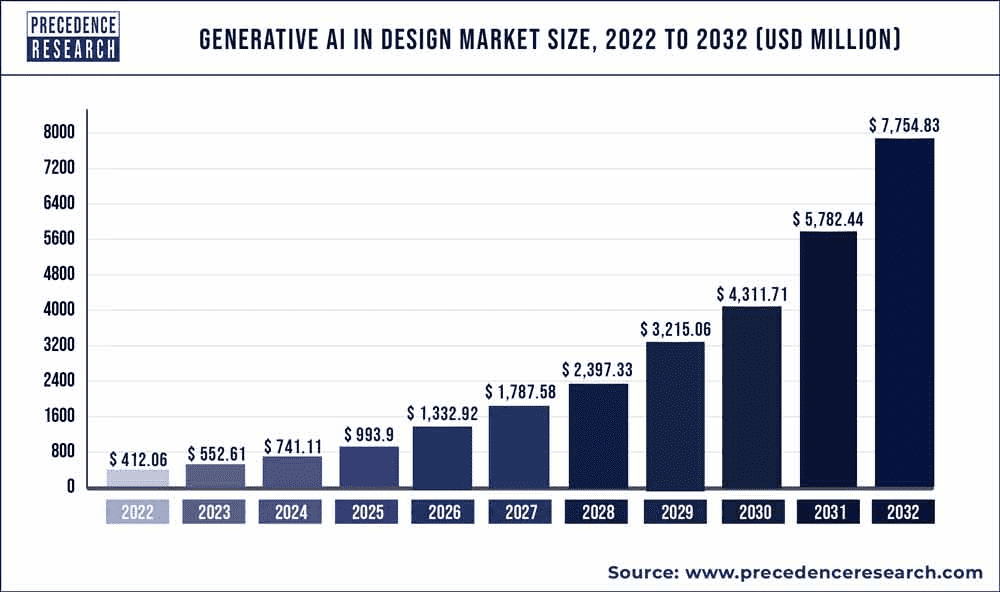
Considering getting deeper into market research, you will know AI is enhancing the creative industry and making it limitless, crossing the set pattern.
Top Benefits Of AI In Creative Design
AI in creative design arrives with numerous benefits that boost innovation, personalization, and efficiency.
Let’s check out the top advantages of integrating AI in creative design:
1. Improved Creativity and Innovation
AI surfaces with new concepts and ideas that designers should consider to elevate creativity and innovation. Also, AI algorithms analyze vast datasets to recognize the latest patterns and trends that can put forth unique design solutions.
2. Boosted Efficiency and Productivity
AI is best at automating time-consuming and repetitive jobs, freeing designers to aim at more creative and strategic aspects. This results in increased productivity and rapid turnaround time, letting designers attain tight deadlines and manage larger projects.
3. Personalized Design
AI holds the caliber to analyze user data to craft highly personalized designs that align with individual requirements and preferences. This customization level can improve customer loyalty and satisfaction.
4. Enhanced Consistency and Quality
AI ensures consistency across varied design elements, diminishing errors and enhancing overall quality. AI-enabled tools can also automate jobs, such as image optimization, color correction, and typography. It led to more professional and polished designs.
5. Improved accessibility and Inclusivity
AI can let designers craft designs that are more accessible to specially-abled people. By analyzing user feedback and data, AI holds the caliber to identify possible hindrances. Thus, it can suggest enhancements to make more inclusive designs.
AI’s benefits for creative designers help meet the evolving requirements of their audience.
Use Cases of AI in Creative Design
By integrating AI into creative design, AI offers innovative solutions for a broad range of apps.
Below are some use cases, let’s take a walkthrough:
1. Automated Graphic Generation
AI can automate the creation of graphic elements, like patterns, illustrations, and textures. Allowing designers easy access to a vast library of customizable assets.
2. AI-Powered Logo Design
AI algorithms can put forth various logo design options depending on specific criteria and preferences, saving designers effort and time while ensuring visually appealing and unique outcomes.
3. Data-Driven Design Personalization
AI holds the caliber to analyze user data to craft highly personalized designs, customizing elements, such as typography, color schemes, and imagery per individual preferences.
4. Generative Art Creation
AI can generate visually appealing and unique art pieces, usually examining abstract and experimental styles that human designers may find challenging to accomplish.
5. AI-Powered Image Editing
AI-enabled tools can smoothen image editing tasks, like improving colors, removing backgrounds, and restoring old images. This way, it delivers professional-quality outcomes with minimal effort.
6. Content-Aware Layout Design
AI can smartly arrange elements within a layout, ensuring alignment, optimal spacing, and visual hierarchy, proceeding to more user-friendly and pleasing designs.
7. AI-assisted UI/UX Prototyping
AI can facilitate designers in crafting interactive prototypes speedily and more efficiently, permitting early iteration and testing of user interfaces.
8. Virtual Fashion Styling
AI-enabled virtual fashion platform lets users try on outfits digitally, offering a personalized shopping experience and diminishing the need for physical fitting rooms.
With the constant evolution of AI technology, we can predict even more exciting and interactive applications.
A Step-by-Step Process To Integrate Artificial Intelligence (AI) In Creative Design
You can reap the benefits of AI in your creative design either by creating an AI-powered creative design mobile app from scratch or integrating AI into your existing design system.
By integrating AI into creative design processes, you can innovate more, enhance efficiency, and boost personalization.
Below is a sequential guide to assist you in successful AI implementation in creative design workflows:
1. Define Project Objectives and Scope
Precisely outline the objectives you want to attain with AI integration. Recognize specific edges where AI can append value, like new ideas generation, task automation, or design personalization.
Thus, you can define your project scope and ensure your efforts are lined up with your overall business goals.
2. Identify Suitable AI Tools and Technologies
Research and decide which available AI tools and technologies can meet your specific design requirements. Opt for factors like ease of use, cost, integration capabilities, and scalability. Pick the tools that match perfectly with your current design workflows and software.
3. Collect and Prepare Relevant Data
Accumulate varied and representative datasets that perfectly showcase your desirable design inputs and outputs. Ensure that data is consistent, clean, and well-structured to ease practical AI training.
4. Develop or Integrate AI Models
You can either create custom AI models from scratch or use available pre-trained models from AI platforms. Consider varied factors, such as your design tasks’ complexity and your team’s expertise, when making this decision.
5. Train the AI Models with Design Inputs
Offer the AI models with your design inputs, ensuring your training data is diverse and representative. The more data you offer, the better your AI models will learn and give out accurate outputs.
6. Validate and Test AI-generated Outputs
Evaluate the relevance and quality of the AI-generated outputs to confirm fulfilled design standards. Perform thorough testing to recognize any biases and limitations in the AI models.
7. Deploy the AI Solution in the Design Workflow
Integrate the AI solution into your current design workflows to attain smooth collaboration between designers and AI tools. Offer perfect training and clear guidelines to your team on how to maximize AI technology.
8. Monitor Performance and Continuously Improve
Track your AI solution’s performance and collect feedback from stakeholders and designers. Utilize this data to identify areas of improvement and accordingly adjust AI models and workflows.
By following these steps, you can seamlessly integrate AI into your creative design operations, driving new opportunities for innovation, personalized experiences, and efficiency.
Also Read: A Complete Guide To Generative AI App Development
Challenges To Face While Integrating AI In Creative Design System
There’s no rose without a thorn. Similarly, AI integration into a creative design system can unveil several challenges.
Some key areas to consider are:
1. Ensuring Creativity and Originality
As AI can raise new ideas, it’s essential to maintain human originality and creativity in the design process.
An equilibrium should be maintained between AI-generated suggestions and human intuition.
2. Managing Data Privacy and Security
AI depends on larger datasets, which can elevate concerns relevant to data security and privacy.
Implementation of robust measures can help to protect sensitive details.
3. Overcoming Resistance from Designers
Designers can occasionally resist the introduction of new technology. They might be hesitant to include changes.
Locating concerns and putting forth the AI benefits can help win this resistance.
4. Balancing Automation with Human Input
While AI can automate mundane and repetitive jobs, it’s essential to keep away from over-dependency on automation.
In critical areas, maintaining human input can help ensure the designs are aligned with cultural nuances and creative vision.
5. Handling Bias in AI Algorithms
AI algorithms can acquire biases present in your training data, resulting in discriminatory or biased outputs.
It’s crucial to address bias and ensure fairness in AI-generated designs.
6. Keeping Up with Rapid Technological Changes
AI is ever-evolving, with its new tools and technologies surfacing regularly. It’s essential to stay updated with the latest developments to use the comprehensive potential of AI in the creative process.
While AI provides significant advantages, integrating AI into creative design demands careful consideration and attention to potential challenges.
Future of AI In Creative Design In 2025 And Beyond
With the advancement in AI, its influence on creative design will increase.
Below, let’s discuss the exciting prospects of AI in the future.
1. Enhanced Collaboration Between AI and Designers
AI will become helpful for designers, offering them real-time suggestions, generating new ideas, and automating routine jobs.
2. Real-Time Design Personalization for Users
AI will allow designers to craft highly personalized user experiences, customizing designs per individual behaviors, preferences, and real-time contexts.
3. AI-Driven Augmented Reality (AR) and Virtual Reality (VR) Experiences
AI will be a crucial aspect in creating interactive and immersive AR and VR experiences. By analyzing user preferences and data, AI can personalize experiences to individual requirements, improving satisfaction and engagement.
4. Expansion of Generative Design Techniques
AI Generative design will become more sophisticated, facilitating designers to examine expanded design spaces and emerge with innovative solutions that may be impossible or difficult to attain through traditional methods.
5. Seamless Integration Across Design Tools and Platforms
AI-enabled tools will become more connected, facilitating seamless data sharing and collaboration between distinct design platforms. It will smoothen workflows and boost efficiency.
6. Emergence of Fully Autonomous Creative Systems
Fully autonomous creative systems can generate designs, write code, and also compose music with no human intervention.
The future of AI in creative design is promising and filled with numerous possibilities.
How Can EmizenTech Help To Build AI-Powered Applications For Creative Design?
EmizenTech, a leading AI development company, offers custom AI creative design app development services.
You can also reap the rewards of increasing the use of artificial intelligence in creative design by AI creative design app development.
EmizenTech has years of experience and a team of expert AI developers who have the caliber to build AI creative design mobile applications.
Key Highlights of Choosing EmizenTech
- Cutch Awarded
- Competitive Pricing
- Faster Time-to-Market
- Have a Portfolio of 50+ Successfully Developed AI Mobile App
- In-Budget and On-Time Delivery
- Team of Expert AI Developers
- Agile Development Approach, etc.
Conclusion
The creative software market valuation is anticipated to reach $9.39 billion by the end of this year. Also, you can predict an annual growth rate of around 1.77%, which will make market volume hit $10.25 billion by 2029.
The elevating AI implementation in creative design has created a new pathway for designers to generate new designs. From enhancing productivity and efficiency and personalizing designs to improving collaboration, AI technology can arrive at significant benefits.
Connect with a reliable mobile app development company for AI creative design mobile app development and take your business to a level ahead with improved creativity, consistency, and boosted efficiency.
Frequently Asked Questions (FAQs)
Will AI replace human designers?
No, AI will not replace designers but will help them by automating tasks and offering suggestions. Designers still control the creative process.
How easy is it to use AI tools for design?
AI design tools are becoming more user-friendly, making it easier for both beginners and professionals to use. You don’t need to be an expert to get started.
What industries use AI for creative design?
AI is used in industries like advertising, fashion, product design, and digital media. It helps companies create innovative and efficient designs.
What is involved in developing an AI creative design app?
Developing an AI creative design app involves building a robust algorithm that can understand and generate design elements, integrating user-friendly interfaces for seamless interaction, and continuously refining the model through user feedback and data analysis.
How can EmizenTech help with AI in creative design?
EmizenTech offers expert AI solutions to enhance your creative design process. They can help integrate AI tools that boost efficiency and innovation in your projects.




 +1 (989) 535-9295
 info@emizentech.com
 emizentech


