
 Add us as a preferred source on Google
Artificial Intelligence or AI, not a relatively new technology has affected every sector in a positive way, and mobile app development is one of them. As we all know, AI in mobile app development has boundless opportunities. So as we look forward to 2025, AI is all set to revolutionize the mobile app industry in some unimaginable ways.
Mobile applications have now become a go-to-tool for all users. And in order to remain competitive in the market, it has become critical for all businesses to build a mobile app.
Globally, the market for AI for mobile app development is expected to reach $126 billion by 2025.
With the emergence of voice assistants and chatbots, we are well aware how AI is simplifying our everyday lives.
So let’s understand how AI is affecting the mobile app development industry and what future folds for the mobile app market.

Market Statistics of AI in the Mobile App Development Industry
Nowadays, ecommerce businesses are leveraging AI chatbots to boost customer services. Gaming businesses are also using AI players in various games such as Chess and other games. Shopping apps use machine learning, a feature of AI, to give personalized product suggestions. Undoubtedly, AI is ruling the world of technology, and mobile apps aren’t an exception. Here are some statistics that show the same:
According to Gartner, 80% of mobile apps use AI technology to enhance their user experience and provide better service.
A study conducted by Clutch found that 61% of businesses believe that embracing AI advancements in app development helps to secure competitive positions.
According to a report by Allied Market Research, the healthcare industry is expected to rely more on AI integration for healthcare mobile app development, with the potential for a CAGR of over 43.5% in 2027.
What is AI in Mobile App Development?
In simple words, AI in mobile app development is the process of creating intelligent and responsive applications using artificial intelligence. Unlike traditional programming methods, AI integrated features analyses the data, make decisions, and evolve in real-time to enhance app functionality and user-experience.
Mobile apps can learn and understand user preferences to automate tasks like offering customer support as well as recognizing voices and images. These capabilities of AI makes the interaction more natural and also allows to integrate modern technologies such as AR/VR, wearables and IoT easily.
How AI is Impacting Mobile App Development?
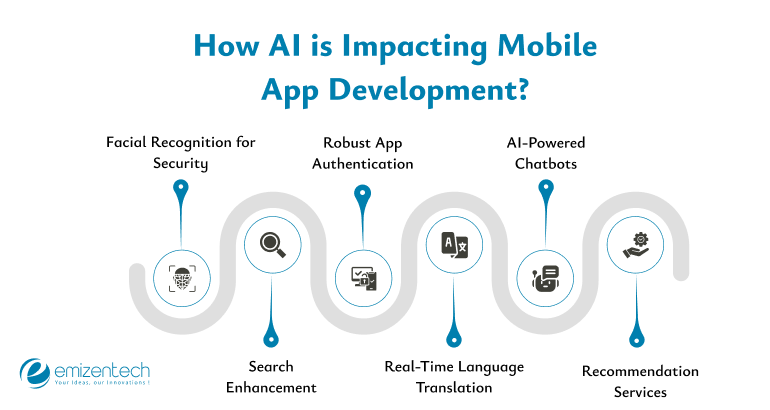
Mainly AI in mobile app development is used to address everyday issues of users and enhance the quality of their life. AI can gather vital information on mobile devices, including locations, contacts, and daily activities, to increase users’ satisfaction and solve complicated problems.
AI-integrated apps can collect and track data by analyzing customer behavior and interactions. Let’s explore some of the main factors regarding the impact of AI in mobile app development.
1. Facial Recognition for Security
Face recognition on the Apple iPhones is processed with an AI algorithm. With an integrated AI algorithm users can easily unlock the app even after minor changes in their appearance.
It can also stop children from accessing forbidden information on internet and help identify or anticipate cybersecurity risks.
2. Search Enhancement
Developers are using AI and ML technology to develop speech and image recognition to improve mobile application usability. This technology of image recognition has already been implemented into Google lens.
To use it, you have to snap a picture of the object using Google Lens, and it will give you all the information about the particular object. The user experience and the usability of the search engine will be enhanced. It is possible to increase the conversion rate through its assistance.
3. Robust App Authentication
AI will likely have a greater impact on user authorization and app security. This is because cybercriminals and hackers are using advanced technology.
Mobile app developers must stay updated with the latest technological advances to anticipate security concerns and eliminate them in real time.
With integration of AI in mobile apps, the application can also easily keep users updated with variations and inconsistencies in user actions.
Furthermore, blockchain and other technologies such as machine learning and AI, can reduce vulnerabilities and risk estimates.
4. Real-Time Language Translation
Mobile apps may include translators equipped with AI capabilities. Many translation apps are accessible, but most cannot operate offline. AI-capable translators are a boon in this context.
Your smartphone can translate between several languages instantly and in real-time without the need of an internet connection.
As with artificial intelligence, machine learning becomes feasible, applications can learn and easily translate multiple forms of language. With AI and ML combined together, translation can be modified for latency. Hence allowing the user to adjust the time required for translating a spoken phrase or a sentence.
5. AI-Powered Chatbots
The majority of mobile application developers use AI-integrated chatbots. They can also easily communicate with customers. Whenever a user connects with chatbots, they function as customer service experts and respond promptly. Nowadays, every business prefers to integrate chatbots in their mobile applications to enhance customer services.
It helps them avoid the cost of hiring the entire customer service team. You can also ask the development team to integrate AI chatbots in your mobile app for answering frequent queries. So, you don’t require a support representative to respond to these typical queries.
6. Recommendation Services
To maintain user engagement, it is important to offer relevant information to your users. One common example of this that you must have seen is the “Customers who purchased this also purchased” feature in most of the online retail or eCommerce stores. This means that customer retention rate will increase rapidly, hence improving conversion rates too.
You can also collect data about user preferences to offer suggestions to your app users.
What Future Holds for AI in Mobile App Development: Top Trends

AI is transforming custom mobile app development by improving app functionality and offering customized experiences. From predicting user preferences to enabling hands-free interactions, AI improves app usability for users and increases engagement. Let have a look at some of the major trends of AI in mobile app development:
1. Machine Learning
If you are a developer, you must be familiar with this innovation. It is among the most effective AI technologies that allow apps to learn from user interaction, analyze patterns in data, and make decisions without having to be explicitly programmed. The accessibility of ML algorithms has made studying user behavior awe-inspiring.
This is evident in applications such as Netflix and Spotify, which use machine learning to suggest movies, shows, and music based on each user’s preferences. Applications like Google’s Gboard use algorithms to determine what word a user will likely enter and speed up the message process. Then there’s Amazon, which uses machine learning to give personalized shopping recommendations based on previous browsing. That’s why about 35% of Amazon’s revenue is generated by its recommendation engine.
2. Multimodel AI
At a 2023 session of the EmTech MIT Conference, Mark Chen (the chief of research on frontiers at OpenAI) stated, ” The interfaces of the world are multimodal. We want our models to see what we see and hear what we wear, and we want them to also generate content that appeals to more than one of our senses.” Are you aware of exactly what Mr. Chen is talking about?
The guy is arguing over Multimodel AI. This revolutionary technology simulates how people perceive the world in different ways. It takes inspiration from the models used by OpenAI’s GPT-4, Google’s Gemini, and a variety of other tools.
3. Predictive Analytics
AI can analyze user behavior and forecast user actions, assisting mobile app development firm in making decisions based on data regarding features and their functionality. Examples of AI-powered predictive analytics apps are Waze, Google Maps, and Spotify.
4. Voice Recognition
AI-powered voice recognition systems could facilitate voice commands and controls within mobile applications, making them more accessible and comfortable for users. Examples of apps using AI-powered voice recognition are Amazon Alexa, Google Assistant, and Siri by Apple.
5. Advanced Search Capabilities
With AI-powered Natural Language Processing (NLP), in-app search functions have become more user-friendly than ever before. Instead of relying solely on precise keywords, AI-powered search will discern the purpose of user queries and provide more relevant results, even when users type words commonly used in conversations.
This advanced search extends beyond traditional text-based queries. Users can now conduct visual searches by uploading photos or voice-based searches to provide effortless convenience. Whether they’re looking for a particular product or searching for a specific item using AI, the search engine will ensure that they spend less time searching and more time interacting with the information they require.
6. Personalized User Experience
AI helps mobile apps provide a unique, user-centric experience by customizing content and interfaces to users’ preferences. AI goes beyond basic customization. It analyzes user behavior, records interactions, and uncovers patterns to offer relevant and useful suggestions and interfaces that appeal to the individual user.
For example, an AI-powered streaming application might suggest movies or music according to the user’s previous choices and preferences, while a shopping app may display products that align with their browsing habits and interests. This personalization keeps users interested and returning for more, increasing retention rates. Users are more likely to remain happy and loyal when they are satisfied that the application “understands” them.
7. Security and Fraud Detection
AI is crucial to ensuring the security of mobile apps, particularly in sensitive sectors like healthcare and finance. By analyzing users’ behavior in real time, AI algorithms can detect and avoid fraud by identifying unusual patterns, such as unusual login locations or transactions. This proactive strategy secures user data and guards against unauthorized access.
This level of security increases trust and gives security users confidence that their data is safe.
Common Challenges of Implementing AI in Mobile App Development
There are many challenges when it comes to leveraging AI to develop mobile apps. Here are the most common challenges:
1. Data Privacy Concerns
Privacy issues are common with AI-integrated applications as they typically require collecting and storing huge amounts of data from users. To reduce these issues, app developers must ensure that the use and collection of personal data are transparent and adhere to all applicable privacy regulations. The solution to these issues requires careful planning and implementation to ensure that AI’s advantages in mobile app development surpass the associated risks and costs.
2. Complexity of AI Algorithms
AI algorithms are complicated and require specialist knowledge to manage and implement. There are chances that a mobile app development agency might need to engage AI experts or third-party AI service providers to ensure the app works efficiently.
3. Lack of Explainability in Decision-Making
Most of the mobile applications integrated with AI often lack transparency in explaining how recommendations or certain decisions are made.
Law provides users with the right to know about how recommendations and suggestions are made. So developers must focus on developing explainable AI models that allow users to understand how algorithms make some specific decisions and suggestions.
4. Consent and User Awareness
Developers should also consider user’s informed consent for the use of AI in developing mobile apps as it is also an ethical issue. In most cases, users do not know that AI algorithms can influence their experiences within the app.
AI developers use transparent communication strategies regarding the way they apply AI, the types of data they gather, and how they can use it to enhance the app’s capabilities. Teaching users about the effects of AI will ensure that they are aware of their involvement while using the app.
One of the major issues with AI mobile app development is the cost. Developing AI-powered apps requires complicated algorithms and a substantial amount of time to develop, which can result in additional expenses.
Real-Life Examples of AI in Mobile Applications
The transformative nature of AI to develop mobile apps is evident when looking at successful use cases across different industries. These use cases not only show how AI is adapting to needs of users but also their positive effects on the user involvement with the app, showing recommendations, and so on.
1. Starbucks
Starbucks uses AI in its mobile application to monitor user activities directly through the app. The app uses AI, which helps it understand customer preferences, suggest personalized beverages, and even ease the order process. With unique personalized promotions and rewards based on customers’ habits, Starbucks has increased customer satisfaction and loyalty.
2. Duolingo
Many e-learning businesses use AI within their applications to offer personalized suggestions. For example, Duolingo, an app for learning languages, aims to provide its users with the most effective learning route that matches their needs. However, the app adapts to each user’s individual strengths and weaknesses to ensure that every user gets individualized practice to enhance their learning experience in the language.
The model of adaptive learning powered by artificial Intelligence has led to remarkable improvements in retention and proficiency. Users are still interested and efficient in their learning, which aids in establishing Duolingo’s status as a top-rated language app.
3. Spotify
The well-known music streaming app, Spotify leverages AI to create personalized playlists and suggestions for its users. Spotify’s AI algorithms analyze listeners’ preferences, preferred genres, and even mood swings to adjust their recommendations accordingly.
The level of personalization businesses have achieved with AI has been a significant step in increasing engagement. The result? A higher rate of subscription and an impressive rise in revenues.
4. Snapchat
Snapchat is an innovative social media platform with attractive and useful filtering. It has discovered ways to implement AI through the use of Augmented Reality among its standard functional features. These filters, using AI algorithms, can recognize faces and integrate interactivity elements.
Snapchat’s AR filters do more than just increasing customer engagement. They also attract sponsorship and partnerships. Brands use these filters to make innovative ads, which, in turn, provide Snapchat with an income stream every time a user utilizes one, thereby increasing user experience.
5. Uber
Uber, the giant of ride-sharing, uses AI for predictive analytics to improve the user experience and operational efficiency. The app anticipates pattern demands, also enabling strategic placement of drivers and maximizing customer waiting times.
Leveraging AI to provide dynamic pricing based on demand, Uber has achieved increased revenues during peak times. The precise predictions not only enhance customer satisfaction but also play an important part in the overall effectiveness of the service.
How AI can Benefit your Business?
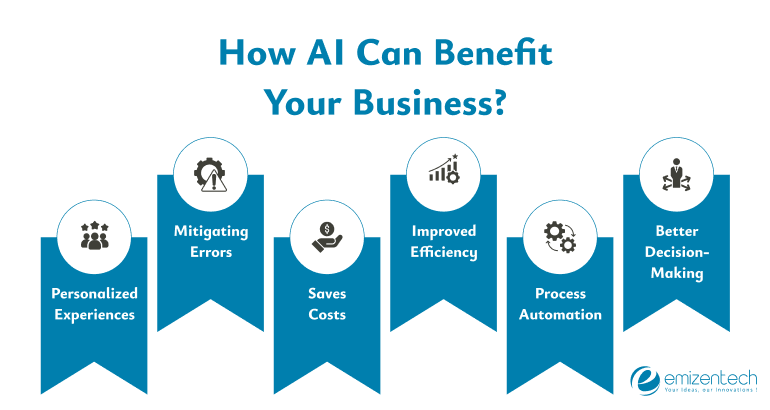
Here are some ways you can improve your business procedures.
1. Personalized Experiences
Smart AI algorithms allow data to evolve within the changing landscape. Furthermore, these algorithms can work with data to ensure consistency. They tailor the service and user experience. Additionally, they allow you to create personal interests and preferences. Furthermore, they increase your chance of gaining their trust.
2. Mitigating Errors
Human-based integration of business processes can lead to many mistakes. However, when it comes to AI integration, it is guaranteed to deliver the best outcomes. Additionally, it consists of companies that can handle mundane and repetitive tasks. Additionally, AI can provide the most effective approach to eliminate human errors.
3. Saves Costs
You can also lower the costs to accomplish specific tasks. AI simplifies tasks for businesses to cut down time and costs. Additionally, you can allocate human resources that are aligned to AI capabilities, making the process more efficient.
4. Improved Efficiency
AI can also help in enhancing employee productivity and streamlining business processes. Additionally, it can easily complete bulk tasks simultaneously which is not possible for a human to perform.
5. Process Automation
AI can automate business processes to a greater extent. It also enhances performance by focusing on the quality. It is possible to automate processes that hinder productivity. Furthermore, you can effectively manage staff as AI can perform multiple tasks easily without affecting the current staff.
6. Better Decision-Making
Enterprises can manage and receive huge amounts of data every day. Additionally, they can employ AI-integrated predictive analytics for further processing. The data can be analyzed to give you the best insight to help you make better decisions. Therefore, you can easily utilize this knowledge to enhance your data-driven processes and business decisions.
How Emizentech Can Help You With AI-Powered Mobile App Development?

To achieve maximum potential of your business, partner with Emizentech. We are a leading mobile app development company that can help you to create cutting-edge AI integrated mobile applications.
Our team of expert mobile app developers can create custom AI-powered mobile applications to elevate your business in this competitive landscape. With our proven experience we will help you to enhance user-experience, speed-up development process and leverage the potential of AI innovation.
Together, we can create a custom mobile app solution for your business that will make your business thrive. Hire mobile app developers from Emizentech today!
The Key Takeaway
Artificial Intelligence (AI) in hybrid mobile app development offers unlimited possibilities for business. It is a means of profound change that enhances mobile apps with the latest capabilities and features.
As we look ahead to the next technological advances, it’s obvious that the fusion of AI and mobile application development isn’t just a fad. But it is an incredible revolution for modern digital reality.
By leveraging the potential of AI, businesses will be able to maintain an edge in the market, providing their customers with exceptional customer experiences while enjoying the benefits of greater satisfaction and engagement. As we progress, the role of AI in mobile application development will continue to grow, making it a vital part of any strategy for app development.
FAQs
#1 How can AI improve user experience in mobile applications?
AI enhances user experience through individualized user interactions, predictive analysis, and streamlined integrations. From individualized suggestions to a flexible interface, AI makes mobile applications more intuitive and engaging.
#2 What are the most effective AI techniques for mobile applications?
A few of the Artificial Intelligence methods with great potential to be employed in the development of mobile apps include machine-learning algorithms (supervised and unsupervised learning) and natural language processing (NLP), machine vision, image recognition, chatbots, and conversational AI (chatbots and virtual assistants).
#3 How does AI contribute to app personalization?
AI can customize the user experience on mobile apps by studying user behavior and preferences. It determines what every user enjoys and customizes content suggestions, features, and recommendations to meet the individual’s needs, making the app more personalized and enjoyable.
#4 What role does Artificial Intelligence (AI) play in application development?
Modern apps rely heavily on AI. AI allows for capabilities like the natural language processing of voice assistants for image recognition, photo-based apps’ prescriptive analytics for greater user engagement and intelligent automation to increase productivity.




 +1 (989) 535-9295
 info@emizentech.com
 emizentech


