 Add us as a preferred source on Google
 Artificial Intelligence has led to revolutionary innovations across all industries. One industry that has seen incredible change in transportation, which is using artificial intelligence to create self-driving vehicles, leading the mobility revolution. The core of autonomous vehicles is the AI in self driving cars, which allows cars to sense their surroundings, make decisions based on information, and perform their duties as safely as human drivers.
The rise of autonomous vehicles, as well as advanced systems for driving paired with AI solutions, has changed the way we travel offering the promise of increased security, efficiency, and convenience. The use of AI in self driving cars goes beyond just the car itself. It is also changing how cars are built, how parts are delivered, and even how car companies talk to their customers.
Everything is becoming smarter and more efficient. As AI continues to grow, we can expect even more exciting changes in how we travel in the future. Self-driving cars might one day become a normal part of our everyday lives.
In this blog, we’ll look at the role of AI in self driving cars. We will also discuss the benefits and application of AI in self driving cars.
So, let’s get started.
What Is AI in Self-Driving Cars?
AI and self-driving cars go hand in hand in today’s digital world, where vehicles can drive themselves without human help. The use of AI in self-driving cars and smart traffic systems has completely changed the automotive industry. AI is the “brain” of a self-driving car. It helps the car think, learn, and make decisions like a human driver. Instead of needing a person to drive, the car uses AI to understand what’s happening around it and choose what to do next.
AI works by using cameras, sensors, and special software. The cameras see the road, people, signs, and other cars. Sensors help the car know how far things are. All this information goes to the AI, which looks at it in real time and decides what the car should do like stop, go, turn, or slow down.
Self-driving cars use a type of AI called machine learning. This means they can learn from past experiences and get better over time. AI also helps the car stay safe by reacting quickly to danger, like a person crossing the street. It doesn’t get tired or distracted like people do. In simple terms AI lets cars drive by themselves, safely and smartly, by seeing, thinking, and reacting just like a human but often faster and better.
Market Statistics For Autonomous Vehicles
Driving technology is advancing fast. Self-driving cars are no longer just a future idea, they have started to become a reality. More and more vehicles are expected to include AI-powered features. To better understand how this market is growing, let’s take a look at some important statistics.
- The automotive AI market size is predicted to reach about $134.3 billion by 2033, up from $ 7.7 billion in 2024, expanding at a CAGR of 37.4% over the period between 2025 and 2034.
- It is estimated that the self-driving cars market was valued at $1.7 trillion in 2024 and is expected to hit $3.9 trillion in 2034, increasing at a rate of 8.6%.
- The autonomous vehicle market is estimated at $1,500.3 billion in 2022. It is expected to expand to $1,921.1 billion in 2023 and reach $13,632.4 billion by 2030, showing an annual growth rate of 32.3% over the projection period.
- Globally, driverless cars could account for a significant portion roughly 25% of the total market in 2035–2040, likely due to advances in AI technology. Additionally, by 2030, the market for automotive artificial intelligence is expected to reach USD 74.5 billion.
Key Components of AI-Powered Autonomous Vehicles
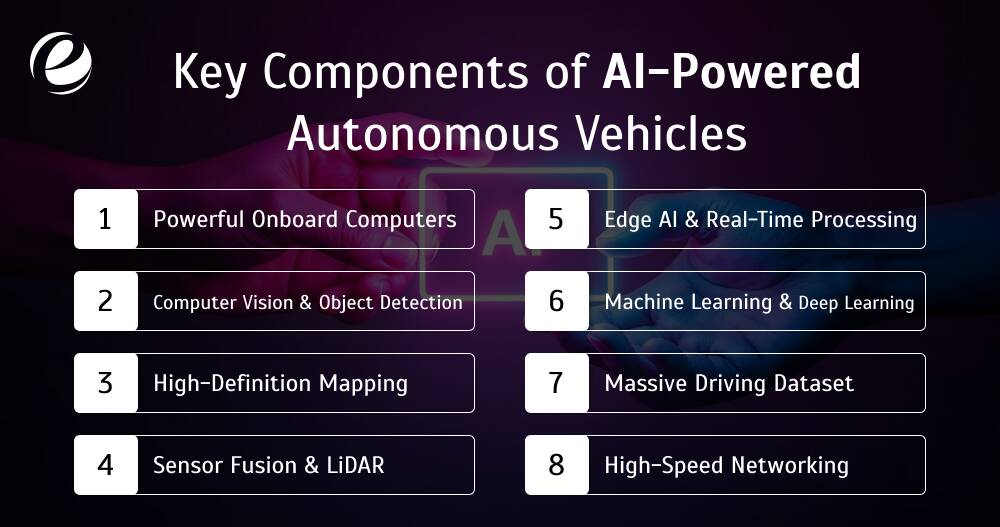
Artificial Intelligence (AI) in autonomous vehicle technology is the foundation of self-driving cars, allowing them to function smoothly even in highly dynamic conditions. With the help of AI-powered systems, autonomous cars can detect their surroundings, process data in real-time, and make intelligent decisions that allow them to navigate safely and efficiently.
The following are the main components that make autonomous vehicles function and contribute to their capabilities.
1. Powerful Onboard Computers
Autonomous vehicles require extremely robust and high-speed computers to run advanced AI algorithms. These systems process massive amounts of information collected from sensors, cameras, and maps in real time. They use specialized chips such as GPUs and multi-core processors to handle multiple tasks simultaneously. This allows the vehicle to think quickly and make fast driving decisions. Without the processing power of these computers and sensors, cars wouldn’t be able to respond quickly enough to travel safely.
2. Computer Vision & Object Detection
Autonomous vehicles use AI and specialized cameras to perceive and understand their surroundings. This system, known as computer vision, detects vehicles, pedestrians, traffic signs, and road markings. It helps the car identify roads, avoid accidents, and adapt to roadway changes. Deep learning models enable continuous improvement. Even in complex and chaotic environments, the vehicle can recognize its surroundings and take the safest driving actions.
3. High-Definition Mapping
High-definition maps provide self-driving cars with detailed views of routes, traffic signs, curbs, and barriers. These maps are created by combining LiDAR data, GPS, and cameras. AI helps keep the maps constantly updated with real-world changes. These are far more precise than standard GPS and provide centimeter-level accuracy. This allows vehicles to plan routes, determine their exact location, and drive safely even in unfamiliar or challenging areas.
4. Sensor Fusion & LiDAR
Autonomous vehicles use various sensors, like cameras, radar, and LiDAR, to understand their surroundings. Sensor fusion combines this data to create a comprehensive picture of the vehicle’s environment. LiDAR uses lasers to measure distance and detect obstacles, allowing the car to “see” in all directions and operate safely in poor visibility or at night. Through sensor fusion, the vehicle can make more informed driving decisions.
5. Edge AI & Real-Time Processing
Edge AI means the vehicle processes data instantly within the car itself instead of relying on the internet. This is vital for safety, as the car must react immediately to events like pedestrians, sudden stops, or obstacles. Real-time processing reduces delays, making driving faster and more comfortable. The car can make decisions on the spot without waiting for cloud-based responses, helping to prevent accidents.
6. Machine Learning & Deep Learning
Self-driving vehicles use past experience to improve their performance. Deep learning, a type of machine learning, helps the car recognize complex patterns, like traffic behavior or when to stop.These systems constantly improve by analyzing real-time driving data. The car can make smarter decisions, adjust to new environments, and ensure safety. Over time, it becomes better at handling unexpected situations, such as roadblocks or reckless drivers.
7. Massive Driving Dataset
To train self-driving vehicles, companies collect large amounts of real-world driving data. This includes sensor measurements, camera footage, and unusual road situations. The more data the vehicle receives, the better it can learn and improve. AI models use this information to understand road types, driving habits, and rare incidents. Massive datasets are essential for training cars to drive like humans only better, safer, and continually evolving.
8. High-Speed Networking
High-speed internet, especially 5G technology, keeps self-driving cars connected. With fast connectivity, vehicles can receive live traffic updates, download new maps, and communicate with traffic signals and other vehicles. This helps them navigate traffic, anticipate hazards, and improve safety. They can also receive software updates without needing a physical service. High-speed networks make driving more efficient, faster, and smarter by keeping vehicles connected to everything around them.

How AI Powers Each Level of Vehicle Autonomy
The shift from manually automated systems to fully autonomous vehicles has been accompanied by significant advances in technology and changes to the regulatory framework. In the beginning, automation relied on simple systems for driver assistance, like cruise control or basic lane-keeping functions.
But the latest autonomous vehicles feature sophisticated decision-making algorithms that enable them to handle complex driving situations with minimal human involvement. The evolution can be classified into distinct levels of automation, each representing progress toward complete autonomy.
Level 0 (No Driving Automation)
The majority of vehicles on the road today are Level 0 that are manually controlled. Humans perform the “dynamic driving task,” although there are devices in place that assist the driver. For instance, an emergency braking system isn’t considered automated because it doesn’t technically “drive” the vehicle.
Level 1 (Driver Assistance)
This is the lowest degree of automation. The car has a single automatic system to assist the driver, such as steering or acceleration (cruise control). The adaptive cruise control system, which makes sure that the vehicle keeps a very safe distance from the one what is in front, is regarded as Level 1, since the driver is still responsible for other aspects of driving, including braking and steering.
Level 2 (Partial Driving Automation)
This refers to advanced driver-assist systems, also known as ADAS. The vehicle can easily control both steering and acceleration/deceleration. However, it doesn’t qualify as self-driving, since a driver must remain in the seat and be able to take control at any time. Tesla Autopilot is considered Level 2.
Level 3 (Conditional Driving Automation)
The leap from Level 2 to Level 3 is significant in terms of technology, though it may not be obvious from a human perspective. Level 3 cars are equipped with “environmental detection” capabilities and can also make independent decisions such as accelerating to pass slower vehicles. However, they still require human intervention. The driver must remain alert always and ready to take over if the system fails.
Level 4 (High Driving Automation)
The major distinction between Level 3 and Level 4 automation is that Level 4 cars are designed to continue driving even if something goes wrong or a system malfunctions. This means they do not need human interaction in all situations, though a human can still take manual control.
Level 4 vehicles can function in self-driving mode. However, due to current legal and infrastructure limitations, this is restricted to specific areas. This restriction is known as geofencing. As a result, most existing Level 4 vehicles are developed for ride-sharing purposes.
Level 5 (Full Driving Automation)
Level 5 vehicles require no human attention, and the “dynamic driving task” is completely automated. These cars lack steering wheels and acceleration/braking pedals. They are not limited by geofences and can go anywhere, performing any task a human driver could. While autonomous vehicles at this level are being tested in various parts of the world, none are currently available to the general public.
Top Benefits of AI in Self Driving Cars
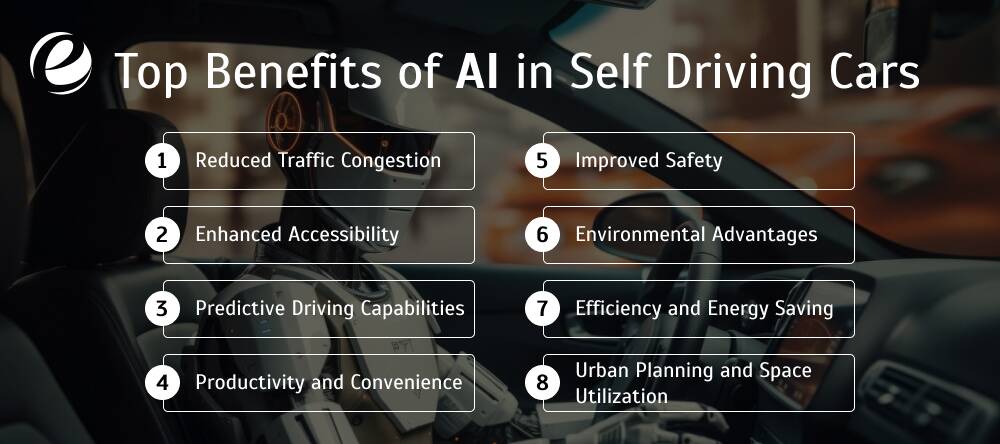
The introduction of AI in self driving cars has opened up a new world of improved safety, enhanced processes, and a host of other benefits. A few of the most significant benefits of use of AI in self driving cars include:
1. Reduced Traffic Congestion
AI aids self-driving cars to move closer to each other at steady speeds and reduces congestion. The cars are able to communicate with each other in order to avoid sudden stops or changes in lane. This keeps traffic running effortlessly. This means fewer delays, shorter travel time, and less road rage. AI can also help plan routes better and avoid congestion hot spots. Together, these functions assist in reducing congestion in cities and make driving easier for everyone.
2. Enhanced Accessibility
AI in self driving cars makes transport easier for those who are unable to drive a car. These include people who are elderly, physically disabled, and children. The cars provide autonomy by giving people the ability to travel independently without the need for a driver to take their vehicles. They can be useful in remote areas or in places where public transportation is not available. As time goes on, this could increase mobility for millions of people, making daily tasks such as shopping and doctor visits easier to manage.
3. Predictive Driving Capabilities
While predictive driving is part of the safety functions in autonomous automobiles, the revolutionary technology is worthy of separate mention. The technology is no longer limited to films, as cars connect with one another to swap information. Information broadcasts like road accidents, weather patterns, or high traffic levels enable the artificial intelligence of cars to respond appropriately to situations by making smart choices.
4. Productivity and Convenience
As self-driving automobiles take care of the driving, the passengers are able to use the time they spend traveling to do various other activities. This feature is extremely beneficial on long commutes and road journeys. It allows you to relax while avoiding stress caused by traffic and reach your destination rejuvenated. This transforms wasted time in the car into productive personal or work time and adds value to each journey.
5. Improved Safety
One of the main advantages of AI in self driving cars is increased safety. The majority of accidents result from human error, such as speeding or using a smartphone while driving. AI won’t become exhausted or disoriented. It makes use of sensors and information to make quick, intelligent decisions that prevent collisions. Lane detection, emergency braking, and real-time monitoring are a few of the safety features. When there are fewer accidents, the roads are safer for everyone, drivers, passengers, and pedestrians.
6. Environmental Advantages
AI-powered self-driving cars help to reduce the amount of pollution. The majority of these vehicles are hybrids or electric, which means they emit fewer harmful emissions into the air. AI can also make cars move more smoothly, with less speeding up and hard braking, which means they consume less energy. More efficient fuel use results in less damage to the environment. Over time, it can aid in combating global warming and help keep air clean, particularly in large cities where vehicle pollution is a big problem.
7. Efficiency and Energy Saving
Use of AI in self driving cars assists cars to run more efficiently by making intelligent choices regarding braking, speed, and routes. Instead of wasting fuel through traffic or speeding, AI plans the most efficient route to take. AI also stops unnecessary idling and picks routes with lower congestion. This reduces fuel use and also saves money. It also aids in extending battery life. All in all, intelligent driving using AI will help conserve energy and safeguard the earth.
8. Urban Planning and Space Utilization
With self-driving vehicles becoming more popular, cities could alter the way they utilize space. Since fewer people will need parking, the spaces can be converted into shops, parks, or even housing. Roads can be widened to allow more space for walking or biking. These changes can create greener cities and make them more relaxing. Additionally, it helps public transportation by making it easy to connect with self-driving shuttles or shared vehicles. This can lead to better and more sustainable cities.
Types of AI Algorithms Used in Self-Driving Cars
Self-driving technology is a complex area that depends on algorithms and filters to process data from sensors, make decisions, and control the vehicle. In this section, we’ll explore various types of algorithms and filtering methods employed in self-driving technology.
1. Localization Algorithms
Localization algorithms are used to identify the exact location of a vehicle. These algorithms rely on data taken from GPS modules as well as sensors like lidar and radar. This data is compared with an image of the surroundings to pinpoint the vehicle’s location. It also takes into consideration factors like changes in elevation or roadsides.
2. Perception Algorithms
Perception algorithms help detect objects within the vehicle’s surroundings. They rely on sensor data from lidar, cameras, radar, and other sensors. The data is processed by machine learning algorithms that can identify objects like cars, pedestrians, or road signage. These algorithms are able to detect patterns in the sensor data, allowing them to differentiate between various types of objects.
3. Mapping Algorithms
Mapping algorithms help produce a precise image of the area surrounding the vehicle. The maps contain information about road markings, traffic signals, and additional features in the environment. These algorithms are also able to take into account changes in environmental conditions over time, such as road closures or new construction.
4. Control Algorithms
Control algorithms help manage the vehicle’s speed, direction, and acceleration. They receive information from the planning algorithm and then send instructions to the vehicle’s actuators to regulate movement. The control algorithm may alter the vehicle’s speed and direction in response to environmental changes and other variables.
5. Kalman Filters
Kalman filters are used to estimate the state of a system using sensor data. They can predict the future state of a system with a mathematical model and then compare the prediction with real sensor data. The filter adjusts the prediction to match real-world information more accurately, which helps make the data more precise and useful for autonomous vehicles.
6. Planning Algorithms
Planning algorithms help AI in self driving cars decide where to go and how to get there safely. They use data collected from maps, sensors, and other systems to understand traffic rules, road conditions, and obstacles. By analyzing this information, these algorithms determine the most efficient route and steps for the car to take, allowing it to drive more effectively and make smart decisions.
7. Filters
Filters clean the sensor data, making it more reliable and accurate. Sensors may give false or noisy readings, so filters help eliminate these errors. This improves the car’s ability to understand its surroundings. Various types of filters, including Kalman and particle filters, are used in self-driving vehicles to ensure the system operates safely and efficiently.
8. Particle Filters
Particle filters estimate the system’s state using many small guesses, called particles. Each particle represents a possible version of reality. As new sensor data arrives, the particles are updated to show the most likely options. This method helps self-driving cars follow their position and movement, even when data is unclear or noisy.
Real-World Examples of AI in Self Driving Cars
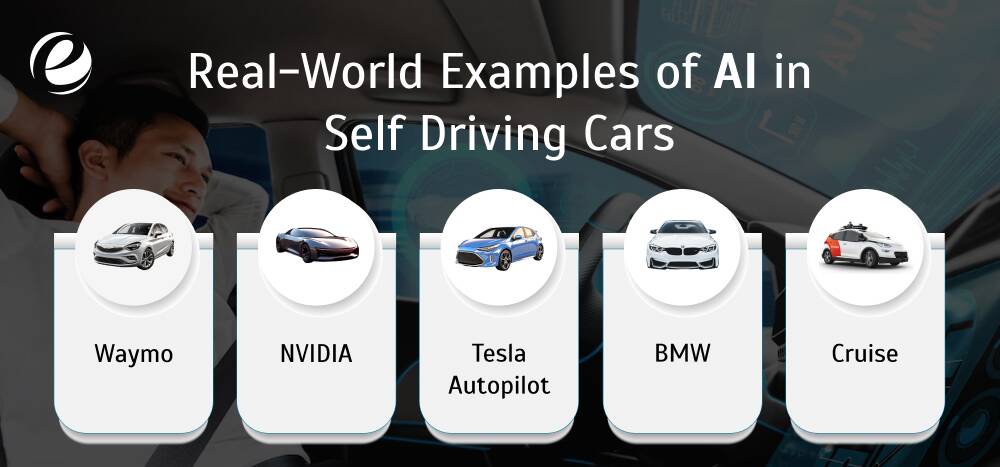
The companies mentioned below have been able to successfully implement AI in self driving cars, further enhancing the function of AI in the transportation industry and improving the user experience.
1. Waymo
Waymo has established itself as a leading company in the field of autonomous vehicle technology and has introduced AI-based self-driving technology that displays intricate route planning and smart responses to the surrounding environment. With the incorporation of AI within its operation, Waymo has become a leading player in autonomous transportation.
2. NVIDIA
NVIDIA has developed a comprehensive array of AI computing technologies and platforms specifically for the automotive industry and helps integrate AI into the design of cars and management. NVIDIA’s Drive platform provides an example of how well it integrates AI functions like perception, map-making, and planning of routes, which makes autonomous vehicles think more clearly and have better navigation abilities.
3. Tesla Autopilot
Tesla Autopilot uses smart AI to help make fast driving decisions and maintain control of the car. The Autopilot assists the car in controlling its speed, steering, braking, and accelerating in a safe manner by itself. Tesla provides Superchargers at a reasonable price, which makes electric charging less expensive and more convenient. The combination of latest technology and ease of use makes Tesla the most popular option for environmentally conscious drivers.
4. BMW
BMW is committed to implementing AI within its vehicles to enhance the driving experience. Driver assistance systems help ensure safety and comfort. BMW’s Intelligent Personal Assistant uses voice commands to manage car features. It recognizes natural voice, making driving more personal and pleasurable, demonstrating BMW’s dedication to combining luxury with modern technology.
5. Cruise
Cruise, part of General Motors, builds fully self-driving vehicles. Cruise AV utilizes a mixture of radar, lidar, and cameras to navigate driving conditions. The majority of its devices are specifically developed for autonomous driving. Cruise’s technology is designed specifically for urban driving and aims to improve safety and make travel completely autonomous without the need for a human driver.
Use Cases of AI in Self Driving Cars
Many applications of AI in self driving cars vividly illustrate the potential of AI in changing the automobile industry and increasing safety and operational efficiency. Let’s have a look at the different use cases of AI in self driving cars:
1. Predictive Maintenance
AI is a tool to keep autonomous cars well-maintained. It monitors how the vehicle’s parts function and can tell what could go wrong. In this way, any issues are fixed before the vehicle ceases to function. This saves money and time because it avoids breakdowns.
It uses data from the past as well as smart algorithms to predict what maintenance needs to be done. This results in fewer unexpected events and safer rides since the vehicle is in good condition without waiting for anything to go wrong.
2. Insurance Data Analysis
In the event of an accident, it’s essential to understand the cause. The self-driving car collects a great deal of information regarding how it’s driving. AI makes use of this information to discover what occurred when a car crash happens. Insurance companies can then determine who was at fault.
It’s similar to keeping a camera or notebook within the vehicle, maintaining records. This helps with making legitimate insurance claims. It also helps make the driving experience safer by learning from past incidents.
3. Traffic Detection & Traffic Signs
Autonomous AI systems in cars are able to “see” traffic lights and road signals. The car can stop at red lights and proceed at green ones. This is vital, as human drivers often miss signals due to exhaustion or distraction. AI is always alert and makes the best choice at the correct moment. It keeps other motorists safe from accidents that could occur if road signs are ignored or misinterpreted.
4. Inspection of Dangerous Turns & Traffic Circles
AI monitors the road and detects the areas which can pose a risk. For example, it can watch cars go through roundabouts or around tight bends. It even verifies the safety of cyclists or pedestrians? It could also suggest safer alternatives to upgrade or build roads.
This assists city planners to create safer streets for bicyclists, motorists and pedestrians alike. In other words, you use advanced data to run a check-up on streets, in order to minimize the chances of crashes.
5. Parking Management
Parking in busy locations can be difficult. AI assists by displaying spots with available parking. It monitors parking spaces using cameras and sensors, then informs drivers of the best places to go. It can even remember exactly where you parked your vehicle! This is extremely helpful in crowded areas like stadiums and airports. AI saves time, reduces congestion, and makes parking faster and easier for everyone. Additionally, it helps cities improve the management of parking spaces.
6. Processing Sensor Data
Autonomous vehicles are well equipped with many sensors that send out large amounts of data each second. AI can read and interpret this data quickly. It informs the car of its surroundings such as other cars, people, or even animals.
It helps the car make smart decisions like slowing down, stopping, or changing direction. It functions like the human eye and brain but is faster and more accurate. This ensures the vehicle remains safe on the road and helps prevent collisions.
7. Behavior Prediction
AI enables self-driving cars to predict the behavior of nearby vehicles or pedestrians. For instance, if you have a person walking on the road, the vehicle will decide whether or not they are going to cross in front of it. It taps past driving data and complex automotive software to analyze the person getting close and evaluate his mode of movement, speed and direction. This enables it to decelerate or halt when it finds a safe location to do so.
8. Motion Planning
After the car knows what it sees, AI helps the car the best possible way to get through. It analyses the course with least resistance, the most natural path to proceed on to reach your destination. Just like an experienced human driver, the system predicts when to accelerate, turn or slow down. It complies with every traffic law and is able to recognize obstacles that will lead to accident and avoid it. The car checks on and recalibrates the road in real time, making sure the trip is a safe one.
9. Navigation & Localization
Autonomous vehicles need to know their exact location. AI helps them do this by using high-precision maps and live sensor data. This enables the vehicle to travel smoothly to its destination, avoiding traffic and following the most efficient routes. AI handles even challenging situations, like tunnels or crowded streets, ensuring the car knows where to go at all times.
10. Decision Making
Sometimes, driving decisions can be complex, such as at a four-way stop or when a car is in danger of colliding. AI helps self-driving cars make the safest and most reliable choices. It assesses all potential risks, weighs the options, and selects the one with the least danger. These intelligent decisions are based on hours of training with both real and simulated scenarios, allowing the car to handle emergencies as smoothly as a skilled and cautious driver.
11. Anomaly Detection
Unexpected events can occur on the road, like falling trees or a car suddenly stopping. AI helps self-driving vehicles recognize unusual situations. The system learns normal patterns and can quickly detect anything out of the ordinary. If it identifies an anomaly, the car can stop or change direction to avoid accidents and keep the ride smooth.
12. Automated License Plate Recognition
AI can detect the license plate of cars the same way a person can read a sign. This can be useful in areas which only certain types of vehicles can travel, such as highways that require a fee or in private zones. If cars are permitted, access opens automatically. Police can use this method to find stolen vehicles or verify if someone is at a specific location. This is an effective way to secure roads and enforce rules.
What’s Next: The Future of AI in the Automotive Industry
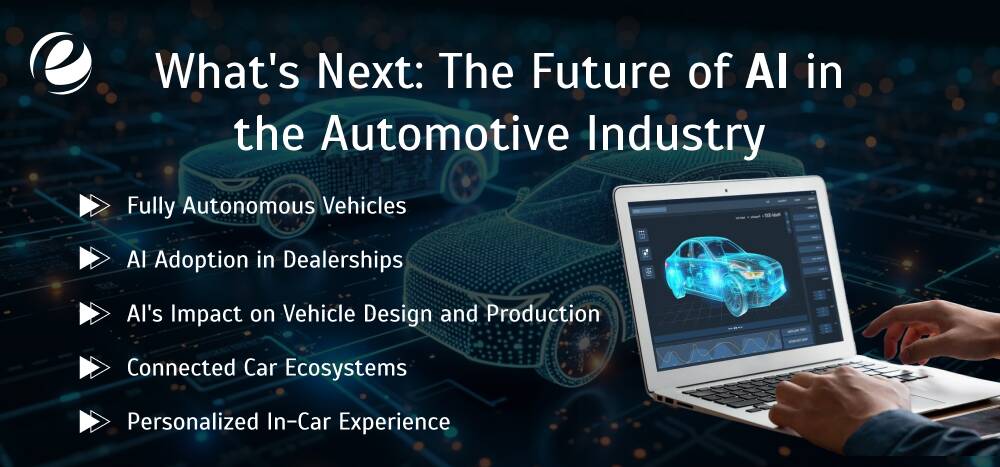
AI is pushing the boundaries of what is possible in the field of autonomous vehicles. The technology is set to change our perception of transportation. AI-powered vehicles will be able to make real-time decisions, navigate difficult roads, and communicate with other vehicles to improve traffic flow. This will result in safer, higher-performing transportation, potentially leading to a significant reduction in carbon emissions. As AI continues to evolve in the automotive industry, its future looks promising.
Let’s explore some of the latest trends in AI within the automotive sector.
1. Fully Autonomous Vehicles
In the near future, vehicles are expected to drive entirely on their own, without the need for a human driver. AI will enhance the vehicle’s ability to recognize traffic signs, pedestrians, other vehicles, and roads more effectively. This will lead to fewer accidents and safer travel. Drivers will be able to sleep, read, or work while the vehicle drives itself, without the need for a steering wheel or pedals. This will make travel easier for seniors, people with disabilities, or anyone who prefers not to drive.
2. AI Adoption in Dealerships
AI has transformed the way auto dealerships operate by improving sales, customer service, and inventory management. AI can engage customers instantly through chatbots, provide personalized recommendations, and streamline administrative tasks. Dealership staff can focus on building relationships with clients and solving complex problems. AI’s quick and consistent responses enhance the overall customer experience and improve dealership efficiency.
3. AI’s Impact on Vehicle Design and Production
AI has revolutionized the manufacturing process of automobiles. By analysing voluminous consumer data, AI helps automakers understand driver preferences regarding features, comfort, and functionality. This enables the creation of cars tailored to individual needs. AI will also provide a more personalized driving experience, suggesting routes, finding parking, or recommending nearby restaurants. This level of customization and efficiency was not possible before AI’s integration.
4. Connected Car Ecosystems
AI enables cars to communicate with each other, traffic signals, and nearby infrastructure. These smart connections allow vehicles to share information about roadblocks, accidents, and traffic congestion. By exchanging this data, every car can plan safer routes to avoid accidents. This will help reduce pollution, save fuel, and make driving safer and more efficient for everyone, leading to better highways and cities.
5. Personalized In-Car Experience
The cars of the future will recognize your preferences and adjust settings to suit your needs. AI will remember your preferred music, seat adjustments, temperature settings, and even recommend stops along your journey. The vehicle will communicate with you like a personal assistant, helping with navigation and answering questions. The ride will always be comfortable, as the car learns from your daily habits and adapts over time.
Why Choose EmizenTech for AI-Powered Automotive App Development?
Autonomous vehicles are bringing about an exciting transformation within the automobile industry. The implementation of AI in self driving cars is indeed a challenging task, and an expert AI development company is required to ensure a smooth process. EmizenTech is the industry leading automotive app development company that excel in creating high-quality AI-powered automotive solutions. These cutting-edge AI technologies are designed to drive innovation, resulting in increased revenue growth and enhanced customer engagement.
At EmizenTech, our AI specialists have a proven track record of creating robust, AI-driven software and app solutions. Our innovative approaches enhance technological performance, improve customer engagement, and generate substantial revenue growth for automobile firms. Whether it’s intelligent navigation software, predictive maintenance tools, or self-driving technologies, our AI solutions ensure clients stay ahead in the competitive automotive industry.
Contact us today to discuss your project requirements.
Conclusion
The integration of AI in self-driving cars has propelled the automobile industry into an era of unmatched safety and innovation. As AI technology evolves and social acceptance grows, the vision of fully autonomous vehicles becomes increasingly achievable offering safer roads and simplified commutes.
The impact of autonomous vehicles extends beyond convenience. This technology has the potential to reshape transportation infrastructure, enhance road safety, reduce traffic congestion, and promote environmental sustainability. Now is the ideal time for automakers to invest in AI strategies that drive technological advancement and offer a competitive advantage in a rapidly evolving market.
FAQs
What role does AI play in autonomous vehicles?
AI enables vehicles to navigate streets, make decisions, and interact with their surroundings without human input. It processes data from cameras, sensors, and other sources to guide the vehicle safely and efficiently.
How long does it take to develop an AI solution for the automotive industry?
Creating an AI solution for the automotive industry can take several months to over a year, depending on the project's size, features, and testing needs.
How safe are self-driving cars?
By eliminating human error and reducing accident risks, autonomous vehicles equipped with AI capabilities are generally considered more secure.
Will AI in self-driving cars replace human drivers?
AI in autonomous vehicles is designed to assist or even fully replace human drivers in certain tasks. While it's not about completely replacing people, self-driving cars will become increasingly common and capable of performing all driving activities, especially in controlled environments.



 +1 (989) 535-9295
 info@emizentech.com
 emizentech


