 Add us as a preferred source on Google
 AI in industry is not new, but it definitely changes the landscape of the retail industry. Retailers are investing in AI-powered retail software development to optimize their business operations.
To be upfront in this competitive market, retailers need AI-powered retail software.
59% of retailers are said to be using AI in retail to help store associates make product recommendations. At the same time, 55% are using digital assistants to help online shoppers.
AI-powered retail software is solving several challenges retailers face, such as managing inventory efficiently, understanding customer preferences, and providing personalized shopping experiences.
As technology continuously evolves, retail AI is gaining momentum, and retailers are investing in AI-powered IT solutions. With AI-powered retail software, businesses can stay competitive in the market while meeting their customer’s evolving needs.
If you are planning to do the same, you will explore the benefits of AI-powered retail software and its essential features in this guide. Along with the cost of building AI-powered software in 2025. So, without any further delay, let’s dive in!
AI in retail commerce: Market Overview

AI in retail is becoming increasingly essential as consumer expectations change and the market continuously grows. According to future market insight reports, the adoption of AI in retail is going to surpass $127.09 billion by 2033. The demand for artificial intelligence in retail will grow by 28% CAGR from 2023 to 2033.
Another report shows that AI in the retail market is projected to grow significantly, and the market size is expected to reach 164.74 billion by 2030.
AI-powered software support activities such as dynamic pricing, real-time inventory tracking, and personalized promotions across channels are essential for staying competitive in a digital-first retail landscape.
As more and more consumers engage with multiple touchpoints, retailers are turning to AI to optimize their operations and meet the growing demands of omnichannel shoppers.
Overall, AI will transform the retail sector in the coming years. If you are a retailer, it is the right time to invest in retail software development powered by AI.
But before you do that, understand what is AI-powered retail software development.
Understanding AI-powered retail software development
First things first: You probably know what Artificial intelligence is, but you still might have questions about “ Why does AI in retail matter and how AI can be used in retail?”
As we know, AI-powered retail software development plays a major role in every aspect of the retail industry. From automating tasks to delivering personalized shopping experiences to users, it has transformed the retail segment completely.
AI-powered retail software development involves creating applications and systems that leverage AI to enhance various aspects of retail operations. This development process integrates advanced technologies such as ML, NLP, and big data analytics to deliver solutions that improve overall retail operations.
| “ Retailers who are ahead of the curve when it comes to AI applications will have to learn more from their early experiments and reap the benefits.Those playing catch-up may find themselves continuing to be just that- Followers.” Karina van den Oever, principal, Elixirr |
Businesses can generate revenue and grow while using AI-powered retail software. In the next section, we will explore the benefits of AI-powered software in retail.
Benefits of AI-powered software in retail
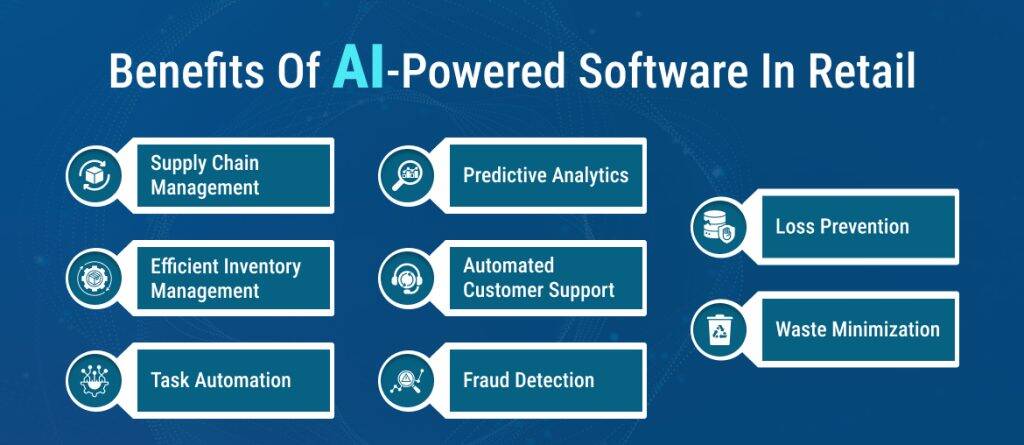
There are many advantages of AI-powered retail software development. Let’s explore them below:
1. Supply chain management
With AI-powered retail software can optimize supply chain processes by predicting demand, managing logistics, and identifying potential disruptions. This will lead to a more resilient and responsive supply chain.
2. Efficient inventory management
Retailers can leverage AI algorithms to predict demand trends, helping them to optimize their inventory levels. This reduces the risk of overstocking, pricing strategies, and product launches. This proactive approach helps in maximizing sales opportunities.
3. Task automation
Retail software powered by AI can automate repetitive tasks such as collecting and analyzing data from multiple internal and external sources in order to calculate demand forecasts and quantities that need to be allocated to a particular store.
4. Predictive analytics
AI-powered retail software leverages predictive analytics to analyze historical data and identify patterns that can inform future business decisions. From forecasting customer behavior, sales trends, and market shifts, they can make data-driven decisions that enhance marketing strategies.
5. Automated customer support
By integrating AI-powered chatbots in retail software can manage a variety of tasks. These AI systems can address customer inquiries and issues in real-time. Such as answering frequently asked questions, processing returns, and guiding customers through the purchasing process.
6. Fraud detection
The AI powered retail software enahcne security measures by employing advanced algorithms to detect fraudulent activities in real-time. They can analyze transaction patterns and identify anomalies and flag potentially fraudulent transaction before they escalate.
7. Loss prevention
With AI powered powered software they helps in loss prevention by monitoring inventory and sales data to identify discrepancies that may indicate theft or operational inefficiencies.
8. Waste minimization
AI-powered software can significantly reduce waste in retail operations by optimizing various processes. For instance, predictive analytics can help retailers manage perishable inventory more efficiently.
Key Features For AI-powered retail software
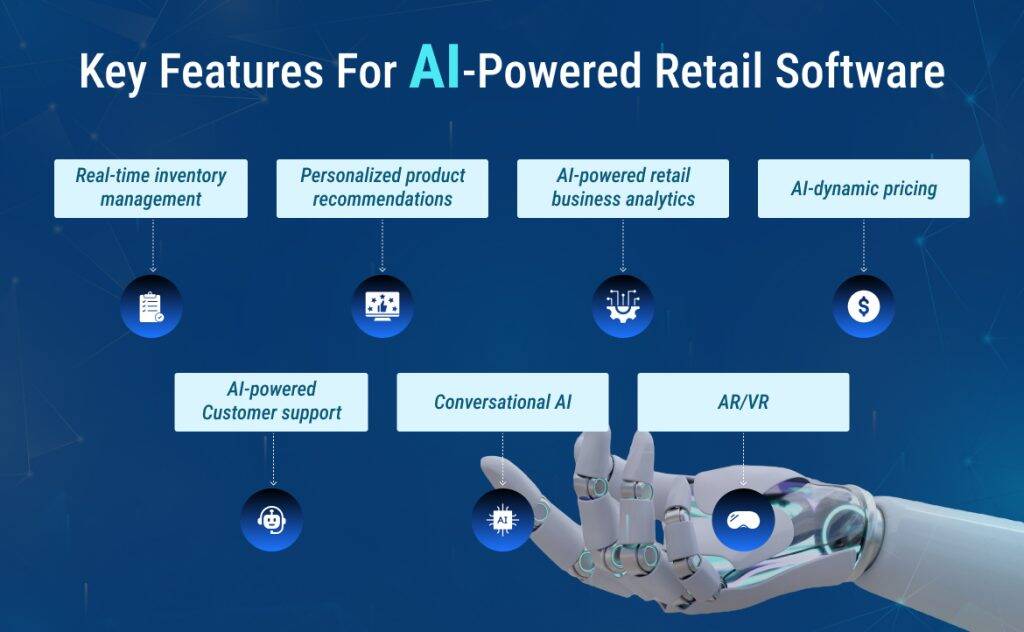
To create a successful AI-powered retail software, you need to integrate some essential features to stand out in the market. Take a look.
1. Real-time inventory management
With these features, retailers can monitor stock levels in real-time, providing insights into inventory across multiple locations. It helps prevent stockouts and overstock situations by making sure that the products are available when customers need them.
2. Personalized product recommendations
With AI algorithms, customer behavior, purchase history, and preferences can be analyzed to deliver tailored product suggestions. This enhances the user shopping experience, increases customer engagement, and drives sales by presenting items that resonate with individual customers.
3. AI-powered retail business analytics
This is the key feature of retail AI solutions, which provide deep insights into overall store layout. Helping you to identify the areas for improvement, optimize product placement, and make data-driven decisions to drive sales.
4. AI-dynamic pricing
Managing the price right is the most challenging task when it comes to retail. This feature can automatically adjust the price based on real-time factors like market factors, customer behavior, and competitor pricing.
5. AI-powered Customer support
Integrating a customer support system powered by AI to provide customers with round-the-clock support, making your employees focused on more important tasks. This feature will improve response time and provide immediate assistance to customers, improving customer experience.
6. Conversational AI
Conversational AI technologies enable NLP interaction between customers and chatbots or virtual assistants. This will improve customer support and engagement, making it easier for customers to get the help they need.
7. AR/VR
AR/VR features not only enhance the shopping experience but allow customers to visualize products in their environments or explore virtual stores. This immersive experience can increase engagement and eventually drive sales.
8. AI-powered workforce optimization
This feature is very helpful in managing labor cost. With AI-powered workforce optimization you can predict peak shopping times and adjust staff according to the hectic days or doesnt go understaffed when peak days are over.
9. Retail virtual assistants
AI-powered virtual assistants can assist customers with their shopping experience, providing product information, answering questions, and guiding them through the purchasing process. This will help you enhance customer engagement and satisfaction.
10. AI-driven product assortment optimization
This is a must have feature which helps in analyzing sales data, customer preferences and location specific trends help you ensure high product in stock. With this feature you can cut down the excess products which are not in demand.
11. Customer insights AI
This feature helps you analyze vast amounts of customer data, whether it’s about their shopping patterns and preferences. This data will help you provide users with a personalized shopping experience and identify high-value customers.
12. AI predictive analytics
When it comes to predicting future demand, what is better than AI predictive analytics. Thai feature helps retailers to analyze historical data and real-time trends to forecast demand for future products and help them make final decisions.
13. Gen AI for anomaly detection
This feature can save retailers from huge losses. The Gen AI for anomaly detection will help them spot irregular patterns in transactions, customer data, and inventory. Moreover, they can catch suspicious transactions and identify operational inefficiencies before they escalate.
14. AI-powered customer segmentation
With this feature, you can categorize your customer based on their demographics, behaviors, and purchase history. You can create a targeted marketing campaign for each segment, helping you to create higher engagement.
15. Visual search for retail
By integrating a visual search feature, you can enable customers to search for products using images instead of text. By uploading a photo or using a camera, customers can find similar products and enhance their shopping experience.
16. AI supply chain management
With this feature, you can analyze data to optimize logistics, inventory levels, and supplier relationships. This will lead to reduced costs, improved delivery times, and a more responsive supply chain.
AI-powered retail software development step-by-step process
To start the process of AI-powered retail software development, you need a strategic plan and an experienced development partner to understand your idea and work accordingly.
Here is a step-by-step process of retail software development to help you get started:
1. Start with a clear strategy
Before you start the retail software development journey, it is crucial to define a clear strategy. Start by determining your needs and what you want to achieve with AI retail software, whether you want to improve your business operations or customer experience.
2. Market research
Do market research and analyze industry trends, customer needs, and other competitors. This process will help you outline the specific features and functionalities so you can achieve your business objectives.
3. Choose tech stack
To start with the development process, choose the appropriate tech stack to create successful AI-powered retail software. You can choose programming languages, AI frameworks such as TensorFlow or PyTorch, databases, and hosting services that will help you with the development of the project.
4. Design architecture
Now, create the system architecture with precise details about how different components will interact and how data will flow with ease. Make sure that the system architecture is built to be strong and scalable so that it can support all the necessary functions for retail operations.
5. Use high-quality data
Now, collect data from various sources, including sales records, customer interactions, and market trends. Ensure the data is accurate, complete, and relevant. Make sure to clean and preprocess the data to eliminate the inconsistencies and errors. You can also use diverse datasets to train AI models, which helps improve their performance.
6. Develop the software
Begin the development process by providing functionality to the frontend user interface and backend server logic. Both processes go hand in hand, backend development ensures the server-side logic, database interfaces and feature integration. However, the frontend takes care of seamless navigation and interactive elements of the software.
7. Testing
Test every software component to make sure they perform as expected. Ask your team of QA to perform various tests on your software to conduct performance, usability, integration testing, and more. With UAT, user acceptability testing ensures that the software satisfies the user’s expectations. Meanwhile, performance testing ensures responsiveness under various circumstances. Before releasing the software in the market, make sure all the issues and errors have been resolved.
8. Deployment and ongoing maintenance
After resolving all the issues, deploy and launch your AI-powered retail software. Choose your deployment strategy, whether it’s on the cloud, hybrid, or on-premises, and implement CI/CD practices for smooth updates. Additionally, offer training sessions for users so that they can use your software easily.
Use cases of AI-powered retail software
Retailers can’t just build AI-powered software and expect it to fix everything with magic.
They need to take a practical approach that focuses on areas of their business where AI in the retail industry can have the greatest impact. There are certain areas where retailers use AI to improve efficiency, drive down costs, and improve customer experiences.
Let’s understand it better by looking at some use cases of AI-powered retail solutions:
1. Merchandising
By leveraging AI-powered retail software, merchandisers can easily redefine product selection and inventory management. They can also predict future trends and overcome overstock and stockout situations.
Moreover, merchandisers can effectively tailor their offerings and strategies by analyzing the data and offering the best prices, which increases sales and profitability.
2. Customer service department
To elevate the customer experience, renowned retailers are leveraging the best AI-powered retail software integrated with chatbots to provide immediate responses to customer inquiries.
Additionally, AI can analyze customer feedback and suggest areas for improvement, whether it is about better communication strategies or improving the overall customer experience.
3. E-commerce operations
AI in retail commerce can elevate the overall ecommerce operations. It can be utilized to enhance user experience through chatbots, personalized recommendations, inventory management, or streamlining supply chain management.
Moreover, retail software powered by AI can analyze customer behavior, easily detect fraud, and identify suspicious activities, eliminating the chance of fraudulent activities.
4. Procurement department
AI-powered retail software is used to optimize procurement processes. By analyzing the data to identify the best suppliers, negotiate optimal terms, and manage purchase processes.
The best part is AI can predict when the stock is short. According to that, it can automate the ordering processes so that the constituency should be maintained in procurement operations.
5. Research and Development (R&D) department
Most individuals think AI in retail is limited to analyzing market trends and improving business operations. Although the benefits of AI retail software are not limited, it can be very helpful to the R&D department in guiding new product development or improving existing ones.
The ML algorithm can predict essential features and innovations that might resonate with consumers in future offerings.
6. IT department
AI-powered retail software can be helpful for the retail IT department. AI can enhance cybersecurity by identifying potential risks and mitigating these threats.
Moreover, it can automate routine tasks and manage the entire IT systems and networks to streamline the entire infrastructure.
7. Store operations management
For retailers who have brick-and-mortar stores, leverage AI-powered retail software to analyze the geographical and demographic data to identify places to expand their reach.
Furthermore, it can efficiently manage the inventory supply chain and streamline the entire retail chain operations.
8. Logistics department
In the retail logistics sector, AI-powered software is driving efficiency and saving costs through innovation. From monitoring the condition of vehicles and supply chain management can reduce downtime and maintenance costs.
With AI-powered software, retailers can easily track the movements of deliverable goods. And can identify potential challenges and interruptions contributing to the logistics processes.
9. Finance and accounting department
Many retailers are leveraging AI based accounting retail software to automate data entry, invoice processing & reconciliation, which is quite beneficial in reducing manual errors and saving time
AI can also help with cash flow management, which can help the finance team make informed budgeting and investment decisions.
How much does it cost to build AI-powered retail software?
When developing AI-powered retail software, analyze cost carefully. The cost of building AI-powered retail software starts at around $20,000 and goes up to $300,000 or more, depending on the complexity of the software.
The cost of developing basic retail AI software begins at $20,000, which includes minimal features and functionality. As the complexity of the software increases, so does the cost.
This means integrating more advanced features, such as machine learning, data analytics, or sophisticated user interfaces. Adding additional functionalities that require more development time and expertise can cost up to $300,000 or more for more complex systems.
Overall, the factors that influence the cost of AI-powered retail software development are the feature you chose, the technologies used, and the development team and their expertise.
So, it is crucial to understand the cost before starting project development. When you understand your needs and the complexity of the software, you can analyze the budget.
It is recommended that you consult the cost with an experienced software development company with expertise in developing AI software and retail software so they can convert your idea into reality.
Tech stack we used in building AI-powered retail software
Choosing the right set of tools and technologies is essential for creating successful AI-powered retail software. We have created a list of tech stacks that we use for creating robust retail software powered by AI.
| Layer | Technology |
| Frontend | React / Angular / Vue.js |
| Backend | Node.js / Python (Flask/Django) |
| Database | MongoDB / PostgreSQL |
| AI/ML Frameworks | TensorFlow / PyTorch |
| Cloud Services | AWS / Google Cloud / Azure |
| Containerization | Docker |
| CI/CD | Jenkins / GitHub Actions |
| Monitoring | Prometheus / Grafana |
| API | REST/GraphQL |
How EmizenTech can help you build AI-powered retail software?
As more and more retailers are investing in AI-powered software development, it has become more crucial than before to stay upfront in this continuously evolving market.
According to the report, retailers who are using retail software powered by AI have seen a 10 to 30% increase in revenue. Not only this, but AI-driven automation can also lead to cost savings, with an average of 20-40% on operational costs.
If you want to achieve the same, invest in AI retail software. This will not only streamline your retail operations but also increase revenue and provide users with a better customer experience.
As a leading AI development company, Emizentech offers AI-driven solutions that enhance your overall retail operations and customer experience tailored to the unique needs of your business. We have expertise in developing software mobile apps for various categories, along with e-commerce sites.
Whether you want to implement AI into your existing systems or want to create AI chatbots to enhance your business operations, we have your back.
Speaking of best, we have successfully created retail apps such as Moriitalia or Colour Pops beauty and cosmetics apps, and you can check out our expertise.
Now, partner with us to build AI-powered retail software that will transform your retail operations and drive ultimate growth.
Conclusion
AI-powered retail software development is not just a trend, it has become a necessity today. Businesses are looking to adopt new technological solutions to be upfront in the competitive landscape. There are endless benefits of AI in the retail market, whether they want to improve customer experience or enhance business proficiency.
The ability to handle AI is remarkable, which leads to better personalized recommendations and increased conversion rates. You can leverage AI-powered mobile app development services and enhance customer engagement through chatbots that provide instant support for their queries.
We hope that with this blog, you have understand the nitty gritty of AI-powered retail software development. Now you can confidently invest in the retail segment. As, the retail industry will continuously evolve, invest in AI-powered software solutions to drive growth and ensure long-term success.
FAQs
How AI can benefit the retail industry?
AI can enhance customer experience through personalization, streamline operations with automation, provide data-driven insights for better decision-making, and optimize inventory management, all of which lead to increased sales and cost reduction.
How is AI being used in the retail industry?
AI is used in retail in many ways: chatbots for customer service, demand forecasting, inventory optimization, and analyzing customer behavior to improve marketing strategies.
What is AI-driven retail software development?
AI-driven retail software development involves creating applications that utilize AI technologies to automate processes, enhance customer interaction, and provide actionable insights for retailers.
What is the future of AI in retail?
The future of AI in retail will revolutionize the entire segment in the upcoming years. It includes more advanced personalization, integration of augmented reality, enhanced supply chain management, and greater reliance on data analytics to predict trends and consumer behavior.
What are the benefits of AI-powered retail software?
There are a plethora of benefits, including improved customer engagement, increased operational efficiency, cost savings through automation, better inventory management and enhanced decision making through predictive analytics.



 +1 (989) 535-9295
 info@emizentech.com
 emizentech


