
 Add us as a preferred source on Google
 In a time when online platforms shape how people connect and communicate, apps like Amino have carved out a distinct space by fostering interest-based communities. They enable individuals to come together based on common interests, such as books, paintings, anime, or video games, activating groups that are intimate and interactive. These networks provide room beyond the social networking aspect; they create among users a sense of belongingness.
Actually, the global market size for online community engagement platforms is projected to reach USD 595.5 million by 2031. That rising trend speaks volumes about how much people adore platforms that are more close-knit and engaging to them.
It requires far more than the addition of chat rooms or streams of content to create community-driven apps like Amino, however. It is all about planning, the appropriate features, security for users, and knowing your audience. In this blog, we will take you through the steps that you would have to follow, from knowing the idea to coming up with features, deciding on a monetization approach, and guessing the cost and time to build. If you are creating from scratch or conceptualizing, this tutorial is aimed at providing you useful insight.
What is Amino & What Does it Do?
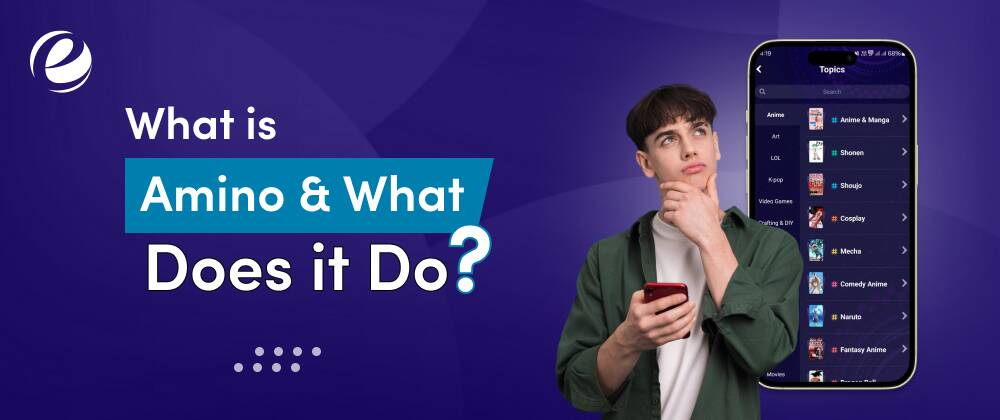
Amino is a social networking app that is community-based and designed for users who want to connect based on their interests. Whether one likes anime, K-pop, art, games, or book reading, Amino is a site where users can discover or create communities to talk, post, play quizzes, and discuss.
Every community on the app is a small, interest-specific group with its members, rules of the community, and topic. This method encourages individuals to become more invested in others who share their interests, rather than navigating through very large, general websites.
What is unique to Amino is its concerted effort to appeal to niche communities. It allows users to be themselves, meet people, and pursue their interests in a personalized but moderated atmosphere. Its mobile-first design also makes it more convenient and more attractive to young people who are used to mobile social apps.
Through this focused and captivating exposure, Amino has richly deserved to become one of the top community-based platforms and can be used as a positive point of reference for an individual interested in creating an app like it.
Key Features That Define a Community-Based App
To construct community-focused apps like Amino, one must incorporate features that enable users to come together, share, and structure their experience in a seamless manner. Seven of these features must be present in every such app:
Community Creation and Management
People must be able to create their own communities centered on specific interests. They must own the name of the group, description, and rules. It attracts the right audience and keeps discussions relevant.
User Profiles
A customizable profile allows users to input basic information, interests, and activity in communities. It allows others to identify with whom they are interacting and maintains a stronger sense of identity within the app.
Content Sharing Facility
The tool should be able to support different types of content, including text, images, videos, and blogs. This will encourage users to share themselves and keep the community interested with fresh inputs.
Group Chats and Forums
Threaded conversations and group chats allow users to easily connect. These features allow effortless conversation, starting debates, or monitoring topics without getting confused by erratic posts.
Interactive Tools, Quizzes, and polls.
Inserting polls and quizzes is a way to make it engaging. They provide an opportunity for users to engage in a friendly and light-hearted manner, and discussions get initiated, and communities become active with new feedback and content.
Moderation and Safety Features
For keeping communities respectful and friendly, moderation features are essential. Admins should be able to delete content, ban members, and enforce rules. There should also be a feature that allows users to report abusive behavior.
Search for and explore options.
A search feature that is intuitive assists in quickly finding communities, content, or members. The explore tab should have new or popular communities so people can learn more about their interests.
How to Build a Community-Based App Like Amino (Step-by-Step)
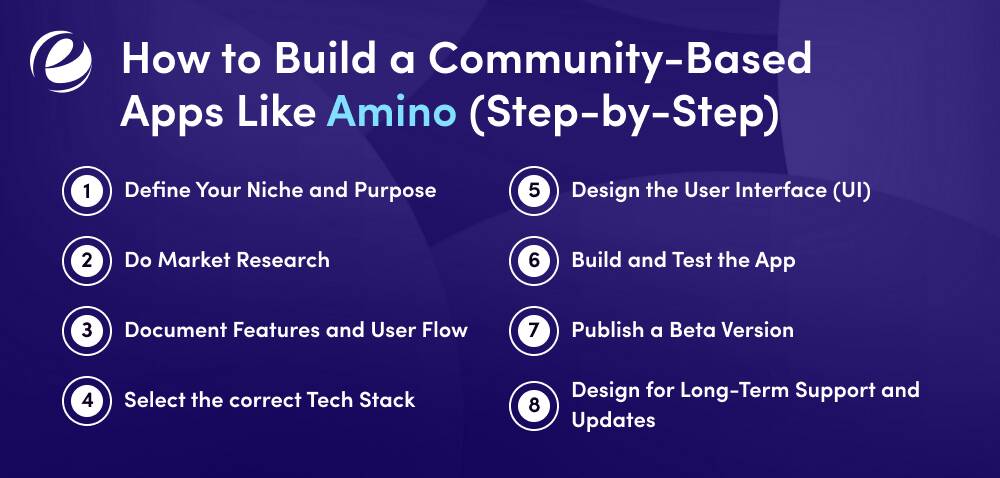
It is not just coding and design that get apps like Amino. It requires planning, understanding how individuals behave, and ensuring the platform can support genuine engagement. Below is a simple explanation of how things went down:
Define Your Niche and Purpose
Begin by determining the type of communities your app will cater to. Will it be open to any and all topics like Amino, or limited to certain interests like fitness, reading, or learning? A niche attracts the right people and establishes a strong user base from the outset.
Do Market research
Look at other community apps to observe what is working and where they feel like they’re falling short. Study what the users expect, what they value the most in features, and what issues they face. This information assists you in molding your app to fulfill actual needs and not on-paper concepts.
Document Features and User Flow
Create a minute-by-minute diagram of what your app will do, from profile setup to having communities run and share content. Then chart out how users will move through the app, from signing up to becoming a member or building communities, so everything has a natural feel and is easy.
Select the correct tech stack
Collaborate with your development team to select technology that supports communication, multimedia content, and user data securely. The proper tools will make a big difference in how quickly, stably, and securely your app becomes, particularly as it scales.
Design the User Interface (UI)
Design a clean, simple look. Prioritize easy navigation, clear icons or buttons, and phone- and tablet-friendly designs. Because community-based applications contain a high volume of content, the design will need to be capable of guiding users to what they are looking for without overwhelming them.
Build and Test the app.
Begin the development process in stages, starting with fundamental features like login, profile setup, and community establishment. Test each segment during development to identify bugs, resolve conflicts, and ensure a smooth experience across various devices.
Publish a Beta Version
Before going out with the final release, release a beta to a smaller group of people. This way, you can get feedback, catch any cracks, and finalize in accordance with actual user experiences before making it available to a wider audience.
Design for Long-Term Support and Updates
Once you launch the app, your work continues. Constant updates, feature enhancements, and technical assistance play a crucial role in ensuring that users remain happy and engaged. Remain attentive to feedback and keep enhancing the app throughout.
Monetization Strategies for Community-Based Apps
Building a good community is merely half the fight of keeping an online successful app running. Once users are hooked, the key is to identify how to keep the platform up and running and keep expanding with sound revenue streams. Five practical monetization strategies that are appropriate for such apps as Amino are highlighted below:
Premium Memberships
A tiered membership structure offers additional features for the price of a year or a month. Add-ons might include ad-free surfing, richer profile capabilities, access to specialized groups, or priority with the material. This is most successful when your program already has an avid fan base who will appreciate upgrading.
In-App Purchases
Allow customers to purchase virtual items like badges on their profile, stickers, layout themes, or packs of reactions. They do not change the functionality of how the app works but bring a bit of fun and personality to it. Since people are engaged and committed to their communities, they will pay a bit to enhance their presence or be creative in self-expression.
Targeted Advertising
Advertising will yield consistent revenue if done in the right way and on time. Ads positioned between content feeds, between posts, or during transitions from application to application can be successful without breaking the process of the user. Adding an advertisement removal feature through a paid scheme is also appealing to users looking for a cleaner interface.
Sponsored Communities and Events
Collaborating with brands, influencers, or organizations to develop sponsored communities generates new revenue streams. They are branded rooms with unique content, live streams, or community challenges. As long as they are user-interest relevant, they are less ad-like and more value-added.
Creators and Community Leaders Support
Providing the users with means to support their favorite content creators or moderators financially using donation or tipping features can enrich the platform. It will make the creators active and engaged and encourage them to provide quality content and reward them with appreciation. It also facilitates the creation of a healthy creator ecosystem within the app.
Cost and Timeline of Building Community Apps Like Amino
The time and cost involved in mobile app development can be so different based on so many variables — the set of features you want, how complex the layout is, if it’s iOS, Android, or both, and what sort of backend you need. The basic version will cost less time and money, and feature-rich apps like Amino will cost more and take more development hours.
| App Version | Key Features Included | Estimated Timeline | Estimated Cost |
| Basic Version | User profiles, text-based chat, post sharing, basic admin tools | 2–4 months | $20,000 – $40,000 |
| Mid-Level Version | Multimedia sharing, polls/quizzes, community moderation, push notifications | 4–6 months | $40,000 – $80,000 |
| Full-Scale Version | Chat, advanced moderation, live streams, analytics, scalable architecture | 6–9 months | $80,000 – $120,000+ |
These are rough estimates and can change according to your app details and development approach.
Top 10 Amino App Alternatives
While Amino does a good job with a community-driven experience, there are a few other apps that enable individuals to engage based on common interests. These platforms differ in their purpose, user base, and how communities come into being and are managed. Below are 10 popular alternatives to Amino that interest-based communities and specialty groups adore:
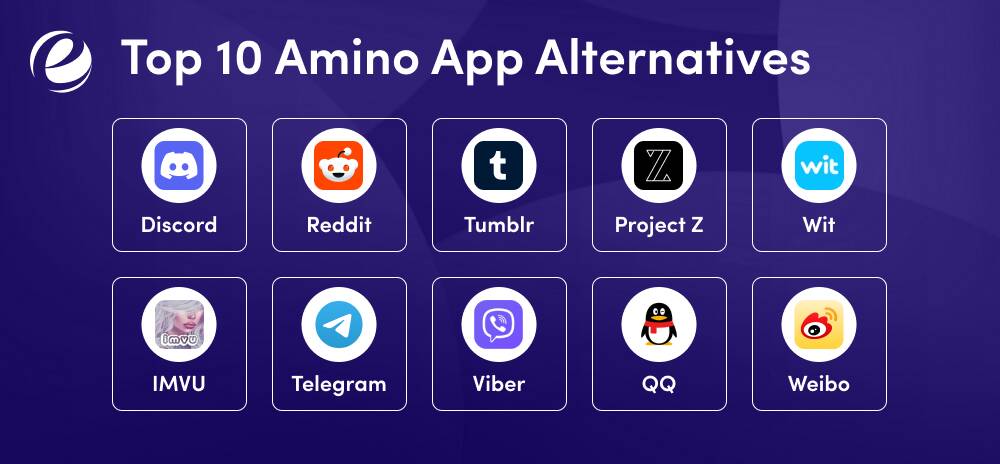
While Amino does a good job with a community-driven experience, there are a few other apps that enable individuals to engage based on common interests. These platforms differ in their purpose, user base, and how communities come into being and are managed. Below are 10 popular alternatives to Amino that interest-based communities and specialty groups adore:
| App Name | Description | Notable Features | Downloads (Google Play) | Availability |
| Discord | A platform for community building through text, voice, and video communication. | Customizable servers, voice channels, and bot integrations. | 100M+ | iOS & Android |
| A network of communities based on people’s interests. | Subreddits, upvote/downvote system, anonymous posting. | 100M+ | iOS & Android | |
| Tumblr | A microblogging platform for sharing multimedia content and short-form blogs. | Customizable blogs, multimedia posts, and community tags. | 100M+ | iOS & Android |
| Project Z | A social platform focusing on fandoms and creative expression. | 3D avatars, virtual spaces, niche community engagement. | 1M+ | iOS & Android |
| Wit | A community app centered around K-pop and anime fandoms. | Multimedia sharing, fan-focused communities. | 1M+ | iOS & Android |
| IMVU | A 3D avatar-based social networking platform. | Avatar customization, virtual goods, and interactive chats. | 10M+ | iOS & Android |
| Telegram | A messaging app with a focus on speed and security. | Channels, bots, end-to-end encryption, and large group chats. | 1B+ | iOS & Android |
| Viber | A cross-platform voice over IP and instant messaging app. | Voice/video calls, stickers, public chats. | 1B+ | iOS & Android |
| A Chinese instant messaging software service and web portal. | Instant messaging, online social games, music, and shopping. | 100M+ | iOS & Android | |
| A Chinese microblogging website, akin to a hybrid of Twitter and Facebook. | Microblogging, trending topics, and multimedia sharing. | 100M+ | iOS & Android |
Why Choose Emizentech to Build Apps Like Amino?

At Emizentech, we possess the craft of social media app development, creating social sites that do more than just bring people together but build enduring communities. With decades of experience designing apps for specialty networks and interactive communities, we understand what it takes to turn an idea like Amino into a reality. From live chat and content sharing to advanced moderation controls, each feature we create is designed with user and admin requirements in mind. Our development cycle focuses on clean architecture, secure connections, and flexibility, so that your app not only works but is ready to scale.
We approach each project with care and close understanding of what most retains users. Our team works closely with you through each stage from strategy and design to deployment and continued maintenance. We’re focused on performance, user experience, and scalability so that your app doesn’t just run great on day one but continues to run great as your user base increases. Should you wish to build a community app with a team who understands both the technical and user perspective, Emizentech can help make that happen.
Final Thoughts
As we’ve come to the conclusion, it’s clear that building community-based apps like Amino requires a well-thought-out plan, the right features, and a strong understanding of what keeps users engaged. These platforms go beyond basic social networking; they create spaces where people with shared interests can connect, contribute, and feel part of something meaningful.
Whether you’re targeting niche enthusiasts or creating more general interactive communities, the point is to select the proper path to development and team. With sufficient vision and technical assistance, your app can become a respected platform where communities flourish.

FAQs
What does it cost to develop community apps like Amino?
The cost is based on the features, platforms (both Android and iOS or both only), design complexity, and duration of development. An easy one-month development can cost between $25,000 and $50,000, and a high-end version with unique features will cost more than $100,000.
How long does it take to create a community app in terms of days or weeks?
The timeline would be 2 to 9 months, depending on the size of the app. It would take two months to build a basic MVP, but an advanced platform would take months to come up with a design, write, test, and deploy.
What maintenance will be needed after deployment of the app?
After launch, the service includes performance monitoring, debugging, feature renewal, and growing the application as user numbers increase. Ongoing maintenance keeps the application running well, securely, and on target.
How is user data protected on a community app?
Security matters too. The app must be developed with safe login mechanisms, encrypted data transmission, proper access control permissions, and security patches applied regularly. Data protection regulations (e.g., GDPR) should also be complied with in an effort to maintain users' data protection status.



 +1 (989) 535-9295
 info@emizentech.com
 emizentech


