
 Add us as a preferred source on Google
 Are you ready to select the best C++ compilers that will meet your project’s requirements in 2026? The global market for C++ application development will expand at a compound annual growth rate of 13.5% between 2026 and 2033 (Source). C++ allows developers to create high-performance applications for gaming, AI and embedded systems, which drives the increasing demand for C and C++ programming and compilation tools.
This guide covers the top C++ compilers, along with their pros, cons, and pricing guidance. It will help you select the right C++ compiler or C compiler for your development needs. From beginners to professionals, users can choose tools that support C++23 and C++26 standards to achieve faster build times and better optimization results.
What is a C++ Compiler?
The C++ compiler is a software tool that translates human-readable code into machine code (binary instructions) that a computer’s processor can execute in multiple steps that include preprocessing, parsing, optimization, and linking. The best C++ compiler functions include checking syntax, linking standard libraries, and producing optimized code for various platforms such as x86, ARM, and GPUs.
Modern compilers such as GCC, Clang, and MSVC increasingly support modular compilation models and are gradually adding support for upcoming standards to improve build performance and code optimization.
Top 10 C++ Compilers to Use in 2026 (Pros, Cons, and Pricing)
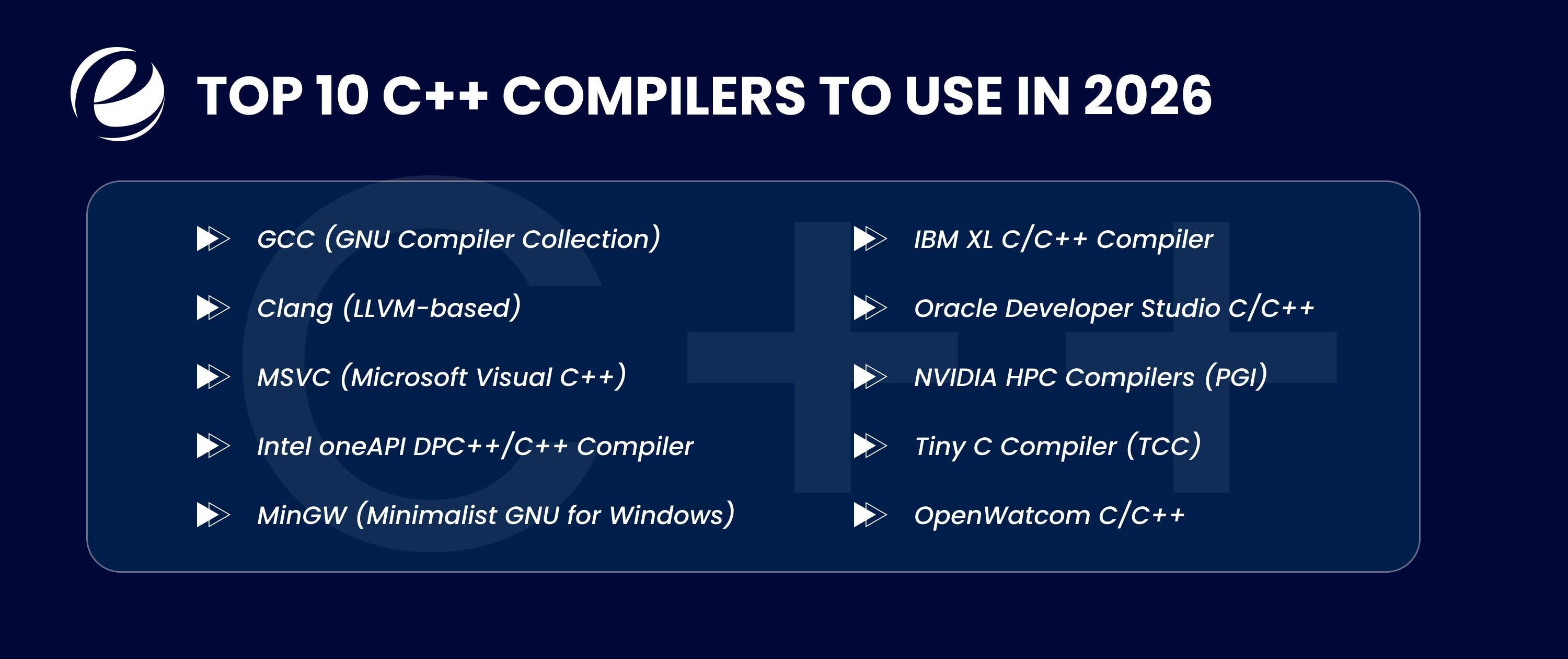
Explore the top C++ compilers for 2026, evaluated by performance, standards support, and value for C and C++ programming and compilation tools.
GCC (GNU Compiler Collection)
GCC 15.1 is one of the leading C++ compilers because it delivers strong C++23 support and the ability to build cross-platform software that operates on Linux, Windows, and macOS platforms.
- Pros: It creates optimized code while utilizing the extensive ecosystem of available resources.
- Cons: The compiler needs significant time to create new code, while users should expect to face challenging situations that result in system failures.
- Pricing: The product offers free access to all users without any charges.
Clang (LLVM-based)
The Clang compiler LLVM/Clang 22.1 provides fast compilation times and accurate error detection, which makes it suitable for large codebases that use the modular LLVM backend system.
- Pros: This provides clear error messages that require minimal memory usage, and it works with GCC compilers.
- Cons: This compiler is not up to the mark, meaning it is weaker on some optimizations.
- Pricing: This provides free access to its services.
MSVC (Microsoft Visual C++)
The Microsoft Visual C++ compiler enables Windows applications to run through its complete integration with the development environment and its partial support for C++23.
- Pros: This offers exceptional debugging capabilities together with IntelliSense features.
- Cons: This requires Windows operating systems, and it consumes a lot of system resources.
- Pricing: It provides a free Community version and a Pro version, which costs $45 or more per month.
Intel oneAPI DPC++/C++ Compiler
Intel oneAPI DPC++/C++ Compiler 2025.3.2 version improves high-performance computing operations by using SYCL to enable GPU processing and oneAPI system compatibility.
- Pros: This provides fast processing through parallel computing while it enhances performance on Intel systems.
- Cons: It requires specific hardware components for operation that result in higher costs for users.
- Pricing: The system provides a free toolkit for users to access.
MinGW (Minimalist GNU for Windows)
MinGW allows users to run GCC on Windows operating systems, which makes it an ideal solution for users who need to create small C++ compiler programs without the extra features of Visual Studio.
- Pros: The compiler provides a small footprint, and it enables users to operate their system using Unix.
- Cons: Manual setup can be tricky, and there is no simple GUI installer.
- Pricing: It offers free access to its services.
IBM XL C/C++ Compiler
IBM XL uses LLVM technology to provide enterprise-level performance improvements for applications that operate on AIX and Power systems.
- Pros: It signifies high performance through its math library, which produces exceptional results.
- Cons: It operates on specific platforms that require expensive licensing fees.
- Pricing: This requires users to purchase commercial licenses for its use.
Oracle Developer Studio C/C++
Oracle Developer Studio provides an advanced, high-performance development environment for Solaris/SPARC through its combined testing and analysis functions.
- Pros: It supports multiple programming languages that allow users to build large-scale applications.
- Cons: This compiler supports only Solaris/SPARC platforms, lacking broad cross-platform compatibility.
- Pricing: The system offers free software access to its users.
NVIDIA HPC Compilers (PGI)
The NVIDIA HPC SDK 24 software package allows developers to accelerate their CUDA and OpenACC programming work, which targets GPU processing for AI and simulation applications.
- Pros: The compiler provides GPU optimization capabilities that allow users to generate output for multiple target systems.
- Cons: It requires users to learn operations because it supports only NVIDIA products.
- Pricing: The system offers a free SDK.
Tiny C Compiler (TCC)
The TCC system enables instant script execution through its minimal C compiler requirements that allow users to develop their projects.
- Pros: The compiler creates extremely small programs that deliver rapid performance.
- Cons: This supports only basic C++ functions because it lacks advanced optimization features.
- Pricing: It operates as a free software product.
OpenWatcom C/C++
The OpenWatcom system allows space-efficient code compilation which maintains reliability across various platforms to serve embedded and legacy systems.
- Pros: It performs well on DOS systems while using minimal system resources.
- Cons: The compiler fails to meet current industry standards that need to be included.
- Pricing: This operates as a free software product.
How to Choose the Best C++ Compiler for Your Project?
Several factors must be considered when selecting one of the best C++ compilers for your software development project, based on your requirements and current market demand. You should evaluate C++23/26 support together with compilation speed, and you can select the best compiler for your project based on compatibility with IDEs such as Visual Studio. C++ development requires experienced developers who can create optimized builds. Testing compilers and build performance on your hardware helps select the most efficient setup, saving development time and improving performance.
Why Do Experts Choose Full C++ Compilers Instead of Online Compilers?
The experts prefer using the Full C++ compilers that include GCC and Clang because these programs give them superior control over their development work. Online tools limit file sizes, lack custom settings, and need the internet, risking privacy for big projects. The complete compilers enable users to work without internet access, while they provide no limits on large code, and they deliver fast performance because of their ability to optimize code execution and their ability to work with integrated development environments for debugging purposes, which makes them ideal for actual C and C++ programming and compilation tools.
Final Words
With the help of this blog, you can choose one of the best C++ compilers for your projects that matches all your requirements in 2026. Your projects should follow standards while matching your chosen platforms and optimizing performance, so you need to use pro workflows without facing online limitations. Modern compilers allow fast build processes that lead to improved code quality for all C++ compiler requirements
FAQs
Which compiler is best for beginners in C and C++?
The best compilers for beginners in C and C++ are Clang/GCC for Linux/macOS, MinGW (GCC) for Windows, or all-in-one IDEs like Code::Blocks (with MinGW).
Which C/C++ compiler is easiest to use?
MSVC via Visual Studio is the easiest, offering a full GUI IDE (Graphical User Interface Integrated Development Environment) with one-click builds, auto-completion, and tutorials, ideal for quick starts.
Is CLang or G++ better?
Clang provides clear error messages and faster performance, while G++ (GCC) delivers superior optimization capabilities that users can select according to their specific requirements.
Is IDE a compiler?
The IDE system functions as an editor and debugger that operates by invoking GCC or MSVC as its built-in compiler.




 +1 (989) 535-9295
 info@emizentech.com
 emizentech


