
 Add us as a preferred source on Google
 The construction industry is adopting technology at a fast pace to automate operations, cut down on delays, and make the project more visible. With the increasing demand for personalized digital tools, the investment in good construction project management software has become a necessity. This hi-tech software solution is helping construction owners, managers, consultants, and tech leaders do all the necessary work related to teams, budgets, and timelines with a lot more competence and professionalism.
But to develop such custom-made software, skilled construction management software developers with in-depth knowledge of the industry’s unique challenges are needed. The current blog post contains the subject of hiring software developers who can build the very best construction project management software tailored specifically for your company’s needs.
Construction Project Management Software Market Outlook 2026-2030
According to TechSciResearch, The construction project management software market is expected to increase from approximately $4.07 billion in 2024 to $7.4–8 billion by 2030 at a CAGR of about 10% from 2026 to 2030.
This upward trend of the market is supported by the digital shift, smart city development, and efficient project delivery necessities.
North America is in the front rank, while Asia-Pacific and some of the rest of the world are catching up quickly.
Why Custom Construction Project Management Software?
Custom construction project management software is specifically designed to cater to the peculiarities of the site, resources, and workflow, which the generic construction project management tools often fail to manage.
- Tailored for Construction Needs: It aims to manage the complicated construction workflows in all their phases, from planning to implementation, by providing the specific characteristics that your firm requires.
- Accurate Budget Tracking: The made-to-order solutions facilitate the process of cost estimation and expense control, thereby enabling the construction projects to have fair financial transparency and profit margins.
- Smarter Scheduling: Unlike the generic platforms, it is efficient in managing the dependencies of equipment, labor, and timeline, which leads to fewer delays and rework of the projects.
- Real-Time Data Access: The teams get to see the updates live; thus, they get to improve decision-making and have the tasks done in the right time and manner throughout all the phases of construction.
- Compliance and Safety Management: It is during the construction activities that the standards, safety norms, and legal compliances that are absolutely needed in large infrastructure and real estate projects are maintained.
Benefits of Custom Software
The development of custom project management software is a way of providing tailored, scalable, and flexible solutions, which can be used and adapted to effectively meet the specific requirements of the construction industry.
- Customized construction solutions: Custom project management software is much more capable of managing the unique workflows and challenges of the construction sector than the off-the-shelf solutions.
- Integration Capabilities: The construction software solutions offer integration with bookkeeping, CRM for construction industry, and ERP applications in such a way that it will not alter the use of the applications but will enhance it.
- Enhanced Scalability: In a way, Custom software development for construction companies can be a remedy to the project scope, personnel, and operations; thus, it is very adaptable.
- Improved Efficiency: The corresponding construction project management tools help a lot in the process of communication, scheduling, and task management, where the entire team involved can easily go through.
- Long-Term Flexibility: Tailored construction project management software will not be static but will evolve with the new technologies like IoT applications and AI software development services that are entering the construction industry.
Key Features of Effective Construction Project Management Software
Today’s construction project management software should be supported by flexible, scalable, and customizable features for easy execution, budgeting, compliance, and collaboration among teams.
Scheduling & Resource Allocation
The powerful scheduling tools help in manpower, equipment, and material assignment, which eventually results in on-time completion of projects and also proper utilization of resources throughout the construction process.
Budgeting & Financial Tracking
The actual budgeting and simultaneous financial tracking promote cost-monitoring transparency, which leads to an increase in profitability, and also improves the decision-making process for each construction project.
Real-time Progress Updates
A central dashboard showcasing project metrics in real-time is what enables managers to identify issues at an early stage, make quick decisions, and monitor the development stage constantly.
Mobile Access for On-Site Teams
The emergence of the mobile-friendly construction project management app has ensured that the on-site teams receive updates, get new tasks assigned, and work together with the office staff without any interruption.
Document Management & Collaboration
The document control system that supports the sharing of blueprints, contracts, and updates securely, therefore, increases collaboration and reduces the rework due to outdated information.
Compliance & Reporting
Construction managers have the help in complying with and documenting safety regulations, which is ready for the audit at all times, provided by automated compliance checks and report generation.
Steps to Hire Developers for Construction Management Software
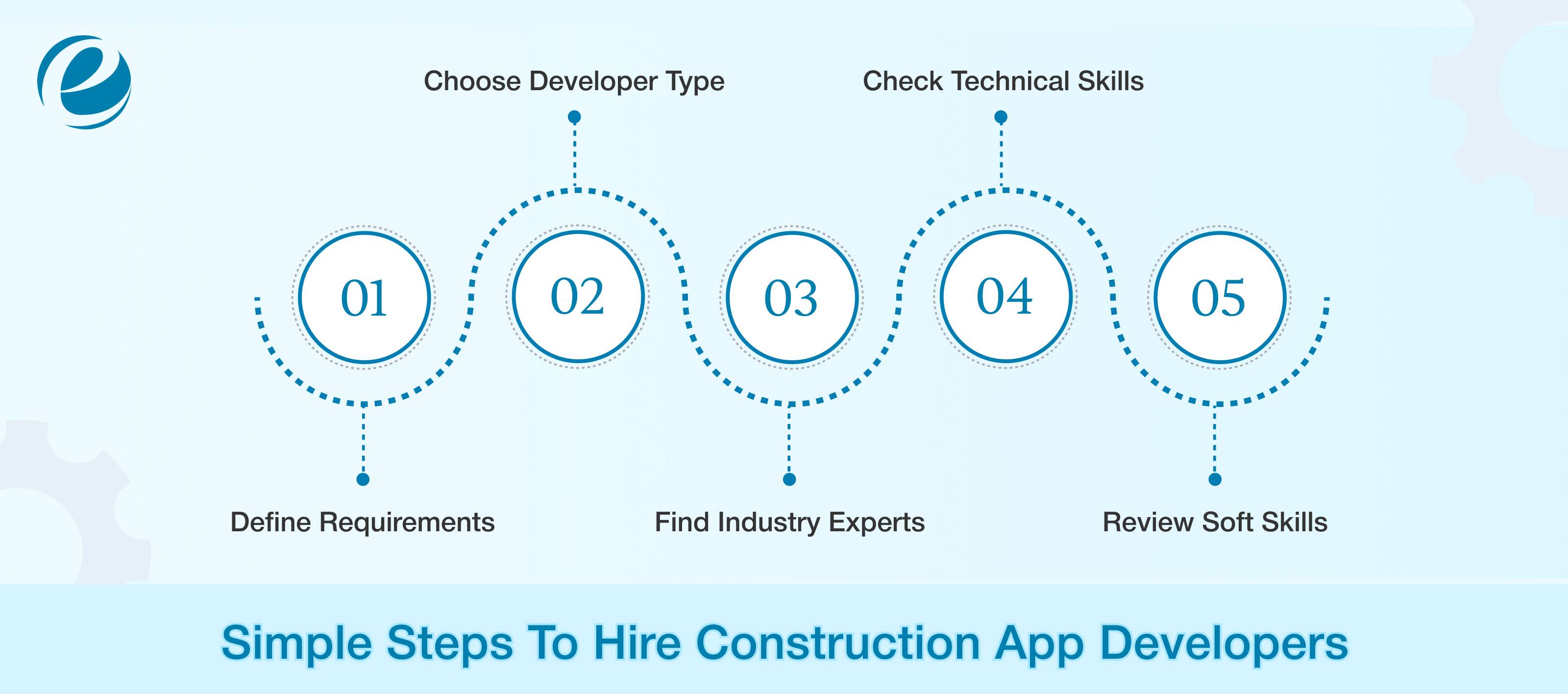
Having the construction software developers who are high-quality involves the process that is well prepared in advance so as to ensure that you will meet the very specialists who are capable of producing reliable, industry-specific solutions.
Identify Your Software Needs and Requirements
Before going further with the custom-made software development, the major goals, the needed features, and the people who will use your custom project management software should first be identified and described.
Determine the Type of Developer You Need
According to the project’s complexity and the technical requirements, decide what you need to employ a developer, full-time, freelance, or hire full-stack developers.
Look for Developers with Industry-Specific Expertise
To get the most out of the domain and to have a system that is practically useful on-site, choose the construction management software developers who are well-versed in construction-related software development.
Evaluate Technical Skills & Technology Stack
Investigate the knowledge of modern frameworks, integration of project management software, and construction software development technologies, such as cloud and mobile applications.
Soft Skills & Communication
Communication, collaboration, and adaptability are strong skills of a developer that help developers align with the business goals and deliver efficient construction software solutions effectively.
How to Assess the Developer’s Capabilities?
The evaluation of a developer’s capabilities ensures that the construction project management software is built by experts who comprehend the industry-specific needs.
Portfolio and Case Studies
Look at their previous projects in the area of construction software development to assess their experience, quality, and creativity in the field of custom project management software and construction project management tools.
References and Testimonials
Checking client reviews and testimonials from the construction sector will be the first thing to do in order to determine the construction software developers’ credibility, reliability, and satisfaction in the industry.
Technical Assessment
Make use of technical interviews or provide sample tasks for the testing of solutions, frameworks, and software for project management software for construction companies and software for construction.
Cost Considerations: Budgeting for Custom Software Development
A realistic budget for construction project management software not only helps to ensure a smooth development process but also high quality and a long-term investment return through efficient project work.
Factors Influencing Cost
The main factors affecting the cost of a construction software project are the amount of the project, the technology stack, the functionalities, the construction management software developers, and the skills of the team. Larger systems would need more resources and custom integration.
Estimating Development Costs
Custom software development for construction companies may consist of simple project management applications or suffer from enterprise-level solutions, depending on the desired functions and the duration of the project.
Maintenance and Support Costs
Post-launch maintenance that promises performance, updates, and security. Construction software developers usually provide support for bug fixes, feature enhancements, and system optimization for the duration of the software, along with the software.
Cost vs. Value
The initial cost of development might be surprising, but the custom project management software will eventually yield a better ROI in the form of automation, efficiency, and reduction of operational waste, thus being less costly over time.
| Cost Component | Estimated Range (USD) |
| Planning & Requirement Analysis | $5,000 – $10,000 |
| Design & UI/UX | $8,000 – $15,000 |
| Development & Integration | $25,000 – $60,000 |
| Testing & Quality Assurance | $5,000 – $10,000 |
| Maintenance & Post-Launch Support | $3,000 – $8,000/year |
When wisely planned, construction companies will be able to hire specifically the construction management software developers for the construction project management app development that can grow with the organization.
The Development Process: What to Expect?
Construction project management software development services in defined stages, and each stage secures the defined quality, usefulness, and scalability that are particular to the industry’s unique concern being solved.
Planning and Discovery Phase
Construction software developers will consider the business goal, figure out the necessity, and delineate workflows as part of a specialized software development for construction process to support the construction.
Design and Prototyping
Designers will create a user-friendly UI/UX for custom project management software for construction companies with a focus on usability, aesthetics, and immediate access to information for the on-site team.
Agile Development Approach
Construction software development companies will apply Agile methodology for the production of construction project management app development modules that are flexible, collaborative, and delivered quickly.
Testing and QA
The software will be subjected to rigorous testing on every individual component to ascertain the performance, security, and availability of the integrated construction project management tools or modules.
Deployment and Maintenance
After testing, the software solution will be delivered to the client. Then, the specialized hiring software developers will handle long-term maintenance, performance updates, and support.
Collaboration Between Construction Teams and Developers
Customized project management software installed with the help of a construction team and a developer working on construction software proves to be a winning idea.
Effective Communication
Just suppose a construction site where managers send real-time updates through a custom project management software to developers. The clearness of the communication helps the construction software solutions to be the most efficient as they are implemented to meet the needs of daily operations accurately.
Defining Roles and Responsibilities
Moreover, when construction software developers comprehend their roles, it results in custom construction project management software, which is a perfect fit for job priorities, timelines, and reporting workflows.
User Involvement
Definitely, the engagement of site engineers and supervisors in the development of a construction project management app facilitates developers in addressing the requirements of the construction project management by giving them more practical and user-friendly construction project management tools.
Real-World Case Studies: Success Stories
Success stories of construction project management software going live demonstrate and explain how tailored solutions lead to changes in operations, efficiency, and collaboration in the construction industry.
Case Study 1: Streamlined Operations
The construction company achieved task coordination and project delay reduction by using custom project management software to automate scheduling and budgeting.
Case Study 2: Enhanced Communication
Site managers and construction management software developers improved the pace of the decision process and pinpointed resource allocation by real-time communication. They did this through the use of construction software solutions.
Key Takeaways
Firstly, these case studies are evidence of the fact that the development of construction software that is specific to one’s workflows results in easier project execution and returns on investment in the long run.
Hence, the success accomplished can be mirrored by companies through the recruitment of construction software developers for construction industry
Latest Trends in Construction Software Development
The construction sector is being transformed at a very rapid pace through the introduction of new technologies, which not only make project management software smarter but also make it more efficient.
Cloud-Based Construction Software Solutions
By using Cloud-based construction software solutions, users can have access to project data at any time and from any place, thus fostering cooperation and enhancing the safety of the data among different teams. This centralization allows for live updates to be done smoothly, which is essential in the control of complicated construction projects.
AI and Machine Learning
The combination of AI and Machine Learning not only takes over menial tasks but also predicts the risks associated with the project and arranges the schedule and manages the cost in the best way. The technologies provide managers with analytics, allowing them to make informed decisions based on data that reduces the time taken and thus increases the overall success and profit.
Internet of Things (IoT) Applications in Construction Industry
Iot applications in construction industry are making the sites smart via the use of sensors and internet-connected devices. These IoT tools not only keep track of the usage of machinery but also supervise the environmental conditions and give immediate feedback, which results in a great increase in the operational efficiency and safety of the site.
Mobile-First Construction Project Management App Development
The development of a Mobile-First construction project management app guarantees that people in the field can report the progress and get access to the information through their smartphones and tablets, promoting communication and decision-making on the spot.
Understanding trends empowers readers to hire skilled developers in cutting-edge technology.
Mistakes to Avoid When Hiring Construction Management Software Developers
Certainly, there are many mistakes that unexpectedly occur while hiring software developers that could be avoided easily, and thus, make your project much smoother, and ultimately, you would get a construction project management software that is just great in performance.
Lack of Clear Requirements
The lack of clarity in communicating your goals, the timelines, and the desired features in the software, which is the case for construction project management software developed by your teams, will lead to confusion and consequently cause rework quite often.
Choosing Developers Without Relevant Experience
Custom project management software being developed from scratch would imply that the software will not be able to depict or include your present workflows, regulations, and functionalities if you do not bring in the construction software developers who have been through the construction industry.
Underestimating Costs or Timelines
If you do not consider the time involved for the proper development of the deconstruction software, you will surely end up with costs far exceeding the budget and a timeline much longer than the expected one. In turn, these two results will negatively impact the efficiency and ROI of a project.
Not Prioritizing Ongoing Support
When the system goes live, not doing maintenance or updates will lead to unreliability. On the other hand, continuous support helps to keep the construction software solutions secure, scalable, and of the same high performance.
How to Choose the Right Construction Software Development Company?
The selection of the development company for the construction software is an unavoidable step in the creation of the custom project management software, which focuses on your needs. EmizenTech and the like are distinguished by their vast knowledge of the construction industry, the reliable technology stack, and client-focused approach.
Industry Expertise
The best to choose are the ones who have not just made construction software but also perfectly understand the field challenges.
Proven Track Record
Check out the portfolios and case studies proving the success in building project management tools.
Transparent Communication
The partners should be those who always put providing the updates and having a collaborative workflow as their number one priority.
Post-Launch Support
Proper maintenance and quick problem-solving are crucial to every team member for success in the long run.
The right choice of development partner guarantees you scalable and efficient solutions customized for the construction project management.
Conclusion
The investment in custom construction project management software is a good decision to optimize operations, control costs, and improve cooperation between the different construction teams. Recruiting professional construction management software developers is a guarantee of obtaining software that is scalable, efficient, and tailored to the industry and that will meet the increasing demands of your company.
The entire process of hire developers, from setting precise goals to considering technical skills and communication, goes a long way in contributing to successful software delivery. By working with skilled construction software development companies, one can do away with guesswork, cut down on delays, and consequently get a higher ROI.
It is a must for construction companies to invest in the most advanced custom project management software and also to hire software developers for construction industry who will turn real concerns into smart digital solutions if they want to be in the race.
FAQS
What’s the difference between off-the-shelf software and custom software for construction projects?
Off-the-shelf software applications give access to basic functions, while custom software specifically for construction project management provides workflows that are designed according to the irregularities of the industry.
Can I build custom software if I have a limited budget?
Of course, starting with a small project is possible. A number of software developers within the construction industry have scalable plans in place so that you can get a budget-friendly construction software solution.
What are the best technologies for developing construction project management apps?
By all means, cloud, AI, IoT, and mobile are among the favorites as they make up the foundation for the most efficient construction project management apps to be developed and integrated.
How long does it take to develop custom construction software?
The process of making custom project management software usually lasts from 3 to 6 months, and it depends on the features, complexity, and expertise of the company in construction software development.



 +1 (989) 535-9295
 info@emizentech.com
 emizentech


