 Add us as a preferred source on Google
Does your monolithic application find it hard to scale with growing demand? The Monolith to Microservices Migration is the new thing, and it is changing the way people do business, with 74% of big corporations intending to switch from monolithic to microservices by 2026.
According to Mordor Intelligence the global market for microservices is projected to reach $5.61 billion by 2030 as more companies migrate to microservices. This post provides a practical guide that reformulates the migration from monolith to microservices into distinct and executable steps for smooth transformation.
What Is Monolith to Microservices Migration?
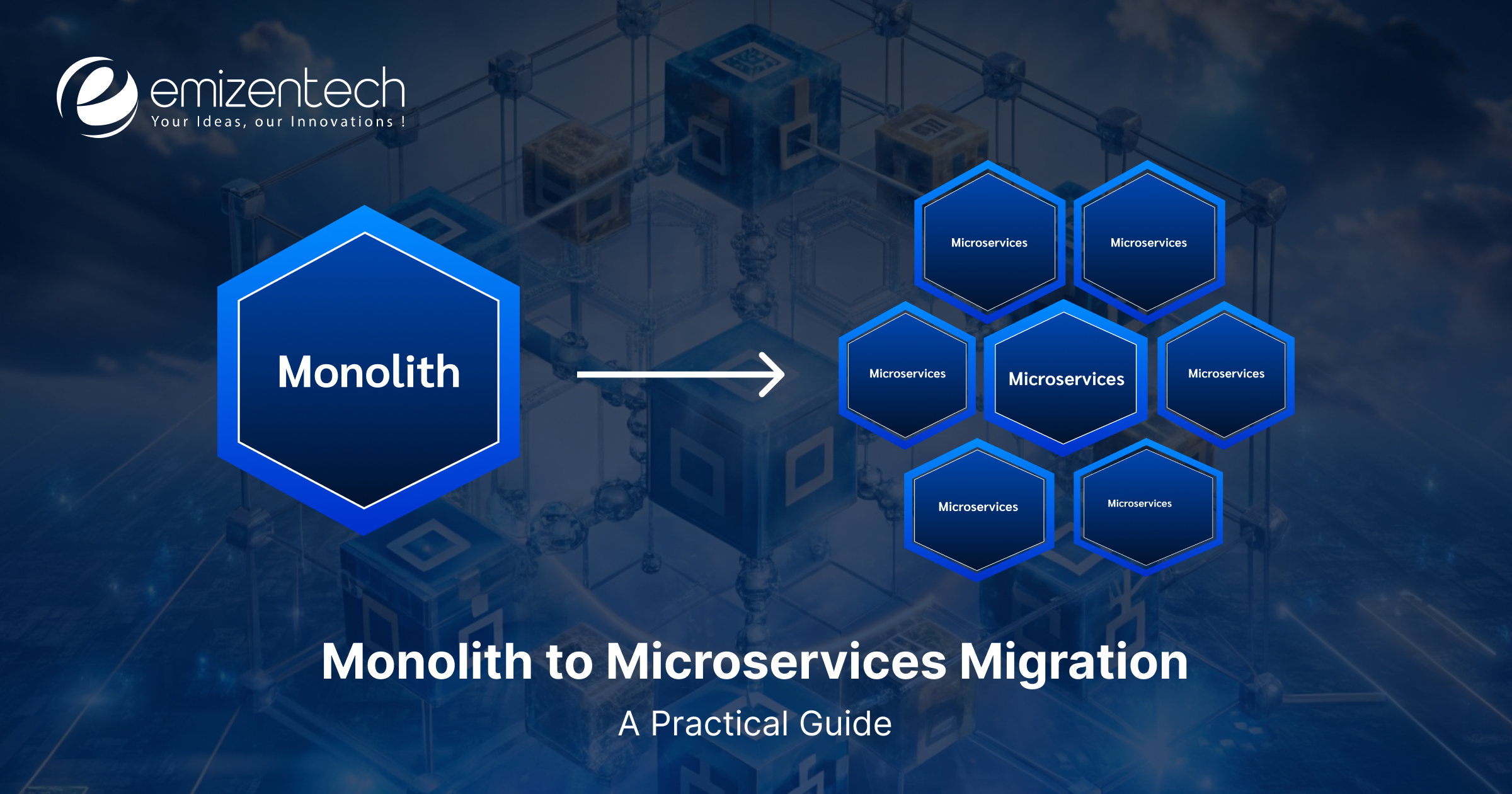
Monolith to Microservices Migration is a term used to depict the method of a tightly coupled, single, and huge application being split into independent, loosely coupled, and small microservices. The difference between monolithic and microservices is that now the different teams can work on different services, deploy them, and even scale them separately.
Monolith to microservices migration process not only transforms traditional single applications into specialized services connected through APIs, but also services that are easy to scale and deliver continuously. It is expensive to maintain the robustness of the transition, and businesses will be able to adapt faster to the market demands thanks to the modular architecture. Companies will get a mix of flexibility and reliability during the migration period.
Should You Migrate from Monolith to Microservices?
Are You Considering Monolith to Microservices Migration? First, check your application’s scalability requirements and also the migration complexity, since this is a radical change.
Signs You’re Ready for Microservices
- Traffic spikes overwhelm your monolith: The user load is so high that you cannot avoid the decomposition of the Monolith into microservices for scaling independently.
- Slow deployments hinder agility: The process of migrating the monolithic application to microservices allows faster and more frequent releases per service.
- Team bottlenecks slow development: Migration from monolithic to microservices architecture lets you have different teams working on different parts simultaneously.
When You Should NOT Migrate
- Small app with stable traffic: Microservices bring unnecessary complexity and overhead to small apps that have stable traffic.
- Limited engineering resources: Now, suppose there are limited engineering resources. In that case, it is going to be very difficult and would require a high level of DevOps maturity, which is beyond the majority of small teams.
- Consolidated regulatory compliance: With a single codebase, audits and compliance validation are made easier.
Monolith to Microservices Readiness Checklist
- Modular code structure verified: Find out if the decomposition of the Monolith into microservices is possible.
- API gateway infrastructure ready: It helps in the communication part of the Monolith to Microservices Migration process.
- Monitoring tools in place: They help in tracking the service health after migration from monolithic to microservices.
Business Triggers for Migration
- Revenue growth exceeds capacity: Revenue flow is so high that the current system cannot take it; hence, Monolith to microservices makes targeted scaling possible..
- Innovation cycles accelerate: Migration from monolithic to microservices architecture is a process that increases deployment velocity.
Team Preparation Steps
- Cross-functional skills assessment: This is to make sure that the migration of the monolithic application to microservices will go smoothly.
- Migration pilot project launched: This is a safe way of testing the feasibility of the Monolith to Microservices Migration.
Understand Your Monolith Before Migration
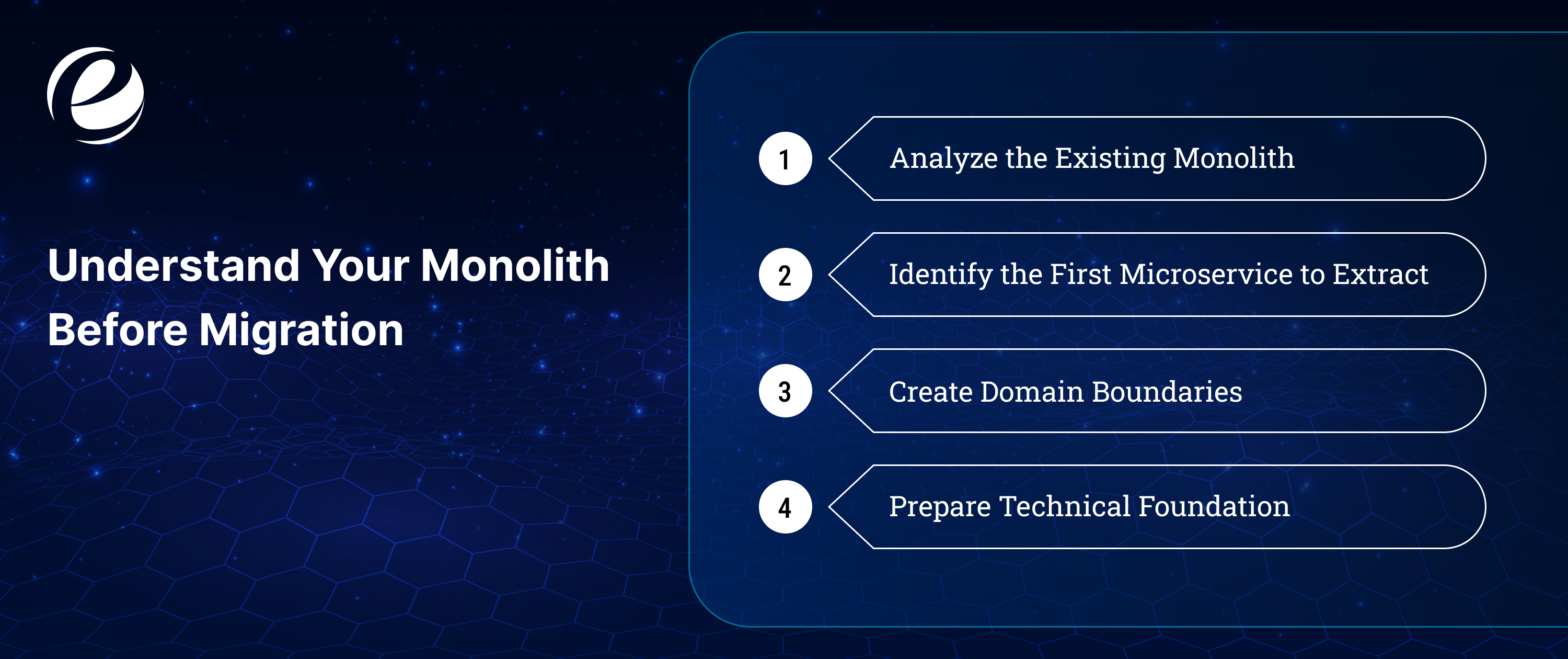
Prior to deploying migrating monolith to microservices, make a detailed map of your current architecture to discover areas where you can break it down and also to reduce risks.
Analyze the Existing Monolith
- Dependency mapping: The monolith to microservices transition necessitates mapping the module couplings before extraction so as to avoid the creation of distributed monoliths.
- High-change areas: Locate the high-change areas first that require the scalability improvements of migration from monolith to microservices.
- Document business domains: The domain-driven design illuminates the migration from monolithic to microservices by establishing distinct bounded contexts.
Identify the First Microservice to Extract
- Choose stable, low-risk modules having minimal data dependency: The migration from monolithic to microservices architecture should focus on the bounded contexts that have little or no database access.
- Prioritize high-business-value services: The separation of monolithic services into microservices yields the fastest ROI through the independent scaling of services.
- Choose loosely coupled components: It guarantees the transition from Monolith to Microservices Migration will be smooth and will require very little refactoring of the database.
Create Domain Boundaries
- Apply Domain-Driven Design principles: Unambiguously describes the boundaries of migrating a monolith to microservices.
- Map bounded contexts: Thwarts monolithic to microservices anaemic services.
Prepare Technical Foundation
- Implement API contracts early: This practice is beneficial for the communication patterns between monolithic and microservice architectures.
- Set up service mesh infrastructure: This practice offers visibility for the entire transition from monolithic to microservices from the very beginning.
Monolith to Microservices Migration Strategies

Monolith to Microservices Migration Strategies necessitate meticulous planning; you should choose between full rewrites or slow evolution according to your team’s power and the business’s urgency.
Big-Bang vs Incremental Migration
Big-Bang rewrites everything at the same time for the sake of monolith to microservices purity, thus risking downtime during migration.
Incremental takes out services step by step, thus facilitating migrating a monolith to microservices with the least disruption and continuous value delivery.
The Strangler Fig Pattern Explained
This method encircles the existing monolith with new microservices while gradually taking over its functions. By doing so, the monolith-to-microservices transition becomes smoother.
New functionalities are assigned to microservices; old legacy calls die out as the extraction from monolithic to microservices becomes complete without any issues.
Branch by Abstraction Technique
Make stable interfaces for the unstable modules and later on change the backend implementations during the Monolith to Microservices Migration without disruption.
This method allows migrating a monolith to microservices by first eliminating the dependencies through abstraction.
Multi-Phase Service Extraction
Service extraction starts from reporting, and then goes to user management-prioritizing the least risky monolith to microservices candidates for steady progress.
Creating the momentum through successful milestones during the migration. Also consider AI ML Consulting Services to accelerate your monolith to microservices migration with expert architectural design and automated service-extraction strategies.
Designing Microservices the Right Way
To achieve successful microservices design, one needs to establish precise limitations and use well-documented practices guaranteed to make the transition from monoliths to a microservices project deliverable in terms of scalability and maintainability.
Defining Service Boundaries
In Domain-Driven Design, bounded contexts serve as a boundary for a smooth transition from a monolith to microservices, thereby avoiding the creation of weak services that could hinder the migration.
The Single Responsibility Principle specifies that each service has one business capability and, at the same time, prevents over-segmentation that would split the monolithic-to-microservices migration into unmanageable services.
Common Microservices Design Mistakes
Distributed monoliths through shared databases, service-to-service intercommunication with too many API calls, and synchronous dependencies recreate tight coupling, which prevents the migration from monolith to microservices.
Monolith to microservice components, chatty services multiply network calls, creating latency that is worse than the original monolith.
Over-granular services force excessive network management during migration from monolithic to microservices without providing any business value.
Database-per-Service Pattern
Each microservice has exclusive ownership over its data schema, thus allowing independent scaling and evolution of the Monolith to Microservices Migration.
Monolithic to microservices migration is still supported, though, by eventual consistency between using either event sourcing or CQRS.
API Gateway Implementation
A centralized entry point acts as a router during the migration from monolith to microservices and masks the complexity of the services that clients are not aware of.
The process of transitioning from monolithic to microservices becomes easier with unified authentication and rate-limiting features.
Database Migration Challenges and Approaches

Database Migration Challenges and Approaches are the most hazardous part of switching from a monolithic architecture to microservices, which, in turn, requires very careful data ownership strategies to avoid production failures.
Why Database Decomposition Is Risky
Using a shared database creates very strong coupling, which in turn negates the benefits of the monolithic to microservice migration, thus risking data consistency during the extraction.
Transactions that cross services die when Monolith to Microservices Migration occurs, hence breaking the ACID guarantees, which are crucial for business operations.
Practical Database Migration Approaches
Using the Strangler pattern, read data is duplicated while new writes are targeted to microservices, thus enabling a gradual transition of the monolithic database to the microservice database.
Event sourcing is a methodology through which state changes are captured for monolithic to microservices data migration across service boundaries.
CQRS Pattern Implementation
By having separate read/write models, it becomes possible for monoliths to microservices databases to grow in different directions without the risk of breaking changes.
The migration from monolith to microservices is optimized by custom-tailoring the data models according to the needs of either the query or command side.
Saga Pattern for Distributed Transactions
Compensating transactions take the place of 2PC in the monolith to microservice migration scenario, thereby preserving consistency across the split databases.
Choreography or orchestration, is a reliable method to coordinate updates to the data from monolithic to microservices.
Keeping Production Stable During Migration
Keeping Production Stable During Migration involves solid methods and techniques to keep and control the uptime of the system throughout the whole process, and thus avoid any losses resulting from failure during migration.
Zero-Downtime Migration Techniques
- Blue-green deployments executed in parallel with old and new services during the migration from monolithic to microservices, instantly switching traffic with no loss of service.
- Canary releases slowly send the users to the new microservices, thereby detecting the problems at the earliest stage.
- Backward-compatible APIs make it possible for the clients to move from one service to another during the extraction without experiencing any interruption.
- Feature flags allow immediate rollback of the defective deployment without any changes in the code.
Rollback and Failure Handling
- Devices, such as breaking circuits, separate failures to limit cascading failures in the system.
- Feature flags provide a way to put back the deployment of the code having issues instantly, without the need to change the code.
- Kill switches cut off traffic right away to the services that are not stable during the period when migrations are happening, and there are crises.
- Stop the migration if the production SLOs go down below 99% or if the team is getting burnt out, consider stability more important than velocity.
Monitoring and Observability Setup
- Distributed tracing identifies and pinpoints latency during migration by tracking requests across monoliths to microservices boundaries.
- Golden signals monitoring makes sure that migrating a monolith to microservices keeps SLOs throughout the transition.
Traffic Management Strategies
- API gateway routing sends requests for features to the specific microservices while the legacy application remains during the process of monolith to microservice extraction.
DevOps Requirements for Microservices Migration
Let’s start with some supporting requirements from the DevOps side for the movement of microservices. That would be the reason for the continuous distribution of services to be possible; however, the Monolith to Microservices Migration pattern is still performed in a way that retains the original concept of this distribution.
Essential Tooling (Minimum Setup)
The usage of container orchestration, such as Kubernetes, not only simplifies the migration process of monolithic applications to microservices but also maintains the management of such deployments during the migration process across the clusters automatically.
CI/CD pipelines facilitate the process of migrating monolith to microservices by taking care of the testing and releases per service automatically.
| Category | Tool |
| Containerization | Docker |
| Orchestration | Kubernetes |
| CI/CD | Jenkins, GitLab CI, CircleCI |
| Monitoring | Prometheus, Grafana, ELK Stack |
| API Management | Kong, AWS API Gateway |
| Service Mesh | Istio, Linkerd |
| Refactoring | SonarQube, IntelliJ IDEA |
| Database | Event Sourcing tools (Kafka) |
Team & Ownership Changes
Cross-functional teams are responsible for the entire process of services, changing the traditional siloed monolith ownership model to one with complete lifecycle responsibility.
You develop, operate, and manage accountability, which involves being on-call ready and minimizing the operational burden by installing automatic monitoring and self-healing systems.
Cost, Performance, and Complexity Trade-offs
Cost, Performance, and Complexity Trade-offs show which factors get pricier, such as infrastructure and tools, while drawing attention to microservices’ gains in scalability and deployment speed. The migration from monoliths to microservices is a costly route, but at the same time, it is a journey towards agility and thus helps the teams to decide wisely.
What Gets More Expensive: Distributed systems require 35-50% more money for infrastructure that is mainly used for orchestration, monitoring, and networking.
What Improves with Microservices: The frequency of deployments goes up by 60%, independent scaling focuses on the services that need it the most, and the mobile app development team’s speed is increased due to working in parallel.
Cost Breakdown for Monolith to Microservices Migration Roles
| Role | Average Cost (USD) |
| Solutions Architect | $180,000/year |
| DevOps Engineer | $150,000/year |
| Backend Developer | $140,000/year |
| Database Specialist | $160,000/year |
| QA Engineer | $120,000/year |
| Platform Team Lead | $200,000/year |
The total cost for the first year of the whole team amounts to approximately $950,000 for migrating from a medium-sized monolithic architecture to microservices-based projects and vice versa. Microservice infrastructure modernization accelerates migration success.
A 30–60–90 Day Monolith to Microservices Migration Plan
The first step is the preparation needed to execute this migration, which is going to take 30, 60, and 90 days with the help of a migration plan that accounts for the whole process of migrating monolith to microservices.
Days 1–30: Planning & System Mapping
Start with an analysis of the dependencies and a domain model to spot the candidates for the extraction of the monolith into microservices. While planning the migration from monolithic to microservices, define the service boundaries according to the DDD principles, create success metrics and risk mitigation strategies for the smooth execution of migrating the monolith to microservices.
Days 31–60: First Service Extraction
By applying the Strangler pattern, the service that has the least risk and the highest value will be extracted first. Route the new traffic through an API gateway while allowing the monolith to continue its operations. Validate CI/CD pipelines and the observability metric to confirm production stability at the start of the migration from the monolith to the microservices architecture.
Days 61–90: Stabilization & Optimization
With the monolith service as a performance baseline, get to 90% feature parity while measuring monolithic to microservices performance gains. Deploy 2-3 additional services with database-per-service boundaries at the same time. Implement a service mesh for traffic management and distributed tracing for reliability.
| Phase | Key Deliverables | Success Metrics |
| Days 1-30 | Architecture maps, extraction roadmap | 100% module coverage analyzed |
| Days 31-60 | First microservice live | Zero-downtime deployment achieved |
| Days 61-90 | Three services operational | 50% faster feature deployment |
Common Monolith to Microservices Migration Mistakes to Avoid
Mistakes in Migration from the Common Monolith to Microservices, if not avoided, can lead to the collapse of even the most financially supported projects, thus causing the consumption of resources during the migration process and, consequently, the nullification of the promised benefits in terms of agility.
Rushing Without Proper Analysis
The monolithic to microservices migration discovery is skipped, which results in the improper delimitation of services and infinite refactoring. The teams pull out the interconnected modules, making distributed monoliths rather than a real microservice architecture.
Underestimating Operational Complexity
Migration from monolith to microservices requires highly developed DevOps, but teams do not take monitoring, tracing, and alerting into account. During the transition, production failures will spread across services.
Premature Database Decomposition
The removal of shared databases too soon disrupts monolith-to-microservices transactions and leads to data loss. The slow data migration through event sourcing is the solution to preventing monolith-to-microservices disasters.
Ignoring Team Readiness
Technical teams give it a shot with service extraction without the cross-functional ownership training. Remote developers find it hard to manage the production accountability completely from start to finish during the transition.
No Rollback Strategy Defined
If blue-green or canary deployments are not implemented, then an outage during the extraction of the service is a risk. Feature flags allow for safe experimentation and instant rollback when problems arise.
Rewriting Instead of Extracting
Full rewrites waste years, while the Strangler pattern extracts incrementally. Live your monolith while building services around it for continuous value delivery.
Migrating Too Many Services at Once
Big-bang migrations put everything at risk based on untested patterns. Take out one service at a time, confirm success in production, and then grow the method.
Ignoring Organizational Constraints
The technical side of things is ready, but that does not mean the team is ready in terms of skills and culture. Train for cross-functional ownership before trying service extraction.
Real-World Lessons from Failed Migrations
The Real-World Lessons from Failed Migrations highlight the most important issues in the transition from monolith to microservices, where 70% of endeavors fail because of the operational realities being ignored.
Amazon’s Early Service Explosion
Over the monolithic to microservices transition, hundreds of nano-services were created, but the people working in the teams were overwhelmed. The transition was only successful after the API standardization was done.
Salesforce Database Nightmare
Conducting the migration from monolith to microservices broke the shared schema access and consequently resulted in a week-long outage. Instead, the transition required a gradual implementation of event sourcing.
Uber’s Cascading Failures
The early microservices transition was marked by poor circuit breaking, allowing one failing service to crash the entire system, thus demonstrating that architecture purity does not matter as much as reliability patterns.
Netflix Rollback Crisis
Not having feature flags during the migrating monolith to microservices meant that full redeployments had to be done. After the failure, canary releases became obligatory.
Monzo Bank’s Scope Creep
Initially, it was only one service that was meant to be done, but everything in the monolithic to microservices migration got rewritten. Strict Strangler pattern enforcement was the reason why subsequent extractions were saved.
When Is Monolith to Microservices Migration “Done”?

When Is Monolith to Microservices Migration “Done”?. Migration completes when business value, faster deployments, and independent scaling exceed operational costs, not when every line of code moves to new services.
Business KPIs Exceed Monolith Baseline
The migration from monolithic to microservices is successful when the frequency of deployments goes up three times and the lead time is reduced by 50%. It is the rate metrics that matter, and not the percentage of code migrated.
New Features Always Target Microservices
The migration of monolithic to microservices is completed when greenfield development completely avoids the monolith. Legacy extraction turns into maintenance-only.
Team Owns Services End-to-end
The maturity of the monolith to microservice transition is shown when the developers are running production without any intervention from the platform team during operations.
Core Monolith Handles <20% Traffic
The migration is successful if the outsourcing services are taking over 80% of the production load. The decrease of the monolith confirms the expansion of the deployment of services independently, thus the targeted resource allocation.
Migration Playbook Documented
Next teams will independently take out the services by applying the techniques that have been proven to be successful. The recorded playbooks are an indication of an ongoing capability that is not dependent on the migration oversight coming from the leadership.
Note: Monolith to microservices Migration enables flexible storefronts powering modern headless commerce platforms.
Conclusion
Moving from monolithic systems to microservices changes the inflexible applications into ones with the ability to scale easily; however, the victory is not a rewriting but a proper planning of the migration. This article describes the analysis, gradual extraction of the Strangler pattern, and the application of strong DevOps for an orderly change.
The teams that can realize the quickest and independent scaling as business value do so through complete decomposition. A demand for strictness in the splitting of the services, the database strategies, and the techniques of no-downtime becomes critical.
Collaboration with the top professionals for software development services for an effortless migration is a must. Start your 30-60-90-day plan now; sustainable agility always defeats architectural purity.
FAQs
What is a monolith to microservices migration?
A monolith to microservices migration is the process of transforming a single, tightly coupled application into a collection of smaller, independent services. Each service is designed to handle a specific business function and can be developed, deployed, and scaled independently. This approach improves scalability, flexibility, fault isolation, and allows teams to work faster by updating individual services without affecting the entire application.
How long does migrating monolith to microservices take?
The usual duration for migrating a monolith to microservices is around 3-12 months. It is advisable to start with 30-60-90 day sprints that will target the milestones of the transition from monolithic to microservices, such as the extraction of the first service and its validation in the production environment.
What are common monolithic to microservices migration challenges?
One of the major challenges encountered during the transition from monolithic to microservices is the database coupling and the complicated implementation of distributed tracing. The use of Strangler patterns and the gradual migration of monolith to microservices approaches are among the ways to ensure a successful transition from monolith to microservices.
Is monolith to microservice migration always worth it?
No, the small teams will not go through the complexity of the migration unless they foresee the need for scaling. Migration is a good choice for high-traffic apps that require separate deployments.
What tools support monolith to microservices migration?
The process of migrating from monolithic to microservices is facilitated by the use of Docker, Kubernetes, and API Gateways. Besides, transitioning from monolith to microservices necessitates the establishment of CI/CD pipelines and observability stacks for the success of production.





 +1 (989) 535-9295
 info@emizentech.com
 emizentech


