 Add us as a preferred source on Google
The eCommerce landscape is evolving rapidly, with businesses facing challenges like shifting customer behavior, economic stress, and the increasing power of AI. In order to stay ahead, businesses must go global and offer frictionless shopping experiences to international customers.
One of the biggest challenges of going global is? Language barriers.
Research indicates that 75% of online shoppers prefer to buy from sites with content in their native language. However, failing to localize business is losing sales opportunities. Translating manually is time and labor-consuming, though, which is a problem for retailers to scale.
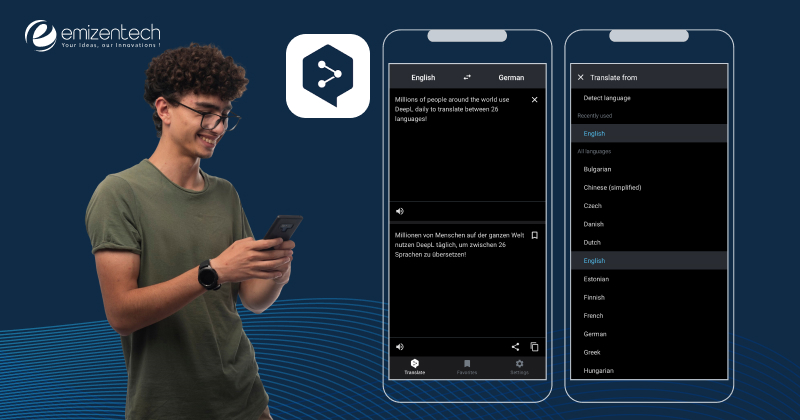
DeepL’s machine translation bridges the gap. It enables eCommerce businesses to automate translations, improve content quality, and localize at scale – enabling them to target high-growth markets.
A study by Forrester Consulting found that DeepL:
- Reduced translation time by 90%
- Delivered a 345% return on investment
- Saved businesses €2.79 million over three years
In this guide, we’ll explore how DeepL integration with e-commerce platforms can revolutionize the businesses by breaking down language barriers and unlocking new opportunities worldwide. Let’s dive in!
What is DeepL?
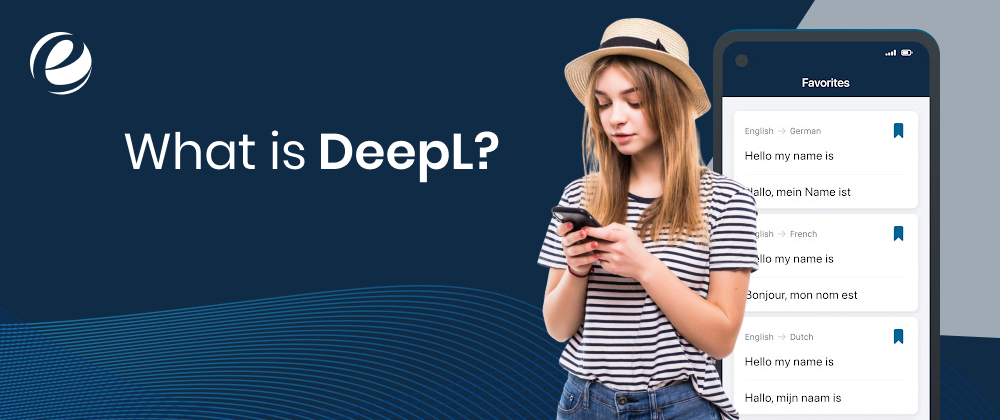
DeepL is not simply a translation program, it’s a deep learning AI-powered language tool that has revolutionized the application of how businesses and individuals work together with translation.
Established by the Linguee team in 2017, DeepL applies neural network technology to provide more than mere word-for-word translation. The way it differs from basic translation software is that it pays attention to context, tone, and cultural detail, so the translations sound natural, fluent, and genuine.
What sets DeepL apart is that it is able to translate entire sentences and paragraphs, taking into account the actual meaning of the words rather than translating them literally word by word. Using deep learning models, it is able to recognize idioms, sentence structure, and regional variation, making it one of the most accurate translation software available today.
How Does DeepL Work?
Machine translation has progressed from the initial rule-based systems to more sophisticated AI-based solutions. Initial models of translation used rigid linguistic rules or statistical processes, in which translations were created by analyzing vast amounts of bilingual text and extracting frequent patterns.
These early solutions had their limitations – translating word by word or short phrases without knowing the overall sentence.
Now, Neural Machine Translation has totally revolutionized the way it’s done. It differs from the traditional models in that they utilize neural networks to scan the entire sentence instead of scanning individual words. Rather than scanning individual words alone, it scans the entire meaning of a sentence before it gives a translation.
An app like DeepL is a perfect example of an advanced NMT system. With its deep learning technology, it learns and adjusts in various contexts and delivers more natural and human-like translations. Its capacity to handle enormous data makes it one of the most accurate and intelligent translation systems today.
Why Multilingual Support is Crucial in eCommerce
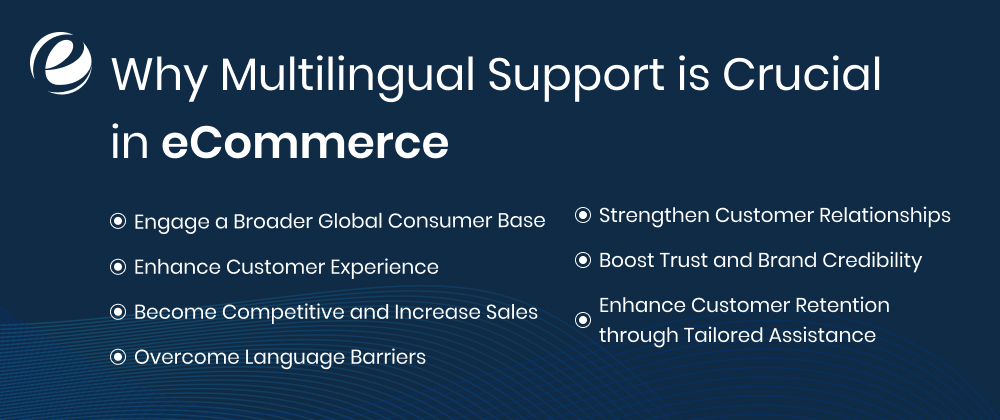
Did you know that over 75% of web shoppers prefer to shop in their own language? Even more convincingly, almost 40% will not complete a purchase if a site does not offer their language. The message is clear – if customers can’t read the content, they won’t buy.
But beyond language preference, there are strong reasons why Multilingual eCommerce support is a game-changer for businesses.
1. Engage a Broader Global Consumer Base
Communicating with consumers in their own language increases confidence and interaction. If an e-commerce website caters to only the English-speaking population, it misses out on trillions of income from non-English clients. By providing content in numerous languages, companies can engage new customers, increase brand awareness, and generate extra income globally.
2. Enhance Customer Experience
An effortless shopping process in a buyer’s native language raises satisfaction as well as loyalty. If buyers are able to understand product details, shipping details, and service support easily, then they have high chances to buy. A localized customer care service also raises the level of trust, which causes high retain rates and recurring business.
Customers prefer to shop with brands that offer a local-language shopping experience. Multilingual ecommerce support makes customers feel that they are being heard and appreciated, increasing the chances of repeat purchase.
3. Become Competitive and Increase Sales
Without the ability to be multilingual, companies lose customers to their competitors who can offer a local shopping experience. The eCommerce development market is very competitive, giving customers plenty of choices. Companies that offer multilingual customer support are distinguishable and can retain customers and boost sales with greater ease.
High competition, in current times, makes a multi-language eCommerce website not just a decision but a necessity. Language being made more simple, the brands are able to reach larger people, strengthen customer relationships, and maintain growth over the years.
4. Overcome Language Barriers
If an eCommerce site is not language-enabled, site visitors will get confused while surfing on the site, reading product descriptions, or even looking for assistance. This frustration tends to result in cart abandonment and lost business opportunities. Enabling multiple languages helps ensure customers can easily shop around, make well-informed choices, and place orders without confusion.
5. Strengthen Customer Relationships
Speaking to customers in their language instills confidence and gives them the security of feeling that they can trust your brand. Customers feel at ease proceeding with the purchase when given product information, price, and guidance through a language they comprehend. This added stream of communication makes shopping easier and maximizes the chances of repeat business.
6. Boost Trust and Brand Credibility
A store that respects language diversity gains credibility with its customers. Clients understand that it is dedicated to their language and culture, so they feel more connected and thus tend to select and recommend your store against others.
7. Enhance Customer Retention through Tailored Assistance
eCommerce businesses that don’t provide support to multilingual consumers miss out on almost 30% of prospective customers. Alternatively, firms that invest in localized communication have better customer satisfaction and loyalty.
Support for a user’s native language improves the shopping experience, confidence, and enables long-term relationships. With an emphasis on personal, culturally aware interactions, companies can increase levels of retention and foster lasting growth.

Benefits of DeepL Integration with eCommerce Platforms
DeepL integration with e-commerce opens up the doors of infinity, allowing businesses to reach out to the world with operations seamless and cost-efficient.
1. Smooth and Cost-Effective Localization
DeepL’s sophisticated translation features guarantee that product descriptions, customer reviews, and marketing content are translated correctly. In contrast to simple tools, it preserves the original intent and tone, which makes content more engaging to local customers. For instance, a top European eCommerce merchant utilized DeepL to translate thousands of customer reviews, instilling trust and eventually driving conversion rates.
2. Quicker Expansion to Global Markets
It will not take long to go global, but DeepL does the translating, enabling companies to enter markets quickly. It avoids the extensive waiting time for human localization, providing companies with a competitive advantage. A fashion brand used DeepL to speed up translations and enter several European markets within a few months – a process that would have taken years using conventional practices.
3. Reduce Operating Expenses
It is expensive to hire massive volumes of human translators. DeepL’s artificial intelligence platform reduces the need for human translation, and businesses can cut their costs while growing their content at a quicker rate. DeepL-related businesses have saved tremendous amounts of money and added ability to translate greater content in a limited budget, enabling them to invest their money in marketing and business development.
4. Improved Customer Support
With DeepL embedded in customer service software, enterprises can deliver real-time Multilingual support. This means your customers, wherever they are will be assisted in their mother tongue, which translates into greater satisfaction and loyalty. For instance, DeepL’s browser extension works seamlessly with tools like Zendesk so that customer service teams can communicate with customers of any language easily without any barrier.
5. Content Management Made Easy
Managing multilingual content can be a bit complex, but DeepL for eCommerce makes that easier with native support for integration with content management systems (CMS). That support enables companies to handle all the translations from a single location, so everything is current and less work is required for manual, tricky updating. With that arrangement, companies can prevent mistakes such as duplicated content and enhance overall workflow efficiency.
6. Enhanced SEO Performance
Precise translations also contribute to vast improvement in SEO. With your content properly translated, your site will end up ranking higher on the local search page results, hence resulting in increased view and traffic to your site. Your online store will thus end up being accessed by potential buyers easily, hence boosting sales and business.
Integrating DeepL for eCommerce into your platform is a potent method of streamlining processes, optimizing customer support, and optimizing your overall online presence.
How DeepL Can Be Integrated into eCommerce Platforms
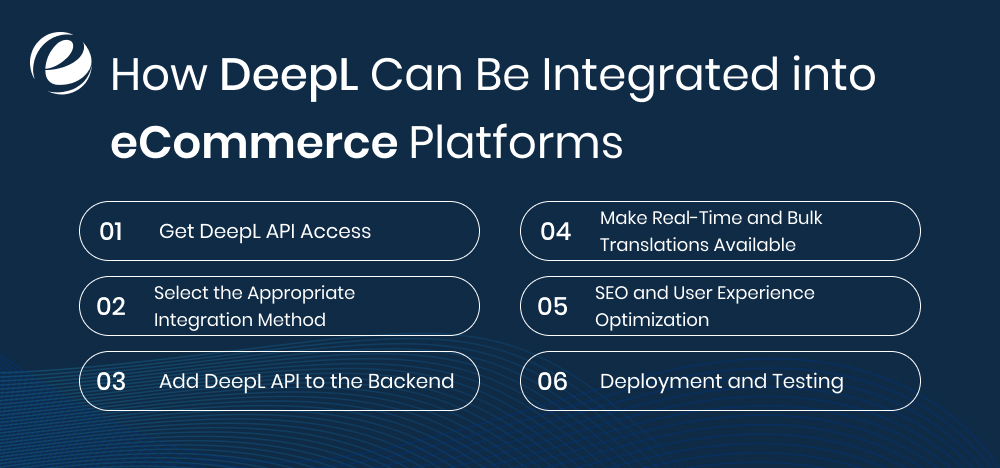
We appreciate at Emizentech the importance it makes to achieve a smooth multilingual experience for eCommerce. Introducing DeepL as an add-on within an eCommerce platform enables businesses to become international through offering accurate translation to product names, checkout process, and customer interactions. Follow these easy steps to successfully integrate DeepL:
Step 1: Get DeepL API Access
The initial step to integrating DeepL into an eCommerce platform is obtaining API access. Companies must register for a DeepL API Pro account and create an authentication key. This key enables the system to utilize DeepL’s translation capabilities and supports automated multilingual content creation.
Step 2: Select the Appropriate Integration Method
Varying eCommerce platforms require integration in a different way. For Shopify and BigCommerce, third-party apps like Weglot or Langify can be utilized in order to integrate DeepL for automated translations. Open-source platforms like Magento and WooCommerce need custom module development to create an interface with DeepL’s API. For headless or custom-coded eCommerce platforms, DeepL API can be integrated directly in the backend to give dynamic content translation.
Step 3: Add DeepL API to the Backend
After the DeepL integration with e-commerce is decided, the second step is to integrate the DeepL API into the backend system. This is done by using DeepL’s official SDKs and programming libraries in Python, PHP, Node.js, and Java. The APIs need to be implemented by the developers to automatically translate key content, such as product descriptions, category pages, and customer reviews. This step translates all content updates in real time without any human intervention.
Step 4: Make Real-Time and Bulk Translations Available
To enhance the customer experience, companies need to have both real-time and bulk translation functionality. Real-time translation allows customer queries, chatbot answers, and user content to be translated in real time, enhancing engagement. In contrast, bulk translation allows for processing large product catalogs and static web pages efficiently, saving effort and time. This way, the entire eCommerce site is offered in several languages.
Step 5: SEO and User Experience Optimization
Insertion of DeepL is not just content translation but has to include international SEO-optimized translated content as well. Companies have to ensure that URLs, meta titles and descriptions, and product descriptions are localized accordingly to enhance search ranking globally. Over this, automatic language detection helps to provide user experience by leading customers to the language version of the site they would like to see, thereby generating higher engagement and conversion.
Step 6: Deployment and Testing
Before implementing DeepL integration with e-commerce on a live website, extensive testing is necessary. It includes checking for accuracy in translation, API response, and whether caching mechanisms are properly configured to avoid loads. A staging environment will be utilized while testing before roll-out of the multi-language feature worldwide. It is also best to conduct regular monitoring to determine performance without any delay after roll-out.

Real-World Use Cases
DeepL integration with e-commerce can be a big step towards business communication of companies with customers across other regions. It can boost customer satisfaction, streamline operations, and open the doors to international expansion. The following are some real-life examples depicting how companies have used DeepL effectively:
1. Alza: Enhancing Customer Satisfaction With Localization
Alza, being the largest Europe-based internet retailer, utilized DeepL to localize to markets. Automation enabled them to translate due to removing 90% of its translations and saving more than €2.79 million. Customer support and offering information concerning the products within native languages ensured easier customer satisfaction improvement as well as easier borderless expansion.
2. Kazar: In-Market Growth at Lightning Speed
Fashion store Kazar utilized DeepL to expand into new markets fast by translating hundreds of thousands of product descriptions in minutes. This was helping them save time and grow their sales in new markets without the delays that come with using traditional methods.
3. KoRo: Saving Time on Multilingual Content Creation
KoRo, an online business, utilized DeepL to manage their content translation requirements. Automating the process, KoRo saved 80% of the time that would have been spent on translation, enabling their team to work on other essential business activities while maintaining their multilingual content up-to-date.
4. Paysend: Boosting Customer Support with Real-Time Translation
With DeepL embedded in their Zendesk, Paysend improved customer satisfaction by 10%. Through the integration, they were able to answer customer queries on time and with precision by removing language barriers, streamlining their customer support process.
5. Shopify Integration: Streamlining Multilingual Processes
eCommerce sites such as Shopify can also use DeepL through automation platforms such as n8n. This setup enables companies to automate translation easily, where multilingual eCommerce stores are always updated at any time. This also enables eCommerce companies to have a global presence with time saved for the translation process.
These instances illustrate how DeepL integration with e-commerce can result in enhanced efficiency, improve customer experience, and quick global growth – all that is required for competing in today’s global marketplace.
Best Practices for DeepL Integration
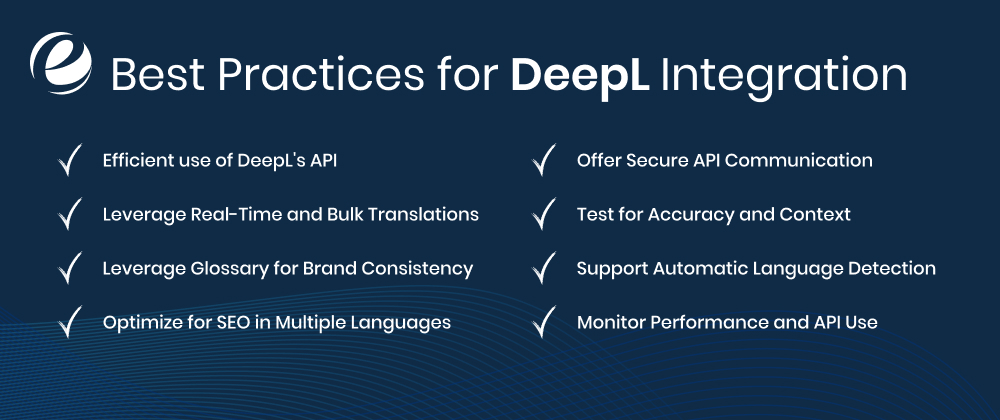
Deploying DeepL in an efficient manner provides users with a frictionless multilingual experience. For maximum utilization of it, execute the following best practices:
1. Efficient use of DeepL’s API
DeepL is equipped with a strong API whereby companies can mechanize website and application translations. Efficient usage of API calls through grouping several requests for translation within a single call accelerates response and lowers cost of processing. Proper deployment yields an improved user experience with fluid content delivery.
2. Leverage Real-Time and Bulk Translations
For interactive conversations like chat support and customer support, real-time translation provides instantaneous communication without delay. Conversely, for large volumes of content like product descriptions, bulk translations maintain homogeneity with fewer repeated API calls. An optimal balance between the two methods maximizes operating efficiency.
3. Leverage Glossary for Brand Consistency
Brand reputation is established based on strong messaging across languages. DeepL glossary feature enables companies to establish exact translations for product names, industry jargon, and slogans. In that way, important words are the same no matter the language, which enhances credibility and trust with global customers.
4. Optimize for SEO in Multiple Languages
To become influential in international markets, business enterprises must aim at multilingual SEO methods. It involves translation of meta titles, descriptions, and URLs along with correct use of hreflang tags. Properly crafted multilingual content not only enhances search engine listings but also offers a localized experience to the end users.
5. Offer Secure API Communication
With the addition of translation services, security must be the top priority. Encrypting API requests through HTTPS keeps sensitive information safe from cyber attacks. Businesses also need to audit API access, implement rate limiting, and authenticate to shield against unauthorized access and ensure data integrity.
6. Test for Accuracy and Context
While machine translation has improved a long way, there are still cultural and context-based differences. Firms should be subjected to intense tests, verifying accuracy in testing various languages. User feedback and A/B testing can further refine translation to be even more in line with local flavor and industry requirements.
7. Support Automatic Language Detection
Automatically detecting a customer’s preferred language improves their web-browsing experience. Companies can use automatic language detection based on browser language or location to enable them to view content in their preferred language without manual settings. This eases navigation and improves engagement.
8. Monitor Performance and API Use
Regular API performance check-up and monitoring of translation requests enable companies to streamline costs and detect areas of improvement. Usage statistics review enables companies to fine-tune their integration, eliminate redundant API calls, and increase overall translation quality. Regular performance checks ensure effective and efficient multilingual support.
Partner with Emizentech for Seamless DeepL Integration in Your eCommerce Store
Expanding your eCommerce business across international markets means overcoming language barriers to effectively reach a multicultural customer base. DeepL integration with e-commerce can significantly expand your global reach by providing accurate and contextually appropriate translations. Having Emizentech as your integration partner ensures a seamless and efficient integration process that is tailored to meet your business needs.
Why Choose Emizentech for DeepL Integration?
- Experience in eCommerce Solutions: With over a decade of experience, Emizentech has successfully deployed over 420 eCommerce stores, demonstrating a personal understanding of several platforms and technologies.
- AI Integration Expertise: Emizentech, a leading mobile app development company is always at the forefront of technology advancement, incorporating AI-based solutions to drive eCommerce capabilities, such as personalized shopping experiences and efficient language translation services.
- Personalized Development Strategy: Understanding that every business is different, Emizentech provides personalized solutions to implement DeepL on your eCommerce website in a way that the translation services are customized specifically to your work requirements.
- Client Satisfaction Established: Emizentech’s dedication to quality is portrayed through its 5-star reviews and satisfactory client testimonials, representing successful eCommerce development and UX/UI design projects.
Conclusion
Now, as we have come to the conclusion, we know that breaking into new markets without compromising on a uniform and continuous customer experience is challenging. However, with advanced AI translation tools such as DeepL, companies can facilitate localization and move into international markets with more confidence.
To achieve the full potential of DeepL, it’s required to employ it on appropriate content and adjust post-editing according to requirements. Incorporating it with appropriate technology, i.e., a translation management system like Phrase TMS, can offer all the requirements to automate localization and make it more efficient.
By knowing DeepL integration with e-commerce mechanics and applying the correct strategies to it, businesses can easily move into new markets and grow in a successful way. An accurate strategy with correct translation tools will enable businesses to grow quickly and access foreign markets, thus giving them a quicker global growth rate.
FAQs
Is DeepL integration affordable for small businesses?
Yes, DeepL has scalable pricing plans. Small businesses can begin with the free plan or affordable API plans and scale up as they grow to global markets.
Will DeepL integration make my website slow?
No, DeepL integration is built to operate without slowing down the website. But optimizing API usage and caching translations will have website speed and performance unaffected.
How well is DeepL compared to other translation tools?
DeepL boasts superior accuracy and comprehension of natural language, eclipsing Google Translate and Microsoft Translator in contextual accuracy in most instances.
How can I get the best results with DeepL for my online business?
For best results:
1. Apply human review on critical translations.
2. Adjust translations according to your industry-specific vocabulary.
3. Update translations periodically on the basis of user feedback.



 +1 (989) 535-9295
 info@emizentech.com
 emizentech


