 Add us as a preferred source on Google
Starting an eCommerce store can be exciting but also a complex task. If you are new into business and planning to launch a web-based store, you’re probably looking into different platforms, evaluating alternatives to software, and thinking about ways to expand your business. For technology professionals and those who are already familiar with e-commerce, the focus could be more on optimizing operations and ensuring your platform is future-proofed.
In 2025, the world of online shopping will flourish like never before. eCommerce sales are expected to surpass $8 trillion, which shows how much people enjoy shopping from their homes. Food, gadgets, or even presents, the ease of shopping online has revolutionized our shopping habits for good.
But with this growth, the chances of competition are also high. Businesses are stepping up their game with stylish, professional websites that attract and hold visitors. A well-designed eCommerce website is now the core of any successful online business. Customers are looking for fast-loading pages, secure transactions, and a seamless shopping experience. Delivering this requires careful preparation and a commitment to developing the eCommerce website.
In this blog, we will discuss the Features and Reasons to Develop an eCommerce Platform, major challenges, and key factors to consider while developing an eCommerce store.
What is an eCommerce Platform?

E-commerce platform development is all about creating an online platform that enables companies to sell their products or services online. It involves establishing the tools, software, and systems necessary for running a personalized online store, which includes listing products, processing payments, managing customers, and shipping.
In essence, the digital platform is the basis for the entire shopping experience, which allows businesses to sell their goods or services online to consumers. Some examples of bespoke eCommerce platforms are Shopify, WooCommerce, and Magento.
Some of the key features of an eCommerce platform are:
1. Product Management
This feature lets you create, edit, and arrange your product listings. You can upload high-quality pictures and detailed descriptions, define inventory levels and prices, and categorize your merchandise to offer easy navigation.
2. Payment Processing
Accepting payments securely is essential for any business online. eCommerce platforms are integrated with various payment processors. Customers can, therefore, pay with debit or credit cards, or digital wallets.
3. Order Management
After an order has been placed, the platform assists you in monitoring its fulfillment. You can keep track of the status of your order, print shipping labels, and work with shipping carriers to ensure timely delivery.
4. Marketing and Analytics Tools
Various platforms offer tools to connect to marketing platforms, manage promotions, and monitor website visitors and their behavior. These data are invaluable to optimize your sales. By leveraging these insights, businesses can create more targeted campaigns and improve their overall customer engagement.
5. Storefront Creation
This is the digital space where customers can browse your items, add them into the cart and then make the payment to complete the shopping. eCommerce platform provides design flexibility to create an attractive and friendly online store that mirrors the brand’s image.
6. Inventory Management
An eCommerce platform keeps track of your inventory levels in real time, so you don’t have to worry about manually checking out-of-stock items. It is also possible to program automated alerts to notify you whenever inventory dips below a certain level. Inventory management will ensure you have enough stock to satisfy customers’ demands.
7. Checkout and Shopping Cart
Customers complete their purchase here. The platform facilitates a smooth checkout process, allowing customers to check their carts, enter their shipping details, and complete the transaction safely.
8. Customer Relationship Management (CRM) Tools
You can ask the eCommerce web design agency to integrate CRM tools to help you control customer data, track purchase history, and even send specific marketing campaigns.
Reasons to Develop an eCommerce Platform in 2025

Online shopping has numerous advantages for businesses that aren’t looking to open an actual storefront. Thanks to eCommerce platforms, you can create an affordable website and then sell your items online. It is also possible to drive customers to your online store and reach global customers. Here are some of the major benefits of developing a custom eCommerce store in 2025:
1. Increased Sales
24/7 availability of stores and unlimited customer reach can help you to generate more sales. eCommerce stores use the latest technology to ease transactions and improve customer relations. When you create an online store to sell your products, you automatically increase sales, and can adjust your stock to meet your customers’ demands.
You can offer products or services overseas by adjusting prices as per global market. This will allow you to spend less on your store and make more capital at the same time, saving a substantial amount of money and growing your business quicker.
2. Insights to Customer Data
Your eCommerce store will assist you in getting a better grasp of the needs and preferences of your clients and potential customers. It helps you in developing an effective digital marketing strategy to ensure you can target them with ads. Customers are more obliged to share phone numbers, email addresses, home addresses, and other details to an eCommerce site they have confidence in.
3. Track Logistics
Monitoring logistics is an integral part of retail marketing and e-commerce. E-commerce is much simpler than a physical shopfront. You can outsource fulfillment to ensure customers enjoy benefits such as two-day shipping or simple return processing.
There’s also an online record of everything that makes it simple to monitor sales and find trends that can help you grow your business in the long run.
4. Automation
eCommerce platforms provide full automation, which includes financial systems, inventory management, shipping, and customer support. All of this is in one place and can be handled by a single user at their leisure.
Chatbots can assist you with most of your queries, and artificial intelligence can provide a personal touch in communication. This level of automation helps businesses save time, reduce errors, and enhance customer satisfaction.
5. Boost Marketing Performance
A well-designed website helps you easily share details about your services with your customers. Whether you’re providing information about your products, blog posts, or other informative content, your site must be designed to ensure that users get the information they need quickly and effectively. This will result in better user engagement and, consequently, improved marketing performance.
Whenever a website is upgraded, the user interface becomes more attractive and enjoyable. It also includes smart tools that can be beneficial for users. The advantage of developing websites is that they provide users with the most relevant and important information and also draw visitors to landing pages.
6. Fast-Loading Speed
Fast loading speed is important for your online eCommerce store, as it may affect your online business in a negative way. An eCommerce site has multiple web pages and individual pages for each product. So it becomes quite difficult to manage the loading speed of your website.
Slow loading time could cause customers to leave your store and visit other websites. So, when you create an eCommerce site, it is essential to ensure that it meets speed and performance requirements.
7. Lower Overhead Costs
Operating an online store is much more affordable than operating a physical store. You do not have to rent or buy a physical space to set up your store, instead you just have to pay an affordable fee for web hosting. There is no need to spend money on protection for the commercial premises, and you also don’t have to stress about hiring staff.
If you are selling on an online store, the typical expenses include your domain, hosting service, the costs of eCommerce website development, and inventory. However, some of the online stores also spend some cash on marketing.
8. Global Reach and Expanded Customer Base
With an e-commerce website development, companies can overcome geographic boundaries, bring customers worldwide, and open up opportunities to expand their reach into new markets and customer segments.
With the help of digital marketing strategies, companies can reach an array of customers and increase their customer base exponentially. The global reach also allows 24/7 sales and catering to customers from various time zones, resulting in more revenue streams and expansion.
9. No Need for a Physical Storefront
There are various challenging aspects of operating an actual store, and using an online store to sell your products means you don’t have to worry about those challenges. Renting a commercial space is costly, especially when you’re located in a big city. With a physical store, you also have to pay for water, electricity, and internet to ensure your property is in good condition and you can manage your business.
Security is also a factor to consider when you’re considering running a physical store. If you want your storefront to be safe, you must purchase cameras and other security equipment. With an online store, you’ll be able to develop an eCommerce platform and start selling your items online without worrying about establishing the physical storefront or spending the most expensive amount you can afford.
10. Simplified Buying Process
The best part about e-commerce is that customers can purchase directly from your store after searching for a product online without ever leaving home or talking to the salesperson. People expect products to be available immediately, and e-commerce can meet that demand.
Since buying online doesn’t require a visit to a shop and items can be delivered anywhere, shoppers don’t have to limit themselves to stores in their own area. That’s why e-commerce is a beneficial option for these businesses.
11. Flexibility
One of the main reasons people shop online is that they can shop whenever they like and from anywhere. This makes the shopping process very simple and easy. This feature allowed online stores to flourish during the outbreak, which left people at home and unable to shop in physical stores.
However, e-commerce’s flexibility benefits not only buyers. Software solutions like service automation or AI software allow sellers more flexibility when selling online.
12. SEO for More Organic Traffic
For e-commerce, site ranking is a crucial factor in determining the effectiveness of your company. Your website must be optimized to be search engine friendly in order to achieve high rankings.
In addition, since these tools’ requirements vary frequently, it is important to update your website to ensure that you update all the essential elements needed to meet the demands of these search engines.
The standard SEO website design, an effective foundation of rich and quality content, and both off-page and on-page SEO campaigns are prerequisites to helping you achieve your goal of having good rankings in the search results table.
You’ll get more organic exposure if your site is listed at the top of search engine results. This can help you save a substantial sum of money in your marketing budget over the long run.
13. Secure Payment Gateway
One of the most important features of your eCommerce platform is the secure payment gateway. This software secures sensitive data during financial transactions, including debit and credit card information, to protect against fraud and theft.
To ensure that your platform is protected by the highest security, you should choose to use standard technologies such as SSL/TLS encryption on all pages on your site, in compliance with PCI DSS standards. Be sure to select well-known and trusted ones, like PayPal, Stripe, or Amazon Pay.
Key Factors to Consider While Developing an eCommerce Platform
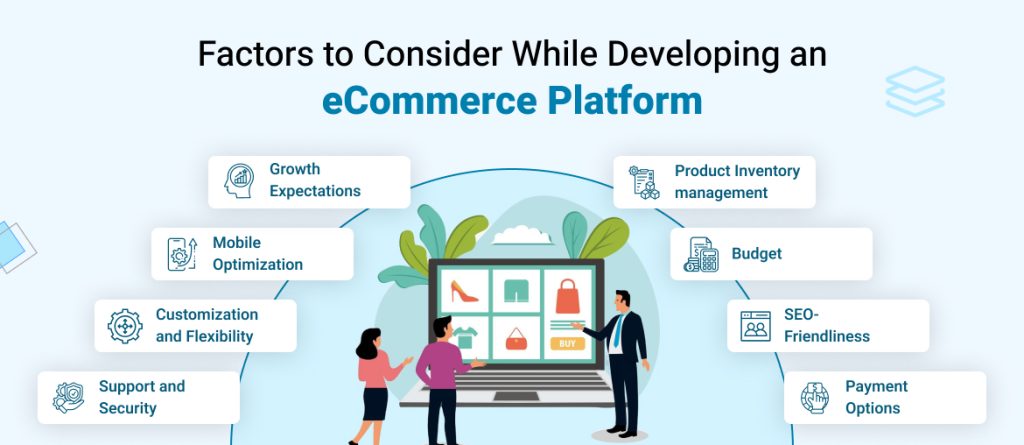
Choosing the right platform for your e-commerce is about evaluating factors like, growth goals, product inventory, budget, and much more. Here are some factors you should consider if you are planning to develop an eCommerce platform.
1. Growth Expectations
Your online store must grow according to your company’s needs. As your business expands, it will require more sophisticated features and capacity. Make sure that the platform you select can scale according to your business growth.
2. Mobile Optimization
With the rise of mobile commerce, it’s vital to select a mobile-friendly platform. Your online store should provide seamless shopping experiences on any device.
3. Customization and Flexibility
Your online store must allow you to customize it to reflect your brand’s appearance and feel. It must also be flexible enough to change to meet your company’s business requirements.
4. Support and Security
Choose a platform with high-quality customer service and strong security features to safeguard your customers’ information.
5. Product Inventory
The size and nature of your product inventory play an important role in selecting the best e-commerce platform. If you have a large product catalog, you’ll require an online platform that can manage this and not charge you based on the number of items you sell.
6. Budget
Thinking about budget and cost to develop an eCommerce platform is also important. Online shopping platforms generally have a monthly cost however, there could be additional charges for transaction fees and third-party integrations. You must consider every potential cost before making a choice.
7. SEO-Friendliness
SEO is essential since it helps drive customers to your store. Select a platform that offers SEO-friendly features, such as custom URLs, blog integration, and alt tags for images.
8. Payment Options
The platform must support your preferred payment method and make checkout as easy as possible for your clients.
Defining eCommerce Business Models
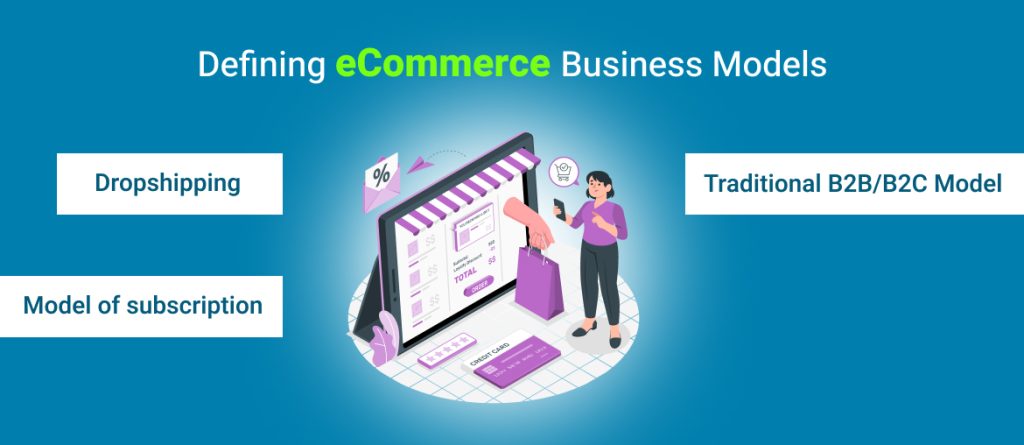
One of the primary aspects to consider in eCommerce growth is understanding the variety of eCommerce business models and then picking the right one for your company.
These are the top three successful eCommerce business models, each of which delivers the best kind of shopping experience to modern day customers.
1. Dropshipping
Dropshipping is a model where you use third-party companies (“drop shippers”) to process the orders you make when you receive them. This allows you to sell items without having them in stock. Spocket, Modalyst, and Pritful, are popular dropshipping platforms.
2. Model of subscription
Under the subscription model, the company frequently offers its products or services, either monthly, quarterly, or even yearly. For B2C selling, subscriptions can usually be divided into three categories: replenishment, curation, and accessibility.
Dollar Shave Club, Blue Apron, and Birchbox are the most popular subscription models.
3. Traditional B2B/B2C Model
Traditional models involve companies offering products and services to other companies (B2B eCommerce) or directly to consumers (B2C eCommerce). Examples of Traditional B2C Models are Amazon, Walmart, and Nike.
Top Features of an eCommerce Platform
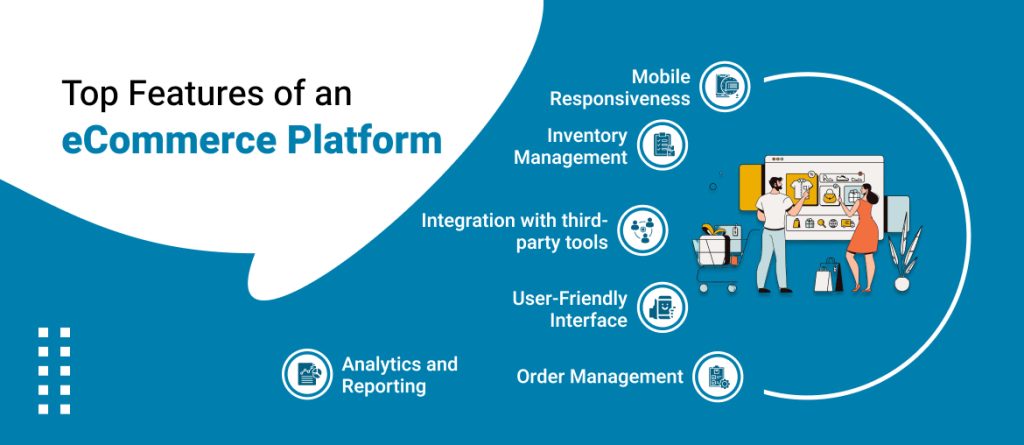
An effortless online shopping experience is exactly what shoppers desire. And to have the best experience, eCommerce platforms must be equipped with the top-notch features. Here are some of the advanced features you can consider integrating in your eCommerce store:
1. Mobile Responsiveness
Today, everything is performed on mobile devices. To ensure that your website runs smoothly, it must be designed for responsiveness. If your eCommerce system isn’t mobile-friendly, then you may not be able to attract potential customers to your store.
Your website must look and feel great on a mobile device or tablet, as on desktop computers. With a responsive mobile platform, customers can browse, choose, and view their items anytime, from anywhere.
2. Inventory Management
Having a real-time inventory management system will give you actual-time information on the status of your stock control pre-orders, restocking, and restocking, as well as provide support for multiple product suppliers.
Automating inventory means that you no longer need to enter the information manually each time you make a sale. This feature will help to avoid backorders, overselling, and cancellations, which could undermine trust and loyalty. Include features like low-stock notifications, live inventory syncing, and out-of-stock message notifications to ensure customers have the most current information.
3. Integration with third-party tools
To reach a large audience, seamless integration with third-party websites for marketing and social networks like Facebook and Instagram is crucial. In addition, the integration covers anything from email marketing software to shipping carriers, payment gateways, and even customer relationship management systems.
Selecting a platform with an array of integrations will simplify your processes, reduce the need for manual data entry, and boost customer engagement. Find an online platform that provides an array of integrated services or offers an API open for customized integration options.
4. User-Friendly Interface
Imagine a platform that provides multiple products to select from, yet the user interface is cluttered with colors. The colors used in the UI are so bright that customers spend hardly five minutes on the site and then leave and never return.
An intuitive interface will ensure that your customers navigate your website effortlessly and find the items they require quickly and easily. This means you have a concise and clear navigation bar, well-organized categories and subcategories, a highlighted display of products, and a simple-to-find search bar.
5. Order Management
Not just stock, but also a solid process for managing orders is essential. This involves keeping track of everything from order placement and processing to shipping and returns, making it simpler to track them at every stage, from placing an order to delivering to customers.
A well-designed order management system lets customers review their order history, track their order status, and allow for simple returns. It will also help you to keep track of order processing, shipment, and delivery and manage stock based on orders.
6. Analytics and Reporting
eCommerce platforms not only offer ease to their customers, however, with admin support, analytics, and support tools, you can effortlessly observe and analyze customer behavior, performance of your products and marketing strategies.
To grow your business, it’s crucial to keep track of the data you collect about sales, traffic, and customer satisfaction. This data can help you improve your product and platform offerings and, thus, your store’s performance over time.
It is easy to add features such as Google Analytics integration, custom tracking events, and data visualizations that aid in understanding the fundamental patterns and opportunities that could boost growth.
Some Major Challenges with Developing an eCommerce Website
Running an eCommerce company can prove extremely rewarding. However, it comes with many challenges. Knowing these challenges and overcoming them is essential to long-term success.
Here are some of the most common challenges faced by eCommerce businesses:
1. Competing in a Crowded Market
With so many businesses online trying to grab the attention of customers, it can be difficult to compete. To differentiate your business in this competitive marketplace, focus on offering distinctive value propositions, such as exclusive products, top customer service, or quicker delivery times.
With a personalized shopping experience and offering loyalty programs can be beneficial in establishing solid customer relationships. Furthermore, using digital marketing techniques such as SEO (search engine optimization (SEO), as well as engaging on social media and targeted advertising, can increase popularity and bring more users to your website.
2. Reduce Cart Abandonment Rates
Cart abandonment is a frequent problem faced by e-commerce companies. It occurs when customers add items to the cart but quit the website without completing the purchase.
To decrease the rate of cart abandonment, businesses can employ strategies like sending automated emails to remind customers, offering discounts for a limited time, and making checkout easier by reducing the number of steps.
3. Handling Returns and Refunds
Refunds and returns are necessary for eCommerce, but managing them effectively isn’t easy. Customers can return goods for various reasons, such as the wrong size, damaged items, or simply changing their minds.
To reduce returns, companies should offer detailed descriptions of their products, high-quality photos, and size guidelines to help customers make informed decisions. Making the return process easy and making it simple for customers to complete returns will increase customer satisfaction and loyalty.
4. Website Maintenance and Technical Issues
An eCommerce website requires regular maintenance to ensure everything is running efficiently. Regular updates of the plugins, platform, and themes are vital to maintaining security and functionality.
Problems with technology, like the site being down or loading times, can frustrate customers and lead to a loss of sales. To tackle these issues and overcome these challenges, companies must invest in reliable hosting services and employ competent technical support personnel. Additionally, they should implement security measures such as SSL certificates, firewalls, and regularly scheduled backups.
How EmizenTech Can Help You With eCommerce Website Development?
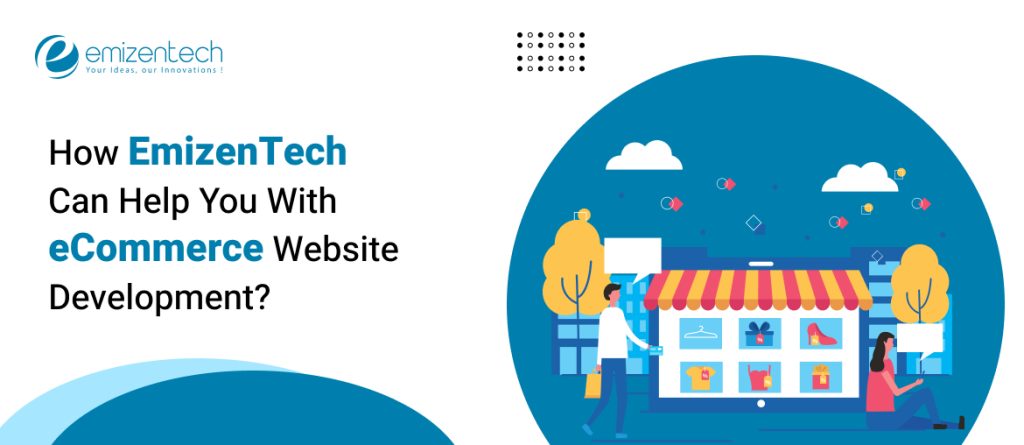
EmizenTech, a renowned eCommerce website development company focuses on delivering intuitive and user-friendly website development services to simplify buying and selling experience. With a proven experience, we offer custom eCommerce development solutions including various business models such as B2B, C2C, B2C, and C2B. Moreover, we also integrate secure payment gateways into scalable eCommerce solutions. This ensures secure and safe transitions for both businesses and customers.
For over a decade, we have successfully assisted various eCommerce businesses in achieving significant success and digital growth.
The Key Takeaway
The popularity of online shopping has increased dramatically with the advent of many e-commerce sites that offer a convenient method of shopping. Additionally, businesses are partnering with custom ecommerce development company to leverage the benefits of online eCommerce stores and generate substantial profits.
E-commerce development is an evolving and vital process for companies that want to establish a strong online presence and benefit from the expanding digital market. With the proper platform, design, and features, companies can build safe, user-friendly, and flexible e-commerce sites that meet customers’ ever-changing demands. By leveraging custom eCommerce platforms as a strategic investment, companies can open up new avenues for expansion, growth, and ensure success in this competitive marketplace.
FAQs
What are the essential features of an eCommerce platform?
An eCommerce platform should include features like product catalog management, secure payment gateway integration, inventory management, order management, and marketing instruments.
In what ways can an eCommerce platform benefit businesses?
eCommerce platforms can help businesses expand their reach, boost sales, improve operations, enhance customer experience, and provide custom marketing strategies.
How much time is typically required to develop an eCommerce platform?
eCommerce platform development depends on several factors, such as the complexity of features, the demands for eCommerce platform customization, integration requirements, and the effectiveness of the development team. It can take a few weeks to several months.
What is the estimated cost of developing an eCommerce platform?
The cost of building an eCommerce platform depends on the features, options, and complexity. It can range from a few thousand dollars to a much higher amount based on your requirements.


 +1 (989) 535-9295
 info@emizentech.com
 emizentech


