
 Add us as a preferred source on Google
 US retail eCommerce reached $326.7 billion on a seasonally adjusted basis in the first quarter of 2026 alone, up 9.8 percent year over year. Every one of those orders had to be captured, routed, picked, packed, shipped, and, in some cases, returned. That entire chain is what eCommerce fulfillment software exists to manage, and it has quietly become one of the most consequential purchase decisions an online business makes.
Shoppers judge a brand by what happens after checkout as much as by what happens before it. A late shipment, a wrong tracking update, or a clunky return does more damage to repeat purchase behavior than most marketing budgets can undo.
That is why so many growing merchants start researching eCommerce order fulfillment software, and why so many of them end up overwhelmed by a market crowded with tools that all claim to do the same thing.
This guide breaks down what this fulfillment software actually does, how order fulfillment software for eCommerce works day to day, the four categories of platforms buyers routinely confuse, the features worth prioritizing, a rundown of the best fulfillment software for eCommerce to look at in 2026, and a practical framework for choosing the right one. If your business is scaling fast enough that spreadsheets and manual order entry no longer hold up, this is the guide to work through before signing a contract. And if fulfillment is one piece of a bigger growth push, it pairs directly with broader eCommerce growth strategies that depend on operations keeping pace with demand.
What is Ecommerce Fulfillment Software?
Ecommerce fulfillment software is the system that manages the full post-purchase workflow, from the moment an order is placed to the moment it lands on a customer’s doorstep and, when needed, comes back.
That includes order capture across every channel a business sells on, inventory synchronization across warehouses, routing logic that decides where an order should ship from, picking and packing on the floor, shipping label generation, real-time tracking, and returns processing that gets stock back into sellable inventory.
How Does Ecommerce Order Fulfillment Software Work?
The mechanics are simpler to describe than most vendor marketing pages make them sound. An order comes in from a storefront, marketplace, or sales channel, and the software captures it in real time. The system checks inventory across every connected warehouse or fulfillment location and routes the order based on rules the business has set: closest location, lowest cost, fastest delivery window, or a mix of all three.
Once routed, the order triggers a pick list at the fulfillment location, often supported by barcode scanning to reduce mis-picks. The item is packed, a shipping label is generated using the carrier selected by the routing logic and the customer automatically receives tracking information. Inventory counts update across every connected sales channel the moment the item leaves the shelf, so a product that just sold out on one storefront reflects that status everywhere else within minutes, not hours.
If a return comes back, the software logs it, inspects the item’s status against return rules, and either restocks it into sellable inventory or routes it into a separate disposition process. Order fulfillment software for multichannel eCommerce operations earns its value specifically in this loop, because the more channels and warehouses involved, the more manual coordination this workflow would otherwise require.
4 Types of Fulfillment Platforms
The term “fulfillment software” gets applied to at least four genuinely different products, and vendors rarely make the distinction obvious during a sales conversation. Comparing platforms across these categories without sorting them first is one of the most common reasons a shortlist ends up misleading rather than useful.

In-House WMS Platforms
An in-house warehouse management system platform requires dedicated staff and essential technologies to help you store, pick, pack, ship, and handle return orders. Small electronics retailers (e-tailers) ideally use the in-house model. However, as demand grows, they may prefer to outsource. Several businesses also rely on e-commerce fulfillment software and systems, especially for major online marketplaces. Most merchants dealing in customized goods often choose an in-house fulfillment platform.
3PL-Facing Merchant Portals
These tools are merchant-facing and sit on top of a third-party logistics provider’s warehouse management system, giving visibility into inventory and orders without requiring the business to run a warehouse itself. ShipBob and ShipMonk are the clearest examples, and they suit brands that would rather outsource the physical fulfillment work entirely while keeping a real-time window into what is happening with their stock.
Multichannel Fulfillment
These advanced platforms route orders through multiple fulfillment sources at once, owned warehouses, 3PLs, retail stockrooms, and dropship suppliers, and are becoming increasingly critical for brands running a genuine multichannel fulfillment strategy at scale. This is also the category where enterprise operations tend to land, particularly for businesses running on enterprise eCommerce platforms or coordinating fulfillment across a global footprint through systems like SAP Commerce Cloud, where volume and channel complexity outgrow a single warehouse or 3PL relationship.
Dropshipping
Dropshipping-focused platforms route orders directly to suppliers, who ship on the merchant’s behalf, removing the need to hold inventory. These tools prioritize supplier integration, order-forwarding accuracy, and automated stock-level syncing between the supplier’s catalog and the storefront, since the merchant never physically touches the product. This model tends to suit lower-overhead operations and specific product categories more than businesses with complex B2B fulfillment needs, where platforms built through dedicated B2B eCommerce website development usually require tighter inventory and shipment control than a dropship model can offer.
Features to Look for in Order Fulfillment Software for Ecommerce
Real-Time Inventory Management
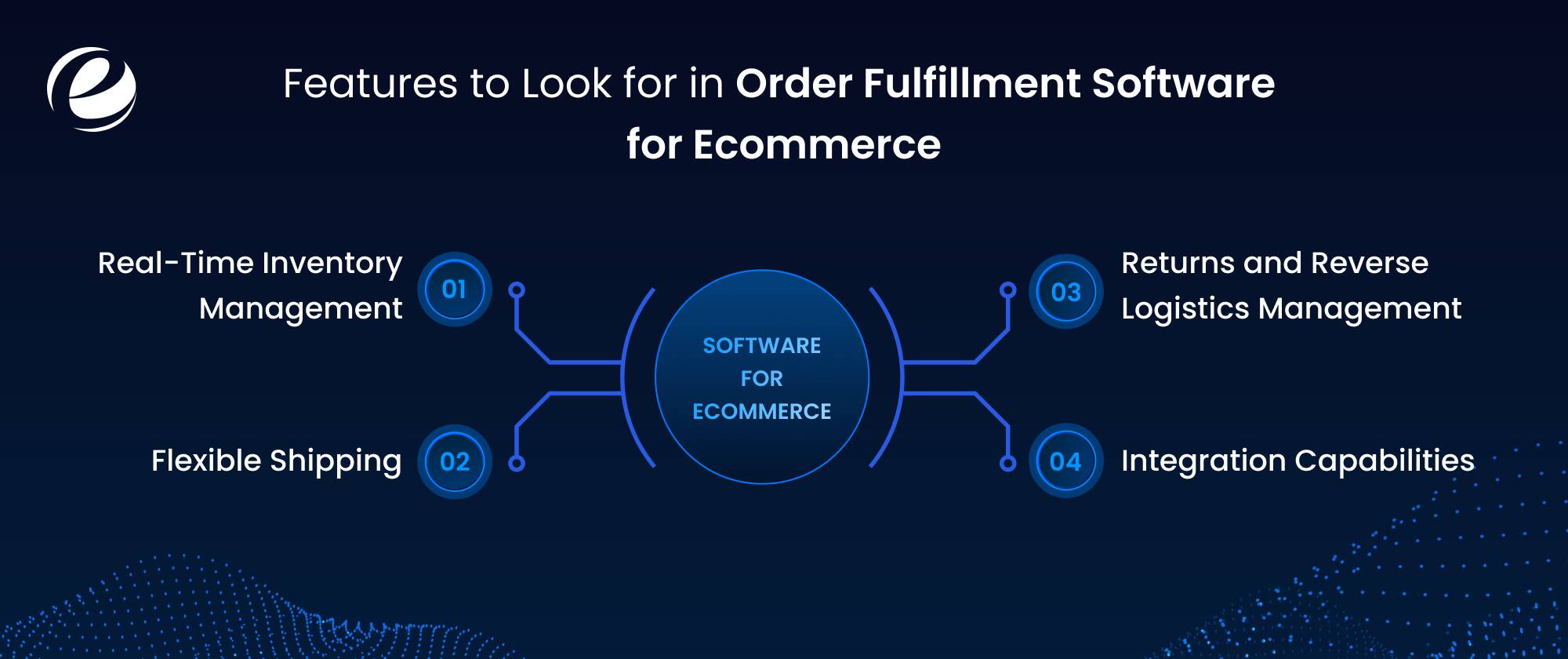
A handful of capabilities separate fulfillment software that actually reduces operational load from software that just adds another dashboard to check. Real-time inventory management sits at the top of the list, including low-stock alerts, aging reports, and visibility into shipped-item frequency, since stockouts caught too late are one of the most common causes of lost sales.
Returns and Reverse Logistics Management
Returns and reverse logistics management matter just as much as forward fulfillment, covering refunds, replacements, and the full reverse supply chain in a way that keeps the customer experience smooth rather than adding friction at the moment a customer is already frustrated. Backorder management, the ability to split shipments or adjust orders when an item is temporarily unavailable, keeps customers informed instead of leaving them guessing.
Flexible Shipping
Flexible shipping options, covering least cost, expedited, standard, and express delivery, let a business balance cost against speed on an order-by-order basis rather than defaulting to one carrier for everything. Lot control and traceability matter for businesses with compliance requirements, particularly in categories like food, supplements, or regulated goods.
Integration Capabilities
Integration depth deserves its own mention, since a platform that connects cleanly to the storefront, the accounting system, and a CRM for eCommerce gives a business one unified view of a customer’s order history, support tickets, and delivery status, rather than three disconnected systems that all know a different piece of the same story.
Best Ecommerce Fulfillment Software to Look For in 2026
Zineps
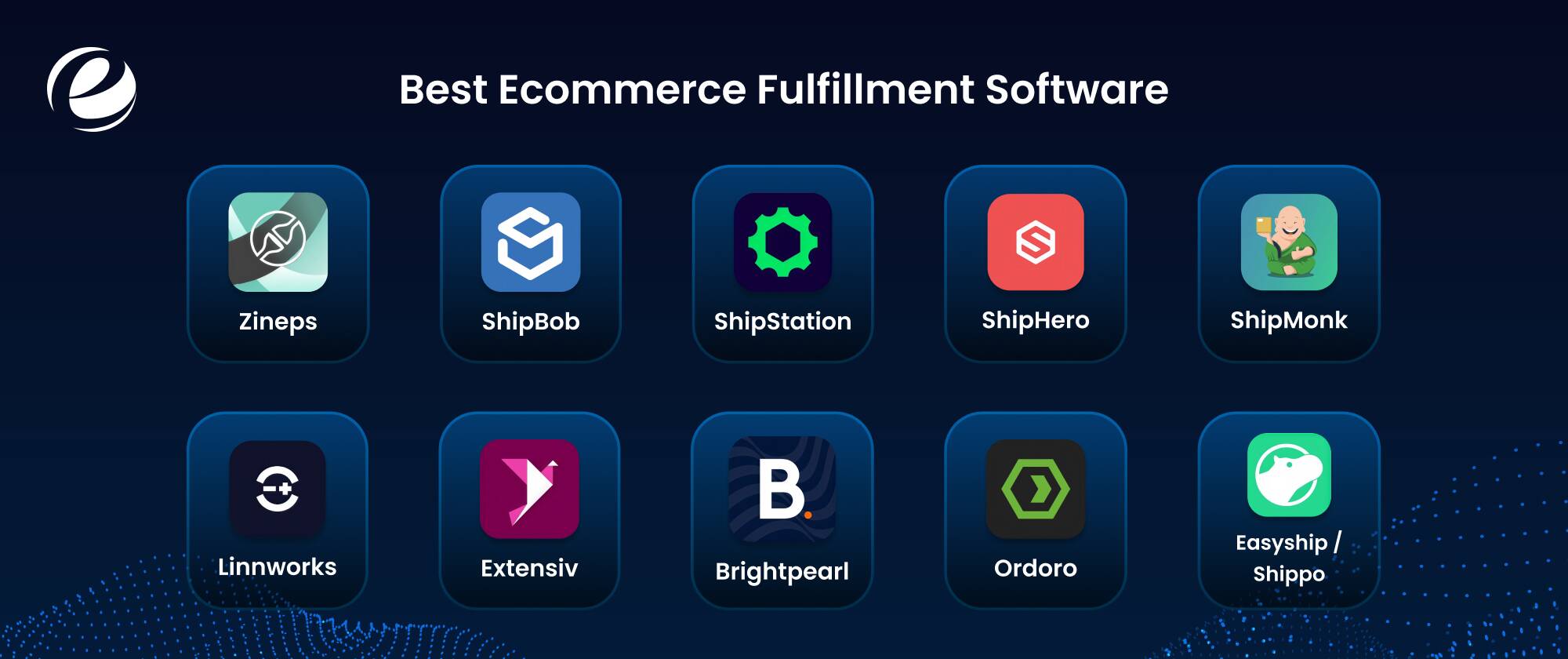
Zineps is an AI shipping platform built to centralize carrier management, automate rate configuration, and support scalable multi-carrier logistics without adding operational complexity. It focuses heavily on automation rules that select the right shipping method based on price, size, or product category, plus branded tracking, a returns portal, and dynamic checkout options that let customers choose their preferred delivery method.
Best for: It suits brands that want a single dashboard to manage multiple carrier relationships without building that logic in-house.
ShipBob
ShipBob is one of the most widely recognized names in the category, offering distributed warehousing and fast shipping across a large network of fulfillment centers in the US, Canada, Europe, and Australia. It lets merchants run fulfillment through ShipBob’s warehouse management software or outsource the physical operation entirely, backed by real-time reporting and analytics.
Best for: It is a strong fit for DTC brands that want the 3PL relationship without losing visibility into inventory and order status.
ShipStation
ShipStation is built for merchants managing multichannel orders and is frequently listed among the best eCommerce fulfillment software options for order processing efficiency. It integrates with Shopify, Amazon, and eBay, automating label printing and carrier rate comparison so a business isn’t manually checking rates order by order.
Best for: It tends to suit merchants who already run their own fulfillment but want the shipping and label layer automated.
ShipHero
ShipHero leans into warehouse management and shipping automation for brands that operate their own physical fulfillment space.
Best for: It is commonly named among the best fulfillment platforms for businesses that want deep control over warehouse execution rather than outsourcing to a 3PL, with features built around bin-level accuracy and pick-path optimization.
ShipMonk
ShipMonk operates as a merchant-first 3PL platform with a unified portal covering shipping, order management, and inventory across multiple sales channels. It gives merchants visibility into best-selling items, low inventory alerts, and stock levels channel by channel, and its MonkProtect suite specifically addresses lost, stolen, or damaged packages, letting customers self-report issues without opening a support ticket.
Best for: It is a common ShipBob alternative for growing DTC brands that want a similarly hands-off outsourced fulfillment relationship.
Linnworks
Linnworks positions itself as a single platform for connecting, managing, and automating commerce operations across every channel a business sells on. It is strongest as an in-house warehouse and inventory management system, consolidating a business’s tech stack so that orders, inventory, and financial data all stay in sync rather than living in separate tools.
Best for: It tends to be favored by multichannel retailers who want to reduce the number of disconnected systems they manage rather than add another one.
Extensiv
Extensiv, built from what was formerly Skubana and CartRover, brings together order management, warehouse management, and integration tooling into one ecosystem. Its order manager focuses on order routing, demand forecasting, and inventory allocation across channels, including splitting a single order across multiple warehouses.
Best for: Extensiv suits businesses with a distributed fulfillment footprint, whether that is multiple owned warehouses, a mix of in-house and 3PL fulfillment or both.
Brightpearl
Brightpearl provides a cloud-based back office built for omnichannel retailers and wholesalers, combining inventory and order management with financial oversight, procurement, CRM and point of sale in one system.
Best for: It connects with major eCommerce platforms and marketplaces, making it a fit for retailers who want fulfillment tied directly into accounting and financial reporting rather than treated as a standalone operational tool.
Ordoro
Ordoro automates dropshipping, shipping, and supplier management through a centralized dashboard, making it one of the more accessible options for small teams juggling multiple SKUs and supplier relationships.
Best for: It is particularly suited to businesses running a hybrid model that mixes owned inventory with dropshipped products.
Easyship / Shippo
Easyship and Shippo both simplify shipping logistics with automated rate comparison, label generation and, in Easyship’s case, automated tax and duty calculation for cross-border sellers. Easyship focuses on international sellers who need cost transparency and automated compliance.
Best for: Shippo tends to suit merchants who want a lighter-weight shipping layer rather than a full warehouse and inventory suite.
How to Choose the Right Platform?
Choosing between these platforms starts with an honest read of the current operation, not a feature-by-feature comparison. A business running its own warehouse needs a fundamentally different tool than one leaning on a 3PL, and mixing categories on a shortlist is one of the most common reasons a fulfillment software rollout underdelivers.
Before evaluating vendors, it is worth mapping the existing order flow end to end, from checkout through warehouse through carrier handoff, to identify exactly where orders stall or inventory data goes stale. That diagnostic step is what Emizentech eCommerce audit services are built to provide, and going into a software evaluation with that map in hand changes the shortlist considerably.
From there, the decision usually comes down to a short list of practical questions.
Can the platform pull orders from every channel the business sells on without manual reconciliation?
Does inventory stay accurate across every warehouse in near real time?
Can the system route an order to whichever location or partner fulfills it fastest and cheapest?
Is the returns process built to get stock back into sellable inventory quickly?
And does the platform’s integration depth match what the business already runs- storefront, accounting, CRM- without requiring a rebuild of the surrounding tech stack?
For businesses where none of the off-the-shelf platforms above fit the specific way orders are routed, or where a niche product category or B2B workflow does not map cleanly onto a generic tool, our custom eCommerce development services become the more reliable path, building fulfillment logic around the operation instead of bending the operation to fit a fixed product.
That kind of build usually starts with the right technical team in place, whether that means bringing in specialized help to hire an eCommerce developer for the integration work or engaging eCommerce consulting services to narrow the category and vendor shortlist before committing budget.
And once a platform is live, ongoing eCommerce managed services keep carrier rates renegotiated, inventory rules tuned, and exceptions caught before they become customer complaints, since a system that was perfectly configured at launch can drift out of alignment within months if nobody owns its upkeep.
Conclusion
Fulfillment has moved from a backend cost center to a genuine growth lever. The businesses treating it that way, auditing the current setup honestly, choosing a platform that matches how they actually operate rather than how a vendor’s marketing page describes the ideal customer, and maintaining the system after launch, are what turn delivery into a reason customers come back rather than a reason they leave.
Whether that means adopting one of the established platforms covered here or building something custom around a specific operation, the right eCommerce fulfillment software fits the business, not the other way around.
FAQs
Do I need fulfillment software if I use a 3PL?
No, you don’t need separate software when you are already using a 3PL software.
What's the difference between fulfillment software and an ERP?
Fulfillment software: Fulfillment software for eCommerce primarily focuses on picking, packing, shipping, and tracking orders inside a warehouse.
ERP: An enterprise resource planning system is responsible for managing a company’s internal functions, including finance, human resources, procurement, and high-level inventory data.
How much does eCommerce fulfillment software cost?
The cost of eCommerce fulfillment software ranges between $15 and $350 per month for single shipping apps. However, enterprise-grade warehouse management systems can cost $1,850+ per month.
Can it integrate with Shopify, Amazon, and WooCommerce at once?
Yes, several e-commerce fulfillment software platforms can integrate with Shopify, Amazon, and WooCommerce at the same time.
At what order volume should I stop using spreadsheets?
When you start receiving at least 200 orders per month, you should stop using spreadsheets and switch to better options like order fulfillment software.



 +1 (989) 535-9295
 info@emizentech.com
 emizentech


