
 Add us as a preferred source on Google
A customer spends twenty minutes in your store, compares three products, and finally drops one into the cart. Then your checkout demands an account, reveals a shipping fee they never saw before, and takes its time loading. So they close the tab, and a sale that was almost finished goes away.
According to Baymard Institute research, the average online shopping cart cancellation rate is 70.19%. Seven carts out of ten are gone at the doorstep. Checkout complication remains one of the biggest challenges in e-commerce, yet most stores keep spending on traffic while the bottom of the funnel slowly breaks.
This blog is written for store owners, marketers, and product teams who want to resolve that problem. You will learn what ecommerce checkout optimization actually involves, how the process works from the shopper’s side, which strategies pay out fastest, and where things are heading in 2026. It is no accident that businesses investing in ecommerce development services now treat checkout as a priority. The money is already in the cart. Your job is to stop losing it.
What is eCommerce Checkout Optimization? Why Does It Matter in 2026?
Ecommerce checkout optimization is the work of improving every step between “add to cart” and “order confirmed” so fewer people quit along the way. The work spreads across checkout page design, form simplification, payment flexibility, loading speed, security signals, and delivery transparency. No single solution on that list will transform your revenue immediately. Combine several of them, and the difference shows up in your monthly numbers. Why does this issue matter more in 2026 than it did five years ago? Three reasons.
1. It Reduces Cart Abandonment
Recovering abandoned carts is the first goal of ecommerce checkout optimization because an abandoned cart is rarely due to a lack of interest. The customer wanted the product. Something in your checkout made them drop out of it, usually a cost that appeared out of nowhere, a demand to register, a missing payment method, or pages that crawled. A minor gain in completion rate is worth real money, and it costs nothing in ad spend.
2. Mobile Commerce Requires Faster Checkout
Try filling out your checkout on a phone sometime. Small fields, an address typed with your thumbs, and a card number copied from a physical card while the screen times out. Mobile shoppers deal with this daily, and they leave accordingly. What they want is one tap and done. Stripe looked at nearly 20,000 B2C businesses and found mobile checkout is now a major transaction channel in its own right, so a checkout that only feels good on desktop is a checkout that leaks.
3. AI is Changing Buying Behavior
Simply explained, some of your future checkouts will be completed by an assistant acting on a person’s behalf, a change people are calling agentic commerce. Stores with slow or confusing flows will struggle to participate. This is a reason why modern ecommerce solutions combine retail technology, payment infrastructure, and checkout design together instead of treating them as separate projects.
How the eCommerce Checkout Process Works
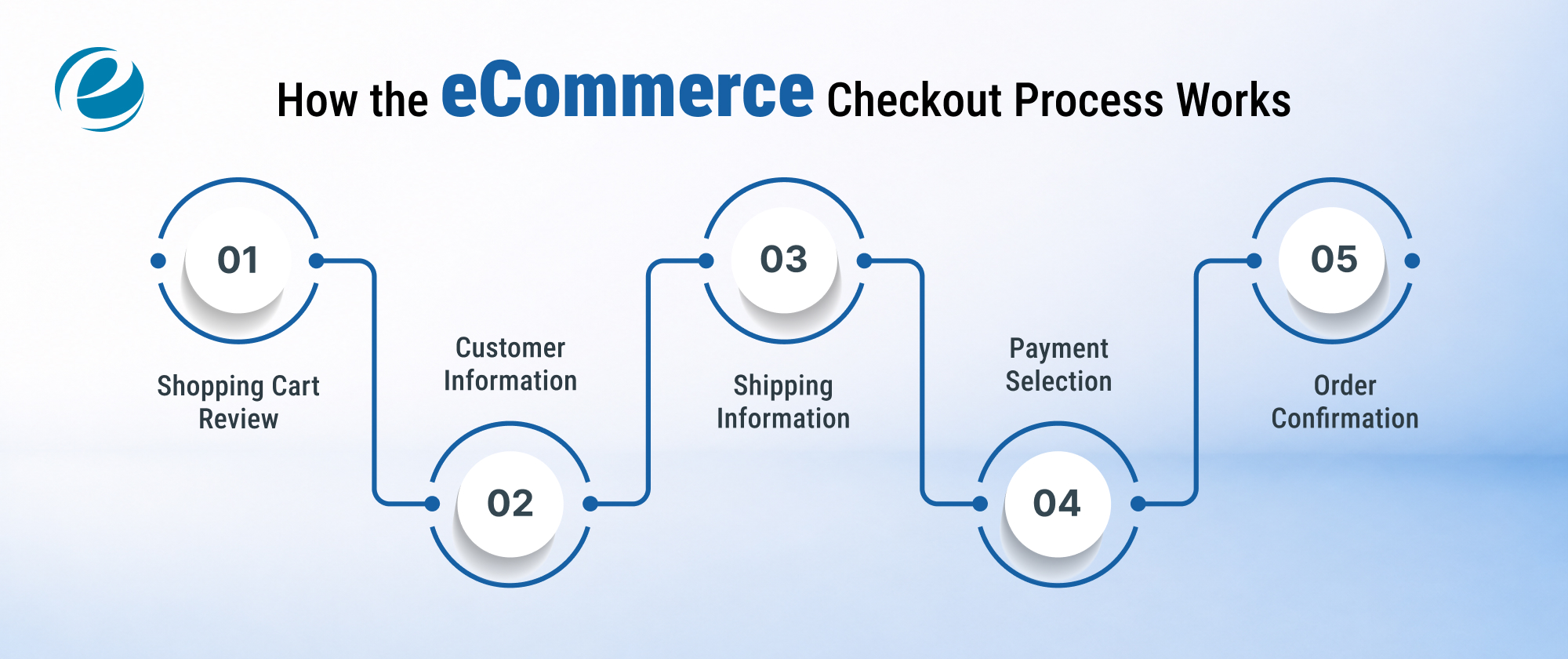
Ecommerce checkout optimization starts with walking the path your customer walks. Five stages, and every one of them loses a few people.
1. Shopping Cart Review
The shopper double-checks the products, changes a quantity, tries a discount code, and looks carefully at the price. Your job here is restraint. A clear order summary, no pop-ups, no last-minute upsell carnival. The customer is trying to say yes, so move out of the way.
2. Customer Information
Who is buying? Provide three options: guest checkout, login, or create an account. And here is a tip that costs nothing: invite account creation after the purchase, not before. Their details are already entered, the order is safe, and the pressure is gone. Conversion first, relationship second.
3. Shipping Information
Address entry and delivery selection. Address autocomplete does two jobs at once here, cutting the typing and catching the mistakes that would otherwise become failed deliveries. Real-time delivery estimates answer the question every shopper is silently asking, which is not “how much” but “when will it arrive?”
4. Payment Selection
Cards, digital wallets, UPI, buy now, pay later, and cash on delivery, where the market expects it. If the customer’s preferred method is missing from this screen, many won’t look for a solution. They will just leave.
5. Order Confirmation
Show the products, the total, the delivery date, and an accurate payment confirmation. Done well, this page converts comfort into trust. Trust is what leads to the second order.
Features of a High-Converting eCommerce Checkout
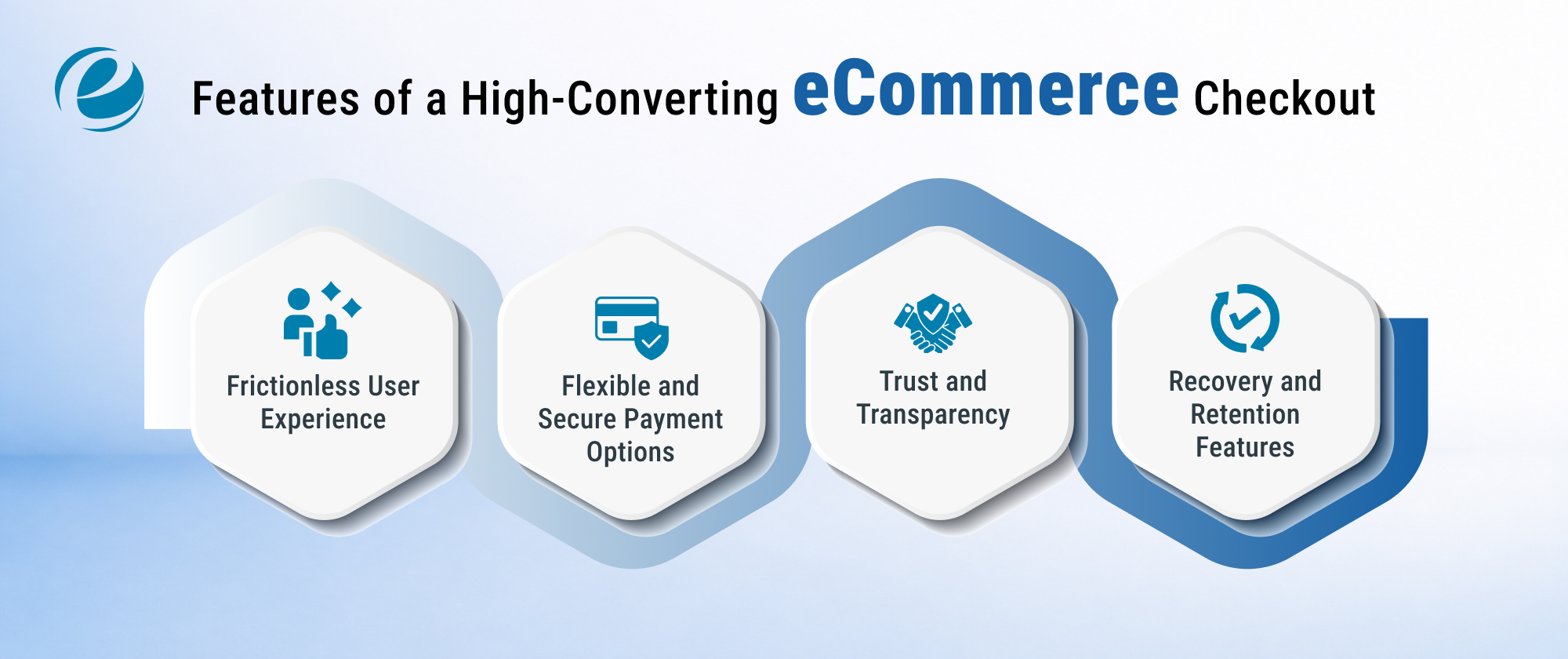
Study enough high-performing checkouts, and the same features keep converting up. They divide into four groups.
1. Frictionless User Experience
Guest checkout is always the first option. Nobody wants to generate a password to buy a phone case, and forcing registration tells the customer their time matters less than your email list.
Then look at your forms, because they are almost surely too long. Baymard measured an average of 23 form elements per checkout. Compare that with what a purchase genuinely requires: a name, an address, and a payment method. Everything else: the duplicate fields, the optional survey questions, and the “How did you hear about us?” Autofill and address validation round out the group. Faster entry, fewer mistakes, and a mobile experience that stops feeling like a burden.
2. Flexible and Secure Payment Options
Digital wallets have become a necessity, not a luxury. Apple Pay, Google Pay, and PayPal: Your payments are just a tap away. They are amazing in scale. Digital wallets made up almost half of the world’s ecommerce transaction value in 2023, according to the Worldpay Global Payments Report. 50% of the market.
India runs on UPI and RuPay; Brazil has Pix; Spain has Bizum. Show a shopper a checkout that ignores how their whole country pays, and you look foreign, and foreign looks risky. Buy now, pay later fills the last gap by splitting bulky purchases into pieces that customers can manage.
3. Trust and Transparency
Nobody types card details into a page that feels insecure. Security badges, SSL certificates, familiar payment logos, and a return policy written in plain language all say the same thing: your money and your data are safe here. Leave those signals out, and doubt shows up at exactly the wrong moment.
4. Recovery and Retention Features
A perfect checkout still loses people. Cart recovery emails, WhatsApp reminders, saved carts, and order tracking all pull shoppers back or keep them close after purchase. And if you cannot tell where your own funnel breaks, ecommerce consulting services exist for exactly this, using UX audits and analytics reviews to point out problems you have stopped noticing.
15 Best eCommerce Checkout Optimization Strategies
A smooth checkout helps convert more shoppers into customers. These ecommerce checkout optimization best practices are designed to reduce friction, build trust, and make it easier for customers to complete purchases. Even small improvements can result in higher conversions and fewer abandoned carts.
- Enable guest checkout: The oldest advice on this list and still the most ignored. Make sure that people buy first. Registration can wait.
- Add digital wallet payments: Apple Pay, Google Pay, and UPI erase manual card entry, and on phones, that single change saves a surprising number of orders.
- Show transparent pricing: Shipping, taxes, discounts, and final total are all visible early. Surprise fees at the last step remain the most cited abandonment reason, year after year.
- Reduce checkout fields: Only ask for the information you need to complete the order. Removing unnecessary fields can speed up the checkout process, reduce work for users, and decrease the chance that customers will remove their shopping carts before completing their purchase.
- Implement address autocomplete: A few inputs, and the API fills in the rest. Faster checkout now, fewer missed deliveries later.
- Simplify mobile checkout: Clean layouts, easy-to-tap buttons, and a clear order summary make it easier to check out on smaller screens. Designed for mobile shoppers who want a fast, seamless buying experience.
- Add progress indicators: Let your customers know how many steps remain in the checkout process. A transparent progress bar helps reduce confusion and motivates shoppers to finish their purchase.
- Remove checkout distractions: Navigation menus, banners, promotional exits—all of it goes. Once payment begins, every extra link is a door out.
- Hide coupon fields strategically: A big empty coupon box sends shoppers away to Google to look for codes, and many never come back. A small reusable link serves coupon-holders without tempting everyone else.
- Add trust signals: Badges, reviews, and policy links belong beside the payment button, where doubt actually happens.
- Use a sticky order summary: Product image, price, and quantity are always in view. Nobody should scroll to remember what they are buying.
- Provide accurate estimates: Give a definite delivery date, not a broad time frame. When you know when an order is coming, you build trust, and it gives confidence to buy.
- Add Inline Form Validation: Mark the mistyped email while the customer is still in that field, not after they submit and lose their work.
- Improve payment success rates: Failed payments are the invisible rejection; the customer said yes, and the system said no. AI-powered payment routing that reads transaction conditions and picks better routes, cutting failures on money you have already earned.
- Analyze checkout performance: Monitor key metrics like checkout conversion rate, cancellations, failed payments, and time to checkout completion. This information helps you find issues and enhance the ecommerce customer experience. Ongoing ecommerce support services can also help ensure your checkout runs smoothly and resolve technical issues before they impact sales.
eCommerce Checkout Optimization Best Practices
The strategies above tell you what to fix. These four habits tell you how to keep your checkout strong over time.
- Build for mobile first: Most of your shoppers are on their phones, so design the checkout for a small screen before you think about a desktop. Use big buttons that are easy to tap, keep the layout in a single column, and offer payment methods that need no typing at all. Here is a simple test: open your checkout on an older phone and try to buy something. If it feels easy there, it will feel easy everywhere.
- Personalize for returning customers: A customer who has bought from you before should never have to start from scratch. Save their payment preferences, show offers based on what they bought earlier, and suggest add-ons that make sense for them. When the second purchase is faster than the first, people come back.
- Localize your payment options: People in different countries pay in different ways. Payment research shows this clearly: shoppers in India use UPI, Brazilians use Pix, and many other markets have their own local wallets. If you sell internationally but only accept cards, you are turning away customers who are ready to pay. Meet each market with the methods it already trusts.
- Keep testing and improving: Checkout work is never done or finished. Use analytics to find the steps where people close, heatmaps to see where they pause or hesitate, and A/B tests to prove which changes actually help before you roll them out. This takes continuous attention, which is why many businesses hand the job to ecommerce management services so someone is always watching performance, managing integrations, and looking for the next small win.
None of these four actions needs a big budget. They need consistency, and consistency is what separates stores that improve every quarter from stores that wonder where their sales went.
Best eCommerce Checkout Optimization Software and Tools for 2026
People often ask for the best ecommerce checkout optimization software as if one product does everything. It does not work that way. The best tools for ecommerce checkout optimization in 2026 are four types; many stores have at least one from each category.
- Google Analytics 4, Hotjar, and Microsoft Clarity help businesses understand customer behavior by showing where shoppers face issues, pause during checkout, or leave before completing their purchase.
- With Optimizely and VWO, businesses can test out different changes to the checkout so they can find out what actually helps conversions, rather than just guessing.
- Stripe, Adyen, and Razorpay help increase payment acceptance rates and carry the wallets and regional methods your customers expect to see.
- For the foundation, Shopify, Magento Commerce, and WooCommerce supply the checkout itself, plus their ecosystems of extensions.
Future Trends in eCommerce Checkout Optimization
Ecommerce checkout optimization in 2026 and beyond will be shaped by five developments.

1. AI-Powered Checkout and Agentic Commerce
McKinsey reports that 10% of consumers are using AI to help them discover products to buy, and 20% are comfortable with the idea of AI actually making purchases for them, so it won’t be long before checkout assistants are recommending items, comparing options, and completing purchases on behalf of a shopper.
2. Digital Wallets are Becoming More Common
Worldpay found they already made up around half of global ecommerce transaction value back in 2023, and nothing since then suggests a slowdown. Think about what that means for a store that still accepts nothing but cards. Every year, a larger share of shoppers arrives at checkout expecting to pay with a tap, sees no wallet option, and quietly leaves. Card-only checkout is not wrong, exactly. It is just falling behind, one customer at a time.
3. Predictive Payment Routing
AI will choose the best payment route for each transaction in real time, reducing failures and lifting authorization rates without the customer noticing anything except that the payment simply worked.
4. Embedded Commerce
Purchases will increasingly happen inside social platforms, apps, and AI assistants rather than on store websites. Checkout must travel to wherever the customer already is.
5. An Adaptive Checkout Brings Everything
Instead of one fixed page shown to everyone, the checkout will slowly reshape itself for each shopper. A shopper in São Paulo gets Pix and Portuguese. Offers, delivery choices, and even the order of the fields adjust to fit the person buying. The customer never notices any of this happening, which is exactly the point. The checkout simply feels like it was built for them, because in a sense it was.
Why Choose EmizenTech for eCommerce Checkout Optimization?
Reading about fixes is one thing. Shipping them to a live store without breaking payments is another. EmizenTech helps businesses cross that gap with custom ecommerce development, checkout customization, payment integration, UX optimization, and performance work. The team builds on Shopify, Magento, WooCommerce, and fully custom platforms, which matters because relevant recommendations have to fit your actual setup rather than a generic template. Whether the need is a complete checkout redesign or targeted repairs to payment failures and mobile interactions, EmizenTech brings engineering depth and conversion focus in the same engagement.
Conclusion
Checkout is where intent turns into revenue, and it has been the ignored corner of ecommerce for too long. Effective ecommerce checkout optimization converts more of the customers you already have by making the final step faster, simpler, and more trustworthy. The essentials are within any store’s reach: cut friction, carry the payment methods your market uses, price honestly, and signal trust. The road ahead adds AI assistants and adaptive experiences, but fundamentals come first. Turn on guest checkout, audit your form fields, and run your own mobile checkout on a real phone. Few investments in ecommerce return as much as fixing the last step.
FAQs
What is ecommerce checkout optimization?
It is the practice of improving everything between the cart and the order confirmation so more shoppers actually finish buying. That means shorter forms, faster pages, flexible payment options, honest pricing, and trust signals in practice.
Why is checkout optimization important for ecommerce businesses?
Because the biggest losses happen at checkout, not during browsing. Baymard Institute measures average cart abandonment at 70.19%, so a typical store watches seven of every ten carts die. Those shoppers already chose the product, and winning back even a portion of them grows revenue without spending anything more on traffic.
What are the best ecommerce checkout optimization strategies?
Begin where the friction is heaviest. Enable guest checkout, add digital wallets, reveal all costs early, and remove unnecessary form fields. From there, tighten mobile usability, place trust signals beside the payment button, and give real delivery dates. Then keep measuring, because checkout improvement is a habit rather than a project.
How can AI improve ecommerce checkout?
On the back end, predictive payment routing picks the best path for each transaction, so fewer payments fail for customers who were ready to pay. On the front end, AI assistants are starting to recommend products, compare options, and complete purchases directly. McKinsey already finds 20% of consumers comfortable letting AI buy on their behalf.



 +1 (989) 535-9295
 info@emizentech.com
 emizentech


