 Add us as a preferred source on Google
In today’s competitive digital landscape, a powerful, feature-rich ecommerce website is essential for businesses that want to build a strong online presence and stay ahead of the competition. This becomes even more important when you aim to lead your industry and compete with established businesses that are already leveraging advanced technologies like AI for search functionality, personalized product recommendations, and customer support.
Choosing the right development partner, however, isn’t always easy, especially with so many options on the market. Understanding how to choose an ecommerce development company that aligns with your business objectives, technical requirements, and long-term growth plans is crucial.
The right partner should offer comprehensive ecommerce development services that combine technical expertise, innovative solutions, scalability, and user-focused design. In this blog, you’ll learn the essential factors to consider when selecting an ecommerce development company, helping you make an informed decision and build an online store that meets modern customer expectations.
Why Does Choosing the Right Ecommerce Partner Matter More?
The technological landscape is dynamic. Something changes, or a new invention emerges every moment. In such scenarios, choosing the right eCommerce partner becomes even more essential. If you compare today’s market with five years ago, you will notice everything is changing rapidly.
From trends and financial fluctuations to shifting consumer demands, you need to handle it all. Choosing the right eCommerce partner comes with great responsibility: you set your projections, while your partner handles complexities and tough market conditions smoothly. Below are some pointers to help you select the right eCommerce solution provider.
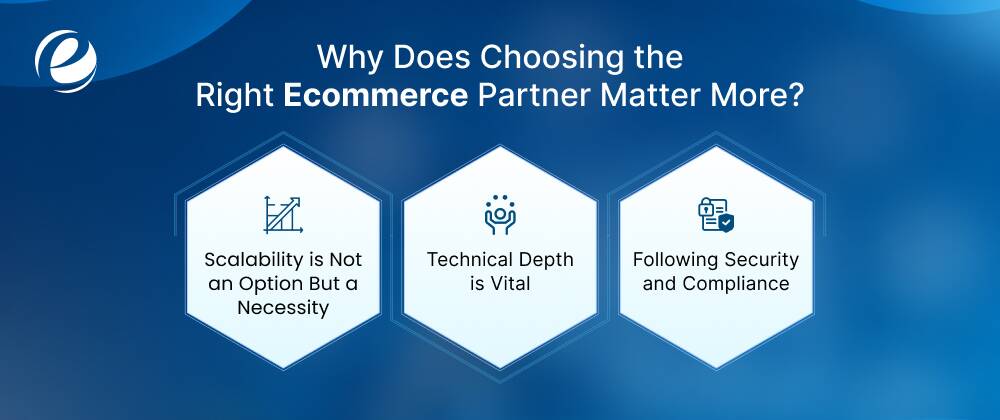
1. Scalability is Not an Option But a Necessity
The right eCommerce partner will focus on scaling your brand, meaning making your business 10x better. Earlier, factors like growth and scalability were secondary concerns, but now most organizations want to partner with an eCommerce solution provider that prioritizes ecommerce growth strategies and scalability. AI shopping assistants and virtual agents are some of the best examples today that can handle customer queries round the clock.
2. Technical Depth is Vital
A competent eCommerce development partner understands the technical depth and complex layers involved. Writing clean code is one side of the coin, but integrating it with technologies such as AI, machine learning, eCommerce automation, and data analytics makes the difference. Your partner shall be familiar with concepts such as predictive analytics, dynamic pricing, and AI-based product recommendations. This is what will help your business stand out.
In the progressive era, you cannot expect your eCommerce solution provider to implement a tech strategy that worked a decade ago.
3. Following Security and Compliance
Data is the biggest asset today. All information you see today is stored online. Imagine you are running a giant enterprise with a database of millions of users. How would you react if you received a message that your data and financial information were being compromised through your email? Where would you rush to?
The right eCommerce solution provider ensures compliance with required data regulations, implements cybersecurity measures, and meets standards such as PCI DSS.
Read More: Ecommerce Security for Adobe Commerce
Ecommerce Development Company Evaluation Checklist
In layman’s terms, an eCommerce development company evaluation checklist is a screening or assessment tool businesses use. The primary objective is to evaluate and identify the best eCommerce development company to help them build, design, and migrate their online stores. Here’s how you can do the same for your organization:
Verify the Company’s Past Projects
To be the top eCommerce development company USA, you need to be an all-rounder. Organizations and companies know what they need; you cannot fool them. They can ask questions like:
- What’s your platform’s specialization? Have you worked on Shopify Plus, BigCommerce, or both? Shopify vs. BigCommerce Enterprise: Which is the best?
- Do you have experience in B2B, B2C, or neither?
- Do you cater to businesses in the D2C sector?
- Are you well-versed in connecting a custom front end with back-office/ERP systems?
- Have you built AI features such as product recommendations, chatbots, or AI-powered search for any of your clients?
You need to ensure everything stays in sync, including your existing clients’ work.
Scope of Services and Methodology
Every seed-stage business or organization has one question on its mind: how to choose an eCommerce development company. To stay the best, don’t leave loopholes that could call your credibility into question. Try to focus on building trust. For this, you can:
- Do a brief assessment of the client’s business before they mention their technical assessments.
- Conduct a SWOT analysis and provide a detailed report to your patron.
- Ask questions like which services they offer and which they don’t. For SEO, UI/UX, AI integration, or other technical services, they either hired an eCommerce developer or outsourced everything.
- Gather information on which project management tools they are currently using. Do they know about platforms like Jira?
- Check whether they know about top AI tools for eCommerce or not.
Compliance and Security
In the past, many businesses paid less attention to safety and security standards. As a result, these companies face penalties and risks of data loss or theft. As a right eCommerce development partner, you should make your client aware of the importance of compliance and security. This should be every organization’s primary objective, as it protects their data from compromise. You can ensure this by:
- Asking about the security and compliance measures the company follows. Speaking about the importance of measures like HIPAA, PCI-DSS, and CCPA.
- Ask your client whether their sites meet ADA and WCAG accessibility standards.
- Speak facts to your client. Tell them that almost 70% of eCommerce traffic comes from smartphones. Review their mobile-first designs and user experience (UX) on mobile devices.
- Ask about how they maintain SEO continuity during redesigns or platform migrations.
This type of checklist works both ways. For businesses wondering how to choose an eCommerce development company, these pointers will help them make the right decision. Ecommerce development partners can use this to-do list to make a strong impression on clients and show their proactivity in current tech developments.
Questions to Ask Before Hiring an Ecommerce Development Company
We are living in a fast-paced environment. In the time it takes to blink, a technological invention happens around the globe. Instead of wondering how to choose an e-commerce development company, focus on execution. To help you choose the right person or agency, we have developed a set of questions you can ask before hiring.
Which Technologies Do You Plan to Use to Build Ecommerce Websites?
This question is a great place to start. You can assess the company’s expertise and understanding of technical concepts. For reference, Shopify is a modern eCommerce platform known for its advanced features and enhanced user experience. Although WooCommerce is older, it remains the most widely used platform for its simplicity, hosted infrastructure, and ease of use.
Similarly, front-end technologies such as Angular or React are best suited to improving website speed and performance. Ask follow-up questions to assess whether they can build a customized eCommerce store from scratch.
The ideal company will answer all your queries without any hassle. They will also give you advice you can use in your business.
Read More: SaaS Ecommerce Platform Guide
Can You Showcase Previous Examples of Ecommerce Websites that You Have Built?
It’s easier to trust an eCommerce development company when they have an extensive, realistic portfolio to showcase. If they have built an eCommerce site before, ask whether it was easy or difficult. What challenges did they face during the website development process? Know specifically which technologies they worked on in the previous projects.
Discuss your projections or vision for eCommerce development with the candidate company. Also ask how many industries they have served so far. What’s unique about them, and how do they differ from each other in terms of concept, methodology, or other technical factors?
If they have a realistic portfolio, you will receive all your answers. If not, move forward with other potential eCommerce companies.
What’s Your Approach to Tackling SEO or Any Other Marketing Activities for Ecommerce Websites?
The success of eCommerce websites is heavily dependent on SEO and other marketing activities. It measures how many potential customers you can attract when they search for the products your eCommerce store sells. Let’s say you run an online shoe store selling all types of shoes across men’s and women’s categories. Your main objective is to ensure that whenever a user searches for any type of shoe, search engines like Google or Bing redirect them to your website.
For this, you need to focus equally on SEO and other marketing activities. This is why you should ask your potential eCommerce development company whether they can manage SEO for your website. If so, what type of SEO and marketing strategy will they implement?
This question will help you determine whether the candidate company knows SEO and ecommerce best practices or is just making it up.
Can AI Help With Forecasting, Stock Alerts, or Fraud Detection?
Yes, AI can help with all three: forecasting, stock alerts, and fraud detection. However, the efficiency depends on your data quality and how well your systems are built.
- Forecasting: Machine learning uses past sales, seasonality, and promotions to predict demand. It works best with 12 to 24 months of clean data.
- Stock alerts: AI predicts stockouts based on sales velocity and supplier lead times, suggests reorder quantities, and flags anomalies.
- Fraud detection: Models score each order using device, address, and behavior signals, then approve, review, or block it. Ask about false-positive rates, since overly strict settings lose genuine sales.
Does Your Company Provide Post-Launch Support?
Many companies fail to offer post-launch support. This is one of the most undervalued questions, which is rarely asked, and many candidate companies try to avoid answering it. The reason is simple: it adds responsibilities, creates unavoidable costs, and drains companies’ resources.
However, the best eCommerce development company focuses on giving post-launch support, ensuring timely bug fixes, and providing security updates. They also handle performance optimization and feature enhancements as part of their eCommerce support services. So now you know: if a potential eCommerce development company hesitates when you ask about post-launch support and maintenance, you can decide accordingly.
How Do You Tackle Mobile Optimization for Ecommerce Websites?
Ask your candidate company whether they have expertise in mobile optimization and responsiveness. Also, find out whether they can help their target audience access their online stores. If they say yes, you are good to go; if they decline or ask for time, you can decide based on their response.
You can also outsource the work to a trusted eCommerce app development agency to launch an app.
Red Flags To Avoid
Here are the red flags to look out for while searching for the best eCommerce development company:
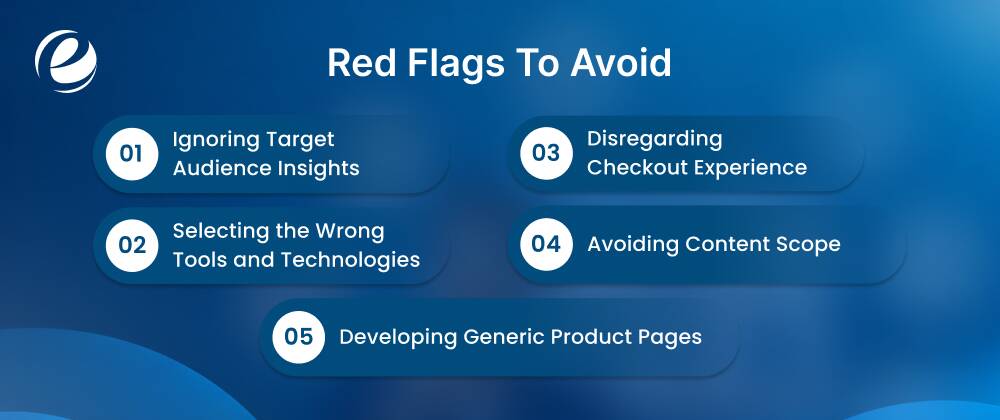
Ignoring Target Audience Insights
Several agencies are rigid in their approach to eCommerce development services or completely overlook audience insights. If you do, it’s time to change direction or stay alert.
Let’s look at an example. Suppose you own a kitchenware eCommerce website, and your eCommerce development partner focuses on revamping the site, while your target audience just wants you to fix the clunky checkout experience. The right company will focus on solutions and consider consumer behavior and buyer personas to help you make the right decision.
Selecting the Wrong Tools and Technologies
Choosing the wrong frameworks, tools, or CMS can cost you a lot. After all, no one wants the headache of duplicate or unsynced customer records or mismatched inventory. The best eCommerce development company also offers professional eCommerce consulting services to help you evaluate and choose the right technologies for your business requirements.
If your business heavily relies on multiple software tools, be they
- Content management system (CMS)
- Customer relationship management systems (CRMs)
- Point-of-sale system (POS) or
- eCommerce platforms
If you notice your partner isn’t prioritizing smooth integration, that’s a major red flag and can significantly hurt your business’s ROI.
Disregarding Checkout Experience
An inattentive company will never focus on improving the checkout experience on your app or eCommerce website. This directly disadvantages your business, as issues like website glitches, shipping restrictions, or limited payment options can instantly drive up cart abandonment rates. If your online eCommerce business has strong security protocols and secure payment channels, it will help build trust in your brand among users.
If you are seeing poor checkout experiences, connect with the best eCommerce development company. Easier, more user-friendly payment options lead to higher sales, and vice versa.
Avoiding Content Scope
Overlooking content is one of the biggest drawbacks. If your associated company believes the website can run efficiently without high-quality content and social channels, think again. It plays a pivotal role in driving organic traffic to a website; its absence can result in lost leads and ultimately lost sales.
The top eCommerce development company in the USA will always focus on expanding the content scope and implementing the best market strategy. They will consistently write SEO-optimized blog posts, regularly update news and information on your social media channels, manage your email newsletter, and more. Focused marketing efforts help you maintain stronger customer relationships.
Developing Generic Product Pages
Check whether your product pages match your expectations and vision. If not, you are working with an incompetent agency that doesn’t understand your ideas.
Generic or haphazard pages with blurry images and weird fonts can leave a negative impression on users. Today, visitors want uniqueness and prefer websites and stores that follow trends. One great example is integrating eCommerce AI agents to automate sales support and deliver hyper-personalized shopping experiences. The best eCommerce development company will never overlook crucial aspects like this. They will also focus on developing high-resolution product pages.
Read More: Fashion Ecommerce Trends
In-House vs. Freelancers vs. Agencies: Which Is Best for You?
Still not sure how to choose an eCommerce development company? To simplify this, here is a detailed table for your reference. It will help you choose the best option among in-house teams, freelancers, and eCommerce development agencies for your business.
| Features | In-House Teams | Freelancers | Agencies |
| Suitable For | Suitable for businesses and organizations that need consistent brand alignment. | eCommerce freelancers are ideal for businesses with short bursts of work, quick tasks, or fluctuating capacity. | eCommerce development agencies are best for businesses and enterprises with complex, multidisciplinary projects and long-term scaling. |
| Upfront Cost | High upfront costs. | Low upfront costs. | Medium-high upfront costs. |
| Time Duration | Hiring a dedicated in-house development team takes time. The process is slow because you need to handle everything from onboarding to training. | For speed, hiring freelancers is the quickest option for businesses and organizations. | You need to invest a moderate amount of time when hiring eCommerce agencies. |
| Expertise | Here, you can see a limited level of expertise. | Has expertise in specialized tasks. | A vast level of expertise is involved here. |
| Control | Offers direct control. | High level of direct control. | Direct control is limited. It often relies on an account manager. |
Why Choose Emizentech for Ecommerce Development?
This question only arises when you have clarity over your project scope, timeline, and budget. The reason why Emizentech will be the ideal choice for your business is that they offer,
- Fair value and pricing models
- Enterprise eCommerce platform specialization
- Next-gen capabilities like headless commerce and AI-powered features, including personalization, smart search, and AI agents
These unique qualities are hard to beat, which is why Emizentech has emerged as a leading eCommerce development agency and earned clients’ trust across the market. A team of highly qualified experts will guide you through the entire development process. From flexible hiring to deploying futuristic tech, everything will be clear and transparent.
Conclusion
You should now know how to choose an eCommerce development company. The tech market is highly volatile and dynamic. Hence, as a business owner, you need to stay alert. If you don’t know about emerging trends and technologies that can directly or indirectly affect your business operations, you may fall behind. In this guide, we have explained why hiring the right eCommerce development company is crucial and how it can benefit your business.
FAQs
Can an eCommerce development company help migrate my existing store without losing SEO rankings?
Yes, and a good one should make this a priority. A proper migration includes mapping old URLs to new ones with 301 redirects, preserving metadata and structured data, keeping site architecture consistent, testing on a staging site, and monitoring rankings and traffic after launch. Ask any prospective company to show examples of past migrations and how they protected organic traffic.
How long does it take to build an eCommerce website?
The estimated timeline for building an eCommerce website typically ranges from two weeks to twelve months. It depends heavily on the platform you choose, whether you opt for a custom design or a pre-built template, and the size of your product catalog.
Should I choose a local or offshore eCommerce developer?
This is a very subjective question. You may need a local eCommerce developer if your project demands a complex strategy, ongoing visual feedback, and strict brand alignment. You may choose an offshore eCommerce developer if you are on a tight budget or have out-of-the-box specifications.
What's the difference between eCommerce website development and eCommerce software development?
In simpler terms, eCommerce website development is setting up a store where customers can buy products online. eCommerce development is the process of designing, building, and maintaining digital platforms that let businesses sell products or services online.
Which eCommerce platform is best for my business: Shopify, BigCommerce, WooCommerce, or Adobe Commerce?
It depends on your size, budget, and customization needs. Shopify and BigCommerce suit fast launches and growing D2C or B2C brands. WooCommerce works well if you already use WordPress and want content-led flexibility. Adobe Commerce (Magento) is better for enterprises with complex catalogs, B2B workflows, and heavy integrations. A good eCommerce development company will recommend a platform based on your goals rather than pushing the one it knows best.
What should be included in an eCommerce development contract?
A solid contract should cover project scope and deliverables, milestones and timelines, payment schedule, ownership of source code and design assets, confidentiality terms, post-launch support and SLAs, and a clear change-request process. Make sure it also states who owns hosting accounts and third-party licenses so you aren’t locked in later.
How can I verify an eCommerce development company’s credibility before hiring?
Review their portfolio and live client sites, read verified reviews on platforms like Clutch or GoodFirms, and ask for client references you can speak with directly. Check how long they’ve been in business, whether they hold platform partnerships (such as Shopify Plus or Adobe Solution Partner status), and whether their past work matches your industry and scale.
Is it better to build a custom eCommerce website or use a pre-built template?
Templates are faster and cheaper, which makes them a good fit for startups and smaller catalogs. Custom builds cost more but give you unique branding, advanced features, and better performance at scale. Many businesses start with a customized template and move to a fully custom or headless build as they grow.
What is headless commerce, and does my business need it?
Headless commerce separates the front end (what customers see) from the back end (inventory, checkout, and order management), connecting them through APIs. It offers faster load times, greater design freedom, and easier omnichannel selling. It’s most valuable for brands with high traffic, complex experiences, or multiple storefronts. Smaller stores can often get by with a standard platform setup.
How can AI help an eCommerce development company improve my online store?
AI helps in several practical ways. It personalizes product recommendations, powers smarter site search, answers customer questions through chatbots, detects fraud at checkout, and forecasts demand. When you choose an eCommerce development company, ask for examples of AI features they have already delivered, since this shows they can build tools that improve conversions and customer experience.



 +1 (989) 535-9295
 info@emizentech.com
 emizentech


