 Add us as a preferred source on Google
The era of basic fintech operations is gone. In 2026, digitizing in the financial industry involves AI integrations, hyper-personalization, stricter security standards, and evolved compliance. All of this impacts the budget. Fintech app development costs usually start at $40,000 and go up to $300,000. However, setting a budget around this figure isn’t the ideal move, as there are multiple factors that determine the actual number.
According to a report by Fortune Business Insights, the global fintech market is growing at a staggering CAGR of 18.20% and is estimated to reach $1760.18 billion by the end of 2034. As a founder, this is a massive opportunity for you. However, before capturing the market, you should assess how much money you need to invest in building something that not only people use but also trust.
This guide will help you pinpoint exactly where your project falls on that spectrum.
Estimated Budget Required for Fintech App Development
First of all, investing in fintech app development is a high-stakes decision. In 2026, meeting compliance and security expectations is as non-negotiable as meeting scalability requirements.
For an MVP, a realistic cost to develop fintech app solutions starts at $60,000. The moment you make it an AI-integrated banking ecosystem, the cost easily climbs to $500,000+.
Basic Fintech Apps
If you are eyeing a solution within $50,000, you are likely looking at a white-label solution. It is great to enter the market, but it may lack the uniqueness required to compete today.
Mid-Range Fintech Apps
Most successful apps in the fintech space nowadays sit in the $120,000 to $250,000 bracket.
Enterprise Tier
Does your project involve a global, multi-currency platform with automated regulatory reporting? If yes, expect the fintech app development cost to be around $400,000.
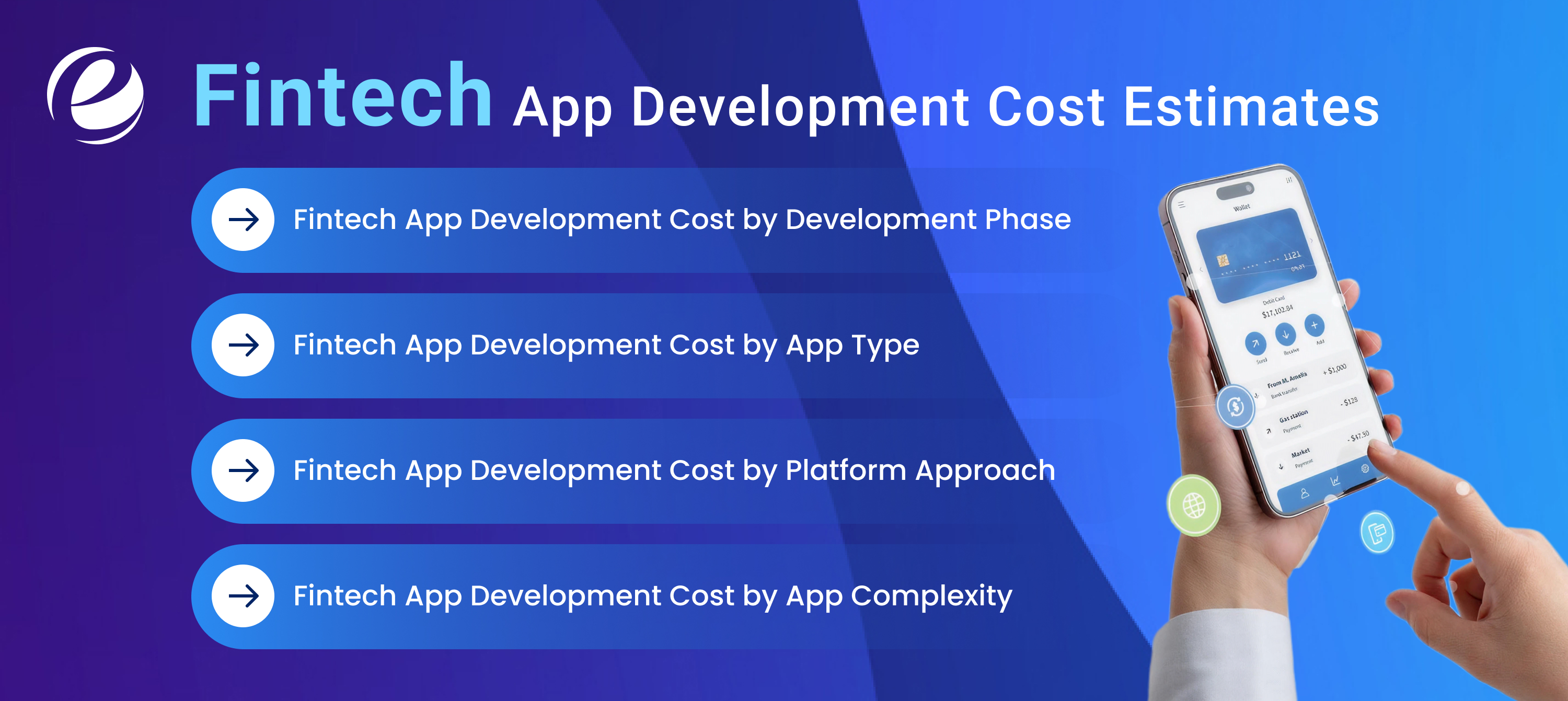
Fintech App Development Cost Estimates
In 2026, businesses are not looking for the best mobile app development company just to write code. The focus has shifted to investing in transparency and trust. The “build fast and break things” situation has transformed into “build safely and scale confidently.”
Fintech App Development Cost by Development Phase
In fintech development, you need a front-loaded budget to manage high-level logic and security. With new AI-driven fraud risks surfacing, the financial weight is now more on QA and backend this year.
| Development Phase | Share of Budget (%) | Cost Bracket – Mid-Range App | Strategic Focus |
| Product Discovery | 10 | $12,000 to $25,000 | Market analysis, product suitability, and strategy |
| UI and UX | 15 | $18,000 to $45,000 | Frictionless journeys and secure flows |
| Backend and API Development | 45 | $60,000 to $130,000 | Core banking, secure ledgers, and data encryption |
| QA and Security | 20 | $30,000 to $60,000 | Pen testing, AI fraud detection, and audits |
| Deployment and DevOps | 10 | $15,000 to $30,000 | CI/CD pipelines and cloud infrastructure |
Fintech App Development Cost by App Type
The cost to develop a digital wallet is different from a DeFi exchange system. Here are the estimates based on app types that significantly determine your budget.
| Type of Fintech App | Technical Focus | Cost |
| Digital Wallets | Gateway integrations and transaction speed | $60,000 to $150,000 |
| WealthTech | Real-time WebSockets and AI portfolio balancing | $90,000 to $250,000 |
| Credit and Lending | Heavy KYC and proprietary scoring | $80,000 to $150,000 |
| Neobanking | Core banking operations and round-the-clock availability | $140,000 to $500,000 |
| DeFi and Crypto | Smart contracts and multi-blockchain audits | $120,000 to $450,000 |
Fintech App Development Cost by Platform Approach
Be it any mobile app development, native and cross-platform stand in different cost brackets and often shape decisions.
| Platform | Performance | Cost |
| Native | High-impact trading and focused hardware biometrics | $150,000+ |
| Cross-platform | Faster MVP and standard retail banking | $60,000 to $140,000 |
Factors Affecting Fintech Mobile App Development Cost
If you’re planning to develop a fintech mobile app soon, the first thing you should do is understand the four primary levers that shift the final quote for your budget.
Geographical Location
The set of features implemented by a development team in the USA costs way more than the same set built by developers in India. The cost changes drastically depending on where the engineering team sits.
Here are the average hourly benchmarks:
| Region | Rate (Hourly) |
| USA and North America | $150 to $250 |
| Western Europe | $100 to $180 |
| Eastern Europe | $50 to $90 |
| India and Southeast Asia | $25 to $70 |
Regulatory Compliance
Compliance is the emerging cost in 2026. In fact, global spending on AI governance and compliance alone is estimated to hit $2.54 billion in 2026, as highlighted by SQ Magazine.
So, here’s how you can budget:
| Data Privacy Laws (GDPR/DPDP/CCPA) | $15,000+ |
| PCI-DSS Certification | $25,000 to $45,000 |
| AI Act Governance | $10,000+ |
Third-Party Integrations
In 2026, integrating with external platforms is where most fintech app development initiatives win or lose. While new-age API-first solutions like Marqeta offer “plug-and-play” documentation to speed up launch processes, legacy banking platforms may act as a bottleneck, demanding custom middleware to translate data.
This translation effort usually triples the engineering hours, eventually boosting the cost to develop fintech apps.
That said, here’s how integrations add to your budget:
| Type of Integration | Cost Bracket | Hours Spent on Engineering | Maintenance (Monthly) |
| API-first (Stripe, Plaid, etc. ) | $10,000 to $25,000 | 80 to 150 | Managed |
| Legacy Core Banking | $50,000 to $120,000 | 350 to 600 | Custom |
| Govt./Regulatory (KYC/Tax Portals) | $15,000 to $35,000 | 120 to 200 | Updates |
The Tech Stack
You will save thousands of dollars if you simply build an app using a template. But then,
- It won’t scale easily
- There will not be any customization based on your unique goals
- The X-factor will be missing, making your app look like just another option
- Security issues may ruin everything for you
These are just some of the reasons why you should invest both time and money in choosing the best tech stack for your app. Many modern fintech apps use a microservices architecture, which gives flexibility for technology, better scalability, fault isolation, and more benefits.
This adds roughly 20% to the initial fintech app development cost. But it also helps save hundreds of thousands in long-term technical reworks later.
How to Reduce Fintech App Development Cost Without Compromising Quality?

Here are the tips that our experts recommend for reducing the cost to develop fintech apps without cutting corners:
Enter the Marker with an MVP
Don’t build a fintech app with 50 different features all at once. Instead, focus on core features with smooth performance. Collect user insights, and then spend your next round of funding on expansion based on validation.
Use the API-First Approach
You can use verified third-party APIs for commoditized features, Twilio for SMS, Onfido for KYC, and Plaid for bank linking. This alone can help you reduce the development time (and ultimately cost) by 30-40%. However, you should consult your technology partner to make a better decision on this.
Choose Automated Security Testing
Manual testing is no longer a smart move. Instead, you should invest in automated security tracking that runs every time code is implemented. This spots vulnerabilities early during the development phase. Fixing at this stage will cost way less than later.
Outsource Smartly
You can partner with a firm in a lower-cost region that demonstrates diverse experience and expertise in the domain. Secure senior-level talent at a fraction of Silicon Valley rates.
How Emizentech Helps You Build High-Performance Yet Cost-Effective Fintech Apps?
Emizentech has been empowering brands in the finance sector for over a decade now. We specialize in custom fintech software and app development, delivering high-value solutions that align with both your ROI goals and your budget.
Here’s a glimpse of our end-to-end fintech mobile app development services:
- Security in every layer: A combination of encryption and multi-layer authentication in the core architecture of your project.
- Pre-verified modules: A library of pre-built, secure components for biometric login and payment gateway connections.
- Transparent pricing structure: No hidden “compliance” fees; a granular breakdown of every hour spent on building your app.
- AI and Blockchain Ready: From Gen-AI fraud prevention to smart contract deployment, your app stays relevant.
That’s just the basics. With over 1200+ projects delivered worldwide, we implement the combination of what works and what doesn’t in modern apps.
Get your own strategy today!
Wrapping Up
By investing in a fintech app, you are investing in your company’s credibility. So, evaluating the fintech app development costs based on all the factors is crucial.
A basic app can cost you $60,000, and a powerhouse platform might even hit $300,000. But the real concern here is to prevent the cost of failure.
That said, prioritize investing in a strong MVP, security, and choosing a fintech app development company that understands and has worked around the global regulatory landscape. These are the basic steps that you can take to avoid costly repairs later.
FAQs
How much does it cost to develop a Fintech app?
A basic fintech app (MVP or white-label) can cost $60,000 to $180,000. On the other side, apps with AI and blockchain can go beyond $350,000.
How much does basic fintech app development cost?
If you’re building an MVP with secure authentication and one primary function (like tracking expenses), you can expect the cost to be around $40,000 - $65,000. This range is when the app is developed with a cross-platform approach.
What is cheaper, outsourcing a fintech app or hiring in-house?
An in-house team for a fintech app involves a CTO, backend devs, frontend devs, and a security officer with full-time commitment. This takes the cost upwards of $600,000/year in the US. Outsourcing to a development company provides the same team at a fraction of the cost.
How long does it take to develop a fintech app?
An MVP takes 12 to 16 weeks, while a standard app takes 6 to 9 months. Enterprise platforms can take 12+ months.
Can the cost be reduced without affecting security and compliance?
Yes. You can minimize the cost by choosing third-party APIs for standard functions (KYC and payments) and focusing custom development strictly on your proprietary features.



 +1 (989) 535-9295
 info@emizentech.com
 emizentech


