 Add us as a preferred source on Google
 Digital payment applications transform money management practices by enabling users to use their smartphones as mobile financial tools, digital banking services and electronic receipt storage systems. In 2026, reliable digital pay apps will enhance your dining expenses, rental payments, and online shopping experience by delivering time savings, reduced cash risks, and organized payment records.
According to Credence Research, the global digital payments are projected to grow from about USD 147.06 billion in 2024 to over USD 474.53 billion by 2032, at roughly 15.77% CAGR, driven by UPI, digital wallets, real-time payments, and mobile-first adoption.
This guide covers the best digital pay applications, their features, and security practices to implement when using or developing these platforms. It provides a comprehensive overview for businesses and entrepreneurs planning to develop a mobile payment service like a cash app.
What is a Digital Pay App?
A digital pay app is a mobile or web‑based application that lets users send, receive, and manage money digitally using bank accounts, cards, wallets, or UPI addresses. These apps connect to payment networks to facilitate the following:
- The app enables immediate bank transfers through UPI, IMPS, NEFT and SEPA.
- Customers use card-based payment systems or NFC technology to make payments at retail locations.
- Online checkout enables customers to make purchases through e-commerce sites and mobile applications.
- Such apps handle bill payments, recharge services and subscription payments.
In India, many digital pay apps are built on the UPI infrastructure, while global platforms like PayPal, Apple Pay, and Google Pay rely on card and token-based networks. This growing ecosystem is driving demand for UPI payment app development to deliver seamless and user-friendly payment experiences.
What Features Should You Look for in Digital Pay Apps?
When evaluating digital payment apps, it helps to think in two layers: basic must‑haves and advanced “next‑level” capabilities that improve convenience and security.
Must‑Have Features (The Basics)
The essential features that define a reliable digital payment application include the following:
- Instant P2P transfers: Users can transfer money immediately through UPI IDs, phone numbers and email addresses.
- Multiple funding sources: People can connect their bank accounts, debit, credit cards and digital wallets.
- Transaction history and receipts: Users can access their previous payments through transaction history, including downloadable and exportable financial statements.
- Bill payments and recharges: The app enables users to pay their utility bills, mobile, DTH, broadband and insurance bills through a single platform.
- QR code and NFC payments: They can make payments by scanning merchant QR codes or using tap-to-pay technology at compatible point-of-sale terminals.
- Biometric and PIN login: Users can access the system through three authentication methods, including fingerprint, face recognition and 4-6 digit PIN.
Next‑Level Features (The Advanced)
The leading applications incorporate advanced features that enhance user experience and improve their ability to generate revenue for companies.
- Rewards and cashback: The app provides users with rewards through loyalty points and discounts that merchants offer.
- In‑app banking and investing: It provides users with banking and investing facilities through its virtual banking platform, which offers mini savings accounts, gold, and mutual fund investment options.
- AI‑driven insights: This uses artificial intelligence to deliver spending analysis tools and budgeting software, providing users with custom spending notifications.
- Offline or tokenized payments: It also enables users to make payments through NFC and token-based systems, which continue to function during internet disruptions.
- Merchant dashboards: This allows small enterprises to access merchant dashboards, present sales data, payment details, and stock control systems.
Advanced features are essential for entrepreneurs looking for fintech app development or aiming to build mobile payment solutions similar to Cash App.
Top 10 Digital Pay Apps
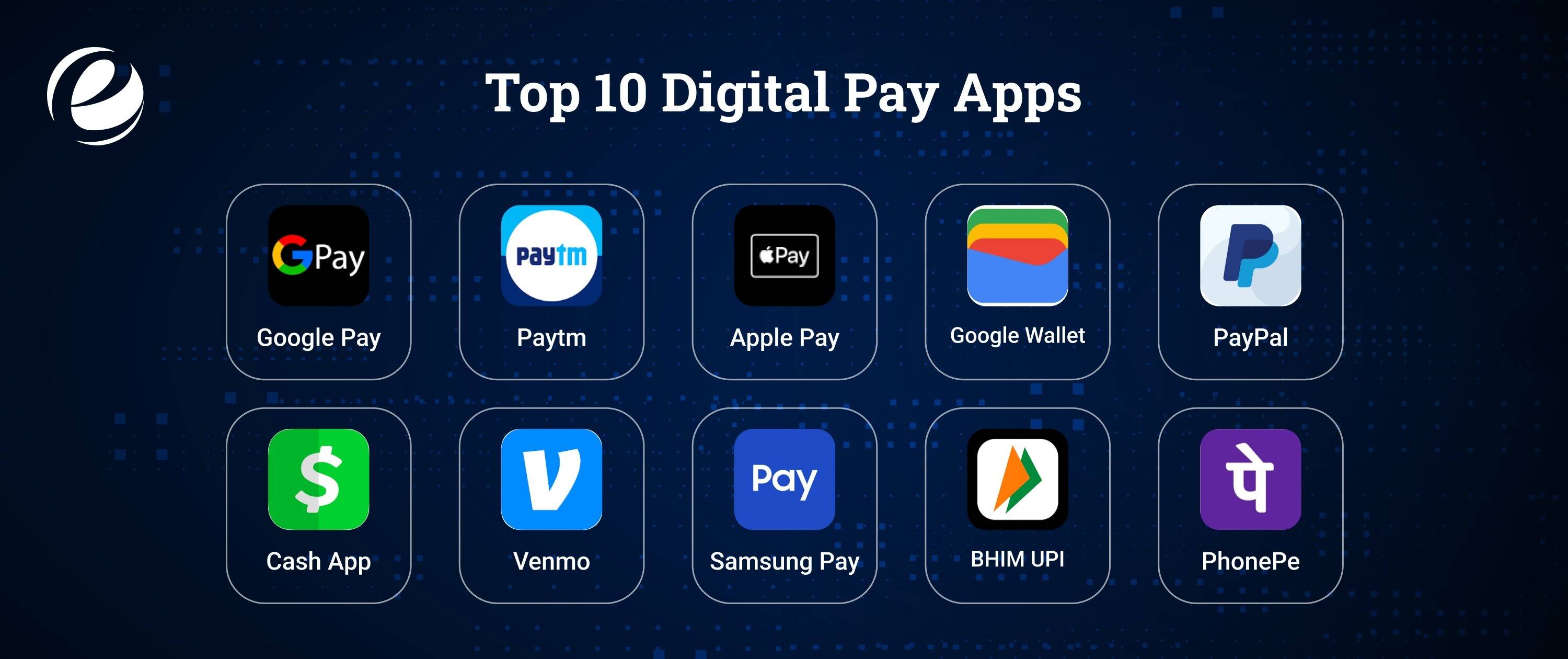
The following 10 digital pay applications available in 2026 provide users with fast, secure and easy-to-use payment solutions.
Google Pay (India & global)
Utilizes UPI, NFC and the Google ecosystem to enable users to conduct person-to-person transactions, pay their bills and make payments to merchants.
PhonePe (India)
PhonePe leads the UPI market through its extensive merchant network, UPI Lite service, insurance and credit offerings.
Paytm (India)
The digital payment application has existed for many years and provides users with a wallet service, UPI payment option, various ticketing, retail and banking services.
Apple Pay (Global)
The application provides secure payments through NFC technology within the Apple ecosystem for users at physical stores, online platforms and mobile applications.
Google Wallet (Global)
Users can access their cards, tickets, pass through this wallet, operate on Android, iOS platforms and work with Google Pay in specific regions.
PayPal (Global)
The platform enables businesses and individuals to make international payments while businesses maintain broad merchant partner networks.
Cash App (U.S.‑centric)
The application functions as a dual P2P and investing platform, allowing users to receive direct deposits and attracting younger users.
Venmo (U.S.)
The application enables users to send money to friends, while they can share payment information and write payment notes.
Samsung Wallet / Pay (Global)
The application enables Samsung users to make payments through NFC technology while they store digital keys and tickets in their devices.
BHIM UPI (India)
The UPI application developed by the government provides users with a straightforward and secure method to make electronic payments.
Comparison Table of Top Digital Pay Apps
| App | Best for | Key Strengths |
|---|---|---|
| Google Pay | Everyday UPI payments | Multi‑bank UPI, bill payments, NFC, rewards. |
| PhonePe | Indian merchants and UPI | Highest UPI transaction share, UPI Lite, and insurance. |
| Paytm | All‑in‑one wallet + UPI | Recharges, tickets, loans, and wallet‑based payments. |
| Apple Pay | iOS users and retail | Secure tokenization, Face ID/Touch ID, seamless Apple ecosystem |
| Google Wallet | Android and tickets | Passes, cards, and Google service integration. |
| PayPal | Global e‑commerce and freelancers | Cross‑border transfers, merchant network. |
| Cash App | U.S. teens and young adults | Investing, direct deposit, simple UI. |
| Venmo | Social P2P in the U.S. | Split‑bill, payment notes, easy sharing. |
| Samsung Wallet | Samsung device owners | NFC payments plus digital keys and passes. |
| BHIM UPI | Government‑trusted UPI | Minimalistic, secure, no‑frills UPI. |
Businesses investing in E-wallet mobile app development can benchmark leading Indian and global payment platforms to design a scalable and competitive fintech app development strategy.
Best Security Practices for Digital Pay Apps to Prevent Fraud and Data Theft
Digital payment applications maintain their security through two elements: their design measures and their user interaction methods.
- Use strong, unique passwords and 2FA: The implementation of two-factor authentication through one-time passwords, biometric protection, and application-based personal identification numbers should replace the current single-factor authentication system that uses only SMS verification.
- Verify UPI IDs and links: Users must authenticate their UPI ID and link verification through UPI handle, phone number and URL verification before making any payment.
- Limit exposure of primary accounts: Users should establish a secondary bank account for their primary bank account protection when dealing with high-risk merchants.
- Keep app auto‑updated: Digital payment applications require users to complete security patch updates through their automatic update system.
- Review transaction history daily: Users should examine their transaction records daily to identify any unauthorized debit transactions required immediate reporting.
- Log out shared devices: Users must log out of shared devices and should not store their login information on public or workplace mobile devices.
For businesses investing in fintech software development, a digital payment app should include tokenization, end-to-end encryption, AI-powered fraud detection, and compliance with RBI guidelines, PCI DSS standards, and regional data protection laws. This helps answer the question, “Is it secure to build a digital payment app?” with a clear “yes,” provided that security and regulatory compliance are prioritized throughout the fintech app development process.
Final Thoughts
Modern digital payment applications serve as comprehensive financial tools that combine payment processing with reward systems, along with banking and investment features. In India, platforms like PhonePe, Google Pay, and Paytm enable users to make online and in-store payments quickly, securely, and conveniently, while globally, apps such as PayPal and Apple Pay offer similar seamless payment experiences.
The current market environment compels developers and product managers to develop UPI payment applications, fintech software solutions, and white-label mobile wallet applications that replicate the user experience of leading platforms.
FAQs
Which is the safest digital pay app?
Apps like Apple Pay and Google Pay are recognized for their strong security frameworks, including tokenization and biometric verification, which keep sensitive card details protected. Samsung Pay also delivers high-level security, while PayPal stands out for its reliable buyer protection and fraud monitoring systems.
Which is the most popular digital pay app?
In India, PhonePe and Google Pay are the most widely used digital payment apps, driven by UPI adoption. Globally, platforms like Apple Pay and PayPal lead in popularity, depending on the user’s device, region, and payment preferences.
Are digital payment apps free to use?
Most consumer digital payment applications provide their basic transfer and selected bill payment services at no cost to users, although customers must pay minor fees for certain instant settlement and currency conversion services.
Is it secure to build a digital pay app?
Yes, the digital payment application development provides security benefits when developers implement strong encryption combined with tokenization, multi-factor authentication methods, artificial intelligence-based fraud detection systems and all fintech development activities maintain regulatory compliance.



 +1 (989) 535-9295
 info@emizentech.com
 emizentech


