
 Add us as a preferred source on Google
 Can a machine assist doctors in identifying diseases more rapidly? Can AI actually come up with new medications or prepare medical reports? The answer is yes, and it is happening right now. Generative AI in healthcare is being utilized positively and disrupting the traditional healthcare sector by providing more intelligent, quicker, and customized treatment than ever before.
This guide aims to provide a complete explanation of generative AI in healthcare, its present usage, real-world generative AI use cases in healthcare
Market Trends & Adoption Stats (2025–2030)
Well, as per the current market report, the generative AI market in the healthcare sector is growing very fast. In 2024, the global generative AI in the healthcare sector was valued at about USD 2.3 billion, and forecasts estimate it could reach over USD 15.5 billion by 2030, growing at more than 30% CAGR. In the meantime, the entire AI healthcare market is going to increase from 26.6 billion USD in 2024 to 187.7 billion USD in 2030. (Source – AI Journ)
Generative AI in Healthcare Market
According to Research Nester, it is expected to be worth USD 2.9 Billion In 2025, with an anticipated growth rate of ~31% CAGR through 2037 and a reach of USD 84.38 billion based on projections from various research sources.
This market in the United States is expected to reach USD 518 Million in 2023, and its growth rate is predicted to be 37.4% CAGR, which will result in USD 4.56 Billion by 2030. (Source – Grand View Research)
Overall AI in Healthcare Market
Anticipated to go up from approximately USD 36.7 Billion In 2025 to USD 187.7 billion by 2030, with a 38.6% CAGR, which is considered to be very fast.
There are numerous different estimates of the market size in 2030. One of them is that the market is expected to be worth USD 14.9 billion in 2024, which will then reach over USD 110–187 billion.
What Is Generative AI in Healthcare?
Well, generative AI in healthcare is the enhancement of human capabilities through the use of advanced artificial intelligence computer algorithms. These AI models are capable of generating novel material. They include medical images, reports, drug compositions, and treatment plans. On the other hand, a traditional AI system, basing its work mainly on data analysis, is enabled to produce informative outputs that serve as the decision-making support for a doctor, a researcher, or a healthcare provider.
The healthcare sector is undergoing a powerful change with the utilization of this technology in testing, drug discovery, and the customization of patient care. The rise of generative AI usage in healthcare is benefiting medical experts in giving speedy, more intelligent, and efficient service to their patients.
Top Generative AI Use Cases in Healthcare
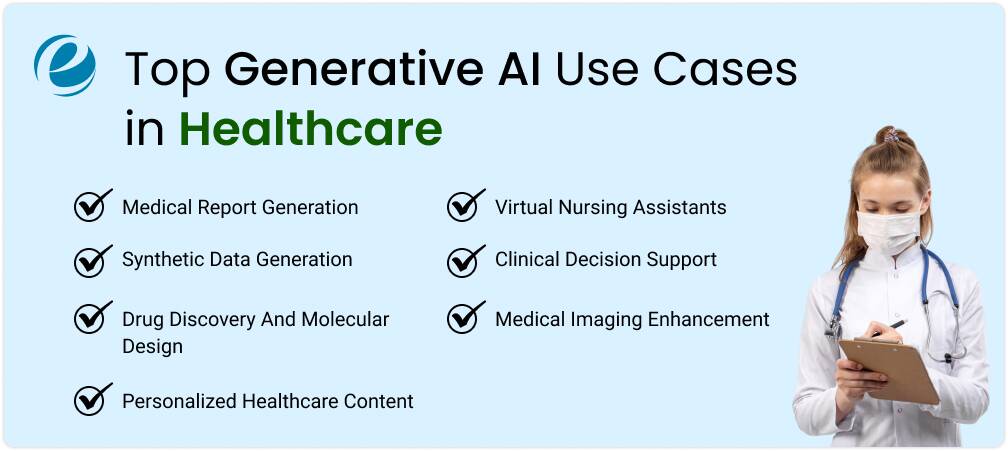
Generative AI adoption in healthcare is beyond words in the medical industry. It’s not all about just automating jobs; it’s about creating valuable data, improving care management, and backing up innovation.
Below are the most influential generative AI use cases in healthcare
Medical Report Generation
Generative AI can efficiently provide correct radiology and pathology reports by analyzing medical images and patient data. Besides, it offers doctors the advantage of having more time and completely safeguards them from errors caused by staff.
Synthetic Data Generation
AI can generate artificial medical data for research and training; thus, without infringing on privacy and without data shortage, it will be possible to improve models.
Drug Discovery and Molecular Design
AI models can generate new drug candidates by predicting molecular interactions, hence drastically lowering the time and the amount of money spent on the process of launching new medications in the market.
Personalized Healthcare Content
Whether it is diet plans or health alerts, the generative AI is able to produce auxiliary informative content for users based on their health history, habits, and therapy goals.
Virtual Nursing Assistants
Generative AI technology enables virtual assistants that use natural language and can provide patients with answers, medication reminders, and post-treatment care instructions.
Clinical Decision Support
The virtue of evaluating the patient documents as well as the research databases is that generative AI offers a diagnosis or the best treatment options. It serves as a tool for clinicians to utilize in decision-making.
Medical Imaging Enhancement
AI helps in upgrading or reconstructing medical images so that the images become clearer and have more details, particularly when the original scans are unclear or lacking.
These applications of generative AI in healthcare
Generative AI in Healthcare Examples
Generative AI is already in the real world, innovatively impacting healthcare with practical and innovative solutions. From discovery labs to healthcare facilities, this digital capability is being applied in specializations that change lives.
If you are searching for examples of generative AI in the healthcare industry, then here are some generative AI in healthcare examples
GPT-Based Medical Chatbots
AI-powered chatbots that are created on GPT models help patients in doing symptom checks, medication suggestions, and booking of appointments through natural, human-like languages.
IBM Watson for Oncology
This AI system is aimed at doctors; it supports the analysis of patient data and gives a cancer treatment plan based on worldwide medical research.
Insilico Medicine’s Drug Discovery
Insilico employs generative AI for the design of new drug molecules that will cure diseases such as fibrosis and cancer, thus significantly cutting down research time and expenses.
Google DeepMind’s AlphaFold
The generative models utilized by AlphaFold to experiment with proteins are very helpful to researchers as they can better understand diseases and come up with new treatments.
Synthea by MITRE
Synthea provided us with a way to come up with healthcare models for training purposes using generative AI as a source of synthetic patient health records without risking patient data.
PathAI for Histopathology
PathAI brings in the use of AI to generate thorough pathology insight from slides, thereby providing more accurate and faster diagnoses for diseases such as cancer.
Aidoc’s AI-Powered Radiology Tools
Aidoc leverages generative AI to improve and prioritize radiology reports, thus allowing physicians to get notifications quicker for emergency situations such as a stroke or a hemorrhage.
Generative AI in healthcare cases exemplifies how the technology is leveraged in diagnostics, pharmaceutical innovation, and patient interaction to energize intelligence and efficiency in healthcare.
Applications of Generative AI in Healthcare
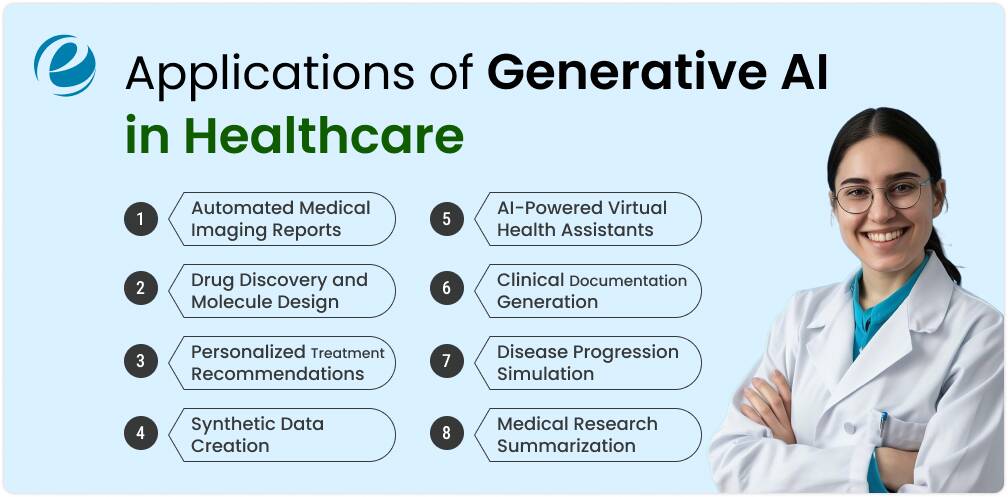
Generative AI has changed the healthcare sector beyond recognition through its ability to produce brand-new content that is based on medical data and that assists doctors in providing quicker, more accurate, and individualized treatment.
The generative AI in healthcare examples
Automated Medical Imaging Reports
Generates radiology and pathology reports based on scanned images and patient data.
Drug Discovery and Molecule Design
Creates simulated data to create new drug compounds and test their efficacy.
Personalized Treatment Recommendations
Generates the most appropriate treatment plans and direction for patients who have situation-specific data.
Synthetic Data Creation
Artificially generates patient data for research, training, and the safe testing of AI models.
AI-Powered Virtual Health Assistants
Continuously provides patients with the most up-to-date information.
Clinical Documentation Generation
Generates medical notes, prescriptions, and discharge summaries.
Disease Progression Simulation
Enables simulation of the potential disease course in order to better plan therapy in advance.
Medical Research Summarization
Removes the essence and transforms it into an easy-to-understand language from several complex sources.
Such enterprises are using generative AI applications in their scope of healthcare to become more efficient, more precise, and more responsive to patients’ changing needs.
Key Features of Generative AI in Healthcare
Generative AI in healthcare has advanced computing algorithms, and its features help patients, doctors, and medical experimenters get their work done smoothly and accurately. These features are the driving force behind the healthcare applications of generative AI and thus make the entire medical system more intelligent, responsive, and fully patient-centric.
Here are the most important features that characterize generative AI tools in the healthcare industry:
Natural Language Processing (NLP)
With the help of Generative AI, the computer can understand and produce a language very similar to human language in the medical profession. This feature makes it possible to automate the design of clinical notes, patient data summarization, and the performance of medical literature.
Image & Scan Generation
Generative AI models have the ability to create new medical images or improve the quality of existing scans. This feature will help doctors in diagnostics, training, and simulation. As such, AI-generated data can be used instead of real patient data, which is limited and comes with privacy issues.
Personalization Engine
Apparently, an AI system can be built for this aspect only because it creates output results such as treatment options or health tips solely based on an individual’s information or records, scientific medical history, genes, and lifestyle.
Data Anonymization & Synthesis
Generative AI can also generate synthetic (completely artificial but realistic) patient data to be used for training purposes without the risk of privacy breaches because real patients’ records are kept confidential and secure.
Conversational Intelligence
Healthcare chatbots and virtual assistants powered by generative AI offer more human-like responses, thus improving patient engagement and support.
Contextual Understanding
Generative AI learns the medical context, and this enables it to create important insights, follow-up questions, and notifications during conversations between doctors and patients.
Multimodal Learning Capability
Generative AI can handle and merge information from various sources, such as text, images, and reports, to deliver more prosperous and more precise answers in medical applications.
The combination of these features of generative AI in healthcare facilitates the automation of tasks and optimization of decision-making, and also ensures the best possible patient experience.
Benefits of Generative AI in Healthcare for Patients
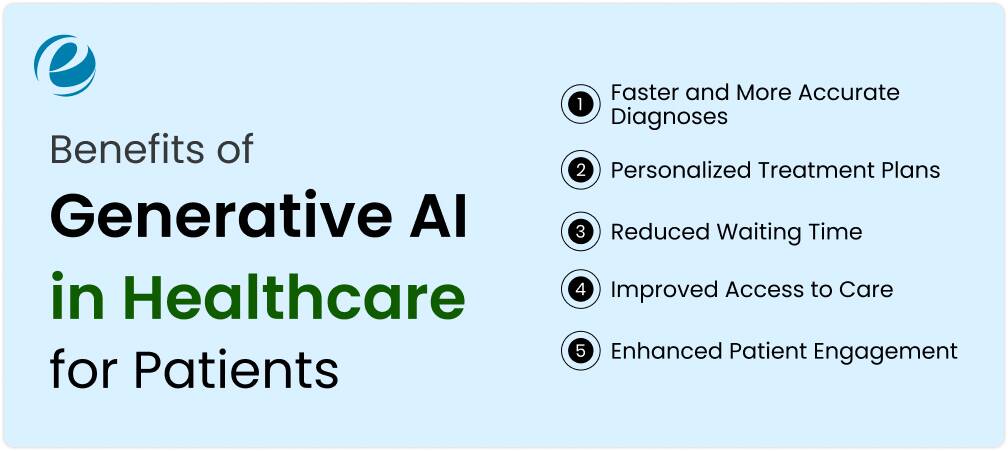
Generative AI is positively affecting patients’ healthcare by helping them with more efficient, accurate, and deeper care processes. Patients are getting better results and more convenient healthcare journeys with faster diagnoses and treatments.
Let us first review what regenerative AI brings to the healthcare sector that benefits patients directly.
Faster and More Accurate Diagnoses
Generative AI is able to scan medical data and images within seconds without failing in accuracy, which can be a great aid to clinicians in detecting cancer, diseases, and heart problems even before symptoms appear with confidence.
Treatment Plans
Having gathered users’ past and recent health data, generative AI services aim to provide doctors with the most efficient and customized therapy solutions that will allow patients to be cured while experiencing the least side effects.
Reduced Waiting Time
With the help of AI, certain tasks such as report generation and documentation can be delegated to machines, thereby freeing up the time of healthcare providers and allowing them to focus on patient care. This will reduce appointment delays and long waiting periods.
Improved Access to Care
AI-powered virtual assistants and chatbots provide 24/7 support, allowing patients to check their symptoms, learn about medications, and get follow-up instructions even when they are in hard-to-reach or underserved locations.
Enhanced Patient Engagement
Generative AI can simplify health information, send reminders, and give wellness tips. Thus, patients can become more knowledgeable, proactive, and involved in managing their health.
The benefits of generative AI in healthcare are rearranging the whole experience by becoming more efficient and accessible to everyone.
Limitations & Ethical Concerns of Generative AI in Healthcare
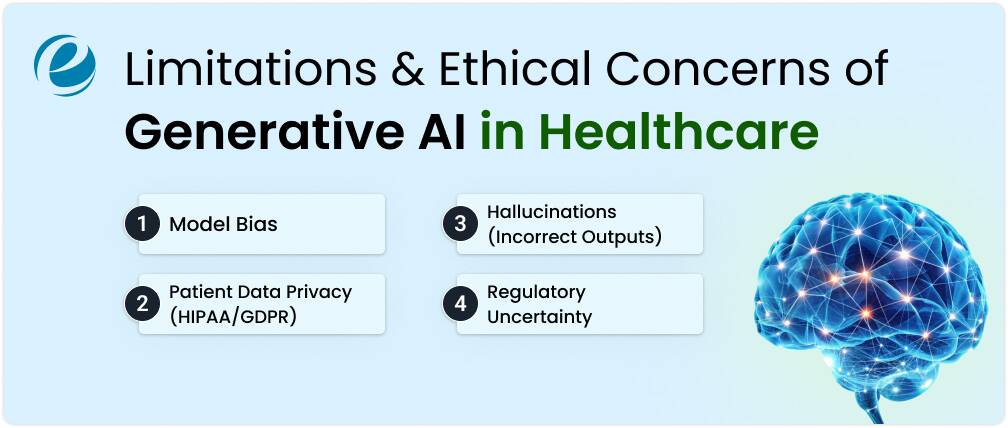
Generative AI has the potential to revolutionize the healthcare industry, but it comes with its own limitations. The technology carries risks to data privacy, and it can produce unexpected outputs.
Such ethical issues are raised by the technology, which developers, providers, and regulators must solve through teamwork. Partially solving these issues is the way forward to building safe, trustworthy, and efficient AI systems in healthcare.
Model Bias
When AI is trained on a small or unbalanced dataset, it may come up with biased results.
Patient Data Privacy (HIPAA/GDPR)
If sensitive health data is used, the privacy rights of patients should be strictly observed to avoid the use of their data in an illegal manner.
Hallucinations (Incorrect Outputs)
Sometimes, AI can be the source of mistakes or fiction in the medical field.
Regulatory Uncertainty
The lack of clarity in regulations around the use of AI in healthcare still exists.
People can use generative AI in healthcare more responsibly and effectively if they understand and address these concerns at the initial stage.
Tech Stack & Tools Needed to Build Healthcare AI Applications
The building of advanced AI applications for the healthcare industry needs a powerful and dependable tech stack. Such tools and technologies guarantee that the app is safe, scalable, and can process complicated medical data without any trouble. The selection of technologies should be done in the case of diagnostics, patient monitoring, or virtual assistants.
The following is an easy explanation of the tech stack and the tools that are necessary for the construction of healthcare AI applications, including programming languages, frameworks, databases, etc.
| Category | Technologies/Tools | Purpose |
| Programming Languages | Python, R, JavaScript | For AI model development, data analysis, and web interface |
| AI/ML Frameworks | TensorFlow, PyTorch, Scikit-learn, Keras | To train and deploy generative AI models |
| Cloud Platforms | AWS, Google Cloud, Microsoft Azure | For scalable infrastructure, storage, and AI tools |
| Databases | PostgreSQL, MongoDB, Firebase | To store and manage patient data securely |
| APIs & Integrations | HL7, FHIR, RESTful APIs | For integrating with existing hospital and EHR systems |
| DevOps Tools | Docker, Kubernetes, Jenkins | For continuous deployment, testing, and app scaling |
| Security Tools | OAuth 2.0, JWT, HIPAA-compliant data encryption tools | To protect sensitive healthcare data and ensure compliance |
| Frontend Technologies | React, Angular, Vue.js | To build user-friendly interfaces for patients and doctors |
| NLP & Language Models | GPT (OpenAI), BERT, spaCy | For chatbot, report generation, and text understanding |
Choosing the appropriate technology stack for generative AI development for healthcare that complies with industry standards, performs exceptionally well, and keeps patient data safe. Furthermore, it enables quicker project delivery and smooth compatibility with the current healthcare systems.
Future of Generative AI in Healthcare: What’s Next?
Generative AI in healthcare certainly has a bright future ahead; the changes anticipated are balanced to make healthcare a lot more intelligent, rapid, and customized. As technology evolves, we will also see that AI will assume complex roles in undertaking patient care, medical research, and clinical decision-making. Here’s a look at what lies ahead:
AI-Powered Preventive Healthcare
Future systems will identify health risks at a very early stage, allowing doctors to take preventive actions and patients to live healthier lives for longer.
Decision Support for Surgeons
Generative AI will be the surgeon’s assistant during operations by continuously providing suggestions and alerts that are in line with the information from scans and vital signs.
Advanced Virtual Health Assistants
As AI assistants become more human-like and smarter, they will dominate the space of patient queries with their mental health support function or chronic condition guidance.
Faster and Smarter Drug Discovery
From the beginning of AI, its models have set the pace for new drug research, speeding up response during outbreaks and also leading to the healthcare app development of new treatments for rare diseases.
Hyper-Personalized Patient Experiences
Future AI tools, using data from genetics and lifestyle, are set to pioneer next-gen care with diets and therapy programs, which are a few of the many new, exciting applications of such technology.
After these innovations are concocted, the foreseeable future of AI will carry onwards and outpace previously established limits, leading to more proactive, intelligent, and patient-centred healthcare.
Why EmizenTech Is Your Trusted Partner for Generative AI in Healthcare
EmizenTech acknowledges that the healthcare sector is going through a transformation with the help of technologies such as generative AI. We leverage our healthcare and AI-powered knowledge to empower medical organizations, startups, and hospitals to develop intelligent, secure, and high-performing applications. Automating clinical processes or creating patient-centric experiences, we provide full end-to-end support aligned with your vision. These are some of the benefits of partnering with us.
Why Choose Us for Generative AI in Healthcare:
- At EmizenTech, we are experts and specialize in providing healthcare software development services. Our team has been building HIPAA-compliant, user-friendly healthcare apps for clinics, hospitals, and telehealth platforms for years.
- We have generative AI full-stack developers and designers. We assist you right from concept to deployment in the design, training, and integration of the AI models that best fit your healthcare requirements.
- Our solutions are safe and capable of quick expansion. We guarantee the safety of the patient’s data using the best security protocols, and we also construct systems that can be extended when your organization grows.
- Also, we keep ourselves updated on the most recent AI tools and trends. Our professionals never stop learning and implementing the latest AI technology that makes you unstoppable in the market.
- Last but not least, we have a close working relationship with our clients at every phase. We think communication and inspiration are the main things that help collaboration happen and ensure your goals and expectations are fulfilled.
EmizenTech is not just a tech team but a trusted AI development company that is passionate about revolutionizing healthcare with intelligent, future-ready solutions.
Conclusion: Is Generative AI the Future of Healthcare Innovation?
Yes, AI-Generative is the innovative part of health care that is growing fast. It’s obvious by the variety of areas where this technology has been applied, i.e., improving diagnoses and treatments, speeding up drug discovery, and simplifying clinical workflows, that it is reshaping healthcare.
In the future, patients can help themselves with a new health service model that is faster, more efficient, and with better outcomes if more healthcare institutions get on this train with generative AI.
With an appropriate healthcare software development company and an emphasis on security and smart solutions, the potential of a generative AI-enabled healthcare industry is more promising than ever. It’s not only a trend; it’s a wise move for the whole healthcare sector.
FAQs
How is generative AI being used in healthcare
Generative AI is mainly used for such purposes as creating diagnostic reports, designing treatment plans, aiding surgeries, and driving virtual assistants.
What are the benefits of generative AI in healthcare?
Among others, it enables rapid diagnosis, tailor-made treatments, relieves doctors' burden, better patient engagement, and improved data analysis.
Is generative AI safe for handling patient data?
Definitely so, provided that the applications of generative AI are developed in accordance with secure, HIPAA-compliant practices, patient information is protected.
How much does it cost to build a generative AI healthcare app?
The costs depend on the features, complexity, and compliance needs. A simple version can start from $30,000+, whereas apps with more features can be more expensive.
Can small clinics use generative AI tools?
Absolutely! The various tools on the market fit the profile of small and mid-sized clinics well to automate workflow and deliver patient services.




 +1 (989) 535-9295
 info@emizentech.com
 emizentech


