 Add us as a preferred source on Google
 Maybe your eCommerce platform is holding your growth back quietly.
Every time a new customer experience needs a backend change, developers get too many requests, marketing gets slower, and innovation ends up limited by what your system can support. Headless commerce offers a completely different approach. By separating the front-end experience from the backend. Teams get the freedom to innovate, test, and work on the digital experience much faster. So what is headless commerce, how does it function, what’s the cost and how is it better than traditional eCommerce? Here’s the business case, in simple terms.
What is Headless Commerce?
So, what is the definition of headless commerce?
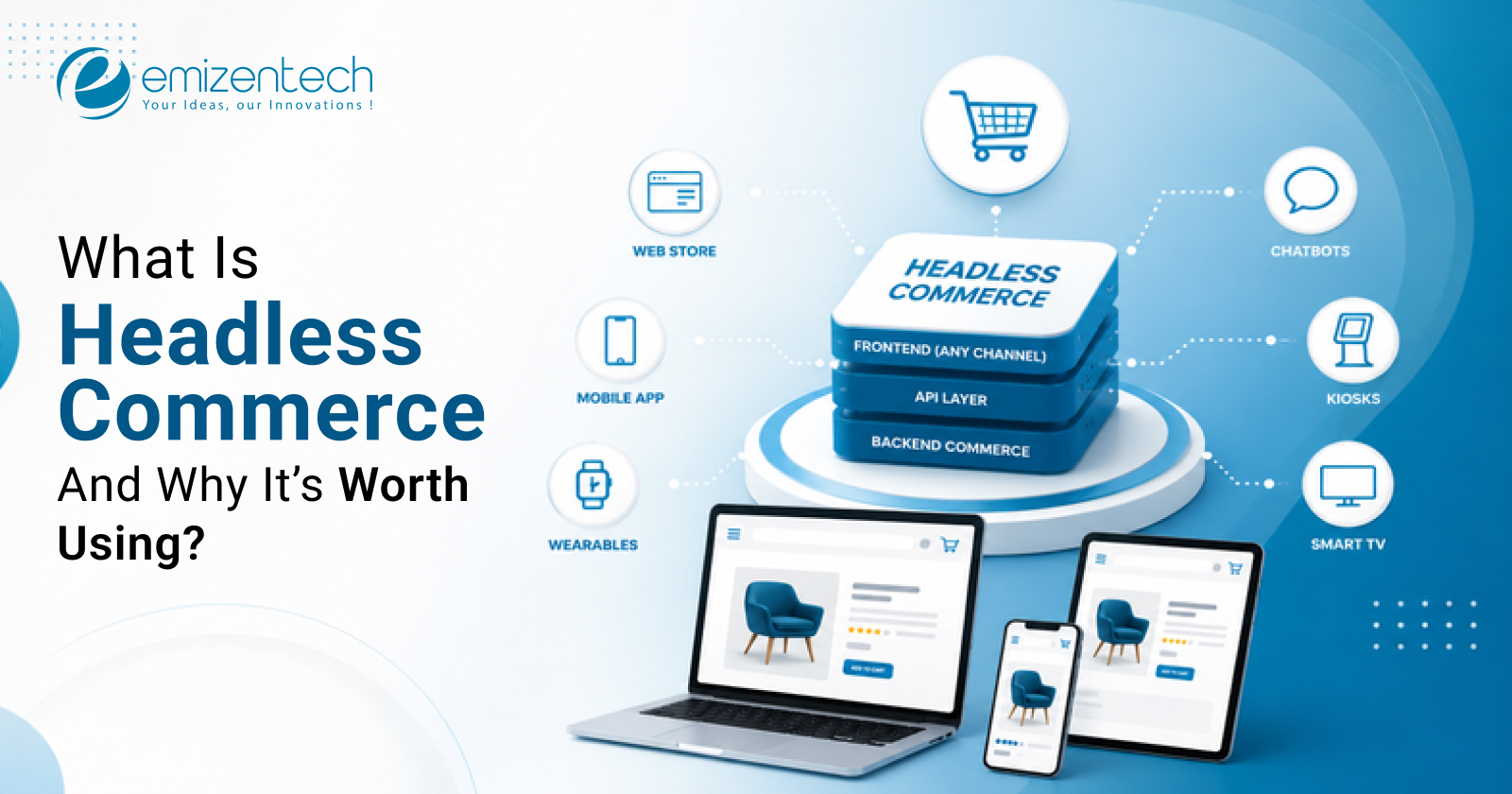
In simple terms, headless commerce is a type of eCommerce architecture that separates the frontend (the part that customers see and use) from the backend (something that handles the essential commerce of a business).
The frontend includes everything customers experience directly. It includes the website, listings of products, content present on the website, navigation and maybe mobile apps, self-service terminals or other digital channels.
The backend handles the operations part of eCommerce. It is mainly responsible for product inventory, pricing, customer data, shopping carts, orders, promotions, payments and other main functions.
In traditional eCommerce, these two components are not separated. The platform works on both core mechanisms and the interface that is visible to the shoppers.
Headless commerce breaks that connection. Now the frontend can work independently while the backend keeps on working BTS. APIs work as a bridge between the frontend and the backend, allowing the frontend to pull products, cost, inventory or any other data directly from the backend.
It is the main idea behind headless commerce, but it doesn’t mean that your store loses its “head.” It just means the customer-side layer is not connected to the backend directly. That separation is better as it gives more options in shaping new digital experiences.
Understanding the Headless Commerce Meaning
The best way to understand headless commerce meaning is not to think about eCommerce as one large system.
Instead, just think of it as two connected layers. The first layer is your backend. It is aware of what to sell, what the price is, and how much inventory is available and what orders are placed. The other layer is the experience. It takes care of how customers are going to discover products, how the information is displayed, how it moves through the website and how the brand feels when someone hovers through the website.
In traditional e-commerce, this platform mostly controls both. The headless system has a higher level of freedom from the experience layer.
Let’s understand more with an example: a business can use the same backend to support the main website, mobile application and in-store digital experience. Every experience can have its own interface but still work through the same data.
This is one of the basic fundamentals behind headless commerce. The backend provides the business capabilities. The frontend turns those capabilities into customer experiences.
How Headless Commerce Works?
Getting to know how headless commerce works is much simpler if you keep APIs as a passage between the frontend and backend.
Imagine visiting a product page. Here, the frontend needs to know the name of the product, description, cost, images and inventory. Rather than having all the info stored directly in the frontend, it can request it from the backend through the API.
The backend handles the request and sends the required information back to the frontend. The frontend then determines how that information should be shown. This same thing can be applied when you add something to the cart, change the quantity, apply a discount or complete the purchase.
The backend continues taking care of the actual commerce logic and the frontend focuses on a better customer experience.
The decoupled structure is what makes headless commerce different from traditional commerce.
It also gives a great idea of why headless architecture can be better for organizations that are planning for more than one digital experience without copying their core commerce functionality.
Headless Commerce vs Traditional Ecommerce
The argument between headless commerce and traditional eCommerce is always quite complicated.
The difference is actually kinda of simple.
Traditional eCommerce usually connects the frontend and backend more closely. A same platform that may provide the database, templates, commerce functionality, themes and other things in as part of one integrated system.
That approach really holds an advantage. It is easier to get started. A business can select a platform, choose a theme, add some products and ya you can start selling your products without making a whole website or platform from scratch.
For businesses with basic requirements, this is something that your business really needs.
Enterprise Headless commerce takes a not-so-similar approach. The backend is mainly responsible for commerce operations, but the business has a higher level of freedom to decide what the frontend looks like and how it should act.
| Feature | Headless Commerce | Traditional eCommerce |
| Architecture | Separate backend and frontend. | The backend and frontend are bundled together |
| Communication | API connects the frontend and backend | Internal system integration |
| Customization | Unlimited designs and personalization | Limited themes and restricted to in-built templates |
| Integrated channel reach | More easily supports websites, apps and IoT with one backend | Limited, not so easy to adapt standard web and mobile views |
| Setup and maintenance | Complex structure needs dedicated developer resources | Fast, plug-and-play launch lowers technical overload |
| Target businesses | Large enterprises or complex or scaling brands | Small to mid-sized businesses with standard needs. |
This doesn’t make headless eCommerce better. This is a major point that businesses should understand. The correct choice depends on the problem you are trying to solve. If your current eCommerce gives you everything you need, there may be a small reason to change. But if your platform is slowing or constantly limiting the customer experience, then you can consider headless eCommerce.
Why Headless Ecommerce Becoming More Important?
Customer expectations are changing faster than many eCommerce architectures. And honestly, customers don’t care what platform is supporting the website. experiences and
They don’t care if you are using the first system of APIs or a traditional eCommerce system or a complex enterprise architecture. They just care about whether they are getting a fast, easy-to-hover, and fun experience.
The customer wants that website to work smoothly. They expect product information to be easy to find and easy to understand. They increasingly expect personalized experiences and regular engagement across different channels.
And those channels are expanding quickly. A customer might find the product via social media, research on your website, and research on different websites then might visit a physical store and eventually purchase through another digital viewpoint.
For a customer, it’s just a journey. “From a business perspective, it can involve multiple systems. This is where headless eCommerce becomes more interesting.”
Instead of making every customer experience use the same frontend, businesses can create new and different experiences while connecting them efficiently with the same underlying capabilities.
The Benefits of Headless Commerce?
Most of the time, people discuss the headless commerce advantages purely from a technological perspective. But for an organization’s decision-makers, the crucial question is what those technical questions mean for the business.
The biggest headless commerce advantage is freedom.
With a traditional commerce platform, the capabilities and limitations of the storefront usually shape your customer experience. Using headless commerce can help you create and design the experience your business wants to provide.
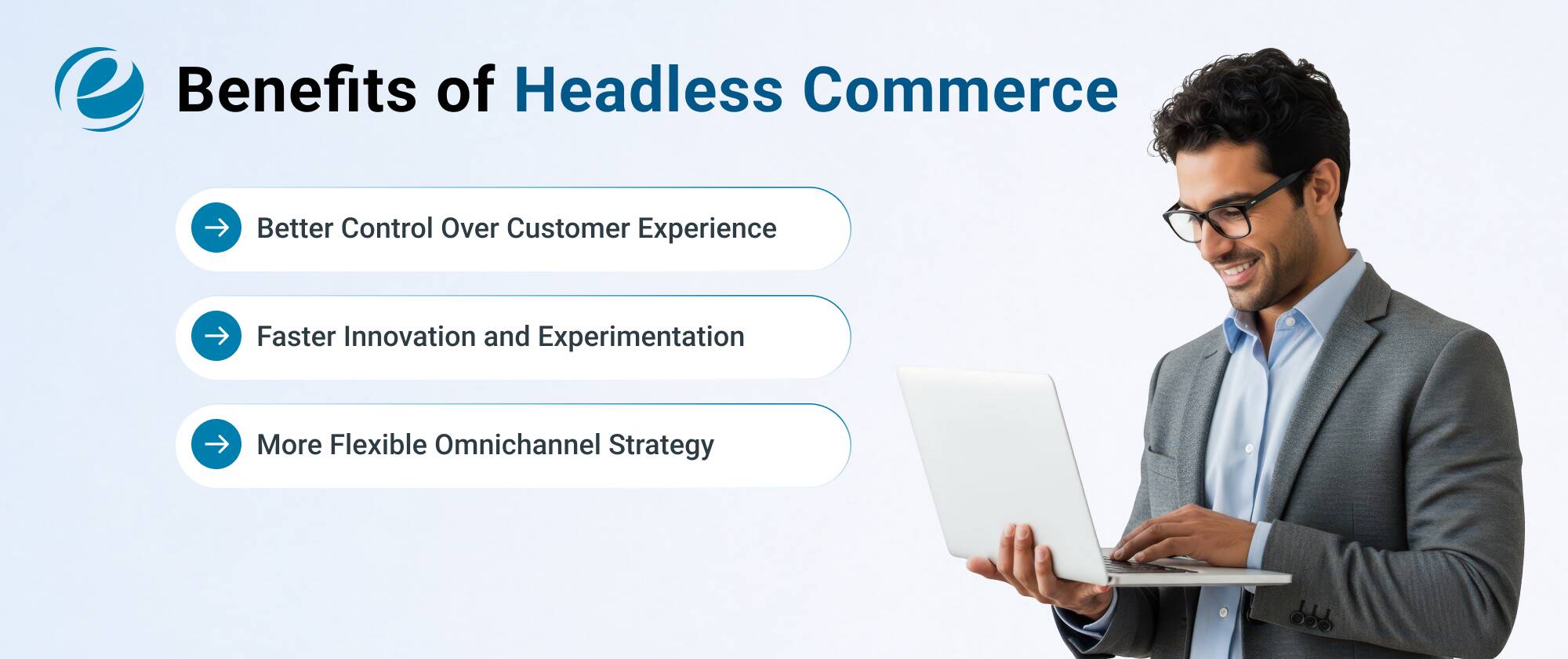
Better Control Over Customer Experience
Imagine there are two eCommerce businesses.
The first one sells products through a traditional online store. Customers see products add them to the cart and check out.
The second one is a premium brand that offers customers an amazing digital experience as part of the product itself, including impressive product pages, storytelling, and a great mobile experience.
The second one may have more reasons to consider headless commerce. The value isn’t just having a custom website. The value is the freedom to build the website around the customer’s interests instead of forcing the experience into the eCommerce platform’s limitations.
Faster Innovation and Experimentation
Teams in enterprise eCommerce need to evolve constantly.
Marketing teams launch campaigns. Product teams bring new experiences. UX teams test new experiences and paths. Developers work on performance. Business teams expand to new markets. In a closely connected architecture, these changes sometimes can become dependent on each other.
A really small frontend change might require major backend modifications, more and more testing, and coordination between multiple teams.
Whereas in headless architecture, the frontend and backend can be improved more independently.
But to be precise, “it doesn’t mean that changes become instant;” there is still testing and governance. But teams can definitely reduce unnecessary dependencies; for an enterprise, it can have a major effect.
More Flexible Omnichannel Strategy
The biggest reason to consider headless commerce is the ability to support different customer-facing channels.
Your website might be the only possible touchpoint. You might also need a mobile app, customer portal, in-store service station and many more digital experiences. A headless architecture can give you the power to connect with a single backend.
The website may have a design. The mobile app might have another. A store might have a completely different interface.
This really creates a new and flexible foundation for omnichannel commerce.
Enterprise Headless Commerce: Why Large Businesses Are Paying Attention
For a small online business, eCommerce is not that complicated.
For a big brand or enterprise, it can be really complex. Large organizations may operate on a larger scale, like multiple brands, multiple countries, and multiple currencies. They usually have a CRM, ERP, PIM, and other marketing systems that need to interact with eCommerce frequently.
They may also have multiple price structures, customer accounts, fulfillment policies, and buying journeys.
This scenario is where enterprise headless commerce can give you a really strong architectural advantage.
Instead of treating your website as a complete eCommerce system, an enterprise can treat it as a series of capabilities that support different experiences.
The frontend can evolve separately without directly affecting the backend.
A new market can be launched without building a new commerce engine.
A new mobile experience can be built without creating an entirely different product catalog.
For large organizations, this separation can make the digital journey more manageable.
For a better understanding, you should try ecommerce consulting services.
Headless Commerce Platforms: What Should You Look for?
Headless commerce platforms have grown rapidly, but your selection list shouldn’t start with popular names.
It should start with “YOUR” business requirements.
The right platform should support your products, customers, pricing, inventory, checkout, and order management. It also needs APIs with which developers can work more effectively and efficiently and integrations that fit your existing ecosystem. This factor is critical in enterprise headless commerce.
The platform may look interesting, but it is sometimes difficult to work with when connected to your actual ERP, CMS, PIM or OMS.
The quality of APIs, documentation, developer experience, and security can be as important as visible eCommerce features.
Long-term operational models should be considered by businesses
Who will maintain the frontend?
Who will manage integrations?
How will updates be handled?
How much internal engineering capability will be required?
These are some questions that help organizations identify the best headless commerce approach for their businesses rather than choosing the platform with the most impressive feature list.
What Is the Cost of Headless Commerce?

The cost of headless commerce is one of the biggest concerns for organizations considering a transition.
Which makes complete sense.
Headless commerce mostly needs more planning and development than launching a normal storefront.
The total cost completely depends on the scale of implementation, the commerce platform, the frontend technology, integrations, infrastructure, migration requirements, and ongoing maintenance.
For relatively simpler businesses, the investment might be manageable. But for bigger enterprises with multiple brands, markets, and integrations, investments can be significantly higher.
The better thing is to consider the cost of ownership rather than looking at the cost of the platform.
A headless project may include frontend design and development, API integrations, hosting, infrastructure, testing, data migration, SEO migration, monitoring, and ongoing engineering.
This is why a headless implementation can have a higher upfront cost than traditional eCommerce.
But cost should always be considered alongside business value.
Is Headless Commerce More Expensive Than Traditional eCommerce?
In most of the cases, yes, at least initially.
Most of the time, traditional eCommerce provides a ready-to-use storefront. Most businesses customize the existing theme instead of building a completely new architecture.
Headless commerce mostly requires more development. In this, you have greater control, but you have greater responsibility.
So a simple comparison shouldn’t simply be:
Traditional eCommerce = Cheaper
The better comparison should be
Traditional eCommerce = lower initial complexity
Headless commerce = greater initial investment for greater flexibility
If your business doesn’t need flexibility, this investment might not make sense to you. But if your current ecosystem is not letting you create new experiences, then investing in headless commerce may deliver significant long-term value.
What Makes Headless Commerce Worth the Investment?
The strongest point of headless commerce isn’t technical.
It’s strategic.
Imagine an enterprise retailer taking months just to make some changes in the digital experience.
Every change requires coordination between designers, developers, marketing, and other teams.
Now imagine a business that separates its frontend experience from its core system. Now the development team can work more independently, marketing can also use content systems designed for faster updates, and the commerce backend can also manage the orders, inventory and products.
Suddenly, the architecture is supporting faster change.
That is where headless becomes valuable.
The return isn’t simply a faster website.
It can be the ability to respond to customers and market opportunities faster.
For businesses, it is important to manage their operations in these competitive markets even more than technology and investment themselves.
The Disadvantages of Headless Commerce
It would be a bit unfair to just talk about the benefits of headless commerce and not discuss the disadvantages.
The biggest challenge is complexity.
When you separate the “frontend” and “backend,” you are giving more architectural freedom, but at the same time you are adding more responsibility too.
Your team needs to understand and manage the relationship between systems.
Developers need to understand the APIs and integrations.
Teams need to be aware of hosting, performance, security, and deployment.
The frontend is not something you configure inside your eCommerce platform.
You own more of it.
That can be a major advantage for organizations with strong technical teams.
It can also become a problem for businesses without the resources to maintain a custom ecommerce development architecture.
There is another risk: overengineering.
Occasionally, companies spend a lot on sophisticated headless architecture, even when a traditional platform could have solved the same problem perfectly well.
That is why you should always weigh the advantages of headless commerce against the additional cost and complexity.
When Should a Business Choose Headless Commerce?

The decision is easier when you see through the problem.
Headless commerce is a great option when your existing platform doesn’t allow you to improve the customer experience.
It also makes sense when a company is planning a new, complex integration and needs more flexibility; then you should consider it.
For example, a global retailer might need separate experiences for different countries while maintaining shared commerce capabilities underneath.
A B2B company might need it to manage customized purchasing journeys for different customer accounts.
A premium customer brand that needs an immersive digital experience that doesn’t fit into a traditional eCommerce experience.
Also Read: Different Types of Ecommerce Businesses You Should Know in 2026
When Should You Avoid Headless Commerce?
Not every business needs headless.
If your business is performing well, you’re satisfied with a straightforward journey, and your team doesn’t need specific customizations, then headless would be an unnecessary investment and add complexity you don’t require.
There is nothing wrong with using traditional eCommerce if it works. In fact, choosing a simple architecture can be a great decision for your company.
The goal is not to have the best technological architecture.
The goal is to have an architecture that supports your business well.
If traditional commerce can provide the experience you need, you may not need to move to headless commerce.
But if your current platform is limiting your growth, then the calculation changes.
Also Read: Top Features and Reasons to Develop an eCommerce Platform
Headless Commerce and SEO
Many people might be concerned that headless commerce is good for SEO.
The answer is “YES,” if implemented properly.
Headless commerce is not something that will damage or improve your search engine rankings. The technical implementation determines the results.
A headless storefront needs to provide search engines with accessible, crawlable, and indexable content. For SEO ranking, consider performance, rendering, page structure, metadata, canonical URLs, internal linking, structured data, and redirects.
This step is really important during migration.
A renowned eCommerce website might have thousands of URLs driving organic traffic and helping it rank. But changing the whole frontend without any proper SEO migration strategy can really damage your SEO rankings.
SEO should be a part of the architecture discussion from the very beginning.
If implemented nicely, headless commerce can provide frontend flexibility, which is needed to create fast, technically strong experiences while maintaining the SEO foundation required for SEO growth.
Headless Commerce and Content Management
Another important piece of the puzzle is content.
New-generation eCommerce is not just about products. Brands use multiple elements like editorial content, buying guides, campaigns, and videos to help customers make better decisions.
Traditional commerce also provides content management system (CMS) capabilities with commerce.
In a headless commerce system, businesses often use separate headless CMS platforms.
The benefit is flexibility.
Content teams can manage content independently, while the commerce platform manages commerce data.
Then the frontend can bring both together.
For example, a product page can combine product information from the commerce platform and editorial content from the CMS.
This creates a better experience without constraining the commerce platform to manage every type of content.
Headless Commerce and Developer Experience
Developers usually have a completely different perspective on headless commerce than other business teams.
From the developers’ point of view, the biggest attraction is freedom.
They can choose their frontend framework and customize components and design the application around the business requirements.
They aren’t necessarily restricted to the templating system provided by the commerce platform.
But that freedom comes with responsibility.
Developers may also need to manage frontend infrastructure, API integrations, caching, performance, security, and deployment.
So for CTOs and CIOs, the question isn’t simply whether developers can build a headless storefront.
The more important question is whether the organization can operate and evolve that architecture over the long term.
A successful headless strategy requires both technology and organizational readiness.
How to Implement Headless Commerce Successfully
A common mistake in headless commerce is that everything needs to be rebuilt. That’s not true.
A better approach is to start with a business problem.
What isn’t working today?
Is the website too slow?
Is the frontend difficult to customize?
Are the new channels difficult to launch?
Are integrations becoming a chokepoint?
Is the development process too slow?
Once you understand the problem, then you can understand what parts of architecture need to be changed.
A step-by-step process can really reduce the risk chances.
Instead of recreating the entire eCommerce ecosystem at once, a business can introduce headless architecture for a specific experience, brand, market, or customer journey.
The organization can then measure the results before expanding the approach.
This is particularly useful for enterprise headless commerce because large migrations can involve significant operational and technical risk.
How to Measure the Success of Headless Commerce?

The success of the project is not measured by whether the new architecture was launched on time.
It should be measured by the improvements.
Is the website faster?
Did conversions improve?
Can marketing teams launch campaigns faster?
Can developers create frontend changes more efficiently?
Can the organization expand into new markets more easily?
These are the metrics that really matter.
A new headless architecture model should make the business more capable and efficient. The technology is simply the foundation to reach there.
Headless Commerce vs Traditional Ecommerce: Which One Should You Choose?
There is “NO” winner in this.
Traditional commerce is good for businesses with a simple model that values simplicity, speed of implementation, and lower technical complexity.
Headless commerce is more important when the customer experience is strategically important and when businesses need greater freedom to build and evolve that experience.
Think of it this way.
If your eCommerce platform is helping you move quickly, keep using it.
If your eCommerce platform is repeatedly becoming the reason you can’t move quickly, it’s time to look at alternatives.
That is the real decision.
Is headless commerce worth it?
So after everything we talked about and covered, is headless commerce worth it for a business?
The answer isn’t a faster website or a modern stack or technology.
The real answer is flexibility.
Headless commerce allows businesses to separate the experience customers see from the infrastructure that supports the business.
It means the website can evolve without forcing changes to your backend.
Your mobile experience can evolve independently.
You can introduce new channels without changing the core capabilities of the backend.
Marketing, UX, and development teams can experiment with new things.
Enterprise technology teams can create an architecture better prepared for change.
But that flexibility isn’t free.
Headless commerce costs more to implement and operate than a simple traditional eCommerce setup.
It requires capable developers, careful architecture, strong integrations, and long-term planning.
That’s why businesses should never adopt headless simply because it is popular.
The right question is whether the business needs what headless provides.
If your organization has simple eCommerce requirements, a traditional platform may be the smarter choice.
If frontend limitations, complex integrations, multiple channels, or slow innovation cycles hold your business back, the case for headless becomes much stronger.
In that situation, the additional investment isn’t simply paying for technology.
You’re investing in the ability to change.
And in commerce, that ability can be incredibly valuable.
Why Choose EmizenTech for Headless Commerce?
Choosing headless commerce isn’t about choosing the latest eCommerce trend. It is about removing the walls that are holding back your customer experience.
Here at EmizenTech, we don’t start with an architecture diagram; we start with business. We analyze how your current stack works, where customer drop-off occurs, how your teams operate, which systems need to talk to each other, and what you will need to scale and then we create a headless approach around your needs.
It doesn’t matter if you are replacing your rigid storefront or creating a new digital experience from zero. Our epic team can help you bring that vision to reality. From frontend development and API integrations to eCommerce migration, performance optimization, and ongoing support, we handle the components that keep a headless setup running smoothly.
And we don’t recommend headless just because you asked for it. If your current architecture is doing your job, then we will say so. But if you are looking for a new customer experience and you need a workaround, every channel can create another development bottleneck, or scaling feels like rebuilding the house everytime, that’s where headless can make a real impact.
With EmizenTech, you’re not just getting another storefront. You’re building a commerce experience where new channels, experiences, integrations, and ideas don’t have to wait for the old architecture to catch up.
Final Thoughts
The future of eCommerce is not something having the most advanced technology stack.
It is about having the technology that can keep up with your business.
This is the reason why headless commerce is an important name in the world of eCommerce.
This approach gives organizations the freedom to control the customer experience while allowing the underlying commerce engine to do what it does best.
The biggest headless commerce advantages come from that separation: flexibility, experimentation, omnichannel experiences, and the ability to evolve different parts of the commerce ecosystem without rebuilding everything around them.
But it’s not a magic solution.
It is not something that is going to increase your sales, improve a weak eCommerce strategy, or bring you some magical leads.
What it can do is something that is increasingly valuable.
It gives you the freedom to build the experience your customers want.
Frequently Asked Questions About Headless Commerce
What is headless commerce in simple terms?
The headless commerce definition in simple terms, says it is a type of eCommerce architecture in which the customer-facing frontend is separated from the backend system.
The frontend controls the customer experience, while the backend controls commerce functionality such as pricing, inventory, carts, and orders.
What is the main benefit of headless commerce?
The biggest benefit that headless commerce offers is flexibility.
Businesses can get greater control over the experience of the customer and can build customer journeys and can eventually give a better digital experience to their customers.
Is headless commerce expensive?
The cost of headless commerce can be expensive, as it requires more frontend development and integrations. But this investment makes sense for businesses looking for more flexibility and wanting to improve their customer experience.
What are the main benefits of headless commerce?
The main benefits of headless commerce are frontend flexibility, easier support for multiple digital experiences, freedom to experiment and better architectural independence between the frontend and backend.
Is headless commerce good for SEO?
Yes, if it is correctly implemented, SEO fundamentals like crawlability, rendering page performance, metadata, and structural data are properly managed.



 +1 (989) 535-9295
 info@emizentech.com
 emizentech


