
 Add us as a preferred source on Google
 Healthcare isn’t just shifting to digital; it’s already there. Apps for virtual consultations, patient tracking, and health records are becoming increasingly standard. But the moment you start dealing with health data, things get serious. A single mistake can lead to significant issues. That’s why HIPAA compliant app development is no longer something you can treat as optional; it’s just part of doing things right.
And the space is only getting bigger. The global eHealth market is expected to reach USD 317.64 billion in 2026, which says a lot about where things are headed. With that kind of growth, rules are getting tighter, and people are far more aware of how their data is being handled.
In this guide, we’ll walk through HIPAA compliant app development in a practical way, covering the essentials, the technical side, the costs, and a few mistakes that are quite easy to make if you’re not careful.
What is HIPAA Compliant App Development? And Why Does it Matter?
HIPAA compliant app development is an advanced way of developing and creating mobile apps under the Health Insurance Portability and Accountability Act (HIPAA). It aimed at ensuring that PHI stays protected against any possible data breaches and unauthorized access.
Complying with HIPAA is not only about privacy; it includes implementation of various kinds of safeguards, such as administrative, physical, and technical safeguards, including encryption, auditing, and access control. In other words, this process allows for the exchange of medical data through digital means while complying with federal requirements.
Why It Matters-
- Prevents unauthorized access to confidential patient data
- Aids in avoiding lawsuits and financial liabilities
- Enhances trust among patients and medical practitioners
- Maintains adherence to healthcare policies and standards
- Facilitates secure and effective e-health applications
Who Needs HIPAA Compliant App Development?
If your app is anywhere near patient data, HIPAA compliance usually comes into the picture sooner than people expect. It’s not just hospitals; there are quite a few others in the mix, too.
- Hospitals and healthcare systems for EHR integration and day-to-day care coordination
- Digital health startups building wellness tools, diagnostic apps, or even simple scheduling features
- Telehealth platforms handling virtual consultations, therapy, or remote patient interactions
- Health SaaS products that store or manage patient medical records for providers
- AI or data analytics platforms working with PHI for insights, reporting, or predictions
Essential HIPAA Rules You Must Follow in App Development
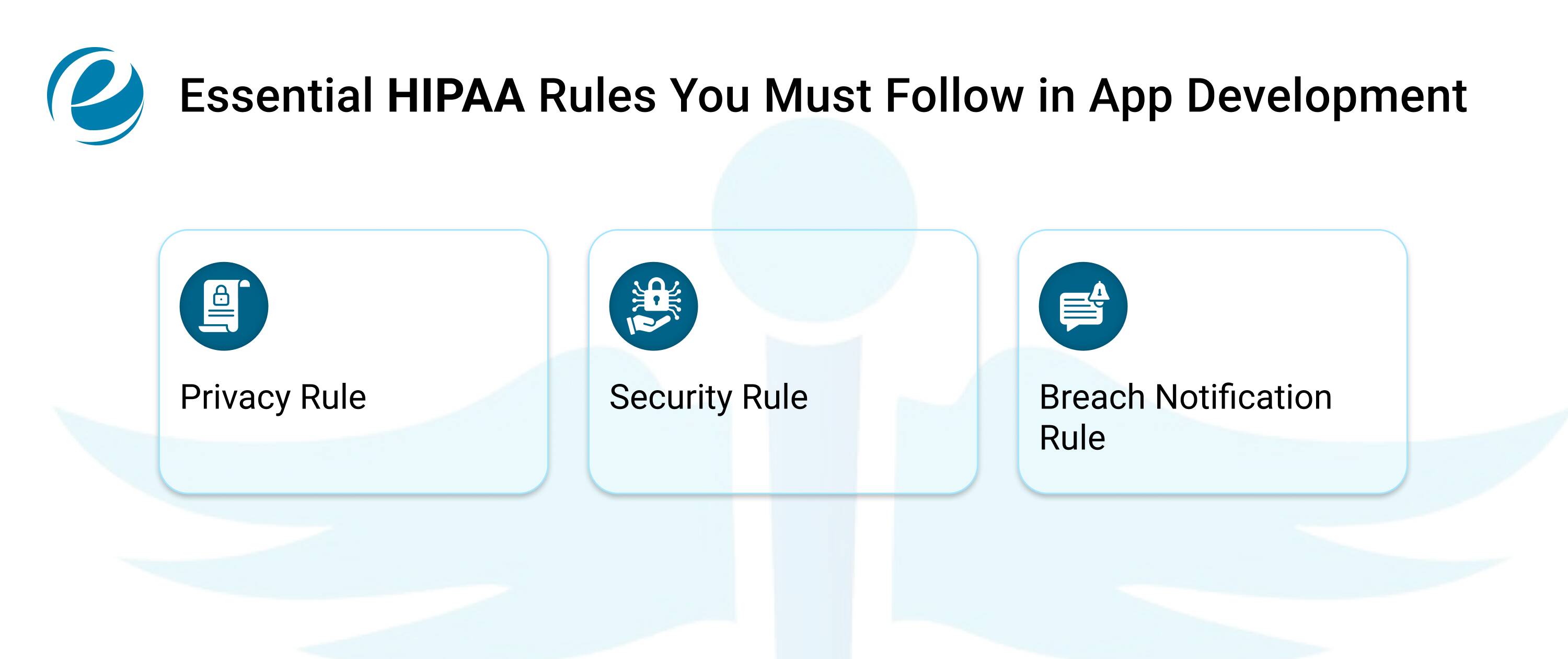
To stay on the right side of HIPAA, these apps really come down to three main rules. Let’s break down the core HIPAA rules you really need to keep in mind when you develop a HIPAA-compliant mobile app
Privacy Rule
The privacy rule lays down the guidelines for the uses and disclosures of PHI, giving patients the power to control their own medical information, which shall be accessed for legitimate purposes only.
Security Rule
It is related to the protection of e-PHI by using administrative, technical, and physical safeguards such as encryption, access control mechanisms, and designing a security system that takes care of the application life cycle.
Breach Notification Rule
In the event of a data breach, this rule mandates the notification process to concerned individuals and authorities, as well as minimizing the harm caused by the data breach.
The 3 HIPAA Safeguards That Shape App Architecture
The HIPAA security rule splits everything into three buckets. They’re simple on paper, but in practice, all three need to line up for anything to actually stay compliant.
Technical Safeguards
- Encrypt stored data with AES-256; PHI should never sit in plain text, not even temporarily
- Use TLS 1.2 or higher for data in transit (TLS 1.3 is usually the better pick)
- Every user should have their own login ID, managed through role-based access
- Multi-factor authentication isn’t optional when ePHI is involved
- Sessions should auto-log out when users leave things idle
- Keep audit logs running in the background for every access or update to patient data
- Add integrity checks so data can’t be quietly changed without proper authorization
Physical Safeguards
- Keep physical access to servers and storage systems tightly controlled
- Workstations dealing with PHI need clear, practical usage rules
- Devices should be tracked, encrypted, and wiped properly when retired
- Only use cloud providers that are HIPAA-ready and properly contracted
- Maintain encrypted backups and test recovery from time to time
- Mobile devices should be locked down with remote wipe and enforced encryption
Administrative Safeguards
- Do a proper risk review before launch, and don’t treat it as a one-time thing
- Assign a security officer to manage compliance responsibilities
- Training needs to happen at onboarding and again every year
- Access should be reviewed and adjusted based on real job roles
- Have an incident response plan ready before anything goes wrong
- Sign business associate agreements with every external vendor handling PHI
Must-Have Features of a HIPAA Compliant App
For a reliable healthcare application, there are some features that must be integrated during development in order to comply with security requirements. Some of these features of HIPAA compliant app development will be discussed below.
- Encrypted Data (End-To-End): This method protects sensitive patient data during both storage and transfer; therefore, no unauthorized party can see or access it.
- Multi-Factor Authentication (MFA): It is an additional verification layer placed upon users’ current password logins to secure all logins.
- Role-Based Access Controls (RBAC): It limits user access to only the data necessary in order to complete their job; thus, it prevents the amount of risk assigned to an employee.
- Data Minimization: Limits the amount and type of data that is collected and stored, which will reduce the risk of security incidents, improve compliance, and potentially lower the cost associated with data collection.
- Secure Messaging and File Sharing: Safe exchange of information between providers while protecting health records.
- Consent Management: The consent of the patient to access, exchange, or use their medical record can be obtained beforehand.
Advanced Features
- Advanced Authentication & Security: Provides more sophisticated security against new forms of cyber attack.
- Audit Trails and Logs: Records every system action so you can track what happened, spot issues, and prove compliance.
- Automatic Session Management: Logs users out when leaving the application for a long time.
- AI-Based Anomaly Detection: It captures the patterns of permitted system behavior and compares the live system activities against the captured patterns. Thus, it becomes particularly helpful in detecting any abnormal access to confidential information in AI in healthcare.
- Secure Architecture & Backend: The application is designed using a secure infrastructure architecture that provides security at the system level.
- Secure Communication Channels: Guarantee that all communication channels used for transferring data are secure by encrypting all communications.
Technical Requirements and Tech Stack for HIPAA Compliant App Development
Now let’s explore what technical requirements and technologies are required for HIPAA compliant mobile app development.
Key Technical Requirements
- Data Encryption: PHI should always be protected properly. That means AES-256 encryption when it’s stored and TLS 1.2 or higher while it’s moving across networks.
- Audit Logging: Every action involving PHI needs to be tracked. Not just basic logs, but something that can’t be altered or tampered with. And those records should be kept for at least 6 years.
- Secure Disposal: When data is deleted, it shouldn’t just disappear from the UI. It has to be properly wiped so it can’t be recovered later; no traces left behind.
- Network Security: Database systems should not be accessible from the open Internet. Make sure that you have firewalls, Virtual Private Networks, and appropriate levels of encryption in place.
- Emergency Access: You need to have an emergency access plan ready just in case anyone needs to access your data immediately. This is something you can’t just improvise on the spot.
Technology Stack for HIPAA Compliant App Development
- Frontend: React, Angular, and Vue.js can be used for web applications. For mobile applications, React Native, Swift, or Kotlin can be used.
- Backend: Node.js, Python (Django/Flask), Java, .NET, or Ruby are commonly used. Typically, it is the developer’s expertise that makes the decision.
- Databases: MySQL and PostgreSQL are common choices. MongoDB works for flexible schemas. On Cloud, Amazon RDS, Google Cloud SQL, or even Oracle DB in more enterprise-heavy setups.
- Cloud Services: AWS, Microsoft Azure, and Google Cloud are the usual options. All can be configured for HIPAA environments if set up correctly.
- Authentication: OAuth 2.0 and OpenID Connect are standard. MFA isn’t optional; it really should be enforced everywhere, not just for admins.
- Monitoring & Auditing: Some of the tools that can be utilized include Splunk, ELK Stack, and Datadog.
- API Management: The common tools used here include AWS API Gateway and Apigee. REST APIs remain the default, while GraphQL is seen as being used in some systems. OAuth 2.0 forms the underlying technology.
- Compliance Tools: Secure messaging systems built for healthcare, plus tools that help track compliance status and maintain documentation for audits.
Step-by-Step Process to Develop a HIPAA Compliant App
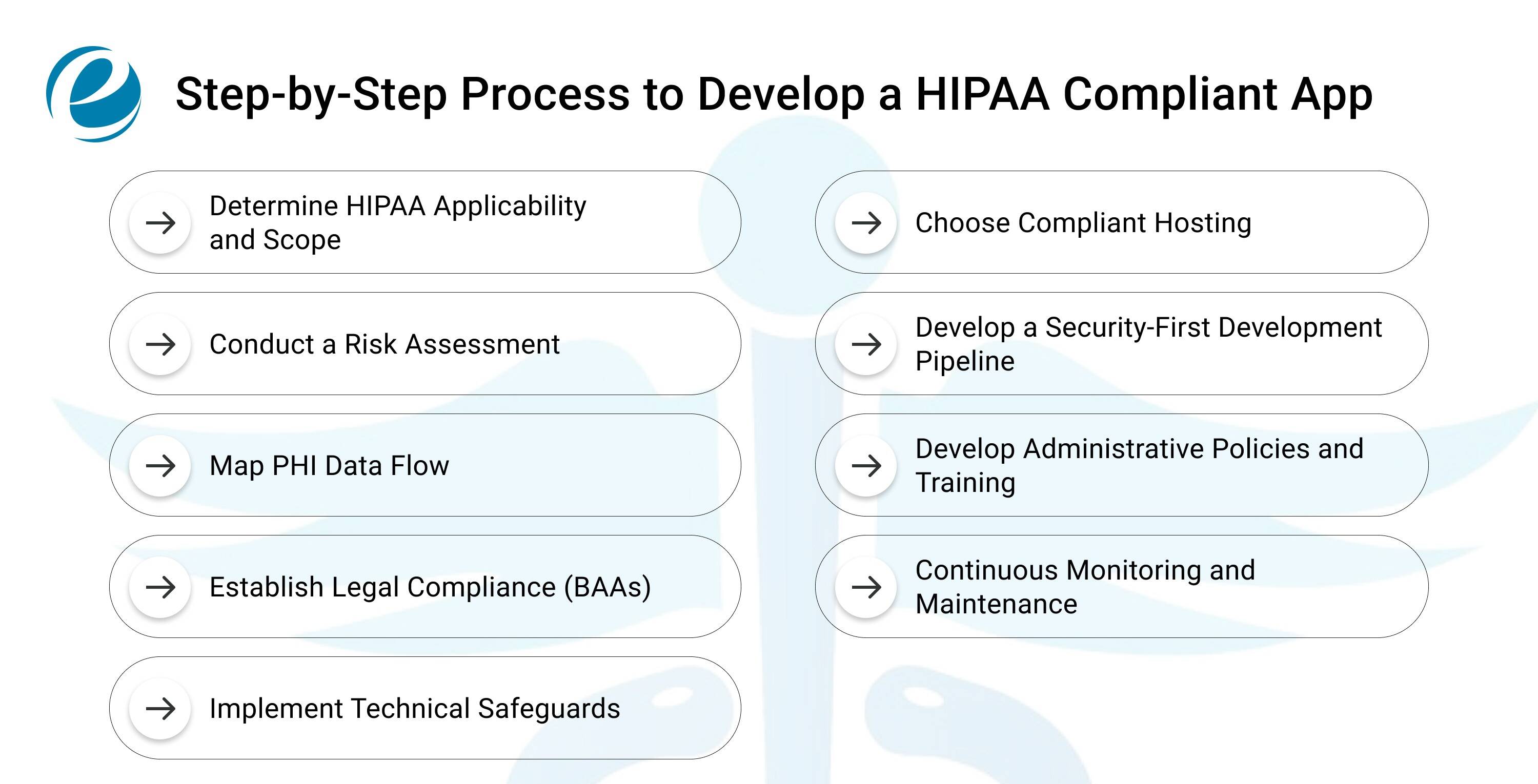
HIPAA compliant app development does not occur in one fell swoop but rather through an iterative process that allows the security of health information to be ensured during the entire process. Some of the steps include:
Step 1: Determine HIPAA Applicability and Scope
The first step you need to take into consideration is whether the application involves any handling of PHI. If it is the case, you have to determine which particular features and modules fall into the scope of HIPAA compliance.
Step 2: Conduct a Risk Assessment
Before embarking on the actual development process, assess possible risks and weaknesses in your design. You can use this information as the basis for making safe decisions regarding the further implementation process.
Step 3: Map PHI Data Flow
It is important to determine how patient data moves within the app – both inwardly and outwardly. This way, you will be able to design the app securely and reduce unnecessary data exposure.
Step 4: Establish Legal Compliance (BAAs)
Develop BAAs with all the third parties involved who have any access to the medical records and ensure adherence to HIPAA regulations.
Step 5: Implement Technical Safeguards
Implement encryption, secure authentication, role-based access control and audit trails to protect sensitive information.
Step 6: Choose Compliant Hosting
Select a cloud vendor that is HIPAA compliant, has secure infrastructure, and provides encryption and secure access to the application.
Step 7: Develop a Security-First Development Pipeline
Security should be integrated into each phase of the project’s development: developing your plan, writing code, testing code, and deploying code. It is not something to be added at the end of your project.
Step 8: Develop Administrative Policies and Training
Train all members of your organization on HIPAA compliance, secure data handling best practices, and data protection to reduce the likelihood of human error.
Step 9: Continuous Monitoring and Maintenance
After launch, you should continue to monitor system performance, conduct security assessments, and implement software updates to remediate any security vulnerabilities in order to remain compliant.
Adhering to this process is an important step in creating modern healthcare software development that can be both secure and compliant from the very start.
HIPAA Compliant App Development Cost Breakdown
The cost of developing a HIPAA compliant app can be different. It depends on the amount and type of features you want, complexity, and security needs. So, understanding the complete breakdown of the costs for an app is important.
HIPAA Compliant App Development Cost by App Complexity
Basic App ($40k – $80k)
Best for simple MVPs that have very few features, such as health-tracking apps and medication-reminder apps that have a basic user login, as well as basic data storage.
Mid-Level App ($80k – $150k)
Ideal for telemedicine apps that have secure messaging, video chat capabilities, and the ability to connect to a smartwatch, or at least a basic health care system.
Advanced App ($150k – $300k+)
Best for enterprise applications that integrate into an EHR, contain artificial intelligence, or are IoT-enabled and require very high security.
Key Cost Factors
- App Complexity: Simple apps are one thing, but once workflows start getting layered and a bit more involved, the effort (and cost) naturally goes up. There’s just more to build and maintain.
- Features and Integrations: This is usually where things start adding up. Connecting to external systems like EHRs or wearable devices takes extra time and money.
- Security Requirements: Strong encryption, compliance needs, and all the testing around it tend to push both effort and infrastructure costs higher.
- Development Team Location: Where your developers are based makes a noticeable difference. Hourly rates vary a lot by region, and that ends up shaping the overall project budget more than people expect.
Common Mistakes in HIPAA Compliant App Development (And How to Avoid Them)
Healthcare apps usually don’t fail because someone meant to cut corners. It’s more often small oversights early on that snowball into compliance issues later. Here are a few of the common mistakes in HIPAA compliant mobile app development we keep seeing and how to stay ahead of them.
Ignoring Compliance Early
A lot of teams jump straight into building and only think about HIPAA when things are already in motion. By then, fixing gaps becomes messy and expensive.
Solution: Bring compliance into the conversation from day one. It should shape the architecture, not sit on top of it at the end.
Weak Encryption
Sometimes data is protected, but not strongly enough or only partially, which leaves gaps. That’s risky when you’re dealing with patient information.
Solution: Use solid encryption for everything: data in transit and data stored on servers.
Poor Access Control
Users may be provided with greater privileges than those that are strictly needed.
Solution: Use tight role-based access control to make sure that users have only minimal access to data.
Lack of Audit Logs
It’s surprising how often systems don’t properly track who did what and when. Without it, the process of looking into issues becomes increasingly complex.
Solution: Apply logging to all operations executed using the application.
Choosing Non-Compliant Vendors
Sometimes third-party applications sneak into the stack without being checked for conformity, and some don’t pass the HIPAA test.
Solution: Only work with vendors that can clearly show they meet compliance and security expectations.
Inadequate Testing
Security testing is often rushed right before launch or, worse, treated as a checkbox. That’s when things get missed.
Solution: Test properly and regularly. Security reviews should be part of the process, not a final step.
Why Choose EmizenTech for HIPAA Compliant App Development
Choosing EmizenTech for HIPAA compliant app development is most often based on our expertise and project execution, which doesn’t complicate matters unnecessarily. Our experts focus on building apps that are secure, scalable, and actually practical to use, especially when healthcare compliance is involved. The process is kept fairly straightforward, from planning and design to development and final deployment, so clients always know what’s going on.
What people often appreciate is our balanced approach. It is not only about functionality addition but also the proper operation of the application within the real-life scenario as well. In case you want to hire mobile app developers to help in your healthcare application development, EmizenTech can be a good choice since we know about technology and business.
Conclusion
Building a secure healthcare product today isn’t just about ticking feature boxes; it’s really about getting the basics right from the start. Regulations are only getting tighter, and users are far more aware of how their data is handled. If you ignore that early on, it usually turns into a bigger problem later.
That’s where HIPAA compliant app development quietly becomes the backbone of everything. It helps keep things compliant, reduces unnecessary risks, and more importantly, builds a sense of trust with the people actually using the app.
At the end of the day, whether it’s a new idea or an upgrade to an existing product, a careful approach to healthcare app development tends to save a lot of trouble down the line and usually leads to something more reliable, too.
FAQs
What happens if my app is not HIPAA-compliant?
If your app deals with patient data and isn’t HIPAA compliant, it can get messy pretty quickly. You might end up with fines, legal issues, and, honestly, a loss of trust that’s hard to rebuild once it’s gone.
Does Every Healthcare App Need HIPAA Compliance?
Not every healthcare app does. It really depends on the kind of data you’re handling. If you’re working with protected health information or connected to hospitals or clinics, then it matters.
How Long Does it Take to Develop a HIPAA-Compliant App?
Some apps are simpler; some are pretty complex. But usually it takes around three to nine months, especially when you’re building in security and compliance properly from the start.
Can AI be Used in HIPAA-Compliant Apps?
Yes, it can. You just need to be careful with how data is handled. If patient information is properly secured and access is tightly controlled, AI can fit in without issues.




 +1 (989) 535-9295
 info@emizentech.com
 emizentech


