
 Add us as a preferred source on Google
Have you ever dreamt of having an AI assistant with the ability to manage repetitive tasks, make choices, and respond without having to intervene? This is where AI agents can help. These powerful AI tools are revolutionizing the way we approach software development and digital support. Unlike conventional chatbots, AI agents are designed to comprehend user needs, respond to context, and function either as part of a team or independently within human-powered teams.
It’s whether responding to customer queries, making processes more efficient, or tackling difficult problems, AI agents are changing the way businesses work. They don’t just react; they think, adjust, and get better over time. They are a great asset in a wide range of fields, including healthcare, tech, and finance, as well as retail.
For businesses, developing AI agents is a smart choice, as they can help teams concentrate on their core tasks instead of being distracted by boring work. This also results in faster response times, fewer errors, as well as happier customers. Since AI is constantly improving, AI agents are becoming more efficient and faster with every new update.
In this blog, we’ll explore everything you need to know about AI agents, from what they are to how to build AI agents from scratch.
Market Statistics For AI Agents
Before we look at how to develop AI agents, let’s take some time to review important statistics about the market to gain a better understanding of its growth potential. This will help us see the bigger picture.
- The market for AI agents is expected to increase by $7.84 billion in 2025 to $52.62 billion in 2030 at a rate of 46.3% over the forecast period.
- Productivity can increase by up to 20-30% with automation powered by AI, and the majority of these improvements will be driven by AI agents.
- The global AI agents market is divided into single-agent and multi-agent categories. Within these, single-agent systems will grow the most, capturing 74.34% of the market by 2035.
- By 2025, 85% of businesses are expected to use artificial intelligence. AI agents are critical to improving business efficiency, reducing costs, and enhancing customer interactions.
- 70% of banks employ AI to identify fraud, which can help improve the number of fraudulent transactions by 40%.
What Is an AI Agent?
AI agents simply refer to the software that has been designed to work on their own, that does not require the supervision of a human. They make decisions based on their programs and on the data they handle. AI agents aid in routine tasks; for example, handling emails and schedules. They learn from various information sources. AI-powered agents are programmed to understand and respond to human speech, making interactions smoother and more natural for users.
Their abilities mostly come from the different types of AI models and generative AI. AI agents can work with different kinds of data, like audio, text, video, and more, all at once. They can talk, think, and make decisions. They also learn as they go, helping with business tasks and processes. Agents can also work together with other agents to complete more complicated tasks.
Understanding the Basics of Building an AI Agent
The process of creating and training AI agents is about teaching them to interact with and understand human languages in efficient and appropriate ways. The method is basically bringing three main concepts together, i.e., machine learning (ML) and natural language processing (NLP), along with data labeling.
Before we explore how to build AI agents, let’s have a look at each one of them.
1. Machine Learning
The term “machine learning” (ML) can be described as a form of AI that gives systems the capacity to continuously learn and grow from their experiences without having to be programmed. While learning to train an AI agent, the machine learning algorithm uses previous data (examples of human interaction) to discover patterns and then make choices. The more information the AI processes, the better it becomes at anticipating and responding to requests from users.
2. Natural Language Processing
Natural language processing (NLP) is an area of AI that deals with the interactions between humans and computers by using natural languages. The goal is to enable computers to be able to comprehend and process vast volumes of information from natural language. When used in conjunction with AI or an AI agent, NLP enables the system to comprehend, understand, and create humans’ language in a manner that is both real and useful.
3. Data labeling
Data labeling is an essential procedure that AI development company follow for training the AI, which involves humans identifying data using meaningful labels or tags to raw data so that the AI is able to comprehend the data. As an example, when the process of training an AI agent, labeling data may involve marking the speech parts in sentences, identifying the meaning of text, or separating queries into categories. The labeled data is then used as a source for the AI to study and use this information to determine the meaning and context of inputs from users.
What are the Key components of AI agents?
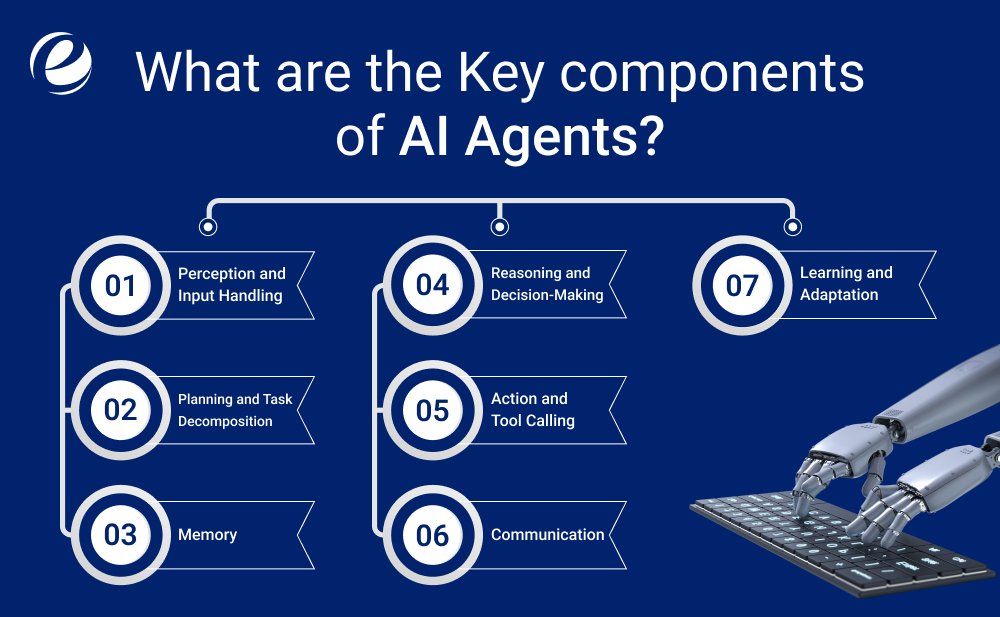
AI agents are becoming essential to modern companies, enabling productivity, efficiency, and personalized experiences. What is the source of these AI agents? What makes them capable of making decisions, learning, and then acting independently? It all lies in their architecture, a carefully designed collection of interconnected elements. Let’s take a look at the primary components of an AI agent and discover how they interact before we explore how to build AI agents.
1. Perception and Input Handling
Perception refers to the process by which an AI agent gathers and interprets data from its surroundings. It processes different types of input, such as user text, sensor data, or system logs. Techniques like natural language processing, computer vision, and data parsing aid in the interpretation of this information.
For instance, Alexa uses speech recognition to understand commands, whereas autonomous cars evaluate inputs from sensors and cameras. A clean, organized dataset is vital to ensure that the AI can make accurate decisions. Poor perception can lead to poor decisions and reduce the performance of the AI system.
2. Planning and Task Decomposition
The process of planning allows the AI to think ahead by breaking big projects into smaller, more logical steps. In contrast to reactive systems, planning agents create a sequence of actions before executing them. They take into account priority, task dependencies, as well as potential risks. AI uses algorithms, machine learning, or rule-based systems to develop these strategies.
In multi-agent systems, the planning process includes negotiation and cooperation. A well-planned system allows for flexibility and long-term performance. Without it, the agent may become unable to function or fail when facing unexpected problems.
3. Memory
Memory helps an AI recall past events and maintain context. There are basically 2 types of memory, one is short-term memory to retain recent interactions, and the other is long-term memory for general knowledge, such as facts or user preferences. Memory enables smoother conversations through personalization and helps avoid repetitive questions.
AI agents store information as structured data or vector embeddings. An efficient memory system is essential for advanced AI applications, such as multi-agent collaboration and customer service. Without memory, AI can become unreliable, unpredictable, and ineffective.
4. Reasoning and Decision-Making
This module enables the AI to evaluate circumstances and decide on the most effective options. It may be based on rules and probabilistic, or it can be learned by studying information. Advanced reasoning models incorporate ReAct (Reason as well as Act) as well as utility-based models that weigh the results in terms of their usefulness.
AI agents employ algorithms or deep learning to resolve challenges step by step. A good reasoning ability helps AI agents to avoid errors and perform well on complex projects such as review of financial or legal issues. Unsound reasoning leads to bad results and frustration for the user.
5. Action and Tool Calling
Action modules allow an agent to take action based on the decisions it’s taken. This might mean responding to the person, moving a robot arm or contacting the external API. Tool calling expands AI’s capabilities by letting it make use of external programs and data sources.
For example, a travel assistant could use an airline API to purchase tickets. The module connects the AI to the actual world, which makes it practical and useful. Without this module, AI agents would be inactive and useless.
6. Communication
Communication allows an AI to communicate clearly with systems, users, or any other agent. It utilizes naturally generated language (NLG) to interact with human-like manners. When working in complex systems, agents interact with one another in order to exchange information or communicate.
The quality of communications affects trust among users as well as the performance of tasks. When it comes to responding to humans during a conversation or updating an AI in a logistic chain, the module will ensure smooth interactions. If it wasn’t for this module, an AI will struggle to work together or even be understood.
7. Learning and Adaptation
Learning helps an AI develop over time by analyzing past actions and outcomes. The AI uses unsupervised, supervised, or reinforcement learning to adjust its behavior and make better decisions. A chatbot, for example, can respond to queries more effectively based on feedback.
Learning makes AI systems adaptable, enabling them to respond to new requirements, changes in data, or evolving user needs. Without learning, AI becomes outdated and ineffective. This is a key element in ensuring that systems evolve and remain functional and relevant in constantly changing environments.
6 Steps to Build an Effective AI Agent
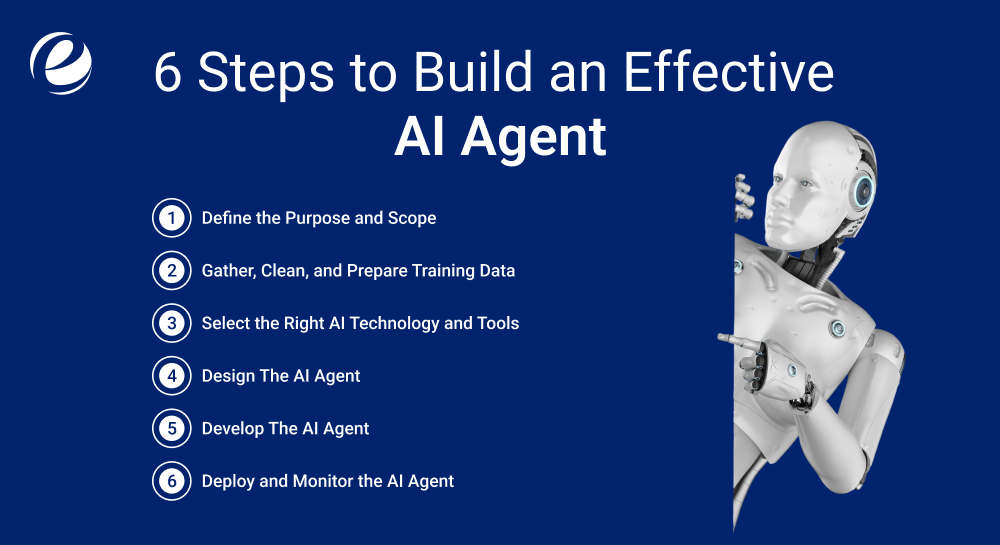
Now, let’s come to the mostly asked question: “How to build AI agents for beginners?” Creating AI agents from scratch might appear daunting, but when you break the process into smaller steps, it becomes a simpler procedure.
This step-by-step guide will help you, starting from defining the purpose of your agent to setting it up and maintaining it.
1. Define the Purpose and Scope
Start by thinking about what you want your AI agent to do. Make a list of the problems it should solve or the tasks it can handle, like helping customers, answering questions, or giving suggestions. Be aware of whether it is required to operate by itself or have assistance from a human. Consider who you will be using it for?
The needs of the users and their expectations influence the way your AI operates. Consider real-world scenarios in which the agent might use its capabilities, for example, aiding people to shop on the internet or make appointments. The purpose you have defined gives the AI agent direction and can make the process of development easier.
2. Gather, Clean, and Prepare Training Data
Your AI agent learns from knowledge, so collecting accurate data is crucial. Gather data from within your company (like customer sales details), external sources (like publicly available datasets), as well as from people (such as reviews or social media posts). After you’ve collected the information, clean it, correct issues, remove duplicates, fill in gaps, and make sure all data is formatted consistently.
Clear and organized data helps your AI agent improve its performance and work more efficiently. This step is vital because poor data quality can lead to poor results, no matter how effective your algorithms are.
3. Select the Right AI Technology and Tools
Choose the most effective techniques and software with the help of AI and ML consulting services, based on the tasks your agent needs to perform. For example, you can use TensorFlow or PyTorch for machine learning, spaCy and Transformers to understand language, and OpenCV if your AI needs to work with images.
Consider where the agent will run: on a cloud service (like AWS or Google Cloud), your personal computer, or even at the “edge” (closer to users for faster results). Use tools that have strong communities and helpful guides to support your learning. Also, choose tools that work with your existing systems to ensure everything runs smoothly.
4. Design The AI Agent
It is important to determine how the AI agent operates. Select a modular architecture that each component is able to perform a single task (easy to modify and expand) or concurrent that handles a variety of jobs at the same time.
Choose what your agent should accomplish: collect feedback, analyze it, and then provide intelligent results (like solutions or ideas). You should think about how your users might communicate with your agent using buttons, text or through voice. Plan how data moves through the system in order to ensure the system is efficient in handling data and produces beneficial outcomes.
5. Develop The AI Agent
The next step is to develop your agent. Begin by writing the primary components based on the concept you’ve created. If you’re working with a modular system, you can build each component at a period of time (like input processing or decision-making), then test it before connecting it to the whole system. Connect your AI to different systems using APIs as well as databases.
Utilize machine learning libraries (like TensorFlow or PyTorch) to allow it to learn from information. Include memory to help it recall previous interactions and get better with time. Once you have built the system, test it by doing unit tests (check each component), integration tests (check the parts), as well as performance tests (see the way it performs under stress).
6. Deploy and Monitor the AI Agent
When your AI agent is completed and tested, it is now time to start running it. The first step is to test it using a fake environment (like a “sandbox”) to catch any last-minute issues. Make use of smart deployment strategies such as blue-green releases or canary releases. These allow you to launch the app to just a small number of users, to fix any issues prior to launching it fully.
When it’s live monitor your AI working, see its speed, its accuracy and how happy the users are. Constantly solicit feedback and iterate. Update the system to eliminate bugs, work faster and safer, and dependable as time goes by.

Common Mistakes To Avoid When Building an AI Agent
A lot of businesses are unsuccessful with AI agents because they overlook the common mistakes when building AI agents. Let’s have a look at what these mistakes are:
1. Overlooking Scalability
A few companies create small AI agents that function well initially but cannot handle the demand of users or jobs as the organization expands. A chatbot, for instance, might fail during busy times if it was not designed for large audiences. It is important to think ahead and ensure the AI platform you choose can scale easily from a user base of 100 today to perhaps 100,000 users in the near future without the system slowing down.
2. Underestimating Long-Term Costs
Most people believe that investing in the AI agent is just a one-time expense, but in reality, it must be updated regularly, maintained, and supplied with new information. There is also a cost to cover things such as cloud storage and API usage. These will add up over time. The best practice is to allocate 20% of the initial cost each year to cover maintenance. Make sure that the vendor includes maintenance and updates in the agreement.
3. Ignoring User Adoption
However, even if the AI agent is intelligent, it will not help if people don’t utilize the technology. Employees may be unsure or lost if they don’t receive proper instruction. Users may be hesitant to use the application because it’s difficult to navigate. This is why it’s crucial to make the app user-friendly. Provide training, write easy guides, and offer incentives for its use so that people are comfortable and active.
4. Neglecting Data Quality
AI agents rely on data to learn and make choices. If the information is sloppy, outdated, or incorrect, the AI cannot function effectively. The AI could give incorrect answers or even make mistakes. In order to avoid this, make sure you have clean, well-organized, and up-to-date information. Make sure you regularly check and correct your data so that the AI keeps its accuracy and intelligence. More accurate data results in better efficiency and fewer problems.
5. Ignoring Security and Privacy
AI systems typically utilize personal or corporate data, which must be stored securely. If your system isn’t protected, hackers may steal confidential data. Furthermore, storing data in a way that doesn’t respect privacy regulations can lead to penalties. Be sure to ensure that your AI’s security is strong and complies with rules like GDPR. Maintain trust by demonstrating how your data is protected and properly handled.
6. Not Setting Measurable Goals
If you do not set clearly defined objectives, it’s difficult to determine if the AI agent you employ performs well. The key is to determine the criteria for success, such things as faster customer service, fewer errors, or increased revenue. When you have set your targets, you will be able to monitor the progress of your AI throughout the course of time. This allows you to improve your AI agent and display its benefits to the world, and make wise decisions about the future.
Top Use Cases for AI Agents

You are now aware of the process of how to build AI agents. If you’re looking for an opportunity to begin using AI agents, this section will guide you through some of the most important AI agent use cases. So, let’s have a look:
1. Improving Customer Experience
AI agents help improve customer care by providing personalized service and anticipating customers’ needs. Unlike chatbots, which are merely machine-generated, AI agents can engage in genuine conversations and assist with tasks such as granting refunds or generating support tickets.
They can track a customer’s history, enabling them to provide more effective assistance. AI agents handle simple tasks, allowing human agents to focus on more complex issues. This improves customer satisfaction, reduces response times, and helps companies lower operational costs.
2. Content Creation
AI agents have become invaluable tools for content creation. They can generate a wide variety of content, including article scripts, blogs, and social media posts, all tailored to meet specific goals. Additionally, AI can assist in developing or editing video content with very little input from humans.
This automation reduces the need for constant human involvement, enabling creators to produce large volumes of high-quality content at a faster pace. For example, The Associated Press uses AI to write basic news articles, which helps increase productivity and reduces the strain on human journalists.
3. Healthcare
AI agents are revolutionizing healthcare by reducing administrative burdens, such as scheduling, billing, and prior approvals. They help hospitals better manage their budgets and allow doctors to focus on patient care.
AI can also continuously monitor patient health and detect potential issues earlier, which improves diagnosis, treatment plans, and speeds up research. AI enhances decision-making, ensuring more accurate and personalized treatment, benefiting both patients and healthcare providers.
4. Human Resources
AI in HR helps streamline processes such as screening resumes, scoring candidates, and scheduling interviews. It also facilitates onboarding by creating customized programs for new employees. AI assists in managing employee inquiries, leave requests, and compliance.
By reducing time and minimizing errors, it enhances recruitment and talent management. With data-driven insights, HR professionals can make more informed decisions, improve the employee experience, and focus on higher-level strategic initiatives.
5. Marketing
AI helps marketers analyze information from customers in order to produce personalized advertisements, content, well as campaigns. Businesses can gain insight into customer behavior and adjust their strategies automatically in order to boost results. AI agents are able to manage activities like monitoring social media, along with campaign scheduling, as well as customer engagement.
Through predicting trends and creating user personas for customers, AI enhances marketing efficiency by making campaigns more effective. AI agents also aids companies in staying ahead of the competition by focusing on the correct people with little effort.
6. IT and Process Automation
AI agents improves IT functions by autonomously managing infrastructure, identifying issues as well as improving the performance of systems. It reduces downtime as well as dangers by recognizing problems prior to them becoming major problems. AI helps developers by keeping track of system health and repairing issues instantly.
When it comes to security, AI detects and responds automatically to security threats, increasing security. AI decreases manual tasks, improves the performance of systems, and helps ensure smooth, efficient IT business operations.
7. Supply Chain Management
AI agents improve efficiency in the supply chain by studying information in real-time by automating tasks such as the selection of suppliers as well as order management and monitoring inventory. This ensures accuracy and can help to avoid disruptions or errors in your supply chain.
AI is able to predict the demand, improve deliveries, and cut costs through better buying choices. Additionally, it ensures compliance of the regulations. Through the use of AI agents, firms can streamline their operations, cut down on risks, and enhance decision-making across all stages of the supply chain.
8. Transportation and Logistics
AI optimizes logistics by coordinating the delivery routes and vehicles fleet by reducing the use of fuel and time to deliver. AI agents can anticipate maintenance requirements to avoid breakdowns of vehicles, which improves the efficiency of operations.
They can also assist in assigning the tasks of delivery based on variables such as weather, traffic, and urgency. In a real-time manner, AI improves cost-effectiveness, achieves sustainability targets, and improves overall performance. Automation benefits logistics firms in reducing time, lowering costs, and enhancing services.
9. Banking and Financial Services
AI agents in banks automate processes such as risk audits, compliance surveillance, and loan approvals. It detects unusual patterns within data, allowing banks to respond quickly to threats. AI helps manage wealth by analyzing markets and developing investment strategies.
It improves decision-making, reduces errors, and increases efficiency in the banking sector. AI-powered virtual assistants offer personalized financial guidance, helping consumers better manage their finances and enhancing the operational efficiency of banks.

How Can EmizenTech Help You Build an AI Agent
EmizenTech is a trusted AI app development company that specializes in creating custom AI agents for businesses regardless of size. Our expert team has years of experience in AI and machine learning and can help you at every stage from planning to launching your AI agent. We have created a number of highly impressive AI solutions across different sectors, with a focus on providing real value for enterprises.
Whether you are looking to increase customer satisfaction and automate your tasks or increase productivity, we’ll build an AI agent that is suited to the goals you have set. Our process is simple, clear, and tailored to your needs. Let’s work together to bring your AI agent to life and develop a solution that will benefit your company.
Wrapping Up
AI agents have made huge advances in transforming industries by making tasks easier to perform, improving decision-making, and enhancing the customer experience. We’ve seen that AI agents have a strong impact in areas like finance, healthcare, and customer service.
Making your own AI agent may have appeared to be an overwhelming task initially; however, we hope this guide will help you understand the procedure. We’ve broken the process into steps that are manageable, beginning with the definition of your agent’s goal and selecting the appropriate software to train the agent, testing it, and finally using it efficiently. As AI technology improves with time, the development of AI agents is likely to bring even greater capabilities to the table that will allow for greater impact on every aspect of the economy and society.
FAQs
What are the benefits of AI agents?
AI agents reduce time, enhance the accuracy of their work, complete tasks faster, assist in making better decisions, and improve customer service by being available 24/7 and never getting tired.
How long will it take to build AI agents?
The development of AI agents could take anywhere from few weeks to several months, depending on the size of the project, the goals, quality of data, and the level of complexity required for the AI agent.
In which industries AI agents are employed?
AI agents are utilized in a variety of areas such as finance, healthcare, education, retail, and customer support to help with tasks, resolve questions, control data, and enhance the user experience.
Do AI agents replace human jobs?
AI-powered agents are able to automate certain things, but in the end they assist people to work quicker and more effectively. They let humans to work on more intricate or imaginative jobs.




 +1 (989) 535-9295
 info@emizentech.com
 emizentech


