 Add us as a preferred source on Google
 Before Google made answers instant, students still needed somewhere reliable to check a fact, settle an argument, or finish a report the night before it was due. Infoplease was a place for a lot of people. One site, five reference tools bundled together: an encyclopedia, an almanac, an atlas, a dictionary, and a thesaurus. It’s still around. The real question in 2026 is whether it’s still worth your time or if there’s something better now. Here’s what the Infoplease website actually offers, why people trusted it for so long, and which alternatives are worth checking out instead.
What Is Infoplease? And How Does It Work?
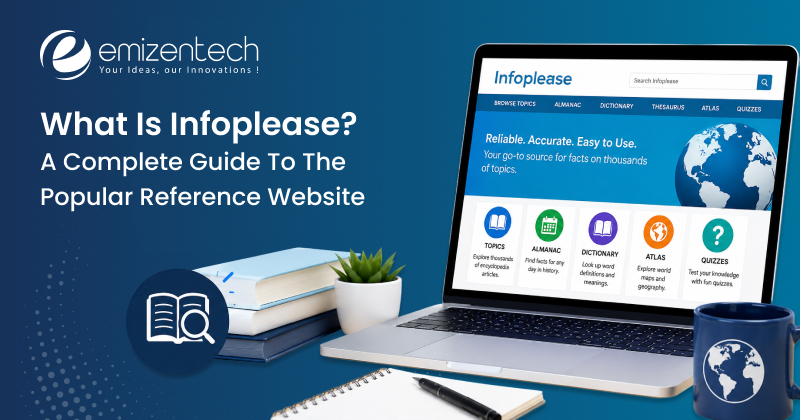
The Infoplease website is a free reference site that crams an encyclopedia, almanac, atlas, dictionary, and thesaurus into one place you can search. It doesn’t rely on open, crowd-edited entries the way Wikipedia does; content comes from established sources like the Columbia Encyclopedia and the Random House Dictionary instead.
You type something into the search bar or browse by category (history, geography, science, sports, whatever), and you land on a page that’s already fact-checked and easy enough to cite.
It feels more like walking through a library than scrolling through a wiki. Each section technically runs on its own, but they link back to each other, so searching a country usually pulls up its atlas profile, a timeline of its history, and a few dictionary terms thrown in too.
Editors go back and update entries with newer stats and events from time to time, which is honestly part of why the Infoplease website has managed to stay useful even with AI search tools eating into everyone’s traffic.
Key Features of the Infoplease website
Nothing flashy here. The infoplease website isn’t winning any design awards, what it has going for it is the sheer depth of editorially sourced content stuffed into a plain layout.
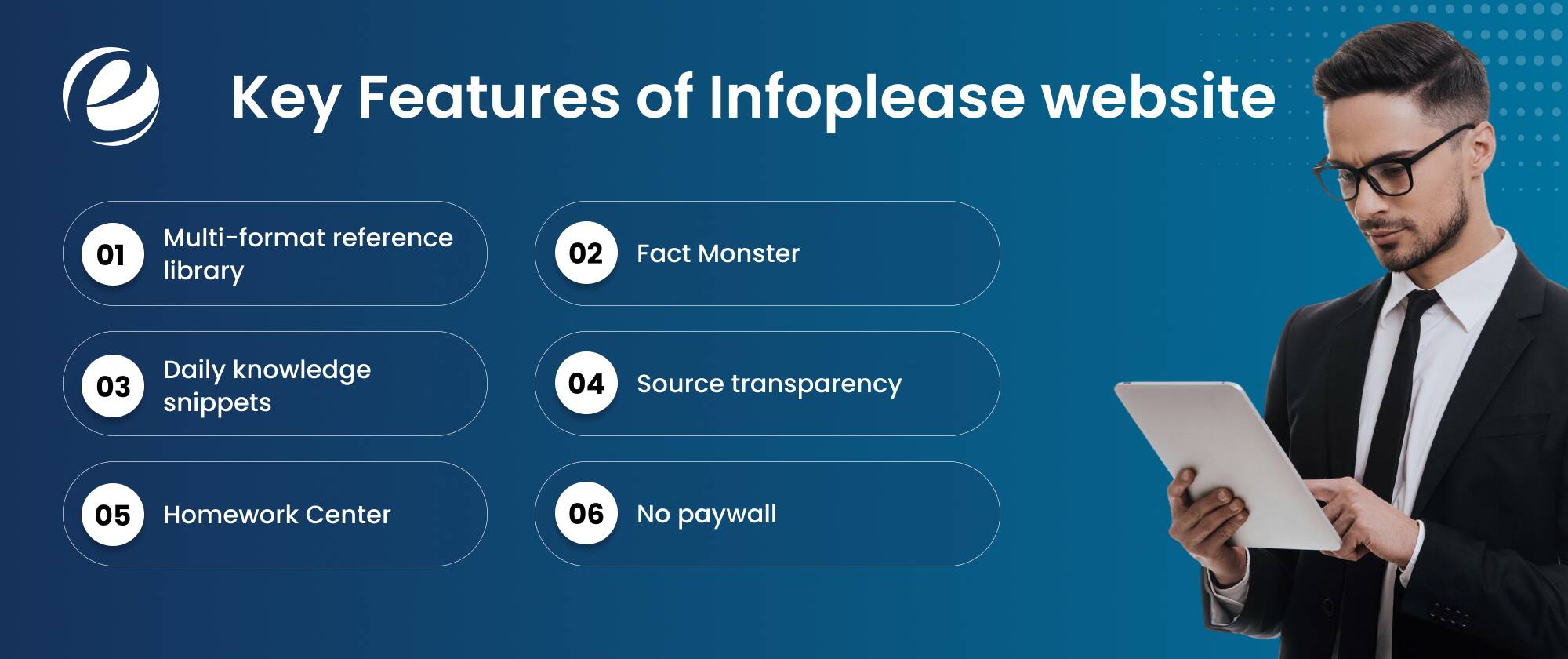
- Multi-format reference library: Encyclopedia, almanac, atlas, dictionary, and thesaurus content, all in one spot.
- Daily knowledge snippets: “This Day in History,” daily trivia, and birthday facts updated regularly.
- Homework Center: Study guides broken down by subject.
- Fact Monster: A kid-friendly version of the same site, run by the same team.
- Source transparency: Entries actually credit where the info came from, including government and academic sources.
- No paywall: Everything’s free, which is still not true for a lot of its competitors.
So, these are some of the most crucial features that the Infoplease website adds to keep users engaged with it.
What Information Can You Find on Infoplease?
Breadth is really the whole pitch here. You’ll find country profiles with maps and population data, historical timelines going back centuries, bios on public figures, and a decent dictionary/thesaurus combo for quick lookups. The almanac section is genuinely useful if you’re comparing stats, population, economy, and science data, all laid out in a way you could actually cite without embarrassing yourself.
Past the core reference stuff, the Infoplease website also covers current events, sports records, and pop culture trivia, plus homework content split by subject (math, science, social studies, etc.). Younger users get a simplified version through Fact Monster. None of it is user-edited, which matters a lot if you’ve ever had a wiki entry change under you mid-research.
Why Is Infoplease Popular Among Students and Educators?
Mostly, it’s about trust. Teachers can point kids toward the site without worrying that some random edited the page an hour ago, since everything traces back to vetted encyclopedias and government data rather than anonymous contributors.
And that trust factor matters more than people think. Almost all students now research using the internet, with adoption sitting above 96%, according to a 2026 student research report from BroadbandSearch. When basically everyone’s researching online, the quality of the sites they land on actually matters.
The Infoplease website also just fits into homework routines easily. It’s free, loads fast, and requires no account. For teachers building lesson plans or assigning independent research, that mix of credibility and simplicity has kept this site relevant for over two decades, which, on the internet, is basically forever.
Top 10 Alternatives of Infoplease Website
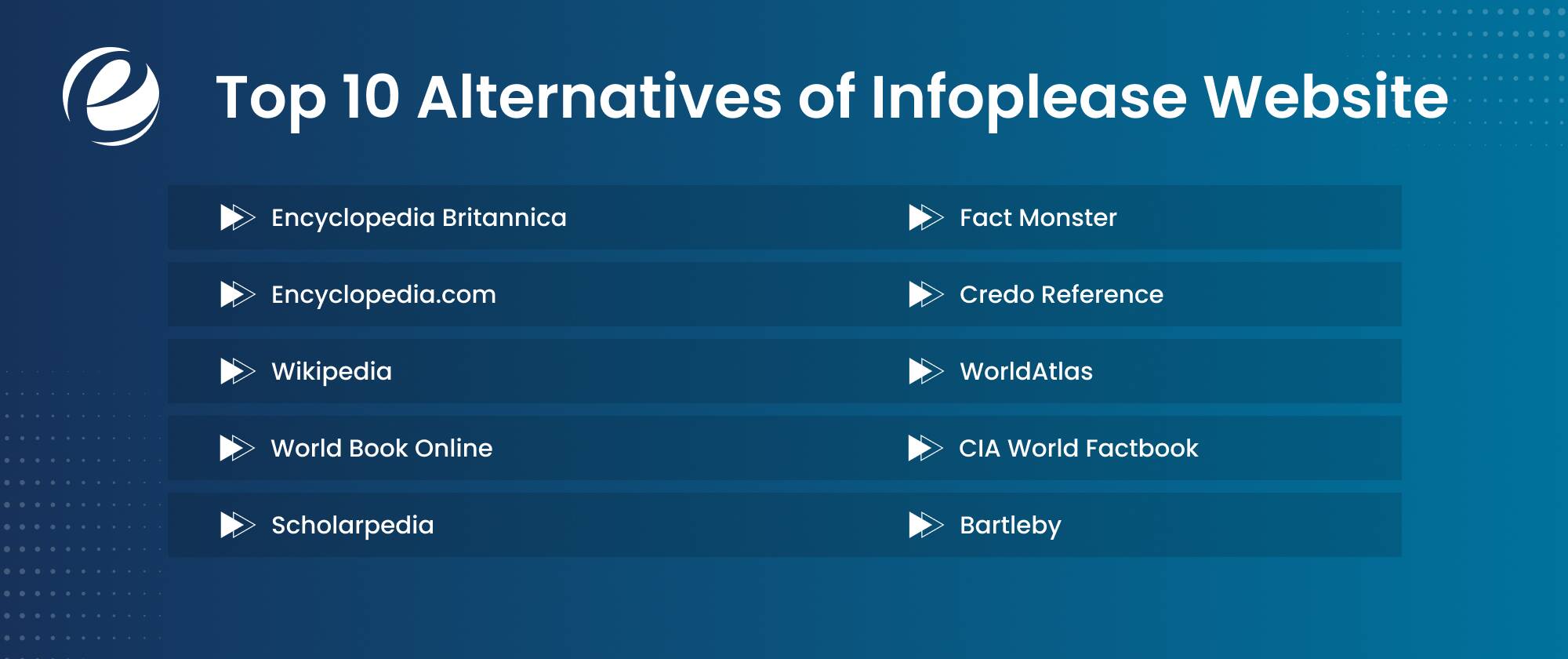 If you’ve outgrown Infoplease or just want a second opinion on a fact, these are the strongest alternatives right now:
Encyclopedia Britannica
Professionally written and fact-checked, with no open editing at all. Britannica goes deep on nearly every subject and is still one of the most cited sources in academic circles. You’ll need a paid subscription for full access, though a handful of articles are readable for free.
Encyclopedia.com
A free aggregator pulling from over 200 reference works, including Oxford University Press and the Columbia Encyclopedia. Hundreds of thousands of citable entries, no login, no payment—honestly, one of the better free options out there for serious research.
Wikipedia
The biggest, most constantly updated encyclopedia online, covering basically everything. The open-editing model means entries can be wrong or biased occasionally, so treat it as a starting point and double-check against something more vetted before you cite it anywhere formal.
World Book Online
Subscription-based, built specifically for classrooms. Tens of thousands of index entries, daily current events, and assessment tools teachers actually use. Widely adopted in schools and libraries, it’s the only general reference encyclopedia still being actively published today.
Scholarpedia
Peer-reviewed and written by actual subject-matter experts instead of general contributors. Narrower than Infoplease for sure, mostly scientific and academic topics, but the entries carry more weight if you’re citing something for serious research.
Fact Monster
Infoplease’s own sister site is made for younger students. Same encyclopedia, dictionary, and almanac content, just simplified into shorter entries, with quizzes and games thrown in. A natural next step for elementary or middle-school kids.
Credo Reference
Pulls from more than 100 publishers, including academic encyclopedias and journals. Good for digging deeper into a topic, though you’ll usually need to log in to read full entries—a bit less convenient than the fully open options on this list.
WorldAtlas
Geography-focused, with detailed country profiles, maps, and regional data. It’s narrower than Infoplease overall, but it goes deeper on geography specifically, so think of it as a companion site rather than a full replacement.
CIA World Factbook
It’s free, government-published, and genuinely reliable for hard data country stats, maps, and political profiles. Since it comes straight from official government research instead of being aggregated from elsewhere, it tends to be more accurate on the demographic and economic side.
Bartleby
Mixes reference content with literature and writing support, study guides, and citation help included. Leans more toward language arts and writing assistance than general encyclopedia lookup, so it’s a niche pick if you’re focused on writing-heavy coursework.
How to Choose the Best Infoplease Alternative?
Honestly, choosing the best alternative basically depends on your needs and what you are looking for. Below are a few quick filters to help you decide this easily:
- Need broad, free coverage? Encyclopedia.com and the CIA World Factbook provide the broadest coverage at no cost.
- Need scholarly depth? Britannica or Scholarpedia is more rigorous, though Britannica will cost you money.
- Working with younger students? Fact Monster and World Book Online are built for that age group specifically.
- Cross-checking facts? Wikipedia’s fast, but pair it with something vetted like Infoplease or Britannica before you cite anything.
- Need country or geography data? WorldAtlas and the CIA World Factbook go deeper than a general encyclopedia ever will.
No single alternative replaces the Infoplease website completely. Most people end up bouncing between two or three of these, depending on what they’re researching that day.
Thinking About Building a Site Like Infoplease?
A reference platform like Infoplease isn’t just a pile of content; it’s a content-heavy web application that needs fast search, clean architecture, and a database that can handle tens of thousands of articles without choking. If you’re thinking about building something similar, an educational resource, a niche knowledge base, or whatever, the technical foundation matters just as much as the content does. That means thinking early about web development decisions: how content gets indexed, how search holds up under load, and how the site performs as your library of entries keeps growing.
How to Develop a Site Like Infoplease?
If you are planning to build a site like Infoplease, it requires building a structured content management system (CMS) that delivers encyclopedias, information, and daily trivia. Building something like a site generally breaks down into a few stages:
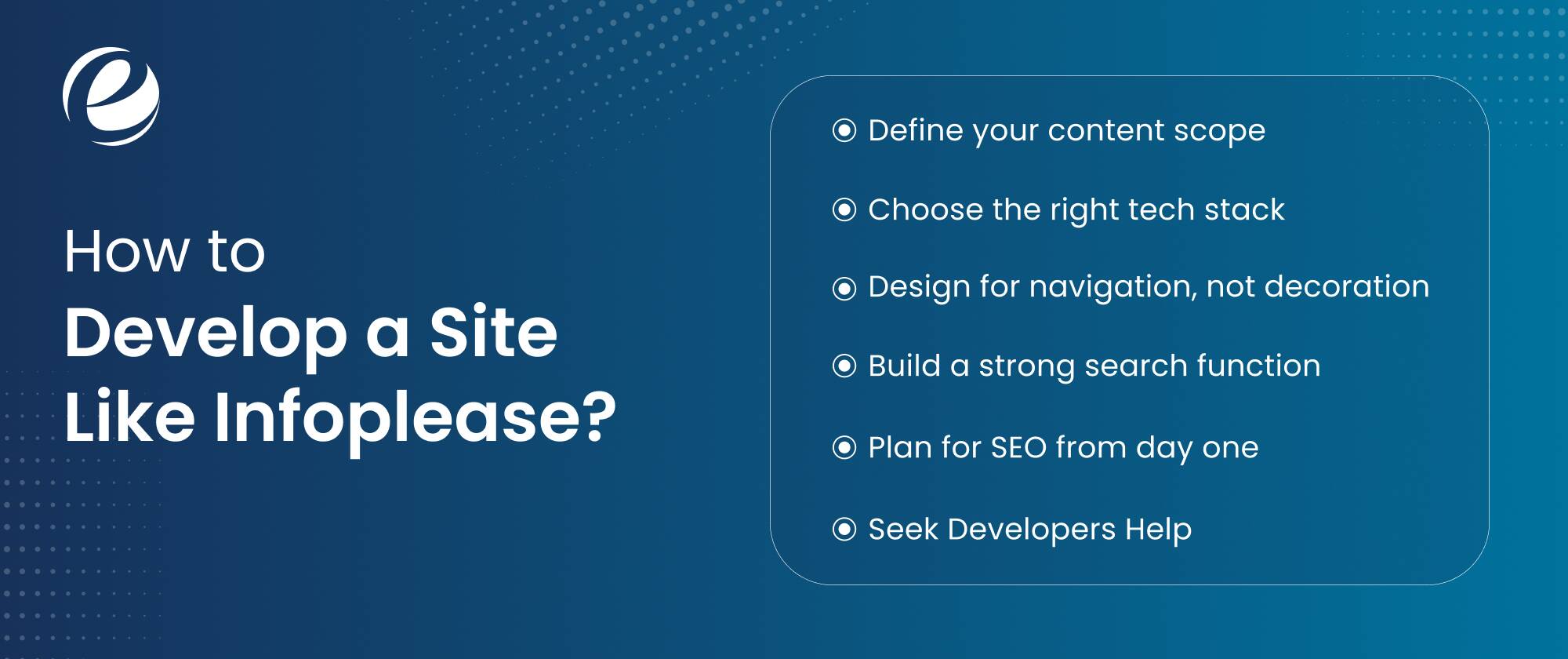
- Define your content scope: You have to pick which categories you’ll cover (encyclopedia, dictionary, almanac, etc.) and figure out where the source data is coming from.
- Choose the right tech stack: something that can handle large volumes of structured content and fast full-text search without falling over.
- Design for navigation, not decoration: categorized menus, breadcrumbs, internal linking. None of it needs to look pretty; it just needs to work.
- Build a strong search function; this is the feature people will actually use most, so it has to return accurate results fast.
- Plan for SEO from day one: reference content lives and dies on organic traffic, so clean URLs and structured data aren’t optional.
- Seek Developers’ Help: a project this content-heavy goes a lot smoother with a team that’s handled big databases already; you can hire web developers with that exact experience instead of building a team from scratch.
Budget and timeline swing a lot depending on the scope. And if you’re working off an existing site that just needs a content overhaul instead of a full rebuild, check website redesign cost first.
Why Choose EmizenTech for Educational Website and eLearning Platform Development?
Building a reference or learning platform takes more than just good content; you need a development partner who understands how these tools are used in practice.
- EmizenTech specializes in education app development, with real experience building platforms that handle large content libraries, user accounts, and search-heavy navigation.
- Our team also has hands-on experience with e-learning app development, covering everything from content delivery to interactive learning modules.
- Projects are built with scaling in mind, so a site that starts with a few thousand entries doesn’t need an expensive rebuild later when it grows.
- We handle both web and mobile builds, which helps if your reference platform eventually needs a companion app alongside the website.
Always remember a dedicated team sticks with the project through every phase: planning, design, development, and post-launch support instead of handing off a finished build and vanishing. This is all you will get on Emizentech.
Conclusion
The Infoplease website has stuck around for one simple reason: it’s a free, trustworthy reference tool in a sea of unreliable ones. The mix of encyclopedia, almanac, atlas, dictionary, and thesaurus content still works for students and casual researchers, even with AI tools and Wikipedia dominating most conversations now. That said, no single resource covers everything. Pairing Infoplease with something like Britannica or the CIA World Factbook gives you a more complete toolkit. Whether you’re a student double-checking a fact or a developer who just got inspired to build something similar, the lesson from Infoplease sticking around this long is pretty simple: clean structure and credible sourcing are always valuable.
FAQs
Is the Infoplease website free to use?
Yes. The whole site, encyclopedia, almanac, atlas, dictionary, and thesaurus is free, and you don't need an account to use any of it.
Is Infoplease a reliable source for academic research?
It draws from vetted sources like the Columbia Encyclopedia and government data, which makes it easier to cite than open, crowd-edited platforms like Wikipedia.
What is Fact Monster, and how does it relate to Infoplease?
Fact Monster is Infoplease's sister site, built for younger students. It mirrors a lot of the same reference content, just simplified into a kid-friendly format.
What's the best alternative to the Infoplease website?
Depends what you need. Britannica gives you more depth, Encyclopedia.com gives you more free breadth, and the CIA World Factbook is your best bet for country-specific stats.




 +1 (989) 535-9295
 info@emizentech.com
 emizentech


