
 Add us as a preferred source on Google
 The construction industry had a crucial role in infrastructure development for decades but has been hesitant to embrace new technology. That is changing rapidly now as the Internet of Things (IoT) spreads to building construction.
IoT is no longer new; it is simply one more component of the standard machinery used in ensuring the planning, execution, and monitoring of the projects are enhanced. From safety improvement for employees to improved efficiency in resources, the technology is transforming the management of the projects.
The global market of IoT Applications in construction industry was valued at approximately USD 11.46 billion in 2023, with projections indicating a 16.2% CAGR growth from 2024 to 2030. This is due to the enhanced use of smart devices, automation, and real-time data monitoring during the process of construction.
Firms are embracing IoT to make their businesses more productive, automated, and cost-effective. IoT is helping firms exploit predictive maintenance potential on assets, remote site monitoring, and improved energy management, creating sustainable construction practices. As more and more companies are beginning to understand its worth, IoT is about to unleash innovation and transform industry practices.
Here we will discuss what is IoT in construction, the most essential IoT apps in construction industry, and highlight how technology is transforming the sector. Let us proceed and discover how IoT is transforming construction and streamlining the construction process.
What are IoT Apps in Construction?
The Internet of Things (IoT) is revolutionizing the construction industry of buildings by connecting devices and systems for real-time data gathering and sharing. Through the application of smart sensors, wearables, and autonomous machines, IoT allows experts to collaborate on sites. These network-based systems offer enhanced monitoring, communication, and decision-making to improve the building process and facilitate easier management.
Studies have shown that IoT applications in the construction industry are growing at a very fast pace with smart technology guaranteeing cost savings of up to 29%. It simplifies most issues in the industry by improving resource planning, improving operations, and allowing data-driven project management.
IoT devices play an important role in monitoring equipment usage, ensuring workers’ safety, tracking environmental factors, and aiding in project planning. The adoption of IoT by construction companies prevents delays, optimizes costs, and optimizes overall efficiency. Most firms also implement IoT-based project management software to streamline workflows. Finally, this technology makes construction safer, smarter, and extremely efficient.

Benefits of IoT Applications in Construction Industry
Now, you have a quick glimpse of iot in the construction industry, let’s simply start with understanding the benefits. The inclusion of IoT devices in building construction processes facilitates the easy attainment of delivery of many benefits to companies in areas of improved efficiency, safety, and cost management. Without any further ado, let us go ahead and expound on some of the benefits of IoT in construction:
1. Enhanced Safety Measures
IoT sensors aid in work environment monitoring through tracking of workers’ movements and access to locations. In the event of an emergency, the devices enable instant alerts and quick responses, and therefore safe working conditions.
2. Efficient Workflow Management
Real-time data from IoT sensors allows construction managers to make real-time adjustments for maximum efficiency with no wasted resources. IoT is found to deliver up to 14.2% in terms of cost saving on labor.
3. Fewer Downtime
Smartly monitored worker and equipment activity averts unplanned delays. IoT predictive maintenance assures machines are always in top-notch performance, bypassing breakdowns that can disrupt work.
4. Cost Reduction
Through monitoring the usage of resources and enhancing budgeting, IoT facilitates wastage and unnecessary costs reduction for businesses. Improved financial management translates into large cost savings for long-term construction projects.
5. Improved Productivity
IoT technology simplifies tasks by avoiding unnecessary repetition, thus enabling teams to maximize the usage of resources. Through capabilities such as real-time monitoring and scheduled maintenance reminders, construction can run more efficiently and productively.
6. Improved Communication and Coordination
IoT-enabled software facilitates improved collaboration among teams by facilitating effortless sharing of information. From remote monitoring of sites to virtual project management, construction businesses can experience greater coordination and alignment.
Additionally, data gathered through IoT sensors provides valuable insights that facilitate decision-making, with project managers able to see performance and make necessary adjustments along the way during building.
Features of IoT Apps in Construction Industry
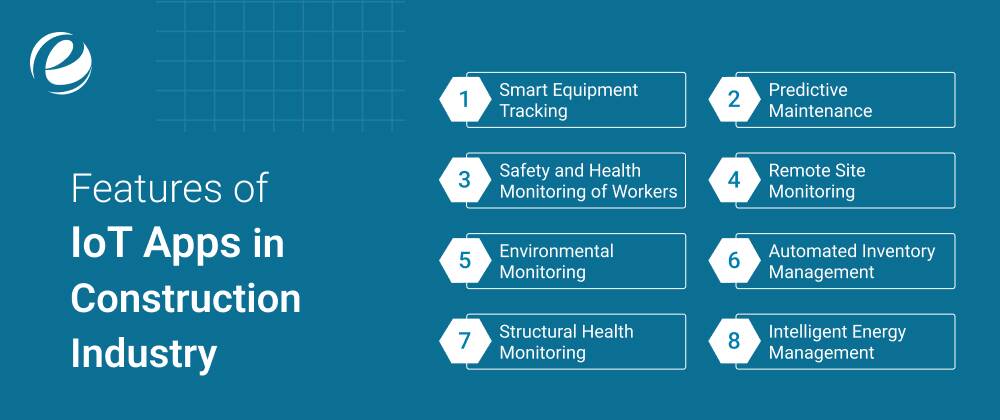
Incorporating the Internet of Things in construction industry brings about some of the primary features that help improve efficiency, safety, and project management. Let’s check them out:
1. Smart Equipment Tracking
GPS tracking devices and RFID tags are connected to building tools and machines. This tracks their location and utilization in real-time, eliminating theft and making resources more effectively managed.
2. Predictive Maintenance
Sensors fitted to heavy machinery can detect potential problems before they become major faults. This allows for on-time maintenance, avoiding breakdowns and saving repair costs.
3. Safety and Health Monitoring of Workers
Wearable IoT sensors such as smart helmets and vests track the health condition of workers such as body temperature and heart rate. The sensors also send alerts in the event of risk, thus responses to emergency conditions are timely.
4. Remote Site Monitoring
Supervisors are able to monitor locations remotely through IoT-driven dashboards. Sensor data, live video feeds, and feedback from automated systems allow for real-time decision-making without physical presence.
5. Environmental Monitoring
IoT sensors deployed in the location monitor air quality, noise, and temperature levels. It is always safety standard compliant as well as preserves a secure working environment for workers.
6. Automated Inventory Management
The developers can monitor materials like steel, cement, and bricks by utilizing IoT-based inventory management software. As the material level falls, the managers receive instant notifications and hence never fear project delay.
7. Structural Health Monitoring
IoT sensors incorporated into buildings and bridges track stress, vibration, and condition of the materials. Thus, even the slightest symptoms of structural faults can be detected without having to incur the excessive expense of repairs in the future.
8. Intelligent Energy Management
Construction sites will be using a lot of energy. IoT systems can monitor energy usage and balance the use of energy to save power and reduce energy wastage and operational costs.
Top IoT Applications in Construction Industry in 2025
Around the world, top construction companies are embracing IoT technology to operate their companies smarter, safer, and more environmentally friendly. Take a look at some of the various iot applications in construction industry that are available on the App Store and Google Play Store.
| Application | Platforms | App Store Rating | Play Store Rating | Play Store Downloads |
| Autodesk Construction Cloud | iOS, Android, Web | 4.5 | 4.2 | 100,000+ |
| Procore | iOS, Android, Web | 4.3 | 4.4 | 500,000+ |
| Fieldwire | iOS, Android, Web | 4.7 | 4.6 | 1,000,000+ |
| LetsBuild | iOS, Android, Web | 4.4 | 4.2 | 50,000+ |
| Buildertrend | iOS, Android, Web | 4.5 | 4.3 | 100,000+ |
1. Autodesk Construction Cloud
Autodesk Construction Cloud connects construction workflows so that project data, including sheets, files, and 3D models, are shared with the team in real time. It integrates IoT devices to monitor equipment and site conditions so that the office and on-site teams can interact with each other seamlessly.
2. Procore
Procore offers end-to-end project management software with the inclusion of IoT features for real-time monitoring of equipment and materials. The interconnectivity enhances communication among stakeholders and keeps the schedule and cost saving of the projects intact.
3. Fieldwire
Fieldwire is targeting in-field work management through IoT sensors that monitor equipment usage and the safety of workers. The app ensures real-time notification, allowing instant resolution of problems and ongoing productivity.
4. LetsBuild
LetsBuild optimizes site visits and team collaboration through the application of IoT sensors to track site conditions and progress. Rapid response to any issues can be made through real-time data, keeping projects on schedule.
5. Buildertrend
Buildertrend integrates project scheduling, budgeting, and communication tools with IoT data to offer real-time insights into project progress. Together, this makes it possible to make informed decisions and maximize efficiency.
Through their IoT solutions, these companies are setting the standard higher for construction industry efficiency, safety, and sustainability.
Implementation of IoT in Construction Industry
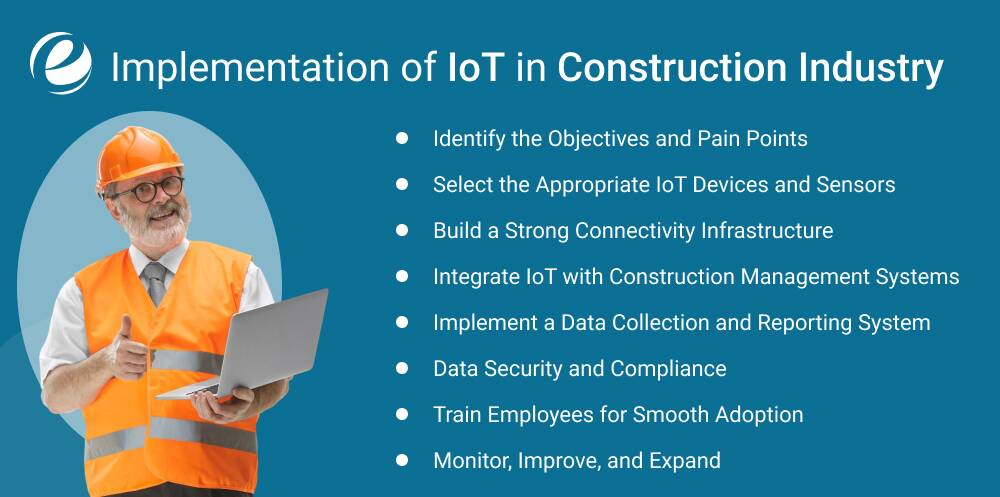
The Internet of Things (IoT) is applied in the construction industry to promote efficiency, safety, and project management. Applying the IoT in construction industry is all about bringing together intelligent devices and sensors to provide and process information, leading to better-informed decisions and more efficient processes. The following is how IoT is being applied in the construction industry:
Step 1: Identify the Objectives and Pain Points
The initial step in deploying the internet of things construction industry is to identify the definite pain areas that need to be removed. Most construction projects are plagued by excessive project completion time, inefficient utilization of resources, safety hazards, and excessive maintenance. Recognizing such pain areas enables companies to have specific goals, like enhancing the safety of workers, monitoring equipment usage, or minimizing the loss of material. A precise goal ensures IoT solutions get deployed in the appropriate spots, where the investment would be justified.
Step 2: Select the Appropriate IoT Devices and Sensors
Once the goals are set, the second is choosing the right IoT devices that can be leveraged for construction site use. The most widely used devices are GPS tracking units to monitor machines and materials, wearable sensors to protect workers, smart cameras and drones to monitor the site, and environmental sensors to monitor temperature, humidity, and air quality. Good selection of the device set ensures seamless operation and increases office productivity. A reputed IoT solutions company can assist in selecting the optimal devices and package them on a single platform for tracking.
Step 3: Build a Strong Connectivity Infrastructure
IoT devices rely on real-time data sharing, and hence a sufficient and solid connectivity infrastructure must be provided. Construction sites, particularly distant construction sites, will be plagued with network connectivity issues that will affect data transmission. Firms should establish Wi-Fi connections, 5G network installations, or cloud-based infrastructures in a bid to facilitate seamless data transmissions. A secure and scalable ecosystem aids in ensuring real-time reminders, notifications, and data analysis. The process is complex, but hiring a professional IoT solutions firm to outsource the job guarantees proper installation and operation in the future.
Step 4: Integrate IoT with Construction Management Systems
The IoT technology performs best when it is in the process of being integrated with already existing construction management systems. Because IoT equipment can be paired with project management software, business entities can track equipment usage, worker productivity, and material levels of stock real-time. Even the alert on low stock levels, equipment fault, or incursion into prohibited areas can automatically be reported. This facilitates minimum delay in a project and supports decision-makers by providing real-time updates at any given time.
Step 5: Implement a Data Collection and Reporting System
Construction sites produce heaps of data every day. But without an effective system, this data might be wasted. An IoT data collection and reporting system ensures IoT device data is stored, sorted, and analyzed in the correct manner. The equipment performance, worker safety, and site condition reports will be accessible to managers so they can make informed decisions. A good IoT platform can even generate auto-reports and alert in case of potential hazard.
Step 6: Data Security and Compliance
Since IoT devices take and send confidential project information, security cannot be an afterthought. Hacking into building construction information is calamitous, i.e., data breaches or system failures. IoT in construction business should create encrypted communication channels, secure access control, and adhering to industry standards to protect data. Working with a professional IoT app development firm helps deploy security features so that data does not come under cyberattacks or breaks of industry standards required.
Step 7: Train Employees for Smooth Adoption
Technology adoption is worth it only if the employees are trained to work on it. The employees must be instructed on how to run IoT devices, read data insights, and react to system warnings. Routine troubleshooting when equipment fails and safety procedures for IoT-powered monitoring systems should be covered under training workshops. An IoT services provider can assist in creating a user-friendly interface and provide relevant training resources so the employees are comfortable using the new technology.
Step 8: Monitor, Improve, and Expand
After the pilot, there ought to be continuous monitoring and evaluation to measure the effect of IoT. Enterprises should keep track of whether IoT solutions are yielding the desired benefits, e.g., postponing decline, safety improvement of employees, and equipment performance optimization. Employee and project manager feedback must be considered for improvement. With the growth of the construction industry, the IoT system can be enhanced to encompass more sophisticated automation, predictive maintenance, and AI-driven insights.
Cost of Implementing IoT in Construction Industry
The cost of the implementation of IoT in construction industry is dependent on numerous variables like the complexity of the system, the number of features to be handled, the level of integration with the current platforms, and the scope of the entire implementation. Maintenance and updates also contribute to the final cost. It is important to understand all these factors well so that businesses can have a realistic number to make a budget and experience a successful IoT implementation.
The following is a rough cost estimate based on complexity and features of an IoT-based construction management system:
| App Complexity | Average Cost | Average Timeline |
| Basic Solution (Limited Features) | $30,000-$50,000 | 4-6 months |
| Moderate Complexity (Standard Features & Integrations) | $50,000-$120,000 | 4-9 months |
| Advanced System (High-End Features & Extensive Integrations) | $120,000-$300,000 or more | 9 months to 1 year or more |
These numbers are rough estimates and can fluctuate depending on some business requirements, the technology stack employed, and the development team’s skill level. Employing a professional IoT development company can optimize expenses while ensuring smooth and effective implementation.

Use Cases of IoT in Applications Construction Industry
The integration of IoT in construction industry is transforming the sector into an efficient, effective, and safe one. Some of the optimal applications that illustrate how IoT can make things function and assist with digital transformation in construction operations are explained below:
1. Smart Inventory & JIT Supply Management
Material management in construction is essential in avoiding project delay and wasteful spending. Status of inventory is monitored automatically by IoT-based RFID tags on the number of supply units. The system automatically orders when inventory is low, so the material will be available just when it is needed. It avoids project delay, conserves storage space by avoiding overstocking, and minimizes wastage.
2. Fuel Monitoring & Cost Optimization
Fuel is among the most expensive in large construction projects since heavy equipment burns thousands of dollars’ worth of fuel daily. IoT-based fuel sensors can monitor usage, detect inefficiencies, and facilitate real-time monitoring of consumption patterns. Synchronized refueling schedules, minimized fuel pilferage, and assured punctuality, organizations can save operational costs and optimize project schedules significantly.
3. Smart Concrete Curing to Expedite the Project
Both strength and durability of concrete are contingent on the curing process, which can now be optimized using IoT-based concrete curing sensors. They capture temperature fluctuations and give real-time readings, enabling the project managers to precisely know the age of the concrete. This allows effective scheduling of the next phase of construction activities, reduces downtime, and gives structural stability.
4. Real-Time Equipment & Tool Tracking
Inadequate equipment and poor equipment management can hinder construction projects and increase costs. IoT-based GPS tracking allows staff to track tools, equipment, and vehicle fleets in real-time. Apart from avoiding wasted time searching for lost equipment, it is also theft-resistant and can be easily serviced. IoT sensors can even monitor performance metrics, providing predictive maintenance to prevent expensive break-downs and unplanned downtime.
5. Remote Monitoring of Workforce & Worker Safety
IoT technology enhances remote site management with the help of surveillance cameras and live monitoring sensors. The equipment enables the project managers to remotely monitor, reducing site safety and ensuring compliance with safety procedures. IoT wearable sensors can track workers’ health parameters, such as body temperature and heart rate, and alert in real-time if they detect abnormal readings. Such preventive measures improve workers’ safety and reduce the occurrence of accidents.
Future Trends of IoT Apps in Construction Industry
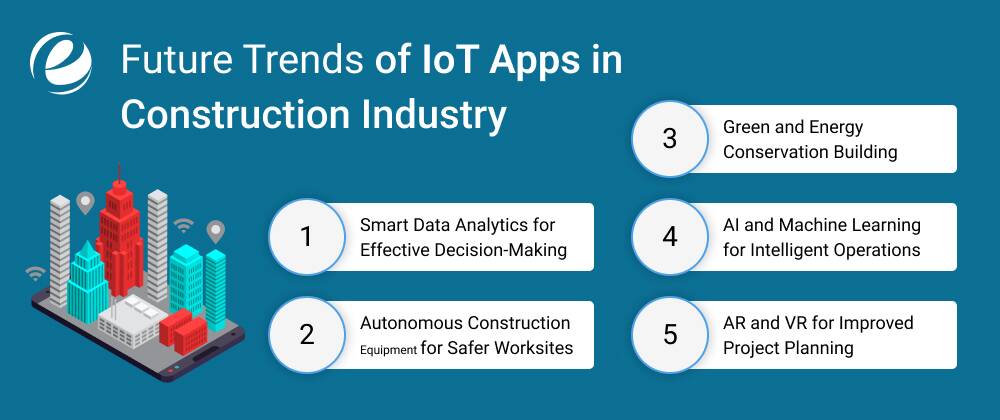
With ongoing technological growth, the use of IoT in construction industry is also going to expand, offering intelligent, secure, and more effective solutions for building sites. Industry reports indicate that the IoT building is also going to grow by a significant amount to $26.5 billion by 2027 at a consistent growth rate of 16.5% (CAGR) from 2022-2027. Below are the following trends that explain how IoT is transforming the construction sector.
1. Smart Data Analytics for Effective Decision-Making
IoT technology is making more advanced data collection and analysis possible than in the past. With real-time analytics, construction firms can monitor operations, streamline resources, and forecast maintenance needs. The predictive strategy saves money and avoids delays, enabling projects to proceed without issues.
2. Autonomous Construction Equipment for Safer Worksites
With artificial intelligence-powered automation and IoT sensors, autonomous operating machines are on their way. With automated means lowering man-hours dedicated to risky works with fewer accidents but more productivity, auto-machines at building locations will make more sections of the building construction site dependent on auto-machines doing heavy-duty works in an exact and streamlined manner.
3. Green and Energy Conservation Building
Green building construction is gaining momentum, and IoT is also making the construction process greener. Intelligent sensors help with energy usage tracking, preventing materials wastage, and being regulatory compliant with regard to green construction. IoT-driven systems help companies create green buildings that can achieve green building certification with ease.
4. AI and Machine Learning for Intelligent Operations
IoT, machine learning, and AI combined are transforming project management for the construction industry. The technologies enable automatic decision-making, enabling utmost process efficiency and improved risk management. From planning to predictive maintenance, AI-based IoT technologies will assist companies in getting ahead of issues before they escalate into expensive complexities.
5. AR and VR for Improved Project Planning
Virtual Reality (VR) and Augmented Reality (AR) are revolutionizing the planning and execution of construction. When combined with IoT, these technologies offer interactive 3D models through which architects and engineers can visualize projects prior to implementation. AR and VR will further improve the training of workers and remote site observation, making the process more efficient and error-free.
| Note: You might also be interested in learning about ‘Salesforce IoT Cloud’ and how it helps build an end-to-end customer experience. If so, check out this blog—it will guide you in successfully developing an IoT app. |
The Bottom Line
As now we have to the conclusion, it’s clear that IoT is transforming project construction management to be efficient, safe, and cost-effective. Real-time monitoring, resource optimization, and equipment tracking enable project managers to make quicker and better decisions. While challenges exist when implementing IoT, the long-term advantages of its use are greater than its implementation.
More and more construction companies are using IoT to enhance safety and maximize operation. Wearables safeguard workers by detecting danger, and smart sensors enable equipment to run at maximum capacity. This reduces downtime, prevents costly repairs, and keeps projects on schedule.
For contractors, IoT technology is becoming a mandatory skill for them. The era of the smart job site isn’t something on the horizon—it’s here and revolutionizing the game with improved, more efficient construction practices.
If you are in the construction business and looking for a reliable IoT development partner, reach out to us. As a trusted construction software development company, we can help you harness IoT to enhance operations, strengthen safety measures, and drive sustainable growth in your projects.
FAQs
What is the role of IoT in enhancing workers safety at construction sites?
IoT wearable technology like sensor-rich vests and helmets can monitor workers' vital signs and trigger alerts for emergency situations. When there is a deviation or risk found, these devices automatically send alerts to top authorities, which is easy to respond in a quick manner and overall improvement in security.
What is IoT accomplishing in energy management in a construction site?
IoT networks can track equipment and temporary site facility power usage in real-time. Construction managers can detect energy inefficiencies and maximize utilization in a way that they can act on energy-saving schemes based on such measurements, which translate into cost savings and a green operations plan.
What are some of the challenges of incorporating IoT into current construction processes?
Implemented in the building, the IoT is fraught with challenges such as security concerns regarding the data, requests for gigantic amounts of start-up capital, incompatibility of systems, and educating staff on the best way to use the new technology.
What Should You Look for When Embracing IoT for Your Building Construction Business
To successfully execute IoT, it's essential to choose solutions that integrate with your current construction management systems. There needs to be seamless communication between contractors, suppliers, and project teams enabled. Scalability and data protection also need to be of top concern, as IoT solutions need to grow with your business while protecting sensitive project information.




 +1 (989) 535-9295
 info@emizentech.com
 emizentech


