 Add us as a preferred source on Google
 IoT tends to be incorporated into smart learning environments and supplemented by smart devices and technologies to modify and change the way educational experiences and operations enhance the impact of IoT in education industry. IoT also allows real-time collection and analysis of data, customized learning, efficient campus management, and a better engagement experience with students.
According to PRNewswire, as the same goes that the next market is predicted to go from $ 8.7 billion in 2022 to $ 46.4 billion by 2032 with a CAGR of 18.6%
This indicates a positive shift in the adoption of IoT solutions in educational institutions across the globe.
Integrating IoT in education industry is transforming conventional learning, but beyond that, it’s a scalable solution for educational institutions; this will allow the establishment of smarter and more connected educational ecosystems.
In this detailed guide, you will explore everything about “how to implement IoT in education industry?”. With the help of this blog you will get information like what is IoT in education, how IoT works, benefits of IoT in education industry, top applications of IoT in education which are leading the market, implementation steps, cost estimation, use cases and many more.
Key Market Stats and Future of IoT In Education Industry
As per 360 RESEARCH, India is now projected to have rapid growth in the global IoT in the education market. The future of IoT in education market is likely to be valued at around USD 5.87 billion in 2024 and is expected to be USD 12.47 billion by 2030, with a growth rate CAGR of 13.38%
Moreover, the United States education market is estimated to be around $1.4 trillion as of 2021 and is forecasted to increase at an average growth rate of 4.2% to $3.1 trillion towards 2030. Such high growth, according to experts, would be attributed to among other things the increased role of education in the United States, increased consumer spending on education, and the progress of smart technologies.
The North American region will continue to take the market ahead as it is the main contributor to income. Emerging markets will also comprise a significant portion of the demand as governments try to bridge the education divide with the West.
The Internet of Things is the technology that can help in finding a successful answer to the challenges of growing competition and financial stability. According to analysts, the revenues that the global IoT in education industry is expected to generate will rise from USD 6.01 billion in 2020 to USD 17.42 billion by 2028, growing by an average of 14.22% per year during the forecast period.
The rapidly increasing use of connected devices, the fast growth of e-learning adoption, and the growing number of solutions in a cloud-based format are expected to be the main reasons why the evolution of IoT in the education market will continue.
What is IoT in Education Industry?
Well, as per the current scenario, IoT radically changes the education industry by breaking away from the ancient models of traditional settings. IoT thus gives a different persona that includes personalization and inclusivity itself, completely supporting students and teachers.
However, using such integrations of advanced technologies is a hard nut to crack. You can use the SAMR model to integrate IoT into your education smoothly. It will help you unfold all the stages involved in the process of integration of technology, giving you step-by-step instructions on how it can enhance your teaching experience.
How Does IoT Work in Education Industry?
Well, IoT in education industry makes learning environments smarter, safer, and more efficient. It makes education more accessible and personal to kids around the globe. You must have a question – “how does IoT work in education” right? Here is the answer!
1. Advanced and Smart Classrooms
IoT has made advanced classrooms with connected projectors, interactive whiteboards, and AI learning assistants. These tools make lessons more interesting and enhance students’ understanding.
2. Learning Personalized
IoT devices collect data on how students perform and help track tutors on how to create personalized engagements in learning relative to individualized needs. Adaptive learning platforms often change content difficulty because of the student’s progress.
3. Real-Time Attendance and Security
School staff use IoT-enabled biometric scanners and RFID-based ID cards that automatically take attendance. Smart surveillance cameras and smart sensors boost security on school campuses.
4. Connected Learning Devices
Through the use of their tablets, smart pens, and wearables, students enjoy immediate access to digital resources, cloud-based assignments, and real-time teacher feedback.
5. Efficient Campus Management
IoT has been proven to manage resources efficiently in schools and universities. Smart lighting, automated climate controls, and energy monitoring have minimized operational costs.
6. Virtual Classrooms and Distance Learning
Through IoT, students can now take part in online education by connecting through devices and cloud-based infrastructure while attending virtual classrooms all over the world.
7. AI Chatbots and Virtual Assistants
Smart assistants answer student questions, provide study reminders, and help with other administration tasks, making learning easier and more effective.
8. Better Decision-Making through Data Analytics
IoT helps to build and analyze data regarding student performance, attendance, and engagement in learning. It can even provide insights on how to improve teaching methods and student development, which educators and administrators can use.
IoT-based Solutions for Education Industry
Here are some of the important IoT based solutions for education industry. Look at these pointers for better understanding.
1. Attendance and Student Tracking
The traditional practice of calling attendance may lead to some time loss and errors. With IoT-based wearables or smart ID cards, attendance can be kept automatically. Beyond attendance, mode log-time tracking gives parents and authorities the assurance of knowing when a student enters or exits the vicinity of the institution.
2. Interactive Tools for Learning
Augmented Reality (AR) glasses/tablets can take students back to another time and place or inside biological systems, providing rich and immersive learning experiences. Very convoluted subjects thereby become interesting and easily understandable.
3. Real-time Feedback Systems
Feedback should be provided on an immediate basis in the learning cycle. Teachers using IoT would, therefore, receive instantaneous feedback on their lessons and adapt accordingly. With this approach, the teachers are in constant tune to the needs of their students.
4. Remote Learning Tools
Nowadays, Internet of Things devices are indeed useful when it comes to online education. It can monitor student participation, contribute to virtual group activities, or even proctor online tests, securing the integrity of remote examinations.
5. Collaborative Learning Environments
A collaborative atmosphere fosters creativity and a better understanding of each other. IoT devices allow students to engage in project work in real-time, sharing data and insights, thus making group projects more efficient and effective.
Benefits of IoT in Education Industry
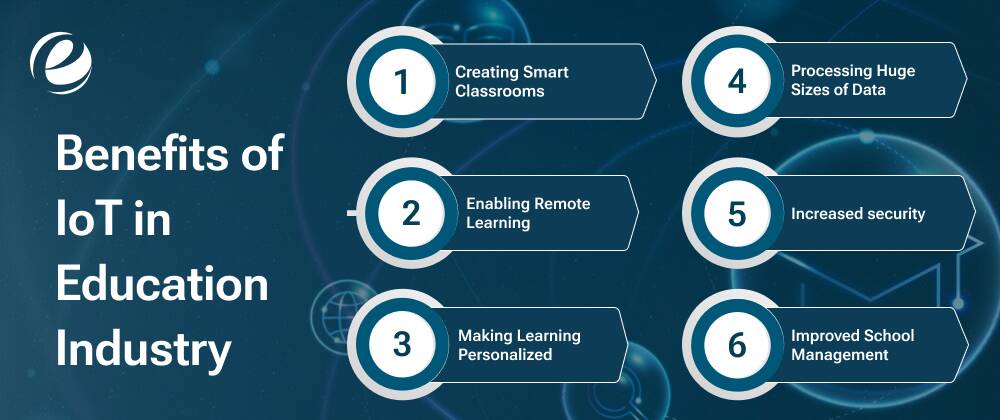
There are many benefits of IoT in education which all are provided by the applications and devices. Some of them are listed below for your consideration:
1. Creating Smart Classrooms
Smart classrooms are advanced education environments that recognize and take attendance of students while tracking their progress. These classrooms are usually installed with SMART boards and AR/VR headsets that make lessons so interesting and easier to grasp.
Teachers can also project tasks for students to perform on their devices while the lesson is ongoing. This occurs when IoT devices track the lesson and upload the relevant pre-programmed assignments whenever the teacher says words such as “assignment,” “homework,” or “project.”
2. Enabling Remote Learning
While the whole world had to come to terms with new realities because of some scenarios which affect globally, one of them was learning from home. With IoT, educators can conduct learning sessions similar to a webinar and take advantage of sophisticated technologies for distance learning.
IoT in education examples: This is using smart sensors for teachers to control a class through speech or gesture. Although the pandemic is now over, teachers and students can still benefit greatly from the tools offered to allow for learning in a remote format.
3. Making Learning Personalized
IoT enables the teacher to personalize the course through the individual student’s data that are generated from IoT sensors and devices. Smart teaching features allow the AI to track and control the pace and content of the curriculum based on student responses to it.
IoT internet of things solutions also provide teachers with deeper insights into what works and doesn’t within the particular classroom to enhance their teaching further.
4. Processing Huge Sizes of Data
IoT in education could help schools and colleges manage terabytes of data at the same time through smart devices that are joining a network. It opens avenues for numerous functions such as teacher professional development management, real-time tracking of student progress, and monitoring security measures.
5. Increased security
Connected devices can also set up a strong security base. Smart door locks, smart sensors, CCTV, alarm buttons, and rapid-response digital signage would serve the purpose of crime and environmental threats.
For example, in case of an emergency, it will immediately activate school security and appropriate safety management authorities.
6. Improved School Management
For well-organized, effective operation and decision-making, an institution needs to conduct activities other than teaching students, such as keeping inventories, managing funds, and handling other important documentation.
Adopting IoT solutions establishes a place where operation and decision-making activities will be faster, more efficient, and foolproof.
Common Challenges Faced While Implementing IoT in Education Industry
The implementation of advanced technologies (IoT) within a large educational set-up, comes with its challenges. Below are some of the challenges that are commonly faced while integrating IoT in existing learning and educating system:
1. Planning Complexity
The extent of efforts to be devoted to implementation planning might deter the administrative staff from IoT technological implementation. But there is no way around it; a thorough pre-implementation planning process must go into the refinement of the guidelines for the creation of the IoT network, detailing who has access to what information, which smart applications and devices shall be allowed, and how the integrity of the information space is maintained, among other considerations.
2. Concerns on Security
One of the biggest priorities for any educational institution is the security of students with respect to both the physical and the informational. That said, with a lot more threats coming in the path of cloud software like IoT, and without good security measures set in place, hackers could have a field day getting students’ personal files or any other sensitive information.
3. Massive Data Overhaul
Most educational organizations like schools and universities shall still keep most of their data printed or even on paper, with very little being stored virtually. The way you store your data and organize it may demand huge optimization in terms of IoT technology working right, be it study material or students’ records.
4. Tech Expertise Required
Even if you had funds to enable IoT to take place in your school, it is doubtful that many qualified technical staff are employed there already to set up the system and its long-term maintenance. It is, therefore, always judicious in these cases to enlist some help from experts.
5. High Costs
IoT is a costly technology, both in hardware and software. Since many schools and universities do not boast large innovation budgets, introducing connected devices could become a challenge.
Top Applications of IoT in Education Industry
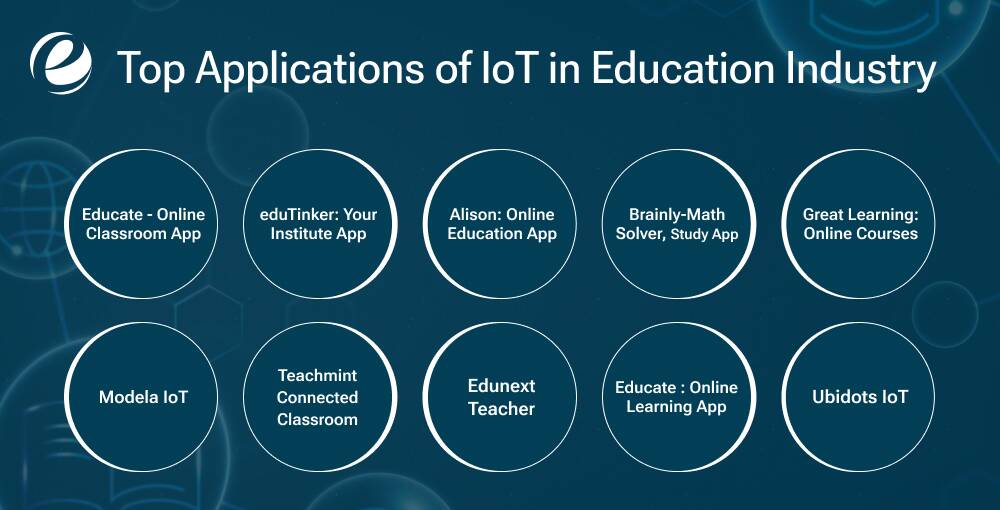
Here’s a detailed overview of the selected top applications of IoT in education. This table includes the launch years, app sizes, platforms, ratings, and user numbers of these applications for your better consideration and comparison:
| App Name | Launch Year | Last Update | Platform | Ratings | Downloads |
| Educate – Online Classroom App | 2023 | Dec 2, 2024 | Android, iOS | 4.5 | 100k+ |
| eduTinker: Your Institute App | 2020 | Mar 8, 2025 | Android, iOS | 4.0 | 100k+ |
| Alison: Online Education App | 2020 | Feb 26, 2025 | Android, iOS | 4.5 | 5M+ |
| Brainly-Math Solver, Study App | 2009 | Mar 12, 2025 | Android, iOS | 4.4 | 100M+ |
| Great Learning: Online Courses | 2013 | Mar 15, 2025 | Android, iOS | 4.6 | 5M+ |
| Modela IoT | 2024 | Mar 6, 2025 | Android, iOS | NA | 5K+ |
| Teachmint Connected Classroom | 2020 | Mar 13, 2025 | Android, iOS | 4.2 | 10M+ |
| Edunext Teacher | 2025 | Feb 12, 2025 | Android, iOS | 4.3 | 50K+ |
| Educate : Online Learning App | 2018 | Mar 16, 2024 | Android | 3.9 | 1K+ |
| Ubidots IoT | 2018 | Nov 28, 2024 | Android, iOS | NA | 5K+ |
Implementation Steps of IoT in Education Industry
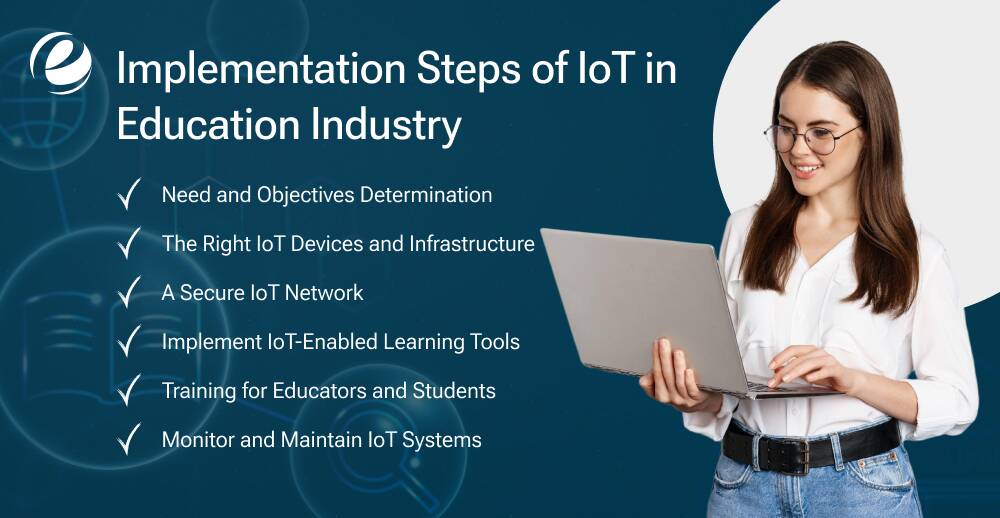
Set IoT devices in some classrooms and administrative areas. In addition, some capacity for learning will be guaranteed through the improvement of efficiency and security. Enormous benefits of IoT in education industry would accrue if implemented in a formalized manner.
Well, you must be curious about how to implement IoT successfully in educational institutions, right? The implementation steps are mentioned below.
1. Need and Objectives Determination
- Understand the institution’s challenges and needs.
- Articulate particular objectives, such as smart classrooms, automated attendance, or campus security.
- Identify the key stakeholders, including students, teachers, and administrators.
Explanation: Every educational institution has different requirements. Some may require IoT for digital learning, while others may focus on security and automation. Understanding these necessities helps in designing a customized IoT solution.
2. The Right IoT Devices and Infrastructure
- Select appropriate IoT-enabled devices, including smartboards, sensors, wearables, and tracking systems.
- Verify compatibility with any existing IT infrastructure.
- Look out for such aspects as connectivity (Wi-Fi, Bluetooth, RFID) and power efficiency.
Explanation: The success of IoT depends on choosing the right devices that seamlessly integrate with the current infrastructure. Schools must invest in reliable and scalable solutions for long-term benefits.
3. A Secure IoT Network
- Set up a strong and secure network that will support IoT devices.
- Data and student institutions should be encrypted and authenticated.
- Always comply with data privacy laws.
Explanation: Another important aspect of IoT is protecting the security of the network for data information through fair channels. Schools must implement cybersecurity measures that best suit the requirements.
4. Implement IoT-Enabled Learning Tools
- Incorporate smart boards, digital textbooks, and AI-enabled platforms for learning.
- Put in place IoT-based attendance tracking and automated grading systems.
- VR and AR will be used for interactive learning.
Explanation: IoT can positively support the traditional teaching-learning process by establishing an engaging interface. Such smart tools encourage student participation through real-time feedback.
5. Training for Educators and Students
- Bring in workshops and seminars to train teachers and students on the IoT.
- Provide user-friendly interfaces with guidance for easy uptake.
- Foster a culture of digital learning and innovation.
Explanation: Successful deployment of IoT requires the comfort level of teachers and students with the new technology. Their training involves adequately using the IoT tools in their daily learning and teaching activities.
6. Monitor and Maintain IoT Systems
- Monitor IoT devices for performance and security updates regularly.
- Implement a maintenance schedule to mitigate system failure.
- Analytics shall be used to examine the impact of IoT in education industry.
Explanation: In order to confirm that good quality teaching is done constantly, a culture of constant monitoring and updating must be created. It helps implement IoT in perspective.
Cost of Implementing IoT in Education Industry
Implementing IoT in education industry is based on hardware and software, infrastructure, and people. The complete cost depends on the complexity of the project, the number of devices, and customization requirements.
Below is an estimated breakdown of minimum project costs and hourly rates for key roles required in IoT implementation.
| Role | Minimum Project Cost (USD) | Hourly Rate (USD) |
| IoT Developer | $5,000 – $20,000 | $40 – $100 |
| Software Engineer | $10,000 – $30,000 | $50 – $120 |
| Hardware Engineer | $8,000 – $25,000 | $45 – $110 |
| Network Engineer | $7,000 – $20,000 | $40 – $100 |
| Cloud Architect | $12,000 – $35,000 | $60 – $130 |
| Data Analyst | $6,000 – $18,000 | $40 – $90 |
| Security Specialist | $9,000 – $28,000 | $50 – $120 |
| IoT Consultant | $5,000 – $15,000 | $50 – $100 |
| Project Manager | $8,000 – $25,000 | $50 – $110 |
Additional Cost Factors
- Hardware & devices like sensors, cameras, RFID scanners, and smartboards may cost between $10,000 – $50,000.
- Cloud & storage services, monthly cloud subscription may cost $500 – $5,000.
- Maintenance & support may cost 10-20 % of the total project cost annually.
The final cost of an IoT implementation in education can range from $50,000 to $500,000, depending on the institution’s size and scope of deployment.

Use Cases of IoT in Education Industry
The Internet of Things covers most industries, and leveling education is never an exception. It offers outstanding learning experiences, increased administrative efficiency, and student safety.
From smart classrooms to the automated attendance system, the applications of IoT make learning more interactive, data-driven, and effective. Below are some of the main uses of IoT applications in education.
1. Smart Classrooms
Interactive whiteboards and smart projectors in an IoT-enabled classroom for excellent teaching. IoT provides AI voice assistants to help students with their queries. It also automates climate control and creates a suitable environment for studying.
Explanation: Smart classrooms consist of IoT devices, which make learning more satisfying and interactive, as teachers can use advanced boards and digitized tools for teaching-automated temperature and lighting systems to create an ideal atmosphere.
2. IoT Enabled Learning Materials
Smart textbooks connected with e-learning platforms. IoT allows hands-on STEM and robotics teaching through IoT-linked devices. It also supports lessons via students’ AI chatbots or voice assistants.
Explanation: The learning materials thus result from enhancement through greater interactivity and flat access. The students will get to learn through connected devices, thus increasing engagement and understanding.
3. Automatic Attendance System
Automatic attendance system for students with IoT biometric and RFID systems. IoT helps track the presence of students using face recognition technology. This also provides parents and administrators with live information about the students.
Explanation: Traditional attendance methods usually consume much time and often have errors usually found in data collection. Through IoT attendance will be done accurately and the records will be saved in teaching hours.
4. Personalized Learning
AI in IoT systems will analyze how a learner progresses and recommend a learning profile tailored to an individual. It also helps indicate variations in learning speed and style of smart devices to personalize learning. Virtual reality (VR) and augmented reality (AR) for interactive and immersive learning.
Explanation: Each student has his or her own way of learning. IoT helps in personalized education by observing how students learn their lessons in order to provide more personalized content that can suit them better.
5. Smart Resource Management
Devices IoT-enabled track the energy consumed to the extent of waste possible. IoT Automated lighting, heating, and cooling based on real-time needs. It also regulates smart inventory management for books, lab equipment, and other resources.
Explanation: IoT thus helps institutions and universities save costs due to enhanced management of resources.
6. Campus Security and Safety
Real-time smart surveillance cameras. IoT-based emergency alert systems for immediate response to threats. It also helps in Geo-fencing and GPS tracking to monitor the movement of students.
Explanation: Safety matters in an educational institution. IoT enhances the security of the campus through automated monitoring and quick emergency response to safety concerns, making it a safer learning environment.
Why Choose EmizenTech for Implementation of IoT in Education Industry
EmizenTech provides smart IoT solutions in the education industry to redesign learning environments into more interactive, efficient, and secure places. The advanced technology boosts student engagement in schools, colleges, and universities with better resource usage and security. A dedicated e-learning app development team of experts ensures all this by providing a fully customized end-to-end IoT integration that best fits your organization.
Reasons to Choose EmizenTech:
- Our developer team has years of experience in smart technology and IoT integration.
- Our professional designers designed the application to fit your education requirements perfectly.
- Experienced coders seamlessly enhance the learning experience by developing smart classrooms, digitized learning tools, and integrated IoT, which better stimulate the engagement of students.
- We at EmizenTech believe in providing cost-effective solutions. Our developers offer smart and affordable scalable IoT systems to maximize efficiency.
- Our app developers are always available to support you anytime, maintaining stretchable drops of support for smooth implementation and maintenance by customer service.
Nutshell
The implementation of IoT in education industry is an improvement for how students learn and how institutions function after IoT integration. Smart technologies engage, increase efficiency, and promise a safe learning environment.
From interactive classrooms to automated administration, IoT provides an educational experience that is connected and data-driven. With the continued infusion of digital solutions into schools and universities, IoT will arguably chart how education is shaped in the coming years.
Without question, embracing this transformation will position students, teachers, and institutions at the forefront of an ever-changing world. If you are curious about “how to build an IoT app” then connect now with us for the discussion. Our dedicated consulting team will help you in this.
EmizenTech will help you to integrate IoT into your existing education or learning systems. Don’t think too much, and discuss your requirements right now!
FAQs
What is the future of IoT in education?
AI-powered education, virtual classrooms, real-time student performance tracking, and fully automated campuses are part of a "better" future of education.
How does IoT help in the education industry?
Smart classrooms, automatic attendance tracking, interactive learning, enhanced campus security, and many more features for managing resources make IoT beneficial.
What are the examples of IoT in education industry?
IoT in education examples include smartboards, RFID attendance systems, AI chatbots, security cameras, smart lighting, and wearable health trackers for students.
Is IoT expensive for implementation in schools?
The cost varies depending on the scale of implementation. However, most IoT solutions are affordable, and they will eventually save money via improved efficiency.
Is there anything like safety in IoT for students and teachers?
Yes, IoT is safe, provided that all security measures are taken into account. Schools must maintain a high level of network encryption, password strength, and regular updates to maintain data privacy.


 +1 (989) 535-9295
 info@emizentech.com
 emizentech


