
 Add us as a preferred source on Google
Over the past few years, some technological revolutions have made life so convenient that it is difficult to even imagine the world without them. The Internet of Things or IoT in healthcare is one of the best examples of these revolutions. This technology brings several other technologies, including Artificial Intelligence, Predictive Analytics, and Blockchain, in one place, creating a hyper-connected, data-led ecosystem. In simple words, this is what the impact of IoT in healthcare looks like:
- Patients can take medical tests from the comfort of their couch.
- Doctors can analyze those tests and provide personalized treatments.
- In-person consultations? Not required!
- Plus, there is a wide range of smart medical devices available.
And that’s just the crux of it. In short, IoT in healthcare industry is an emerging synonym for big-time change in the world. From remote patient monitoring to early detection of potential health risks to streamlining hospital workflows, this technology is setting all-new standards for overall medical systems. And these standards can be life-saving. Continue reading to understand the role of IoT in healthcare, how it works, and lots more.
IoT in Healthcare: A Look at the Numbers and Facts
- The IoT in healthcare market size accounted for an estimated $56.73 billion in 2024.
- The market is predicted to grow to $464.45 billion by 2034.
- 80% of healthcare professionals view IoT in the healthcare industry as an opportunity for innovation.
- 73% of healthcare professionals see the technology as an opportunity for cost savings.
What Is IoT In Healthcare?
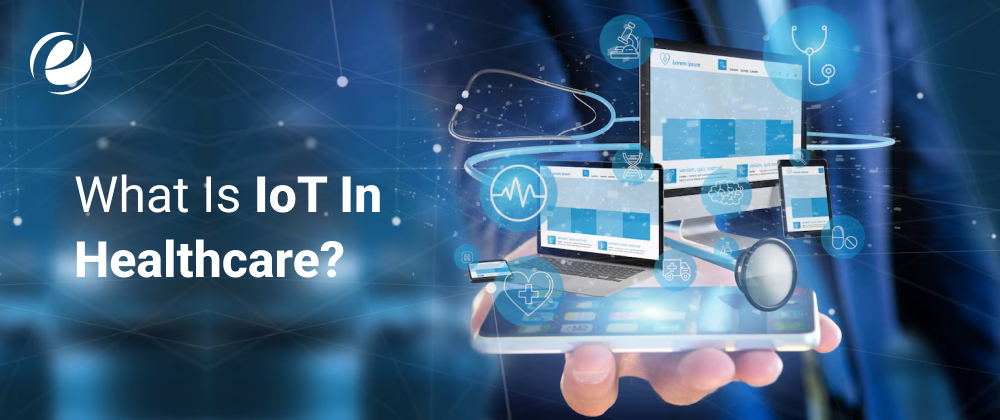
The Internet of Things in healthcare is simply a network of smart medical sensors, software, and devices. These interconnected systems are designed and deployed to collect, analyze, and transmit health data in real-time.
But what for? To enable fantastic systems like uninterrupted monitoring, remote diagnostics, and predictive analytics; and to improve the way patient care works. IoT-powered healthcare solutions have become the new normal in the medical space. Some of the most common solutions are:
- Wearable fitness tracker
- Smart hospital beds
- Connected infusion pumps, and
- Remote patient monitoring
These cool devices and systems are powered by technologies that fetch massive amounts of health data in real time. Medical professionals leverage the same to perform a variety of tasks, like:
- Identifying early symptoms of diseases
- Optimize treatment methods
- Enhance the effectiveness of the treatment
Here’s one important thing to mark: IoT is more than just all-things-patient-care. IoT-enabled asset tracking allows hospitals to monitor medical equipment, automate inventory management, and more.
How Does IoT Work in Healthcare?
The workings of IoT in the healthcare industry largely involve datasets on the move. When it comes to the implementation of IoT in healthcare, it involves a thorough process encompassing a lot many stages, from collecting data to fetching actionable insights.
Let’s quickly understand how IoT solutions in healthcare come into action:
1. Data Collection
It all begins when wearables, smart hospital equipment, implanted sensors, and other such IoT-enabled devices collect patient data at a continuous pace. This data includes heart rate, glucose, and blood pressure.
2. Data Transmission
After the data has been collected, it is transmitted through a secure cloud network, with seamless connectivity between healthcare providers and patients. The data transmission works in real time.
3. Data Analysis
Advanced AI systems and analytics enable data processing. This is to detect anomalies, interpret patterns, and eventually, generate valuable insights. That’s not all, healthcare professionals receive early warning signs related to health conditions before they worsen, all thanks to predictive algorithms.
4. Automation
Doctors, caregivers, or patients get real-time alerts by IoT solutions in case of any abnormal conditions. For example, if a patient’s heart rhythms are irregular, an IoT pacemaker will alert the cardiologist in no time.
5. Integration with Healthcare Systems
One of the most important aspects of the use of IoT in healthcare is integration. IoT devices can easily integrate with hospital management systems. This allows the workflow to operate in a streamlined way. Moreover, it automates basic tasks such as documentation.
10 Benefits of IoT in Healthcare Industry

The impact of IoT in healthcare is remarkable. From detecting early warning signs about a disease to managing routine tasks with automation, there are many ways in which this technology is redefining the benchmarks of medical practices and patient care.
On this note, here’s a roundup of the amazing benefits of using IoT in healthcare:
1. Remote Patient Care
IoT in healthcare has made patient care more seamless than ever. IoT devices enable consistent monitoring of symptoms in patients, which helps healthcare professionals to keep an eye on the concerned health metrics. The catch? They can do it in real time and patients do not have to step out of their homes! This is one of the key benefits of IoT in healthcare, especially when it comes to managing chronic diseases and post-treatment care.
2. Better Medical Decision-Making
While discussing how IoT works in healthcare, we read that IoT devices collect data in real time. Well, this data allows healthcare professionals to gain clarity on the health status or effectiveness of a treatment, making it easier for them to decide the next course of action. This is one of the crucial benefits of using IoT in healthcare since data analysis and insights can be leveraged to detect warning signs regarding a disease and thus, are helpful in tweaking treatment plans proactively.
3. Improved Patient Engagement
Nowadays, patients do not have to make an extra effort to keep tabs on their health, all thanks to sporty fitness trackers, smartwatches, and other such IoT devices. Probably the most exemplary use of IoT in healthcare, these devices track heart rate, physical activity, and even the quality and patterns of sleep. The next thing you know is that the users gain all the details into their health status. In fact, these devices trigger medication reminders too.
4. Enhanced Disease Management
IoT devices collect real-time data on a continuous basis which ultimately improves the management of diseases, like hypertension and diabetes. Moreover, healthcare providers can track when and as a disease progresses, making it easier to revise treatment plans, medications and more accordingly.
5. Operational Efficiency
Where there’s technology, there’s ease. After all, that’s the very purpose of tech-led solutions in our day-to-day lives. In the case of IoT in healthcare industry, this ease can be defined by automation. The technology enhances the efficiency levels in various healthcare operations simply by automating tasks, like tracking assets within a hospital or monitoring the use of a medical device. As a result, the manual workload simmers down and resource optimizations become more efficient. Moreover, automation also reduces the risk of errors.
6. Cost Efficiency
You read that right! Cost savings is one of the biggest advantages of IoT in healthcare. First, IoT applications enable remote monitoring. Next, they minimize the need for patients to be physically present in medical settings. Since patients can get consultations and care right from their home, it significantly reduces hospital admission costs. That’s not it, with predictive maintenance triggering alerts for the maintenance of a medical device, hospitals can take proactive measures to do the fixes, ultimately saving costly repairs and downtime.
7. Proactive Care
When the collected data is analyzed, it unlocks new trends and patterns. IoT in healthcare industry can be leveraged to use these new details to detect potential health risks before they become a major concern. This also enables healthcare professionals to take proactive action and revise preventive care strategies.
8. Patient Safety
Patient safety is one of the wonderful benefits of IoT in healthcare. IoT solutions facilitate real-time alerts related to critical health concerns. Smart infusion pumps, for example, make sure the patient takes accurate dosage of medication. Moreover, sensors can identify falls in elderly patients and trigger immediate assistance. These solutions are the example of how IoT in healthcare works towards ensuring complete safety for patients.
9. Streamlined Medical Research
IoT applications offer a collection of massive amounts of health data. This data is essential for medical research and clinical trials. Researchers can track every participant remotely, collect real-time data, and execute analysis for the outcomes. This overall process is accelerated with the use of IoT in healthcare. It not only makes the research and trials seamless, but also speeds up the development of new treatments.
10. Patient Experience
Patient experience is one of the key benefits of using IoT in healthcare. The integration of this technology helps healthcare professionals personalize treatment plans, reduce wait times for patients, and facilitates smooth communication between both the patient and the healthcare provider. Patients can access medical information on their fingertips, experiencing comfort.
IoT in Healthcare Use Cases
There are various practices and integrations exemplifying the use of IoT in healthcare, spanning remote monitoring to personalized medication. Let’s discuss this in detail:
1. Remote Patient Monitoring
RPM is probably the biggest example of the impact of IoT in healthcare. The global remote patient monitoring market was estimated at $5.2 billion in 2023 and is expected to grow at a CAGR of 18.6% between 2024 and 2030. It has changed the way doctor consultations work by enabling healthcare providers to track patients’ health in real time without even requiring them to be physically present. To make this happen, healthcare wearables and connected medical equipment collect and transmit data on various health metrics without a miss. These metrics include heart rate and blood pressure. This makes it easy for doctors to detect any anomalies and prevent medical emergencies proactively.
2. IoT-Enabled Wearables
Smart wearables are now normal devices used on an everyday basis by millions of people worldwide. The wearable technology market stood at an estimated $84.2 billion in 2024 and is projected to grow at a CAGR of 13.6% between 2025 and 2030. The rise of these devices has made tracking health easier for individuals and doctors. Today, smartwatches and fitness bands are the most common IoT in healthcare examples promoting proactive care and not to mention, encouraging people to adopt healthy lifestyle habits.
3. Smart Drug Management
Pharmaceutical supply chains are highly complex, requiring precise monitoring to ensure quality, safety, and regulatory compliance. IoT-based smart drug management systems use GPS-enabled sensors and blockchain technology to track medications from manufacturing to distribution. These systems can help monitor humidity levels, temperature, etc. ensuring vaccines stay effective. Moreover, they trigger instant alerts in case any fluctuations in temperature are detected. This ensures compliance with global regulations for healthcare and also minimizes waste.
4. AI-Driven Diagnostics
Another powerful example of IoT in healthcare, AI-driven diagnostics enables early detection of diseases by analyzing data in real time. AI diagnostic tools and imaging devices process massive datasets to identify anomalies and patterns, detecting potential health risks. Result? Proactive treatment and improved outcomes.
Top 10 IoT Healthcare Apps in 2025
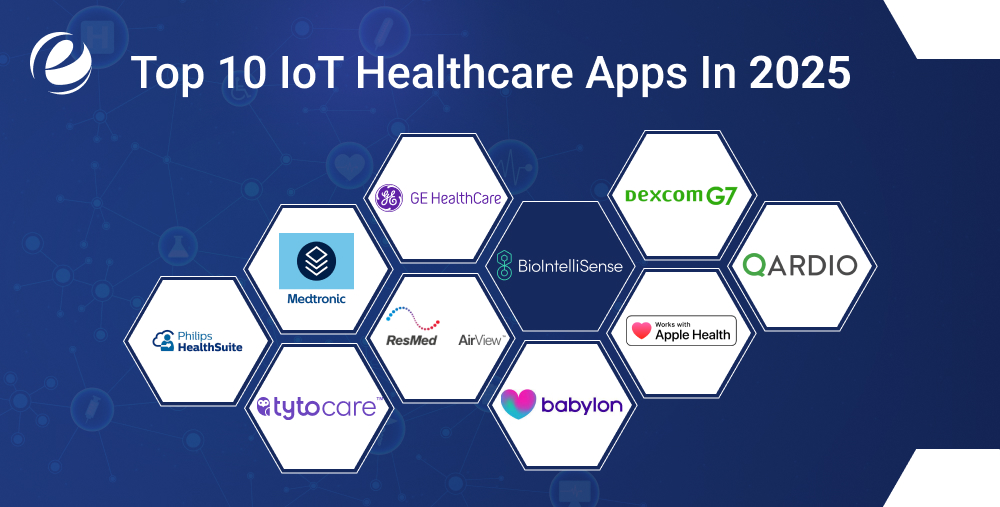
When it comes to the IoT in Healthcare examples, the list is long and tremendous. There are a number of IoT healthcare solutions that are changing the dynamics for hospitals as well as patients. These solutions use AI, cloud computing, and more to improve several processes, including diagnostics. Wondering how IoT helps in healthcare? Take a look at this list of top 10 IoT apps in healthcare that are setting the example right:
1. Philips HealthSuite
A cloud-based IoT healthcare system, Philips HealthSuite collects patient data from different sources, including hospitals systems and smartwatches. This platform integrates AI analytics which enables healthcare professionals to monitor patient’s health remotely and proceed accordingly.
Standout features of Philips HealthSuite:
- AI-enabled predictive analytics for disease management and prevention.
- Cloud-based data storage with real-time access.
- Seamless integration with medical devices and wearables.
- Remote monitoring for patients dealing with chronic diseases.
2. Medtronic CareLink
Medtronic CareLink is one of the top IoT in healthcare examples. This powerful remote patient monitoring platform is designed specifically for cardiac patients with pacemakers or other such implanted devices. This platform enables remote, uninterrupted patient monitoring, without requiring any physical visits, simply by collecting and transmitting heart activity data to healthcare providers. This app can identify irregularities in heart rate and instantly trigger notifications.
Standout features of Medtronic CareLink:
- Automatic data transmission from implanted devices.
- AI-powered alerts in case of abnormal heart rhythms.
- 24/7 remote monitoring of heart rhythm
3. TytoCare
TytoCare is an IoT-based diagnostic kit that allows users to evaluate their health from the comfort of their home and send assessment results to the doctor. It is portable and includes a stethoscope, thermometer, and smart otoscope. This is one of the key examples of IoT implementation in healthcare where accessibility to basic healthcare services are made tremendously seamless.
Standout features of TytoCare:
- AI-powered medical assessments at home.
- Instant data transfer.
- Smart diagnostic equipment.
4. GE Healthcare Mural Virtual Care Solution
An ICU solution, Mural is designed to help care teams prioritize treatment and minimize ICU workload by providing them with real-time insights. This platform collects and integrates data from monitors, ventilators, and various other hospital devices.
Standout features of Mural:
- AI-driven risk evaluation.
- Smooth integration with hospital systems.
- Centralized ICU monitoring in real time.
5. ResMed AirView
ResMed Airview is a healthcare solution that remotely monitors CPAP (Continuous Positive Airway Pressure) usage, tracks patient compliance, and more. This cloud-based CPAP therapy management system is specifically designed for people struggling with sleep apnea.
Standout features of ResMed Airview:
- AI-powered sleep pattern analysis
- Seamless data sharing with doctors
- Remote CPAP therapy monitoring
6. BioIntelliSense BioSticker
BioSticker, an FDA-approved wearable IoT health patch, is yet another example of the use of IoT in healthcare. This platform continuously monitors respiratory rate, heart rate, temperature, and more such viral health signs. It is perfect for remote patient monitoring and post-treatment care.
Standout features of BioSticker:
- Continuous monitoring of health signs.
- Seamless to use.
- AI-enabled detection of anomalies.
- Data transmission to healthcare providers.
7. Babylon Health
Babylon Health is one of the best examples of IoT in healthcare integrated with AI technology. facilitates a platform for patients and doctors to connect virtually. This AI-enabled telemedicine and IoT system offers health assessments leveraging real-time data. Moreover, it uses blood pressure monitors, smart thermometers, and other such IoT-driven devices to provide users with instant medical consultations as well as AI diagnostics.
Standout features of Babylon Health:
- Virtual consultations with doctors.
- Personalized treatment plans.
- AI chatbot for preliminary tests.
- Integration with wearables.
8. Dexcom G7
Dexcom G7 is a one-of-a-kind IoT example in healthcare industry when it comes to monitoring glucose levels. This real-time system continuously tracks glucose and sends data and alerts to the connected smartphone app. With a large share of IoT in healthcare in 2025 being focused on personalization, this app sets a strong example of technology’s role in managing diabetes seamlessly.
Standout features of Dexcom G7:
- Instant alerts related to blood sugar levels.
- Remote data sharing with doctors.
- Real-time tracking without any equipment.
9. Apple Health
Well, Apple Health has evolved into an extensive health tracking system, all with the integration of IoT-enabled devices like glucose sensors, ECG monitors, and more. The tech giant is enabling users worldwide to share real-time data with their doctor, allowing a seamless remote diagnosis and treatment procedure.
Standout features of Apple Health:
- ECG monitoring.
- Integration with IoT medical devices.
- AI-powered insights.
10. QardioCore
A wireless ECG monitor, QardioCore provides continuous heart monitoring without requiring heavy hospital equipment. This platform is specifically designed for people who need long-term heart tracking for cardiovascular conditions. The device collects data in real time and transfers it to doctors, simplifying the process of diagnosis and paving the way for proactive treatments.
Standout features of QardioCore:
- Continuous ECG monitoring.
- Compact, wearable design.
- Early detection of warning signs with AI-enabled insights.
- Instant data sharing.

Future of IoT in the Healthcare Industry: Top Trends to Watch Out
With rapid growth of IoT in healthcare, the future gives a hunch about more advancements and even more stronger examples of IoT in healthcare. A lot of credit for a promising future of IoT goes to fleet-footed technologies like AI in healthcare.
Here below are some of the key future trends for IoT in the healthcare industry:
1. AI for Diagnostics
Disease detection and treatment planning are the areas where AI integration with IoT will bring a revolution. AI IoT devices can analyze patient data in real-time and detect warning signs beforehand. This paves the way for valuable insights that can be used for proactive measures. This change will be especially beneficial to cardiology, neurology, and oncology.
2. Smart Hospitals and Digital Twins
Smart hospitals will be the next big thing by IoT in the healthcare sector! More and more hospitals will move towards IoT automation which will change traditional medical practices into smart settings. This transformation involves implementation of AI-enabled robotic assistants and IoT-based predictive maintenance. To top that, digital twin technology will also come into action to pose a virtual replica of hospitals. Its purpose will be to optimize hospital workflows.
3. 5G-Enabled IoT Networks
5G is already making waves in the tech space. Its integration with IoT in healthcare is expected to take medical practices to a whole new level. But how? Think of data transfer at low latency and high speed. This trend is set to enhance efficiency for remote robotic surgeries, enable faster transmission of medical imaging files, and more.
4. Secure Data Management with Blockchain
Healthcare has pretty much settled down in the IoT world, and yet, it is open to more advancements. The dependency on IoT in healthcare industry is giving rise to concerns about data security. Is there any solution? Enter Blockchain! With tamper-proof, decentralized systems for maintaining patient records, this technology is expected to redefine the security standards for protecting patient data. Moreover, patients will have control over their information, all with blockchain-driven electronic health records. This will pose as one of the major trends for IoT in healthcare.
How to Develop an IoT Healthcare Solution?

Implementation of IoT in healthcare requires a strategic approach, encompassing thorough planning, advanced technology, and post-launch journey. Here are the crucial steps involved in the healthcare IoT app development process:
1. Define Your Goals
The first and foremost step for successful implementation of IoT in a healthcare solution is ensuring clarity about goals, use cases, and user segments. You must define the problem your desired solution will solve, whether it is for chronic disease management or remote patient control. Apart from that, understanding your target audience and their expectations is also essential to ensuring a solution that meets the demands. This step sets the tone for the process that follows.
2. Partner with the Right IoT App Development Company
This step is the one that can make or break the deal. Building a healthcare IoT app requires a team of experts that understand the nook and cranny of healthcare mechanics, regulations, and more. Partner with a trusted app and website development company that brings industry expertise to the table and crafts the solutions with best practices and cutting-edge technologies.
3. Choose the Right IoT Hardware and Sensors
IoT healthcare systems rely largely on sensors, wearables, and medical devices for patient data collection. That said, you would want to make sure the hardware you invest in is worth the price. It should provide accurate results, have maximum reliability, and should also have real-time monitoring capabilities for key health parameters. Moreover, the devices must also offer hassle-free data transmission through Bluetooth, 5G, or Wi-Fi. And to top it all, do pay attention to the security aspect of the device you consider.
4. Check Up on AI Integration
AI Integrations charge up healthcare solutions, making them more efficient and feature-rich. So, the idea is to incorporate predictive analytics, smart diagnosis, automated monitoring, and more such capabilities. These technical factors ensure scalable IoT healthcare solutions, making the platform accessible to a larger audience segment.
5. Design and Develop an IoT Healthcare App
An IoT healthcare solution must be on the top of its game with design and overall functionality in order to ensure it facilitates a smooth interaction between doctors, administrators, and patients. Moreover, real-time data transmission is one of the core components of an IoT healthcare platform, making it more important for developers to ensure easy access to the information. Thus, make sure the app has a user-friendly interface for smooth navigation for all the parties.
6. Test, Deploy, Optimize
Testing is one of the most important steps involved in the IoT healthcare app development process. Here are some of the key testing practices:
- Ensure each element of the app performs as planned.
- Check how the solution handles large-scale data processing.
- Identify and mitigate potential vulnerabilities surfacing from data transmission and storage.
Once the team has cleared this stage, you can move on to the deployment stage phase by phase. For example, start with beta testing in a healthcare environment before rolling out the solution on a large scale. Also, make sure the app undergoes regular monitoring and updates after the launch. This is must for keeping your solution at par with the ongoing market trends.

How Much Does IoT App Development Cost?
The cost of healthcare IoT app development varies based on a number of factors, including the range of features, integration, and the type of solution. While an IoT healthcare app with basic features can cost between $30,000 – $50,000, the cost for an enterprise solution with advanced features can go up to $150,000 and beyond.
The type of sensors and medical devices used in a solution also impact the overall cost. The range for standard IoT sensors and wearables is $50 to $500 per device. On the other hand, a custom smart medical device can cost between $1,000 to $10,000 and more per device.
From customizations to AI capabilities to security measures, there are several other aspects that determine the total cost of developing an IoT healthcare solution.
Why Choose Emizentech for the Development of IoT Healthcare Solution?
The process of custom IoT healthcare app development requires a careful approach involving a well-planned roadmap and post-deployment work that align with your unique goals. At Emizentech, we help you turn your vision for a scalable, flexible digital product into a successful outcome. We strive to ensure all-encompassing app development services, creating a data-driven, robust healthcare solution for the future. Our end-to-end services for implementing IoT in healthcare include:
- AI-enabled predictive analytics for remote patient monitoring.
- Seamless IoT integration with hospital infrastructure.
- Cloud integration for hassle-free data management.
- Custom IoT application development.
- Post-launch maintenance and 24/7 support.
At Emizentech, we make sure your idea of a successful implementation of IoT in healthcare pans out as a highly scalable, robust platform that boosts overall efficiency and streamlines various tasks for you and your patients/users.
Conclusion
As we read above, the impact of IoT in the healthcare sector is substantial. Driven by innovation and the goal to streamline healthcare processes, IoT in healthcare solutions are emerging as the future of the medical industry. On the other hand, IoT implementation in healthcare requires thorough planning and a lot many considerations, including type of devices, tech stack, and cost. With the best IoT development services provider, you can ensure everything on your checklist for a successful IoT healthcare solution is covered, while also saving cost and time.
Faq’s
How is IoT used in healthcare?
IoT in healthcare facilitates functions like remote diagnosis, real-time patient monitoring, and automated clinic/hospital management through medical devices, AI-powered analytics, and wearables.
What are the IoT applications in healthcare?
The most common IoT applications in healthcare include wearables, remote patient monitoring, AI-powered diagnostics, and real-time drug management.
How is blockchain used in healthcare?
Blockchain enhances the security factors involved in IoT implementation in healthcare. It helps secure patient records, ensures data integrity, and enables fraud prevention through decentralized ledgers.
What is the future scope of IoT in healthcare?
The future developments for IoT in healthcare include smart hospitals, blockchain-based secure patient records, and robotic surgeries.



 +1 (989) 535-9295
 info@emizentech.com
 emizentech


