
 Add us as a preferred source on Google
 Do you have any idea how the stores you love keep their operations running smoothly? In today’s fast-paced retail world, managing operations efficiently and staying ahead of the market requires continual adaptation. Retailers face numerous challenges, ranging from intense competition and rising customer expectations to operational inefficiencies and issues with inventory management.
Odoo is a powerful tool that can help retailers improve efficiency, enhance customer experience, and gain valuable business insights. Odoo for retail is a complete business management application that is leading the trend and transforming the retail industry’s POS methods. Did you know that, as of today, more than 88,869 live stores are using the Odoo platform.
Odoo is an amazing and very powerful tool that can help retailers improve efficiency, enhance customer experience, and gain valuable business insights. It ensures that items are always in stock, provides important insights into customer preferences, and manages finances and orders in a single, streamlined hub. In a rapidly growing ERP market, Odoo’s influence on the retail industry is clear, offering the flexibility and security retailers need to succeed in an ever-changing market.
In this post, we’ll discuss how Odoo development services are revolutionizing the retail world by providing seamless POS and eCommerce integration, more efficient inventory management, and a personalized shopping experience.
From Legacy Systems to Integrated Solutions: How Retail Has Evolve
The retail industry is evolving, with customer demands constantly changing. Therefore, retailers must update their software portfolio to Odoo eCommerce solutions in order to adapt to the speed of change in business. Retailers using outdated technology can hinder their business growth. Transitioning from standalone POS and eCommerce systems to integrated systems is driven by the need to better manage inventory, improve data analysis for customers, and streamline processes.
Being able to view both offline and online sales on one platform eliminates the need for manual entry and reduces the possibility of mistakes. It’s time for retailers to upgrade their software to improve business processes and deliver a seamless customer experience.
The Impact of Digital Transformation in Retail
Retail stores, once rigid and slow, have evolved into adaptive and innovative businesses by adopting cutting-edge technologies like artificial intelligence and Odoo retail management solutions. These technologies enable personalized services, automated inventory management, and data management. Where companies once struggled to react, they are now racing to change, understanding that adaptation is not optional, it’s vital for their survival.
Retail is heading in the right direction, thanks to the many advantages that digitalization provides.
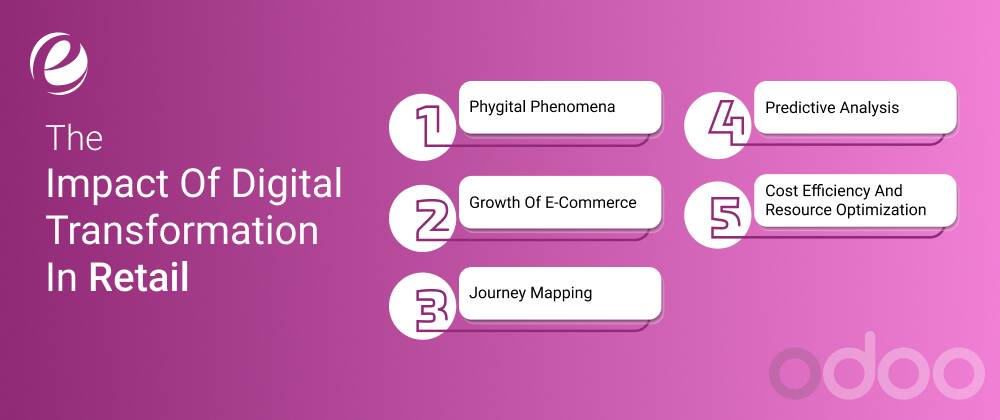
1. Phygital Phenomena
As the title suggests, today’s retail market is flooded with products that combine digital and physical stores to offer the highest-quality customer experience. From online shopping to curbside pick-up, shoppers can choose from a wide variety of options supported by Odoo omnichannel retail that ensure an effortless shopping experience.
2. Growth of E-Commerce
The growth of e-commerce has been phenomenal, particularly during the COVID outbreak, which forced businesses to focus on their digital capabilities. Online shopping has become a major part of our lives, prompting businesses to invest in and develop online platforms, digital marketing, and apps for the ever-growing market of consumers who prefer shopping online.
3. Journey Mapping
Journey mapping is the process of tracking a consumer’s experience and journey using business intelligence, analytics, data, and other technology-powered tools. This approach allows retailers to identify various points of contact, recognize gaps or high points, understand decision-making triggers, and more. It helps transform these insights into a simpler, more seamless experience for customers.
4. Predictive Analysis
Retailers are leveraging digital technologies powered by Artificial Intelligence (AI) and Machine Learning (ML) to efficiently manage and improve various tasks, such as vendor management and payment processing. Digital tools help reduce mistakes and accelerate operational processes.
5. Cost Efficiency and Resource Optimization
With the help of digital technology and the latest trends in digital transformation, retailers can reduce operational expenses. These tools improve processes, simplify routine tasks, and streamline resource scheduling. Advances in technology and automated processes in systems like supply chain management, inventory control, and customer relationship management help retailers run more efficiently and increase profits when executed correctly.

Why Traditional ERP Solutions Fail to Meet Retail Demands
Are you using an outdated ERP system but struggling to meet the modern demands of retail? Do you know why? It’s because these systems fail to keep pace with the fast-evolving requirements of modern retail. Older systems are typically slow, difficult to use, and hard to adjust to the ever-changing needs of today’s retail environment.
They are unable to provide real-time data, which is essential for effectively coordinating stock, sales, and customer details. Retailers need flexibility to respond quickly to trends or stock issues, but traditional ERPs lack this adaptability. Additionally, they often fail to integrate seamlessly with online stores and point-of-sale systems, leading to delays and errors.
In today’s environment, where streamlining operations and providing a better customer experience is crucial, conventional ERP systems fall short. Retailers need solutions that are simple, flexible, adaptable, and capable of processing real-time information, and this is where Odoo for retail can help.
How Odoo is Transforming Retail with POS & eCommerce Integration
Since its inception, Odoo ERP for retail businesses has been the preferred ERP and CRM system, particularly for eCommerce. The open-source business management software easily integrates with a wide range of Odoo modules like Inventory, Accounting, Sales, and CRM, making it a complete solution for eCommerce companies. Let’s take a look at how Odoo CRM for retail businesses is transforming the retail industry.
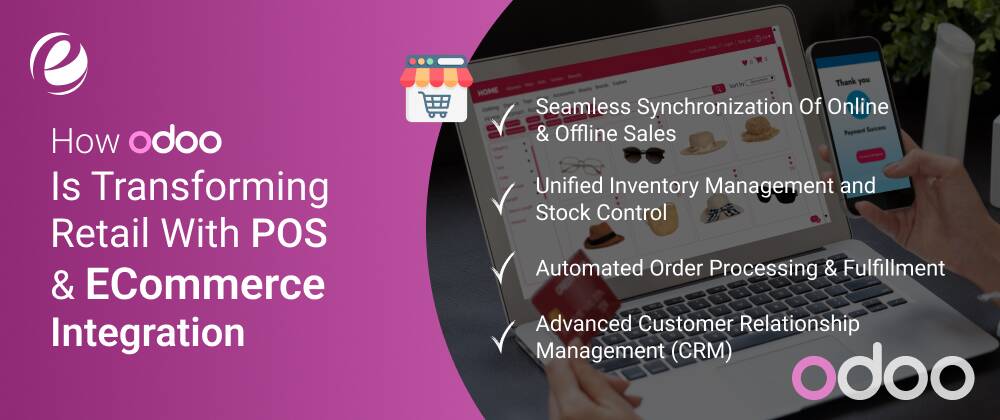
1. Seamless Synchronization Of Online & Offline Sales
Odoo allows you to integrate both offline and online sales. When a customer makes a purchase online or in-store, the system automatically updates orders and stock levels in real time. This constant synchronization helps avoid errors, such as selling items that are out of stock, while making sure a smooth experience for both customers and employees.
2. Unified Inventory Management and Stock Control
Inventory management is crucial for retail companies, and Odoo ERP offers a comprehensive solution. By using the Odoo inventory control module, retailers can establish processes based on the specific operational rules and standards of their stores.
The module facilitates efficient product movement, warehouse storage, and stock management. With Odoo unified retail management system capabilities, retailers can optimize their inventory levels, prevent shortages, and improve overall operational efficiency.
3. Automated Order Processing & Fulfillment
With Odoo, order processing and fulfillment are completely automated. When a client places an order, the system handles tasks such as inventory checks, invoice generation, and even shipping. This greatly reduces the human error chances, speeds up the process, and allows for faster delivery of goods to customers. Retail automation with Odoo allows retailers to focus on expanding their business instead of managing day-to-day operations manually.
4. Advanced Customer Relationship Management (CRM)
The integration of Odoo CRM enables businesses to collect and analyse customer data, allowing personalised marketing and improved customer service. Businesses can use customer information to provide tailored marketing recommendations and messages that boost customer satisfaction and retention.
Offer a seamless shopping experience across all physical stores, online platforms, and mobile applications with Odoo, the best ERP for eCommerce and retail. The POS system ensures smooth and quick checkouts, reducing wait times and increasing customer satisfaction.
Major Challenges Odoo’s POS & eCommerce Integration Solves
Are you wondering how Odoo helps retail businesses? Odoo for Retail, with its unifying features and enhanced capabilities for eCommerce, has helped streamline company operations and improve the user experience. This is driving growth within the eCommerce market.
In this section, we’ll look at the most pressing issues that Odoo POS and online store integration solutions address, and how they can help.
1. Unified Omnichannel Experience
In the digital age, having an online presence is crucial for retail businesses. Odoo ERP seamlessly integrates with the eCommerce platform, allowing retailers to manage their physical and online retail operations on the same platform. This integration ensures consistency in price management, inventory, and customer information across all channels.
Additionally, Odoo enables customers to purchase products online and pick them up in-store. Customers greatly enjoy the convenience of shopping online and saving time by picking up their purchases in person. Retailers also benefit from Odoo ERP’s powerful eCommerce features, including one-step checkout, attractive product pages, and integrated payment modules, providing a better online shopping experience for customers.
2. Smart Inventory Management
With Odoo, you can experience the significant benefits of automating tasks that were previously done manually. Smart inventory management in Odoo allows you to improve inventory handling efficiency, optimize supply chain management, minimize errors, and make your business management more reliable.
Odoo ERP’s real-time inventory tracking system enables you to efficiently monitor and manage inventory levels, reduce carrying costs, and prevent stockouts. Additionally, you can set up automatic restocking guidelines, ensuring that you never run out of essential items.
The Odoo Inventory module is a data exchange application that can work with other system applications, making the process seamless. To ensure complete transparency, the system tracks every operation associated with each document, including supply chain details, shipping orders, and quality control.
3. Faster & Secure Transactions
The latest version of Odoo is compatible with several payment options, such as Stripe, PayPal, Authorize.Net, and other payment gateways. This makes the checkout process easier, more flexible, and user-friendly. Additionally, Odoo provides powerful configuration tools that allow customers to design and implement customized payment strategies to meet their clients’ needs and preferences.
With the accounting tool available in Odoo, retailers can create invoices for sales, track payments, and monitor assets and liabilities. The integrated financial management system offers complete control over all aspects of retail store operations, including managing down payments, follow-up actions, and various payment options.
4. Real-Time Data Analytics For Smarter Decision-Making
Well, reliable data is crucial when making business decisions. By connecting your e-commerce store to Odoo ERP, you get access to detailed reports and analysis of your business operations. Odoo POS integration provides real-time analysis, enabling businesses to make informed decisions based on data.
Businesses that utilize this system can quickly identify trends, better understand customer behavior, and develop strategies to improve sales efficiency. By synchronizing data in real-time, companies can stay updated on inventory, sales, and customer behavior.
Top Odoo Features For Retail Businesses
With Odoo for retail, you can create a scalable and robust online store. Odoo offers effective marketing tools to expand your reach and boost online sales. Let’s take a closer look at the most important features of Odoo that can benefit retail businesses.
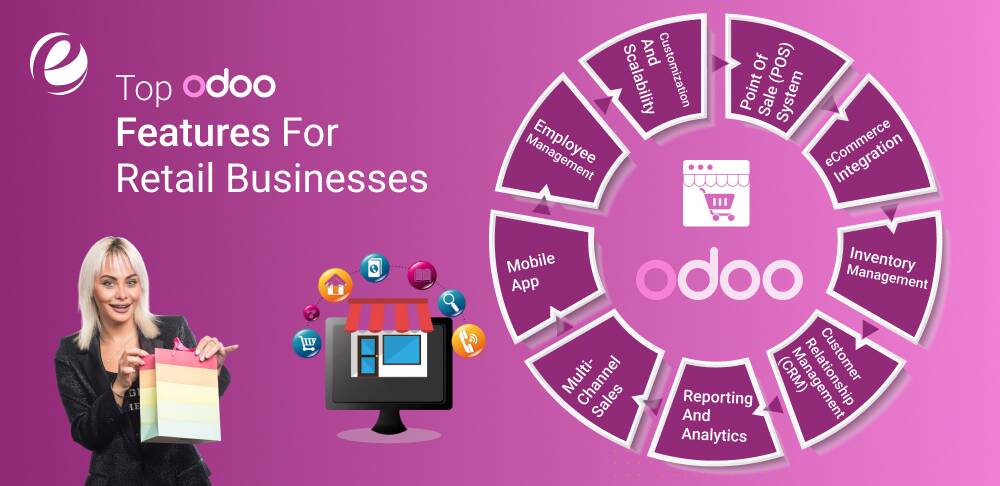
1. Point of Sale (POS) System
The POS and eCommerce synchronization ensures consistency in pricing, inventory, and customer details across all sales channels. The unified system allows businesses to manage online and in-store promotions, sales, and loyalty programs from one platform. Additionally, real-time sales and performance data analysis provide valuable insights which can greatly help refine your business strategies.
2. eCommerce Integration
Odoo ERP integrates online stores with physical shops, enabling retailers to manage everything from a single platform. This ensures consistent inventory levels, pricing, and customer information across both offline and online channels. Retailers can also take advantage of Odoo’s eCommerce features, including easy checkouts, stunning product pages, and integrated payment options, which enhance the customer buying experience.
3. Inventory Management
The Odoo inventory management system is automated and ensures accuracy in stock levels by updating inventory as orders are received, preventing overselling. It simplifies the order fulfillment process through automated picking and shipment tracking. With these improvements, businesses can effectively manage inventory across multiple locations while optimizing delivery routes based on customer access.
4. Customer Relationship Management (CRM)
Understanding your clients allows you to tailor your offerings to their specific needs, creating lasting experiences that encourage repeat business. The Odoo CRM for retail businesses standout in customer care. It’s more than just software, it’s the core of your enterprise, filled with information and insights that empower you to provide services that continuously win over your clients.
5. Reporting and Analytics
Odoo’s analytics and reporting capabilities provide businesses with the necessary tools they need to make better, informed decisions based on data. It generates accurate reports that help companies analyze their performance using various parameters. Odoo sales and analytics tools for retail enable businesses to examine data from multiple sources. This comprehensive analysis helps identify patterns and opportunities for improvement.
6. Multi-Channel Sales
Odoo ERP, specifically designed for the retail sector, can manage sales across different channels with ease. Data shows that businesses implementing multi-channel sales with Odoo see a 35% increase in revenue, as it offers a single platform for both offline and online transactions. Multi-store management in Odoo enhances market penetration and customer satisfaction, driving overall business growth.
7. Mobile App
By allowing mobile access, Odoo for retail enables retailers to operate on the go. Research shows a 20% improvement in productivity for companies that adopt mobile accessibility via Odoo POS development. This feature allows retailers to stay connected, manage inventory, and monitor sales anytime and anywhere, enhancing operational efficiency, agility, and responsiveness.
8. Employee Management
Employee data, such as pay stubs, benefits logs, leave records, and performance appraisals, are automatically stored within ERP systems. To complete tasks such as payroll, time tracking, shift scheduling, and attendance, you and your staff can easily access this data.
Additionally, the time-tracking and employee scheduling capabilities of the ERP help optimize staffing levels based on demand. The performance management features of an ERP system assist in tracking KPIs, providing feedback, and encouraging personal development.
9. Customization and Scalability
Odoo retail ERP software is renowned for its customizability, scalability, and high-end personalization. Whether your company requires a unique workflow, product page, report generation, seamless checkout, or integration with other tools, Odoo is tailored to meet your business needs and provide support. As your company grows, Odoo’s POS can easily scale to support new locations and higher transaction volumes without incurring additional costs.

Future Trends – Odoo In Retail
Odoo for retail has quickly become one of the best open-source ERP solutions, transforming the way businesses manage their operations with its flexibility and user-friendly interface. In the future, the Odoo point of sale system is set for growth, with developments such as AI automation, greater flexibility, and the introduction of cloud solutions.
1. AI-Driven Personalization
Artificial Intelligence has emerged as a revolutionary force across all sectors, reshaping decision-making, processes, and customer interactions. In the case of ERP platforms like Odoo, AI integration adds a new layer of technology that goes beyond traditional automation, paving the way for smarter analytics based on data.
AI’s ability to forecast demand helps provide more accurate market need estimations, improving pricing efficiency and reducing the risk of inventory shortages. In customer service, the use of AI in chatbots and automation has proven to be more effective in delivering support.
AI can also enable Odoo ERP to offer personalized recommendations to users. For example, AI can suggest which items to stock based on consumer demand or advise on the optimal timing for launching advertising campaigns. This type of personalization will help companies remain competitive in the marketplace.
2. Mobile-First Retailing
Shopping on the go is becoming rapidly popular as more and more consumers use their smartphones to purchase goods. Retailers must accommodate this trend by offering mobile-friendly options for their clients. Odoo for retail helps businesses achieve this through mobile-friendly eCommerce platforms that ensure your online store’s design is appealing and functions well on mobile devices. Additionally, it offers mobile-friendly POS platforms, allowing you to sell anywhere, whether in stores or at events.
Odoo ERP for retail business also supports mobile-based shopping through push notifications and marketing tools that enable merchants to deliver promotional offers, updates, and reminders directly to customers’ smartphones. This helps businesses stay connected with their customers, increase engagement and sales, and make shopping more convenient for those using mobile devices.
3. Advanced Reporting and Analytics
Odoo has offered basic analytics and reporting, but future versions will include more advanced capabilities. This will allow organizations to assess their performance more thoroughly and uncover the insights needed to guide strategic decisions.
Expect improved reporting tools for sales, inventory, finance, and human resources. Companies will be able to develop custom reports, track key performance indicators (KPIs), and display data using interactive graphs and charts.
For example, Odoo’s Accounting module is expected to provide more detailed financial reports, such as cash flow forecasts and indicators of financial health. Sales personnel will benefit from greater detail in reports about customer behavior, sales performance, and market developments.
4. Augmented Reality (AR) in Retail
AR and VR are increasingly being integrated into ERP systems. Odoo, as a modular and widely used ERP solution, could leverage these technologies to enhance customer experiences and streamline trade-related processes.
Odoo’s Augmented Reality (WebAR) extension enhances your web experience by breaking the limitations of standard websites and drawing users in with interactive, immersive features. It improves customer engagement, boosts sales, and provides a more complete experience.
This technology seamlessly blends the online and real world, offering an amazing online experience. Odoo’s eCommerce and Point of Sale (POS) modules can integrate AR for virtual items, enabling trial runs, interactive exhibits, or even in-store navigation options.
5. Voice Commerce
As eCommerce evolves, customers expect a seamless, personalized, fast, and efficient shopping experience. To easily meet the rapidly changing expectations of customers, businesses must continue to develop and improve their interactions with them.
One of the most powerful developments in eCommerce is the incorporation of AI-powered voice assistants. These intelligent systems allow customers to connect with your online store using voice commands, providing the most convenient and user-friendly shopping experience.
When integrated with Odoo for retail, this advanced technology will offer your customers a faster, more user-friendly, and more personalized purchasing experience. By offering features such as real-time order processing, multilingual support, and 24-hour accessibility, AI voice assistants provide a scalable and cost-effective solution that enhances the customer experience and boosts sales.
How To Implement Odoo For Retail?
Launching an online retail business is exciting but challenging. With numerous moving parts, from managing inventory to customer service, having the right tools is essential. Implementing Odoo for retail is one of the most effective solutions for improving eCommerce processes, increasing efficiency, and enhancing user satisfaction.
1. Assess Your Business Needs
Take some time to assess your company’s needs. Consider your current challenges and goals, then think about the features that can help streamline your business. Identify what is most crucial to your company, such as inventory management or improving customer experience, and focus on those areas first.
2. Choose The Right Odoo Modules
Odoo for retail offers a wide range of modules to help run your online store efficiently. Some essential modules include:
Website and eCommerce: Quickly and easily create and manage your store online using customizable templates and an intuitive user interface.
Inventory Management: Track inventory levels, avoid overstocking, and prevent shortages by receiving automated notifications.
Accounting: Automate financial transactions, generate invoices, and track expenses to maintain a healthy cash flow.
CRM: Manage customer interactions, track leads, and nurture relationships to achieve better results.
Sales and Marketing: Boost sales by automating marketing campaigns, email outreach, and customer segmentation.
Choosing the right modules that meet your specific business needs will provide a strong foundation for your online store. A reputable Odoo service provider can assist in customizing the modules to meet your unique business requirements.
Partner With An Odoo Implementation Expert
Find an experienced Odoo development company that has a deep understanding of the platform. They can help you set up your system correctly, tailor it to your business needs, and ensure everything runs smoothly. Partnering with a professional will save you time, prevent errors, and ease the transition for you and your business.
Train Your Team
It is essential to ensure that your team understands how to effectively use Odoo for retail. Provide training that helps them learn the functions of Odoo, such as inventory management and order processing. A well-trained workforce will perform more efficiently, reduce errors, and enhance the customer experience, which will contribute to the smooth operation of your business.
Go Live and Monitor Performance
Once all stages are completed, from requirement gathering and development to quality testing, client acceptance, and functional training, the system is launched on a live server. Once live, the client will have access to the software. After implementation, ongoing support is necessary to ensure that the Odoo POS Integration remains effective. Consistent support is a crucial factor in determining the success of the process.
How EmizenTech Can Help You Implement Odoo for Retail
Odoo for retail is a powerful solution that will change the way you run your business by increasing the efficiency of your business, enhancing customer service and providing invaluable insight through access to data in real time. Its compatibility with other Odoo modules and customizable design makes it a perfect ERP solution for businesses of all sizes.
In order to ensure the success of your Odoo eCommerce solutions implementation, and for fully taking advantage of Odoo’s POS solution, partnering with an expert provider is vital. EmizenTech offers expert installation and support solutions tailored to your specific business needs.
We are dedicated to assist businesses in implementing and maximize Odoo solutions, which will ensure smooth transitions and profitability. By relying on our experienced team for support, you’ll be able to make smooth and seamless transitions, as well as maximize the value of Odoo Point of Sale solution.
Conclusion
Well, the future of the eCommerce market with the inclusion of Odoo for retail is on the brink of an enormous digital revolution. Through enhancing the customer experience and streamlining processes for business, Odoo allows retailers to remain ahead of the competition and prosper in a highly competitive market.
The world of retail is evolving fast, and retailers must adopt technology in order to stay ahead of market. Utilizing the advantages from Odoo ERP, retail stores can traverse the world of digital effortlessly and effectively run their stores’ retail operations offline and online. If you are a business looking to grow their online business with efficient operation, Odoo can be an all-in-one ERP platform that can help you remain ahead of the curve in the ever-changing technological time.
Frequently Asked Questions
What's the cost of Odoo to retail companies?
The price of Odoo for retail businesses will depend on the selected plan (Standard or Custom) as well as the number of users. Standard plans include access to all apps where as the custom plan offers greater features and custom options, which begins at a price that is higher per user/month.
Can Odoo handle large-scale retail operations?
Absolutely, Odoo is able to handle large retail operation. It is scalable and has the ability to handle an enormous amount of inventory, sales, as well as customer information which makes it ideal for companies of all sizes.
Is Odoo suitable for small retailers?
Absolutely, Odoo is great for small-scale businesses. It's flexible, and it can expand as your business expands, making the perfect option for smaller retailers looking to grow.
How long does it take to implement Odoo?
The length of time needed to set up Odoo for retail is dependent on the business requirements, however it typically will take between a few weeks and a few months. A well-planned and organized approach to implementation could assist in accelerating the process.


 +1 (989) 535-9295
 info@emizentech.com
 emizentech


