
 Add us as a preferred source on Google
 Modern manufacturing businesses operate differently from how traditional manufacturing companies did years ago. Companies in the manufacturing industry strive to improve their processes, increase effectiveness, and boost efficiency to meet the growing demands of their customers. They also aim to stay competitive in the market.
As demand increases for greater speed, accuracy, and productivity, organizations use Odoo for manufacturing to streamline their processes. Odoo is one of the top ERP tools available for manufacturing, offering a range of products specifically designed to help manufacturers optimize their workflow.
Overview Of Odoo For Manufacturing
Given the fierce competition, efficiency and accuracy in industrial production are crucial. Odoo ERP is a revolutionary industrial program that simplifies production, enhances communication, and improves efficiency. With its extensive toolkit and feature set, Odoo ERP for manufacturing streamlines processes and production.
Manufacturing is Odoo’s primary focus for ERP applications, including smart inventory management, quality control, production scheduling, and supply chain management. Its flexible features and user-friendly interface help manufacturers improve production levels, reduce downtime, and streamline processes.
The global market for software and services for businesses is expected to experience substantial growth, with an estimated worth of $1,153.75 billion by 2030, according to studies conducted by Grand View Research.
Why Businesses Need An Integrated ERP System?
Modern manufacturing processes are complex. They often involve multiple departments and processes that must collaborate effectively to produce products. In addition, manufacturers today frequently face challenges such as disruptions in supply chains, digitization of manufacturing, and changing consumer demands. The combination of these factors can make it difficult to manage operations efficiently.
Odoo ERP for production and manufacturing helps companies overcome these challenges by providing transparency and control over their manufacturing operations. Since the ERP software integrates all of an organization’s processes into a centralized system, it creates functional synergies.
With ERP software in place, companies can gain insights into their supply chains, enabling them to track supplier performance, measure material usage, and detect potential disruptions. It also allows for the optimization of production schedules, monitoring of product quality, and tracking of efficiency in real-time. This enables companies to address issues as they arise.
The Role Of ERP in Production and Supply Chain Management
ERP systems are comprehensive applications that businesses use to manage nearly all their operations. This includes managing their supply chain, which is a complex and interdependent set of processes involved in analyzing demand, procuring materials, and manufacturing and shipping products to customers.
The most effective ERP solutions include modules to handle key supply chain management tasks such as manufacturing, planning, procurement, warehouse management, inventory control, and order administration. ERP systems help businesses coordinate these processes, streamlining and automating operations to consistently meet customer demand while reducing operational costs.
Since ERP systems consolidate all business data into a single database, companies gain a unified view of their supply chain operations, along with financial and other essential details. The integration between Odoo manufacturing module enables businesses to plan sourcing and production according to customer demand.
This built-in integration reduces or completely eliminates the challenges associated with using multiple software systems to manage different supply chain tasks. ERP systems also allow companies to automate supply chain processes, leading to time and cost savings while minimizing the risk of human error.

Challenges in Traditional Manufacturing & Supply Chain Management
Supply chain executives are often faced with the task of adapting to new developments with each revolution. However, in some ways, they remain tied to the old idea that everything must be handled through physical work. In an increasingly complex world of bits and bytes, this is a challenge that needs to be addressed.
1. Lack of Real-Time Data Visibility
The lack of real-time data visibility creates problems in identifying source information. Multiple reporting and record-keeping systems lead to siloed, incomplete, and inaccurate data, which can cause delays for both customers and suppliers.
2. Inefficient Inventory and Warehouse Management
Inventory management can be a major challenge for manufacturers. Consider this scenario, you need to predict what your customers will want, yet their preferences seem to fluctuate like a rollercoaster. Additionally, your suppliers may deliver items late, leaving your work in limbo. Holding onto stock intentionally ties up cash, while losing inventory is disastrous.
Moreover, items may go out of date or become outdated quickly. The situation becomes even more complex when you have many products to consider, making the decision of which to keep or discard difficult. There’s also the challenge of balancing enough stock to meet demand while maintaining extra inventory in case of unexpected changes.
3. Production Scheduling and Demand Forecasting Issues
To prevent loss, spoilage, or excess production, businesses must evaluate consumer behavior and expectations. As markets become more unstable and unpredictable, anticipating changes and planning for manufacturing and distribution is becoming increasingly difficult.
4. High Operational Costs and Manual Processes
Traditional supply chain and manufacturing management often face higher operational costs and rely on manual procedures. They depend on outdated techniques that are slow, inefficient, and expensive.
Employees may be required to perform various tasks manually, which can result in mistakes and inefficiencies. This can increase costs and make it difficult to keep up with customer demand. The search for ways to automate and enhance these processes could help reduce costs and improve efficiency.
How Odoo Transforms Manufacturing Operations
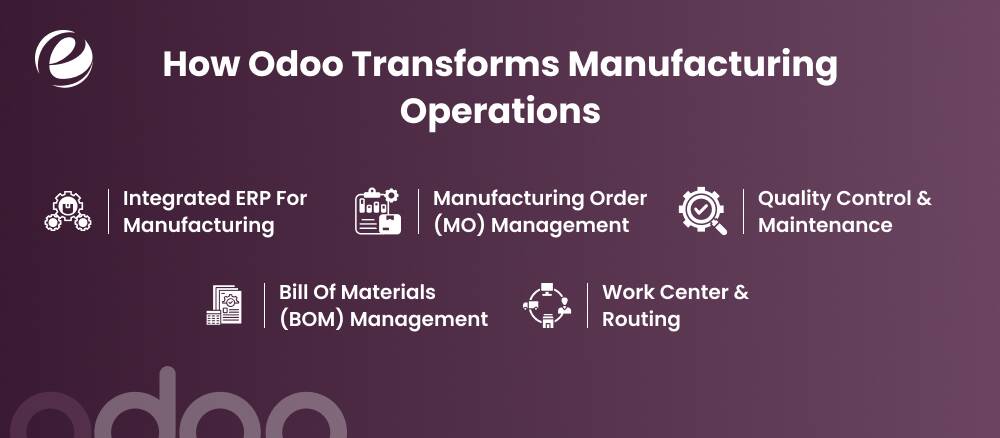
The Odoo MRP system offers manufacturing companies a variety of solutions specifically designed to address these challenges. Below are a few ways Odoo development services for manufacturing helps achieve greater efficiency:
1. Integrated ERP for Manufacturing
Odoo for supply chain empowers companies through centralized management! From work orders to inventories, accounts, and customers, Odoo ERP enables streamlined control of all operations. By using Odoo ERP and its open-source methods, manufacturers can gain the efficiency, flexibility, and transparency needed to drive business growth and success.
2. Bill of Materials (BOM) Management
Odoo’s Bill of Materials (BoM) feature helps companies manage the raw materials, components, and processes required to create every product. Additionally, Odoo provides Product Lifecycle Management (PLM) tools to handle engineering, design changes, and modifications throughout a product’s lifecycle. Manufacturers can define multiple BoMs for the same item to reflect differences in manufacturing methods, materials, or different product versions.
3. Work Center & Routing
Odoo allows for multi-step manufacturing processes through the use of work centers and routings. This advanced technique, compared to a one-step process, enables the creation of more complex manufacturing workflows by establishing work centers, routing, and work order management.
4. Manufacturing Order (MO) Management
When raw materials are verified to be in stock, Odoo automatically notifies the manufacturing team that they can begin production. When the production is finished it transmits an alert to the quality team in order to initiate the quality process. If the item passes inspection it automatically initiates the packaging step.
5. Quality Control & Maintenance
Product quality is of great importance to manufacturers. Odoo’s Quality Control module offers features to help businesses maintain product standards:
- Establish quality control points at different stages of the production process (e.g., raw materials, WIP, or finished products) to ensure consistent quality.
- Automatically perform quality checks based on pre-defined parameters. Quality inspectors can input data directly into the software for real-time monitoring.
- Odoo provides tools for logging non-conformances or defects, allowing businesses to take corrective actions to prevent future issues.
How Odoo is Impacting Supply Chain Management
Odoo Supply Chain is an extremely integrative ERP solution that seamlessly integrates various processes. It ensures unrivaled coordination between different departments. With Odoo supply chain, a company can manage everything from procurement to inventory logistics, customer service, and procurement.
Real-time information monitoring and workflow automation can be achieved with Odoo ERP customization. The scalability and flexibility of Odoo support businesses in multiple ways. Let’s explore different use cases of Odoo in supply chain management.
1. Smart Inventory & Warehouse Management
Odoo warehouse management solutions enable quick tracking of inventory levels and the integration of data from inventory into the procurement and sales departments. This helps prevent both shortages and overstocks.
2. Demand Forecasting & Procurement Automation
Forecasting is one of the popular applications of Odoo in supply chain management. It enables you to analyse historical data and trends to regulate stock levels, helping reduce stock overflow and waste.
3. Multi-location Stock Management
With Odoo, business owners can easily manage stock across multiple locations, including stores, warehouses, and even virtual locations. This ensures accurate inventory tracking and efficient stock transfers.
4. Integration with Vendors & Suppliers
Efficient management of suppliers and vendors is crucial for a smooth supply chain. Odoo enables businesses to monitor and manage their relationships with suppliers through a single system. It tracks vendor performance, order history, and payment terms, allowing companies to maintain strong, reliable partnerships. Odoo also makes it easy to evaluate supplier prices, lead times, and product quality to ensure you’re always working with the best vendors.
What Are The Key Features Of Odoo Manufacturing?
Let’s explore Odoo ERP capabilities and various applications of Odoo in manufacturing sector.
1. Improve Production Workflows with Odoo MRP
Manufacturing Resource Planning (MRP) is essential for companies looking to improve production schedules and resource management. The Odoo MRP module helps small businesses track work orders, organize workers, and manage resources effectively, which increases efficiency and reduces costs.
Through customization with Odoo, small-scale businesses can configure MRP to fit their specific workflows, ensuring seamless production and efficient resource planning. This feature is especially beneficial for startups with limited budgets, as it allows them to optimize resources without additional costs.
Incorporating Odoo’s MRP into WordPress provides customers with real-time insights into production timelines, boosting customer satisfaction and setting high expectations for delivery schedules.
2. Manufacturing Order Management from Start to Finish
Tracking products during the manufacturing process is vital for controlling their lifespan and can help achieve this goal. It also helps in managing the inventory of required items. This tool supports different departments in collaborating effectively. Product Lifecycle Management (PLM) helps companies plan their budgets more efficiently by closely monitoring the lifespan of their products. Additionally, it aids in managing product design modifications. Manufacturing companies find it crucial to track and monitor the duration for which their products are used, so they can plan for potential changes in the future.
Odoo’s PLM module enables you to track various versions and changes to product details. Users can view a history of updates, track different versions, and access previous versions of documents or specifications. This ensures clear documentation of any adjustments to products or services and guarantees that everyone has the most up-to-date information they need.
3. Increase Inventory and Warehouse Effectiveness with Odoo Inventory
Inventory management is a critical element of manufacturing. Odoo for manufacturing provides real-time solutions specifically designed to handle stock-level transactions. Manufacturers can optimize their inventory and eliminate the risk of running out of stock or overstocking raw materials and finished products.
Key features include barcode scanning, automated inventory updates, and the ability to reorder materials or final products as needed and automated production planning, ensuring they are always available when required. Additionally, the smooth flow of goods and materials through the manufacturing chain is facilitated by integrating Odoo’s MRP and purchasing modules.
4. Ensure Quality Compliance with Odoo Quality Management
Controlling quality is crucial for manufacturing companies that want to establish a strong reputation in the market. Odoo’s Quality Management module provides tools to monitor quality inspections and control points, ensuring that every product meets the required quality standards.
Many Odoo development companies offer specialized services that allow you to create custom quality control processes for smaller manufacturing businesses. These customizations help companies maintain the highest standards while reducing product failures, leading to increased customer satisfaction.
For companies with websites based on WordPress, high-quality data from Odoo can be displayed as badges or quality certificates on product pages. This enhances customer confidence and helps build brand credibility.
5. Enhance Sales and Customer Engagement with Odoo CRM
Odoo helps many manufacturing firms meet their targets by attracting new customers. Customers desire top-quality goods, regardless of price. They are often willing to spend more on items that are reliable and high-quality. Numerous examples exist of high-end products that offer excellent quality and sell well.
Odoo supports both improving product quality and keeping prices at a reasonable level. Odoo has a large community of contributors, developers, and users who collaborate on information, resources, and additional features. This active user group ensures that Odoo ERP is regularly updated, with bug fixes and improvements. Additionally, you can access helpful customer support through guides and forums.
6. Enhance Equipment Uptime with Odoo Maintenance
In manufacturing firms with a large amount of equipment and machinery, maintenance management is crucial. It helps keep machines running efficiently and connects equipment maintenance to manufacturing processes. This means you can manage all types of maintenance tasks with strategies that prevent issues or correct them when they arise. Odoo helps businesses manage both in-house maintenance personnel and the work of external contractors.
Odoo allows you to set up schedules for regular maintenance. You can create routines for inspecting and repairing equipment before it fails. Maintenance tasks can be listed, assigned to specific machines, and scheduled based on frequency. This helps prevent unexpected breakdowns, reduces the time equipment is out of service, and extends its lifespan.
7. Streamline Supply Chain & Vendor Management with Odoo Purchase
Odoo ERP for supply chain management offers integrated tools that reduce delays by ensuring components are readily available when needed. Manufacturing can sometimes halt due to delays in receiving raw materials or components. By utilizing Odoo’s Inventory and Purchase modules, companies can automate procurement processes and maintain optimal stock levels.
Odoo automates the reordering of products when stock levels fall below a certain threshold, preventing shortages and ensuring production lines keep running. By streamlining vendor management and monitoring deliveries, Odoo helps ensure materials arrive on time, avoiding unnecessary delays in the production process.
8. Enhance Project Execution and Cost Control with Odoo Project Management
Odoo Project Management helps manufacturers improve project execution and manage expenses by providing simple tools to organize, monitor, and control projects. It allows you to set specific goals, assign tasks, and track project progress in real-time. Odoo ensures projects stay on track by monitoring expenditures, managing resources, and preventing delays. It also makes it easy to view project timelines, budgets, and milestones, helping you stay focused on your goals.
Odoo in supply chain sector also allows you to manage multiple projects simultaneously, ensuring seamless coordination and reducing the chance of errors. Odoo’s automated features reduce manual labor, making processes more efficient. In addition to streamlining operations and improving decision-making, Odoo helps manufacturing firms reduce costs, minimize waste, and complete projects within budget.
9. Increase Product Quality and Traceability with Odoo
Every business aims to offer higher-quality products and satisfy its customers. This is where Odoo’s Quality Management module comes in. Integrated with Odoo’s manufacturing system, it helps monitor product quality and ensures compliance with set standards. It establishes quality benchmarks and alerts you to any issues. This gives customers confidence, knowing they are receiving reliable, top-quality products.
Odoo’s quality feature also allows you to track the performance of your team in maintaining quality standards. Offering durable, reliable products helps you build an excellent reputation, which can lead to higher sales. Poor-quality products don’t last long on the market. If you’ve ever bought a low-quality item, you’re unlikely to return to that business in the future.
Quality control and traceability are crucial in the production process. Odoo provides strong quality controls, enabling companies to set quality specifications, perform checks, and trace a product’s history through every step of the supply chain.
Benefits Of Using Odoo ERP For Manufacturing Businesses
Odoo ERP helps improve processes in manufacturing companies, resulting in lower costs and increased efficiency. Below is a brief list of the benefits of incorporating Odoo for manufacturing, along with some amazing use cases of Odoo in manufacturing.
1. Reduced Production Downtime
Odoo ERP helps reduce production downtime by monitoring the entire manufacturing process in real time. It detects delays or machine malfunctions, allowing companies to address problems quickly.
By automating processes, improving scheduling, and providing real-time insights, Odoo minimizes downtime, ensuring the production process runs smoothly. This increases productivity and helps you meet deadlines more effectively.
2. Improved Demand Forecasting
With Odoo ERP, manufacturing companies can accurately predict the demand for their products. The software uses historical sales data, market trends, and production schedules to create forecasts. This allows companies to adjust production schedules accordingly, avoiding overproduction or stockouts. By improving demand forecasting, companies can better align production with market needs, enhancing efficiency while lowering costs.
3. Enhanced Quality Control and Traceability
Odoo helps manufacturers improve quality control by allowing them to monitor each stage of the manufacturing process. It ensures that products meet required standards and reduces the risk of defects reaching customers. Through its quality management features, companies can closely observe the production process to ensure high product quality and customer satisfaction.
4. Lower Operational Costs
By streamlining processes and automating repetitive tasks, Odoo ERP helps businesses reduce operational expenses. It eliminates manual procedures, reduces error-prone processes, and allows for better resource allocation.
With Odoo for manufacturing, businesses can track costs, manage inventory, and improve production efficiency, leading to significant savings. Additionally, Odoo provides insights to identify cost-saving opportunities, helping businesses run more efficiently and cut overhead expenses.
5. Faster Order Fulfillment
Odoo for manufacturing improves order fulfillment by automating workflows and providing real-time information. Businesses can very easily track orders from receipt to delivery, ensuring timely processing and shipment.
Odoo helps optimize inventory, reduces the time needed to process orders, and enhances communication between departments. This allows businesses to meet customer expectations for fast service, resulting in higher satisfaction and an increased rate of repeat business.
Why Choose Odoo For Manufacturing Over Other ERP Platforms?
In this section, we will discuss the comparison between Odoo ERP, Zoho ERP, and Salesforce ERP. It highlights the reasons why Odoo ERP is the best option for manufacturing companies.
| Feature | Odoo ERP | Zoho ERP | Salesforce ERP |
| Pricing | Affordable pricing with clear structure. | Mid-range pricing with modular options. | It offers expensive pricing with premium features. |
| Customization | Highly flexible and customizable | Offers limited customization options | Offers limited customization options |
| Modules & Features | Extensive features, tailored for manufacturing | General business features for various industries | Primarily focused on CRM features |
| Ease of Use | User-friendly interface with modular design | Simple interface, but limited features | Complex interface with steep learning curve |
| Scalability | Scalable for small to large businesses | Ideal for small businesses only | Best suited for large enterprises |
| Manufacturing & MRP | Odoo offers advanced MRP with automation | Zoho provides basic MRP tools | Salesforce has limited manufacturing features |
| Inventory Management | Uses AI for tracking, automated restocking | Has limited inventory management features | Requires third-party add-ons for inventory |
| E-commerce Integration | Odoo seamlessly integrates with Odoo eCommerce | Zoho offers basic e-commerce integration | Salesforce has strong but expensive integration |
| AI & Automation | Provides AI-driven analytics and forecasting | It has limited AI capabilities | Offers advanced AI, but costly |
| Third-Party Integrations | Offers a wide range of integrations | Provides limited third-party integrations | Offers extensive, complex integrations |
| Community & Support | Has a strong open-source community and enterprise support | Provides limited support options | Offers premium support at a high cost |
| Mobile Accessibility | Provides mobile-friendly apps for easy access | Offers basic mobile apps | Provides robust mobile apps for users |
| Cloud & On-Premise Options | Offers both cloud and on-premise options | Available as cloud-only solution | Available as cloud-only solution |
| Accounting & Finance | Features a fully integrated accounting module | Offers basic accounting tools | Requires additional integrations for accounting |
| HR & Payroll | Includes built-in HR and payroll management | Provides basic HR tools | Requires additional add-ons for HR and payroll |
How To Implement Odoo ERP in Manufacturing – Step-by-Step Process
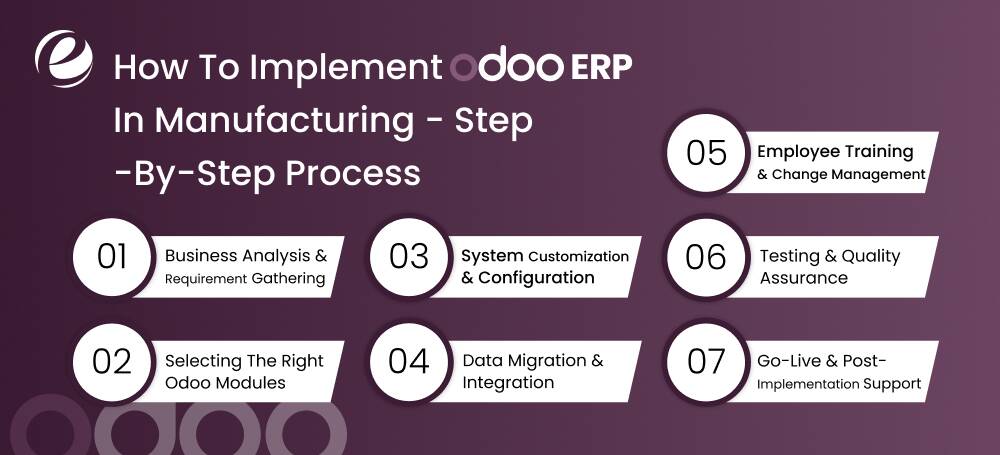
If you’ve decided to utilize Odoo to run your manufacturing company, it’s essential to take note of the following points for an efficient and timely Odoo implementation. Steps to take for success in Odoo for manufacturing implementation include:
#Step1. Business Analysis & Requirement Gathering
Before you begin the process of implementation first, you must understand the reason you should have the ERP system as well as what you hope to accomplish. Establish the goals that you’re hoping to achieve using Odoo ERP. These include increasing the efficiency of inventory management, improving the customer relations management (CRM) or improving the efficiency of financial procedures.
Collaborate with departments across the organization in order to collect detailed needs. This involves understanding your current challenges, the desirable features and the specific functions required by each department. Create clear, quantifiable objectives which are in line with your company’s targets. This can help you evaluate the performance of your ERP implementation.
#Step2. Selecting The Right Odoo Modules
When choosing the right Odoo modules, think about what your business needs. Odoo has different modules for things like accounting, inventory, sales, and human resources (HR). You need to pick the ones that match your business processes.
For example, if you need help managing customer relationships, you might choose the CRM module. Take your time to look at all the options and choose the ones that will help your business run more smoothly and efficiently.
#Step3. System Customization & Configuration
Odoo’s flexibility lets you set up and modify Odoo to meet the needs of your particular situation:
The Basic Configuration: Beginning with initial configuration, including the company’s data, information about users and their roles. Then, you can set the basic configuration for every module.
Module Select: Choose the modules that are in line with your business procedures, like accounting, inventory, sales HR, CRM and so on.
Modification: Make the modules customizable according to your needs. This could mean changing workflows, including customized fields or innovative functions.
#Step4. Data Migration & Integration
Integration and migration of data is a crucial step in ERP integration. Convert your existing data into Odoo fields and ensure accuracy and cleanliness. Eliminate duplicates, correct mistakes and standardize the data formats. Transfer data from different systems to Odoo by using the proper software. Check everything thoroughly prior to finalizing the transfer to ensure that everything runs smoothly.
#Step5. Employee Training & Change Management
Adoption by users is essential to the effectiveness of ERP software. Design comprehensive training courses that cater to the different roles of users. Offer hands-on sessions for training as well as user guides and online tools. Create a change management program to overcome resistance and guarantee an easy change. Inform people about the benefits of Odoo for Manufacturing as well as offer ongoing assistance.
#Step6. Testing & Quality Assurance
Testing thoroughly is crucial in identifying and resolving problems before making the transition to live. Check the functionality of each module and its individual components to make sure they function exactly as you expect.
Check the compatibility between modules as well as third-party systems for seamless data flow. Participate in the testing of end users’ software to verify the system meets their needs and is able to perform well in real-world situations.
#Step7. Go-Live & Post-Implementation Support
After testing has been completed and you’re confident about the stability of your system, it’s now time to make the system live. Once the system has been live, conduct a post-implementation evaluation to review its performance and find points for improvements. Continuous improvement is the best way to improve the efficiency of your process and ensure that it grows to meet the needs of your company.
How Much Does It Cost To Implement Odoo ERP In The Manufacturing Industry?
The total cost of implementing Odoo ERP is not a fixed figure; it depends on variables such as the size of the deployment, customization, and the use of specialized Odoo Development Services. In general, the cost of an Odoo implementation can start at around $1,000. Successful implementations in Odoo in manufacturing sector are not just about software installation but also include Odoo consultancy services, customized training, and support. Each of these factors impacts the final cost.
1. Odoo Community Edition
Odoo Community Edition is a no-cost version of the software that comes with basic functions. It’s perfect for small enterprises that don’t need extensive modifications. Even though you pay nothing to purchase the program, you could retain costs associated with implementation as well as training and help, based upon your requirements. The development process will be customized to add additional cost.
2. Odoo Enterprise Edition
Odoo Enterprise Edition offers additional capabilities and support that is premium which makes it ideal for large businesses as well as those that require the most advanced capabilities. Costs include a per-user fee that is based on quantity of users, expenses for installation and customizing of training and assistance. It’s typically more costly over that of the Community Edition but provides more flexibility and capacity.
3. Customization & Development Costs
The simplest customizations start at around $5,000, while more complex custom development can range from $10,000 to $50,000, depending on the scope. Working with an Odoo software development company specialized in custom solutions will ensure you receive a tailor-made feature set that aligns with your business needs.
4. Implementation & Consultation Fees
Many companies hire Odoo ERP consultants to ensure the smoothest and most efficient implementation. Consultancy fees range from $2,000 to $10,000, depending on the scope of the project and the expertise required.
5. Ongoing Maintenance & Support
Annual support fees for Odoo Enterprise are typically around 15% of the total software costs. Maintenance and custom development fees can vary, with regular support costs ranging from $800 to $10,000 per year, depending on the terms of the service agreement.

How EmizenTech Can Help You Implement Odoo ERP for your Manufacturing Business?
Odoo for Manufacturing offers a comprehensive range of capabilities that can transform your manufacturing processes, improve decision-making, and boost business growth. If you are looking for the best ERP implementation company, partnering with EmizenTech, a well-established and experienced ERP implementation company will be a key factor in the overall success of your ERP initiative.
The greatest thing about our Odoo setups is that they perform well practically every time right from the start. As a leader in our field, with a commitment to quality and a customer-centric focus, we are prepared to help you harness the full power of Odoo ERP, driving productivity and growth in your business. Call EmizenTech today to begin your ERP journey and maximize the potential of your manufacturing management.
Conclusion
Odoo is an ERP software designed for manufacturing firms. It’s cost-effective, adaptable, and offers a wide range of features for managing production, product design, and quality assurance. Furthermore, Odoo helps manufacturers improve efficiency and scale their businesses. Choosing Odoo to manage manufacturing ERP can be an effective decision that will pay off in the long term for businesses of all sizes.
Odoo provides businesses with a flexible and comprehensive ERP solution that offers a variety of features for personalization, flexibility, and scalability. Additionally, with a large number of experts available to assist with real-time reporting and easy integration with other systems, Odoo helps companies operate more efficiently, increase productivity, and achieve greater success.
The best Odoo development company can provide the expertise needed for custom Odoo development services, as well as offshore development. We can help you develop a solution that not only reduces repair time but also boosts productivity. By embracing the power of Odoo, manufacturing companies can secure their future and stay ahead of the competition in an ever-evolving market.
Frequently Asked Questions
What are the Top Use Cases of Odoo ERP in Manufacturing?
Odoo ERP helps manufacturers manage their production and supply chain, inventory, and quality management. It tracks manufacturing schedules, raw materials, and delivery timelines. It also provides insights into efficiency and reduces waste, making processes more effective and cost-efficient.
What is the timeline for implementing Odoo ERP in a manufacturing business?
The normal timeframe to install Odoo ERP for manufacturing could range from a few weeks up to a few months. It is contingent on how big the business as well as the level of complexity as well as the amount of customisation required. In general, this requires planning, configuration training and testing.
How can Odoo ERP help businesses optimize manufacturing costs and improve profitability?
From purchasing to shipping, Odoo ERP ensures seamless collaboration between manufacturers, suppliers and distributors. The software also monitors expenses and tasks that are automated, allowing firms to cut down on energy and time, leading to higher profits and improved decisions.
Do you think that Odoo ERP will be integrated with equipment and other systems for business?
Odoo brings together various business processes in a single system removing the necessity for numerous disconnected apps. Furthermore, it is able to be integrated with third-party apps as well as older software, offering an all-in-one solution to the business requirements.
What kind of support is needed from an Odoo Consultant after the system is implemented?
After Odoo ERP has been implemented, the Odoo consultant will provide ongoing support in the form of system updates, troubleshooting, and customization. They ensure the system runs smoothly, assist with any issues, and offer additional help or training if business growth is anticipated.



 +1 (989) 535-9295
 info@emizentech.com
 emizentech


