
 Add us as a preferred source on Google
Choosing the perfect ERP system for your business may be perplexing with so many choices. Odoo vs ERPNext are two of the popular open-source ERP solutions, each of which offers unique tools for businesses to operate smarter, grow faster, and stay organized.
So how do you choose the right one for you? Maybe you want easy to use, affordable, or really well-featured. Perhaps you want something that will grow with your company and provide a full offering of sales, inventory, accounting, and HR.
In this detailed guide we’ll take a look at the strengths, differences, and practical benefits of Odoo vs ERPNext in a very easy-to-understand language. By the end of this blog, you will know exactly which ERP solution fits into your business targets, allowing you to make an intelligent and confident choice for the future.
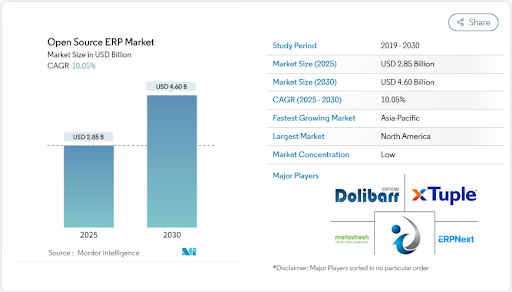
Open Source ERP Market (Including Odoo and ERPNext)
- The Odoo customisation market and services are forecasted to grow from $1.3 billion in 2024 to $3.1 billion by 2030, at a 14.2% CAGR.
- Asia-Pacific and North America are being considered for the highest growth rates of CAGRs of 16.7% and 13.5%.
- As per the Store Leads report, by the end Q2 2025 would have recorded 109,000-plus live Odoo stores, with the increasing number of active Odoo-based online businesses clocking an outstanding growth of 59%.
- Odoo is a key player behind the rise of the open-source ERP market as a whole.
- According to Mordor Intelligence, the Open Source ERP market would be estimated at a value of around $2.85 billion by 2025, reaching $4.60 billion by 2030, growing at a CAGR of 10.05%.
- Odoo accounts for the major part of this market growth, while ERPNext appears to be the alternative for SME size businesses.
Understanding Odoo and ERPNext
About Odoo
Odoo is a new-age, open-source ERP software made to help businesses in managing their core functions in one place. Several business apps, including sales, inventory, accounting, HR, and CRM, work well together.
Odoo stands out due to its user-friendly interface, modular structure, and flexibility that allows companies to select only those features they want and extend as they grow, if need be. With options of cloud-based and on-premise, the Odoo solution presents a good value for money for startups and large enterprises.
The large open-source community helps in continuous updates and options for customizations, while very strong analytics and alternative data integration pave the way for informed choice.
Key Highlights of Odoo:
- Open-source and highly customizable
- Modern, easy-to-use interface
- Modular design with many business apps
- Strong analytics and reporting tools
- Cloud or on-premise deployment
- Affordable for small and mid-sized businesses
About ERPNext
ERPNext is ideally the open source ERP system of choice to automate and smoothen business processes for different industries. Important functions are unified into one system: accounting, inventory, CRM, HR, projects, manufacturing, and e-commerce.
ERPNext is designed for a clean UI that assists employees with task management and information retrieval. It is very flexible, reasonable, and scalable to small-and-medium businesses. Being based on the Frappe framework, companies can customize features as per their requirements and benefit from community improvements.
Key Highlights of ERPNext:
- Open-source, web-based ERP systems
- Combines all business operations in one place
- Simple, user-friendly design
- Excellent for accounting, inventory, HR, and manufacturing
- Built-in website and ecommerce tools
- Cost-effective and highly configurable for different industries
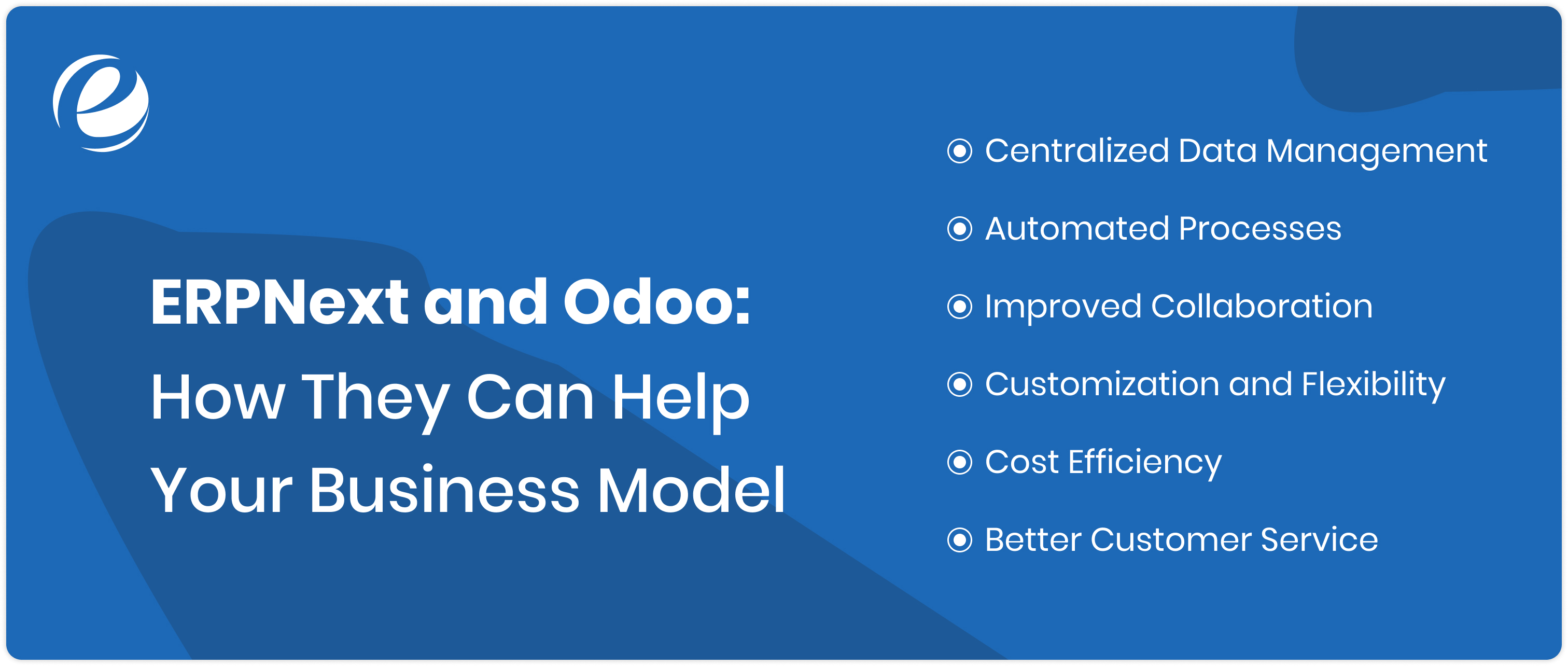
ERPNext and Odoo: How They Can Help Your Business Model
ERPNext and Odoo are two excellent software that can make the daily operations of a company more efficient and speed up its business. These digital platforms have the capability of implementing all of your company’s core activities, such as sales, accounting, inventory, and staff management, into one system.
This not only keeps your team up to date but also facilitates good decision-making and saves time, as it eradicates some steps that require manual input.
Regardless of whether you have a little store or a company that is expanding, you will surely benefit from using ERPNext or ODOO, as this will transform the management of your business into a system that is easy, efficient, and profitable.
1. Centralized Data Management
In both systems, the data of the company is kept in one central repository and this in turn makes it a task that is easier to check on the performance and at the same time prevent errors.
2. Automated Processes
They are using the systems to carry out tasks like invoicing, inventory updates, and reporting, thus saving time for their team and at the same time, so that they may make fewer mistakes.
3. Improved Collaboration
Instant information sharing among teams is possible and they can work together more effectively in this way. This will lead to the implementation of the decisions at the earliest as well as the solving of the problems in the quickest way.
4. Customization and Flexibility
You have the liberty of creating the scenarios for these two platforms to be perfect for your business, adding new features as your business grows or adjusting workflows to conform to your working technique.
5. Cost Efficiency
The use of ERP reduces the cost of labour as well as creates a more efficient workflow pattern, accordingly which has the potential of increasing productivity. This is a great financial advantage, particularly for small and medium-sized businesses.
6. Better Customer Service
Moreover, you have the advantage of complete CRM and communication tools that allow you to be up to date with each customer’s point of contact, making it easier for you to provide them with the best service.
The adoption of ERPNext or Odoo will empower businesses to not only update their operations, but also react to new situations more promptly, and nurture a stronger base for future success.
Difference Between Odoo vs ERPNext – Detailed Comparison
Choosing the right ERP for your business can sometimes become a little challenging. However, both are open-source ERP platforms, aimed at optimizing business processes and increasing productivity. As such, each system has its unique strengths that cater to particular types of businesses and their differing patterns of operations.
1. Customization & Flexibility
Odoo: Very adaptable due to its modular architecture, whereby a company selects and installs only those applications it requires. It can be customized further, with great support from Odoo Studio and thousands of third-party applications. Best suited for companies that have unusual or very complex workflows.
ERPNext: This gives some form of customization but depends on simplicity and common modules in its design. The business opts for smoothing its processes rather than engaging in highly technical alterations.
2. User Experience & Simplicity
Odoo: As it has a lot of features, it is said that Odoo has a modern UI but requires some training and acquisition of skills in order to explore all its potential functionalities. Therefore, end users are required to undergo a little bit of training.
ERPNext: Intuitive and simple interfaces are priorities of EnterpriseNext, with the goal of enabling users to get started at ease without much learning curve, making it ideal for small organizations.
3. Scalability & Business Size
Odoo: It can function effectively in both small startups and big enterprises. Due to its wide range of modules and compatibility with other software, it can accommodate even those companies which aim to have substantial growth in the future.
ERPNext: The primary focus of the software is to serve the SMB market. The software is less likely to smoothly scale up as it is built to handle straightforward business functions and has certain restrictions in proceduralized ones as they become complex.
4. Integration Capabilities
Odoo: The company has been able to prove that their software will enable users to integrate their app with a long list of different apps including their own and various third-party platforms like ERP integration with Salesforce, Google, Amazon, eBay, and many more. The REST API and Zapier integrations also provide numerous other ways in which businesses can connect.
ERPNext: The software is capable of integrating with commonly used platforms such as Google, Shopify, PayPal, and Slack, but is still restricted, as compared to Odoo, which has an active marketplace and more external integrations.
5. Cost & Licensing
Odoo: Odoo is available as an open-source version of the community edition, and there is an enterprise version that is paid. Any cost will go up with the number of users, and the purchase of apps will be based on the sales growth of the company.
ERPNext: ERPNext is 100% open-source and free to use, with only the extra cost of hosting or support in any particular area. It is very budget-friendly, especially for smaller teams.
6. Community Support and Ecosystem
Odoo: The global partner network, vibrant developer community, and vast marketplace make it easy for businesses to find support and upgrades without hassle.
ERPNext: Limited community and support network; the developers are focusing more on the features of the product than the addons.
These fundamental distinctions allow enterprises to find out which ERP, Odoo or ERPNext, is suitable for their size, intricacy needs, budget, and long-term operational objectives.
Pros and Cons of Odoo vs ERPNext
If you are required to choose between Odoo vs ERPNext, which one is better and suits your business? It would be a good point to make a comparison analysis that highlights the main advantages and disadvantages of each solution. Both systems incorporate the most demanding users’ requirements at the least cost, as they are open source ERP solutions.
However, they are two very different products, and it depends on the specifics of your company and the way you conduct your business, which one will turn out to be the better solution.
Odoo: Pros and Cons
Pros
- Highly Customizable: Being built from modules means you can just pick the ones that are suitable for your business and then just alter them to be even more suitable without having to change the whole ERP system.
- Wide Integration Options: It is compatible with a wide variety of third-party applications and platforms, including those of e-commerce and CRM, as well as SEO tools for websites.
- Modern Interface: It provides a very modern and cutting-edge design, which is liked by users who are used to the newest technologies.
- Active Community Support: It is supported by a global network that is involved in development work, provides other resources, and also deals with the problems of the users.
Cons
- Can Be Costly: Although there is an Odoo free version, using some of the modules and adding more users can increase the cost of your solution as well.
- Complex for Beginners: Due to the variety of features, a novice is going to need some training before he/she will be able to use the whole system.
- App Overlap: For instance, there can be more than one module inside your ERP system which has similar functionalities and thus might confuse users or make the processes more complex.
ERPNext: Pros and Cons
Pros
- Simple and Intuitive: The product has been made with easy use in mind; thus, it is good for small businesses and less experienced users.
- Cost-Effective: 100% open-source and zero-cost, with just a small amount of money for hosting or support.
- Efficient Core Modules: Delivers strong performance in essential functions like accounting, HR, and inventory.
- Quick Setup: A more efficient design results in quicker use and a smoother introduction process.
Cons
- Limited Advanced Features: This software may have fewer features and fewer customization options for integrations than Odoo, thus limiting larger companies’ expansion possibilities.
- Smaller Community: There are fewer developers and add-ons than Odoo, so there is also less external support.
- Scalability Challenges: This software is aimed mostly at small and medium businesses; therefore, if the business needs are advanced or large-scale, it might require some additional work or investments.
Both Odoo and ERPNext are attainable choices for contemporary businesses; however, the correct decision is contingent on the particular aims of your enterprise, its size, budget, and its requirement for customization.
How to Choose Between Odoo and ERPNext?
The selection of a suitable ERP system is the basis of long-term business success. Both Odoo and ERPNext are in the race; however, the winning squad is the one that best meets your company’s individual needs, budget, and future plans. By figuring out the key decision factors, you can get an ERP that aligns with your objectives and furthers your growth.
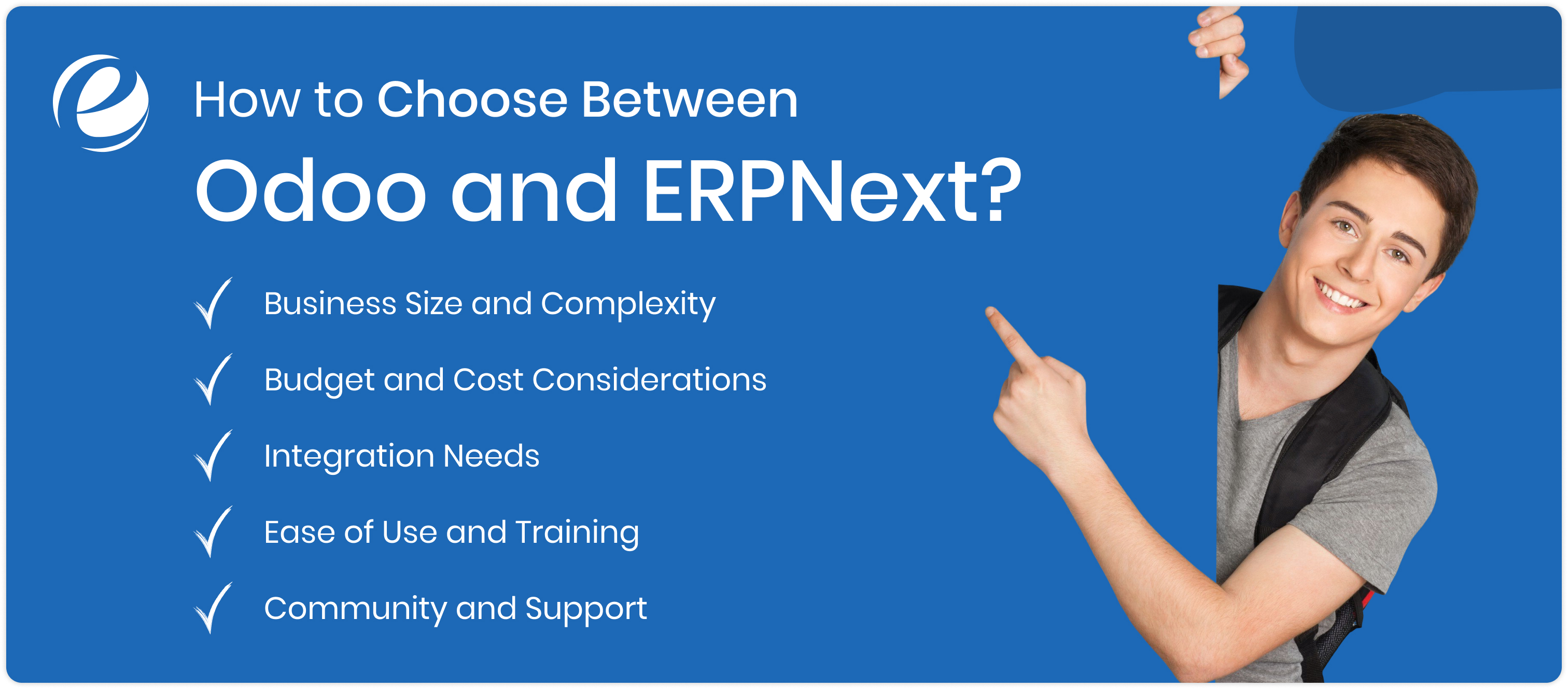
1. Business Size and Complexity
In case your company is big or has complicated processes, Odoo’s modular organization and detailed tailoring might be perfect. In contrast, small businesses with relatively simple requirements of operations may find that the easy-going philosophy of ERPNext works for them as well.
2. Budget and Cost Considerations
Powerful features are available in Odoo, but the costs might rise with premium modules and user licenses. On the other hand, ERPNext offers a free, open-source platform, thus is very cost-efficient for startups and small businesses.
3. Integration Needs
Companies that require thorough eCommerce ERP integration, CRM, or other apps will find Odoo’s multiple compatibilities useful. On the other hand, ERPNext catering to essential integrations is best for companies which have less complicated requirements.
4. Ease of Use and Training
With a limited technical background, a team would find ERPNext with its easy user interface and rapid setup as a time saver for training. Although Odoo’s more diversified feature set may require more initial training, it still offers more flexibility and options as your business grows.
5. Community and Support
Odoo has a vast community worldwide from which they can fetch various resources to fix bugs and get new improvements. ERPNext still has a smaller community, but the product is not only reliable but also thoroughly documented.
By thoroughly comparing these points, you can pick an ERP system that best fits your business objectives and helps your business to run efficiently and grow further.
Final Words
When choosing an ERP system, each step in the chain builds upon the foundation of efficiency and increase in company operations. Odoo and ERPNext are strong competitors, but with different strengths. Odoo ERP Integration is for companies that want a highly customized set of applications with which to integrate many others and be highly scalable.
On the other hand, ERPNext is the choice for companies who want simplicity and quick deployment. Consider your business size, budget, integration needs, and end-user capabilities, and you will be well-versed in deciding which stands best between those two. Both systems will help in reducing your operations and enforcing process automation along with workforce collaboration so as to make management easier and more productive.
Ultimately, whether you choose between Odoo or ERPNext, investment in a good ERP system will put your company in a strong position to compete, grow, and prosper in today’s fast-paced market.

FAQs
What is the main difference between Odoo vs ERPNext?
Well, Odoo is a customizable and modular platform with great third-party integrations for businesses with very complex needs, and ERPNext aims for ease and simplicity and is for small and medium businesses seeking fairly simple ERP solutions.
Which ERP is easier for beginners?
With its simple front-user-interface and easy set-up, ERPNext would work well with teams that have limited technical skills. Odoo would demand a lot of training to get one started because of the numerous features.
Can Odoo or ERPNext handle ecommerce?
While Odoo and ERPNext provide different functionalities to support ecommerce, Odoo offers many more integrations with popular ecommerce packages and thus, gives greater freedom to online sellers who want their stores linked to an ERP.
Which ERP is better for large companies?
Odoo is generally better and suited for larger companies because of its scalability, along with the handling of complex workflows and extensive customizations. ERPNext, meanwhile, subjectively considered powerful, is mainly suited to small or medium enterprises.
What kind of support is available for these ERPs?
Odoo has a huge global community and official partners. Alongside all this is a marketplace where professional support and add-ons might be bought. ERPNext boasts an active open-source community, along with ample documentation and forums. There is also paid support if needed.



 +1 (989) 535-9295
 info@emizentech.com
 emizentech


