 Add us as a preferred source on Google
Your dinner now arrives in 25 minutes and your groceries in 15 minutes! In fact, you can even get medicine at your doorstep in an hour. In 2026, the best on-demand delivery platforms that were once unimaginable are now the baseline expectation. And it’s transforming how millions of people go about their everyday needs.
Grand View Research highlights that the global online food delivery market alone surpassed $380 billion in 2024 and is expected to reach $618.36 billion by 2030. If we add grocery delivery, quick commerce, and logistics services to this, the total addressable market is much larger. One thing is clear: the stakes have never been higher for entrepreneurs, businesses, and logistics companies. However, the most important thing is choosing the right platform that combines speed and affordability. To help you find the best in the lot, we have curated this guide that walks you through the 10 most influential on-demand delivery platforms in 2026, dissecting their features, pricing models, and what makes them work.
Even if you’re building your own solution or integrating with existing players, understanding this landscape is non-negotiable.
What Are On-Demand Delivery Platforms and How Do They Work?
On-demand delivery platforms are digital platforms that connect customers, merchants, and service providers in real time. They are increasingly becoming a comfortable replacement for traditional logistics, where you wait days for delivery. These platforms promise and often deliver within hours, if not minutes. The model is simple on the surface but extraordinarily complex underneath.
Here’s how they work:
- A customer opens an app and selects what they want (food, groceries, parcels, medicine)
- They enter their location
- Within seconds, the platform’s algorithm matches them with the nearest available service provider
Real-time tracking, secure payments, and instant communication are the common features among top on-demand delivery apps. These platforms charge a commission, the service provider gets paid, and the customer gets their order.
Different Types of On-Demand Delivery Platforms You Should Know
The on-demand delivery space fragments into distinct models, each solving different problems:
- Food Delivery Platforms: Heard of DoorDash, Uber Eats, or Grubhub? These are the food delivery platforms that aggregate restaurants and deliver prepared meals. They’re the most visible and most saturated segment of the market.
- Grocery and Retail Delivery: This type of on-demand platform handles perishable goods and everyday necessities, requiring specialized cold-chain logistics. Shipt and Amazon Fresh are the prime examples of such platforms.
- Hyperlocal Quick-Commerce: Gaining immense popularity, these platforms offer 5-to-30-minute delivery of snacks, drinks, and essentials from micro-fulfillment centers.
- Medicine and Pharmacy: These apps are critical for time-sensitive healthcare needs, operating under strict regulatory constraints.
- Parcel and Logistics: These are B2B focused, moving packages and commercial goods at scale.
Note that each one of these models requires different unit economics, last-mile strategies, and regulatory compliance.
Market Opportunity: The Numbers That Matter
The global on-demand delivery software market is projected to reach $632.39 million in 2026 and hit $1.39 billion by 2035, growing at a 9% CAGR. More granularly, the broader on-demand delivery market (including platforms, not just software) was valued at $70.32 billion in 2023 and is expected to reach $225.33 billion by 2030 at 18.1% CAGR.
That’s not all. 75% of urban customers rely on delivery solutions for groceries, essentials, and other logistics.
To put this in perspective: every single day, over 4 billion delivery orders are processed globally through digital platforms.
Top 10 On-Demand Delivery Platforms in 2026

Here are the best on-demand delivery platforms in 2026 that have made a mark on millions of users’ daily lives:
DoorDash
The largest food delivery platform in America, DoorDash, works pretty straightforwardly. It is where restaurants list their menus on the app, and customers order food for home delivery. The app handles the logistics while restaurants prepare orders, connecting millions of customers to restaurants nationwide. It is a default choice for food delivery in most markets.
Key Points:
- Used by most restaurants across the USA
- Customers can order from thousands of restaurants in their area
- Delivery within 30-45 minutes
Uber Eats
Uber Eats is another of the best on-demand platforms that works similarly to DoorDash. However, it uses Uber’s existing driver network for deliveries. The platform has moved beyond restaurants. It now has grocery stores, pharmacies, and convenience items. This diversification addresses the reality that food-only delivery cannot sustain profitable margins.
Key Points:
- Faster delivery in cities where Uber has dense driver coverage
- Accessible in major cities and smaller markets
- Also has grocery, pharmacy, and retail items
- Integrated with Uber’s loyalty program
Instacart
Instacart lets you order groceries online and receive delivery the same day. It doesn’t own warehouses; instead, independent shoppers search for partner grocery stores (Whole Foods, Safeway, and Kroger) and get items directly delivered to their homes. This delivery model enables the app to operate nationwide and also makes it one of the most popular on-demand delivery platforms in 2026.
Key Points:
- Dominates the grocery delivery market with an 80% share
- Works with 700+ grocery retailers nationwide
- Same-day delivery available
- Healthier profit margins than food delivery
Gopuff
Gopuff is a quick-commerce platform where customers get snacks, drinks, and essentials in just 15-30 minutes. It owns small neighborhood warehouses stocked with high-demand items. The delivery model competes directly with convenience stores by offering faster service and home delivery.
Key Points:
- Delivers groceries, snacks, and household items
- 15-30 minute delivery window
- Operating in over 1,000 U.S. cities
- A more profitable model than food delivery
Grubhub
A food delivery platform, Grubhub, has a stronghold in the Northeast and Midwest. While DoorDash dominates across the country, Grubhub enjoys great partnerships with restaurants in specific regions. It works as a solid alternative in areas where it has established merchant networks.
Key Points:
- Strong coverage in the Northeast and Midwest
- Serves 140,000+ restaurants
- Regional specialist approach
- Competitive fees for restaurant partners
Amazon Fresh
Amazon Fresh is another name among the best on-demand delivery platforms that offers free delivery of groceries and essentials for Prime members. A part of Amazon’s broader ecosystem strategy, it provides same-day delivery that is available in select major metropolitan areas. The primary advantage of this platform is the inclusion of grocery delivery within an existing Prime membership.
Key Points:
- Free delivery for Prime members ($149/year membership)
- Available in major metros only
- Same-day delivery
Shipt
Owned by Target, Shipt operates a grocery delivery service that is similar to Instacart’s model. The platform employs independent shoppers who choose groceries from partner stores and deliver them same-day. Its strong integration with Target especially unlocks advantages in regions with high Target presence.
Key Points:
- Same-day grocery delivery nationwide
- Works with 700+ grocery retailers
- Independent shopper model
- Membership-based pricing
GETIR
Getir is primarily a Turkish quick-commerce platform that is now reaching U.S. customers aggressively. The platform offers 10-minute delivery of groceries, snacks, and household essentials from small neighborhood warehouses. It competes directly against Gopuff with the same business model. However, it has different regional strengths.
Key Points:
- Fastest delivery guarantee (10 minutes)
- Expanding across major U.S. cities
- Focuses on speed as the primary differentiator
WAITR
A regional food delivery platform, Waitr caters in the Southeast and Midwest, particularly to those living in smaller cities and towns. Since DoorDash’s focus is mainly on metropolitan areas, it leaves a gap in secondary markets. Waitr fills this gap by providing restaurant delivery in underserved geographies where larger platforms have less incentive to operate.
Key Points:
- Regional coverage in the Southeast and the Midwest
- Supports restaurants in smaller towns
- Lower commission rates than national platforms
- Operates in areas where DoorDash has minimal presence
Postmates (UBER)
Postmates was originally an independent delivery app but was acquired by Uber in 2020. The platform has been largely integrated into Uber Eats, with Postmates functioning as a secondary brand in select markets. It operates as part of the Uber Eats ecosystem for most purposes.
Key Points:
- Acquired by Uber; separate branding in some regions
- Transitioning to full Uber Eats integration
- West Coast presence maintained from original customer base
- Functionality increasingly identical to Uber Eats
Comparison Table of Top On-Demand Delivery Platforms
| Platform | Category | Coverage | Delivery Time | Best For |
| DoorDash | Food | National | 30-45 min | Restaurants nationwide |
| Uber Eats | Food & Multi | Major cities | 30-45 min | Urban restaurants & grocers |
| Instacart | Grocery | Nationwide | Same-day | Grocery stores & retailers |
| Gopuff | Quick-Commerce | 1,000+ cities | 15-30 min | Snacks & convenience brands |
| Grubhub | Food | Northeast/Midwest | 30-45 min | Regional restaurants |
| Amazon Fresh | Grocery | Major metros | Same-day | Prime members |
| Shipt | Grocery | Nationwide | Same-day | Grocery & Target partners |
| Getir | Quick-Commerce | Major metros | 10 min | Speed-focused delivery |
| Waitr | Food | Southeast/Midwest | 30-45 min | Small-town restaurants |
| Postmates | Multi | Regional | 30-45 min | Legacy West Coast users |
How to Choose the Best On-Demand Delivery Platform Model?
To choose the best on-demand delivery platform, you must first define your business model and geography.
Coverage Area
Urban density matters more than you might assume. Platforms like DoorDash and Uber Eats are available everywhere, but there are platforms that are neighborhood-specific. If you’re outside major metros, check availability first.
Commission Rate Structure
Food delivery apps charge 15-30% commission (thanks to high logistics costs), while grocery/retail apps have 5-10% commission (longer shelf life and higher order value). In the case of quick-commerce, the bar stays around 10-15% (pre-stocked inventory). So, match your margin tolerance to category economics.
Customer Price Sensitivity
While affluent markets accept premiums ($9.99/mo subscriptions), emerging markets play on the cost factor, primarily for smooth customer acquisition. The rule is simple: your platform choice for any mobile app development must align with customer willingness-to-pay in your region.
Service Frequency
Food delivery apps typically have 3+ weekly orders per user (high CAC justified) and grocery, 4-8 monthly (focus on retention). For quick commerce, the frequency lowers and varies largely by individual habit. Choose a model that matches your repeat-order expectations.
Integration Standard
Well, this is where things get serious. Mature platforms invest in standardized APIs, backward compatibility, and support teams. Emerging platforms tend toward custom development, rapid changes, and low maintenance overhead. Your lesson? Calculate ongoing engineering costs, not just the initial setup.
Industries That Benefit Most from On-Demand Delivery Platforms
On-demand delivery is not everybody’s cup of tea. Some industries unlock decent value from platform integration, but others fail due to thin margins and regulatory complexity. That said, it’s important to understand which industries thrive and why.
Quick-Commerce and Convenience Retail
Quick commerce stands as the highest-margin opportunity in on-demand delivery today. 15 to 30-minute delivery windows massively reshape consumer behavior, turning impulse purchases into platform orders.
Pharmacy and Healthcare Services
Medicine delivery works in a recession-proof category with regulatory moats safeguarding margins. Pharmacies and healthcare providers expanded delivery capabilities aggressively post-pandemic, growing order volumes by 40% annually. However, regulatory compliance creates competitive barriers, limiting new entrants.
Cloud Kitchens and Ghost Restaurants
Cloud kitchens do not have to struggle with real estate overhead at all as they operate from warehouses with zero customer-facing locations. In fact, 60% of restaurant startups launched in 2024-2026 chose delivery-only models rather than traditional dine-in concepts. Unit economics improve dramatically when things like rent, utilities, and front-of-house labor stay out of the equation.
Niche Dining and Culinary Experiences
On-demand platforms are enabling discovery of ethnic cuisines, health-conscious meal services, and luxury dining experiences that couldn’t survive on foot traffic alone. Margins usually remain thin in this segment.
Retail and Flash Commerce
Same-day apparel delivery emerged as a trend in 2024-2025, with even fashion retailers using on-demand platforms for flash sales and seasonal inventory clearance. Shoes, accessories, and fast-fashion items move rapidly through delivery channels in urban markets.
Thinking About Building Your Own On-Demand Delivery Platform? Top Factors to Consider
Starting a competitive on-demand platform from the ground level requires brutal honesty. Established players operate in 500+ cities and have 10+ years of operational maturity. But you still have all the opportunities, as long as you are willing to dominate narrow segments rather than compete broadly.
Niche Differentiation
Instead of competing head-to-head against billion-dollar platforms in saturated categories, master one specific category (hyperlocal pharmacy, luxury dining, B2B logistics) or one geographic market. This will boost your chances of achieving supply density faster than larger competitors.
Technology Leverage
Use existing infrastructure wherever possible, like Stripe for payments and Google Maps for routing. Allocate resources to your core differentiator, like matching algorithms, supply density, or customer experience, and not commodity infrastructure.
Unit Economics Modeling
Before your on-demand app development hits the launch, calculate the journey to profitability. If your business model can’t reach 10%+ gross margins at scale, reconsider the entire plan. Most platform startups fail due to broken unit economics. You don’t want that to happen to you!
How to Build an On-Demand Delivery Platform?
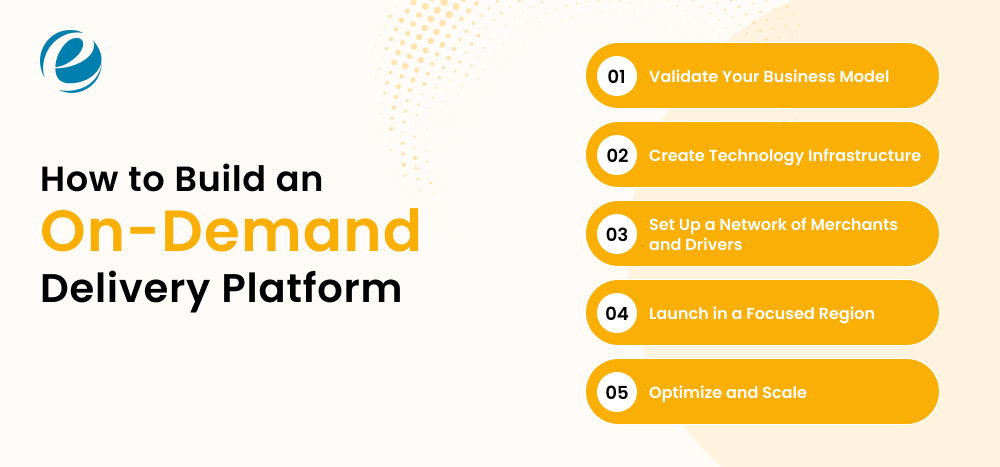
Building a successful on-demand delivery platform requires understanding both technology and logistics. The market continues expanding as consumers expect faster, more convenient services. Whether you’re launching an on-demand food delivery platform or a quick-commerce solution, the fundamental framework remains consistent.
- Validate Your Business Model: Define your on-demand delivery category clearly (a food delivery platform, grocery delivery, or quick-commerce). Study unit economics in the market before investing a penny. Calculate costs (delivery, commissions, and customer acquisition expenses). For a viable on-demand delivery platform model, you will need at least 10% gross margins at scale.
- Create Technology Infrastructure: Build a mobile app for customers, a merchant dashboard, and a driver app. Implement real-time tracking, secure payment processing, and algorithms for matching demand with supply. This can take 4-6 months with a skilled engineering team.
- Set Up a Network of Merchants and Drivers: Recruit restaurants, stores, or service providers to your platform. Simultaneously, build a driver or delivery partner network.
- Launch in a Focused Region: Start in one city, not nationally right away. Achieve operational excellence in a single market before you scale to bigger markets. Handle logistics, customer service, and merchant support manually if needed.
- Optimize and Scale: Track order frequency, delivery times, customer retention, and driver satisfaction. Use the outcomes to plan algorithms accordingly, lower delivery costs, and boost order volume.
Why Choose EmizenTech for On-Demand Delivery Platform Development?
Inspired to get started with on-demand app development? Partnering with the right app development company is non-negotiable to make your goal a success. EmizenTech, a leading web and mobile app development company, specializes in end-to-end on-demand platform development with proven expertise across food delivery, grocery, quick-commerce, and logistics.
We create intuitive, fast, responsive interfaces that users build a habit of opening daily. From push notifications to real-time tracking to seamless payments, we implement capabilities to optimize the platform for retention, not only acquisition. Our development practices span native and cross-platform applications that cater to unique business goals, budgets, and customer needs.
With over 12 years in the field, we’ve built platforms from zero to profitability. Are you planning to create something groundbreaking? Connect with us to get a roadmap for your own platform.
Wrapping Up!
The on-demand delivery market in 2026 is mature in North America and China, explosive in emerging markets, and increasingly competitive worldwide. In this industry, fragmentation is temporary, but consolidation is inevitable. By 2030, we can expect 3-5 dominant global players and thousands of niche regional platforms.
That said, the opportunity for launching meaningful on-demand delivery businesses may be limited in saturated markets, but it is booming in underserved regions and categories. Whether you’re launching in a new category or geographic market or building B2B logistics infrastructure, starting with the right technical foundation matters. Hire mobile app developers who understand both the technology and the business ruthlessly.
FAQs
What exactly is on-demand delivery?
"On-demand delivery" means that you order something through a digital platform, and it arrives at your door within minutes to hours. The platform connects you to restaurants, grocery stores, or warehouses that send someone to pick up and deliver your order.
Which platform delivers the fastest?
Getir and Gopuff specialize in delivering snacks and essentials in 15-30 minutes, while food delivery apps usually take 30-45 minutes. The speed of on-demand delivery platforms depends on your location and what you’re ordering.
Do I have to pay for a subscription?
No, most on-demand platforms offer subscriptions as an option. You can order without one and pay per-order fees. Also, subscriptions only save money if you order frequently monthly.
Can I order from any restaurant on these apps?
No. Each platform has different restaurants and stores. You need to check if your favorite restaurant or store is available on the platform before ordering.



 +1 (989) 535-9295
 info@emizentech.com
 emizentech


