
 Add us as a preferred source on Google
 Grocery shopping moved online faster than most retailers expected. According to Mordor Intelligence, the global online grocery market is valued at $1.06 trillion in 2026 and is projected to reach $1.74 trillion by 2031, reflecting a 10.47% CAGR that’s hard to ignore.
That’s not a niche anymore. That’s where your customers are going.
For grocery retailers still sitting on the fence, the math is pretty simple: every month without an online channel is a month of orders going to someone else. Online grocery website development isn’t a future-proofing exercise at this point; it’s catching up to what shoppers already expect.
This guide breaks down what the process actually involves, which features matter, what a realistic tech stack looks like, and what you’ll likely spend.
What Is Online Grocery Website Development And Does Your Store Need One?
At its core, online grocery website development means building a working digital store where customers can browse, add items to a cart, pick a delivery or pickup time, and pay without coming in. Simple enough in theory.
In practice, it’s more involved than a typical eCommerce build. Grocery eCommerce website development has to account for things most other verticals don’t: live inventory that changes by the hour, weight-based pricing, substitution logic when items run out, and timed delivery slots tied to actual capacity.
Now the question is, does your store need an online grocery website?
If you sell groceries and you don’t have an online ordering option, yes, you need one. The question isn’t really whether to build it; it’s when and how. Customers who can’t order from you online will find a competitor who lets them. That’s not speculation; that’s just how buying habits work now.
If mobile reach matters to you (and it should), pairing your website with a grocery app development project is worth thinking about early; it’s easier to plan for both upfront than to retrofit later.
Must-Have Features in Online Grocery Website Development
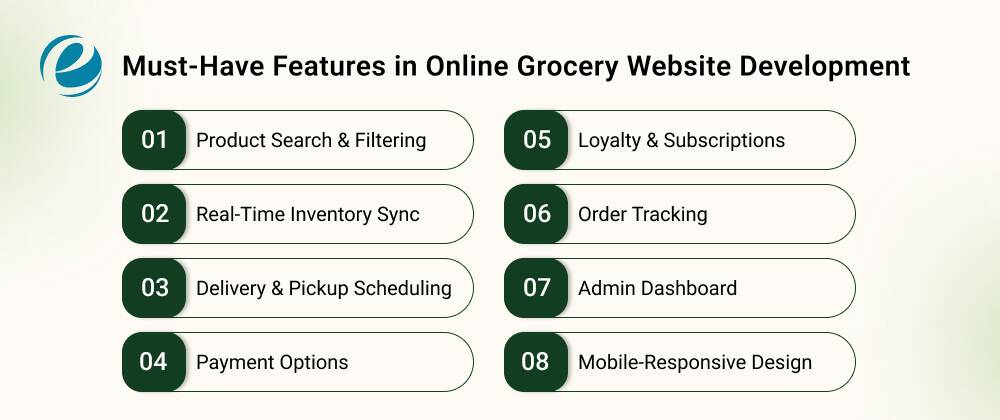
A lot of grocery store website development projects start out too narrowly scoped. The cart and checkout get attention; everything else gets treated as optional. That’s usually where things start to go wrong after launch. Here are the features that really matter:
- Product Search & Filtering: Grocery search has to work for people who type “mlk” instead of “milk.” Auto-suggestions, typo handling, and filters by category, brand, and dietary tags are baseline expectations, not extras.
- Real-Time Inventory Sync: If a customer adds something to their cart that has been out of stock for two hours, you have a problem. Inventory needs to reflect reality, which means direct integration with whatever system you use in-store.
- Delivery & Pickup Scheduling: Customers want to pick a time slot, not just place an order and hope. Slot management tied to delivery zone capacity is one of the more technically complex parts of grocery eCommerce website development and one of the most important for operations.
- Payment Options: Cards, wallets, BNPL, and COD where applicable. The more friction at checkout, the fewer orders are completed. Worth getting right.
- Loyalty & Subscriptions: Grocery is a repeat-purchase category more than almost anything else. Points programs, weekly auto-refill baskets, and subscription discounts, these aren’t nice-to-haves. They’re how you build customers who don’t need to be re-acquired every month.
- Order Tracking: Customers want to know where their order is. Real-time status updates via SMS or push notification cut support queries and build trust—both good things.
- Admin Dashboard: This one gets underestimated constantly. A clean backend for managing products, pricing, promotions, and delivery zones is what keeps your team from drowning in manual updates. Budget for it properly.
- Mobile-Responsive Design: More than 60% of grocery orders are placed on mobile. If the site is awkward to use on a phone, you’ll see it in your cart abandonment rate. Every grocery website development project should be designed mobile-first, not adapted afterward.
Technology Stack for Online Grocery Website Development
There’s no single right answer here; the best stack depends on your scale, your existing systems, and whether you’re building custom or starting with a platform. That said, here’s what tends to work well:
| Layer | Recommended Options |
| Frontend | React.js, Next.js, Vue.js |
| Backend | Node.js, Laravel, Django |
| Database | PostgreSQL, MongoDB, MySQL |
| Search | Elasticsearch, Algolia |
| Payment | Stripe, Razorpay, PayPal |
| Cloud Hosting | AWS, Google Cloud, Azure |
| CDN | Cloudflare, AWS CloudFront |
If your team is still evaluating frameworks, this rundown of web development frameworks is a solid place to start before committing.
What do you think of this custom build vs. an off-the-shelf platform? Which makes sense?
So, platforms like Shopify, WooCommerce, and Magento can get you live faster and for less upfront. For a small operation testing the waters, that’s a reasonable starting point. Custom grocery website development costs more and takes longer.
But grocery has enough operational complexity, like slot management, inventory rules, weight-based pricing, and third-party logistics, that most businesses hit the ceiling of platform capabilities within a year or two. At that point, rebuilding is more expensive than building right the first time would have been.
Step-by-Step Online Grocery Website Development Process

In this section you will learn about the structured process that developers use to build a grocery website. Here’s what a proper grocery store website development engagement actually looks like from start to finish:
- Discovery & Requirement Gathering: Before anyone writes a line of code, the scope needs to be clear. Business model, target audience, must-have integrations, delivery setup, and feature priorities all get defined here.
- UI/UX Design: Grocery UX is very different from fashion or electronics. Customers shop by habit and muscle memory; they want to find the things they bought last week. Category structure and a clean checkout flow matter more than complex design.
- Frontend Development: The customer-facing build: product pages, search, cart, checkout. Load speed matters here more than most people budget for. Slow pages lose orders; it’s that straightforward.
- Backend Development: The real complexity lives here. APIs handling product management, user accounts, order processing, delivery scheduling, and payments. This is also where architecture decisions made early either hold up under growth or don’t.
- Third-Party Integrations: In this phase, you have to include payment gateways, email services, delivery APIs, mapping tools for zones, and ERP and POS connections within the app. The list varies by business but is longer than anticipated.
- Testing: Beyond standard QA, grocery-specific stress testing matters. What happens to inventory sync during a flash sale? Does checkout hold up under simultaneous orders? These need to be tested before launch, not discovered after.
- Deployment & Launch: A staged rollout limited to beta before going fully live reduces risk considerably. Real users find things testing doesn’t.
- Post-Launch Support: The first few months after launch usually surface the most useful feedback. Ongoing maintenance, performance monitoring, and iterating on what real users actually do are part of the process, not an afterthought.
Businesses thinking about delivery infrastructure beyond the web should also consider on-demand app development, as the backend architecture overlaps enough that planning for both at once makes sense.
Online Grocery Website Development Cost Breakdown
Costs of online grocery website development vary a lot depending on the scope, team location, and how much of the project is custom versus platform-based. Here’s a reasonable range for a custom build:
| Component | Estimated Cost |
| UI/UX Design | $2,000 – $6,000 |
| Frontend Development | $5,000 – $15,000 |
| Backend Development | $8,000 – $20,000 |
| Admin Panel | $3,000 – $8,000 |
| Third-Party Integrations | $2,000 – $6,000 |
| Testing & QA | $1,500 – $4,000 |
| Deployment & Launch | $500 – $2,000 |
Platform-based builds (Shopify, WooCommerce) typically land between $15,000–$45,000, depending on how much customization is needed.
What actually drives the number up:
- Complex integrations: POS, ERP, third-party logistics APIs
- Multi-zone delivery management with real-time slot availability
- Large product catalogs with complicated inventory rules
- Ongoing maintenance requirements post-launch
One thing worth noting: businesses comparing grocery eCommerce platforms often focus on upfront cost. The more useful comparison is total cost over two or three years; licensing fees, plugin costs, and the development work needed to work around platform limitations add up faster than the initial quote suggests.
Why Choose EmizenTech for Online Grocery Website Development?
EmizenTech has built grocery eCommerce website development solutions for businesses ranging from single-location stores to multi-city delivery operations. Below, there are a few things worth knowing:
- Industry Insights: A generic eCommerce experience doesn’t automatically translate. Our team has worked through the operational complexity of inventory sync, delivery logistics, and substitution handling enough times not to be learning it on your project.
- One team, full project: Discovery through post-launch support, handled end-to-end. You will not face any handoffs between disconnected agencies.
- We Built to grow: The platforms we build are designed to handle more catalog, more users, and more features without needing to be rebuilt from scratch when things take off.
- Process that’s actually transparent: Regular reviews, clear documentation, and engagement models that fit different levels of project certainty.
If you’re seriously evaluating partners for your online grocery website development project, it’s worth a conversation with EmizenTech before finalizing your approach.
Final Thoughts
The online grocery market isn’t a growth story that’s still getting started; it’s already large, already competitive, and already shaping where customer habits are going. Retailers who have invested in strong online grocery website development over the last few years are seeing the compounding benefit of that now.
If you’re just getting started, that’s not a reason to panic. But it is a reason to take action. Grocery store web development is built on solid foundations; the right features, good architecture, and realistic planning are still some of the better investments a grocery retailer can make.
Done well, it brings in orders you’d never have otherwise. Done poorly, it frustrates the customers you already have.
The difference usually comes down to who builds it and how seriously the brief is taken from day one. If you’re ready to get that conversation going, EmizenTech is a good place to start your custom grocery website development project.
FAQs
What is online grocery website development?
The online grocery website development is the process of building a digital platform that allows customers to browse, order, and pay for groceries online for home delivery or store pickup.
How much does online grocery website development cost?
An online grocery website costs you between $15,000 and $250,000+ to build; it also depends on the complexity. Your inventory scale, real-time logistics integrations, and vendor models heavily drive the costs.
How long does it take to develop an online grocery website?
Developing an online grocery website can take from 1 to 6 months; it depends on the path you choose. The simple eCommerce platforms take a few months, while custom builds requiring advanced features take 4 to 6 months or more.
What are the must-have features for a grocery website?
A grocery website needs some features that minimize cart abandonment and recreate the convenience of in-store shopping. These are some of the crucial features: real-time inventory sync, advanced product filtering, quick reorder options, and frictionless checkouts for the users.
Can I build a multi-vendor grocery website?
Yes, you can easily build a multi-vendor grocery website. In this model, independent grocers, local farmers, or specialty food vendors list their inventory on your centralized platform. And your role is to act as the facilitator that handles customer orders, routes deliveries, and processes the payments.





 +1 (989) 535-9295
 info@emizentech.com
 emizentech


