 Add us as a preferred source on Google
Do you know that the digital platforms now account for 10% of all pharmaceutical retail sales globally? Well, this massive shift has tripled in just the last five years. The pharmacy apps are becoming a crucial part of modern healthcare because they make everything convenient for the patients. With this, patients can manage chronic diseases through smart devices, reducing the need for frequent hospital visits.
This adoption is also encouraging the pharmacies to invest in digital solutions that improve the service speed and accuracy. However, features like automated refill reminders, secure payment systems, and prescription verification are making the process safer. In this blog, you will learn about pharmacy app development, its features, costs, step-by-step process, and other important things.
What Is Pharmacy App Development? and Why its Booming in 2026?
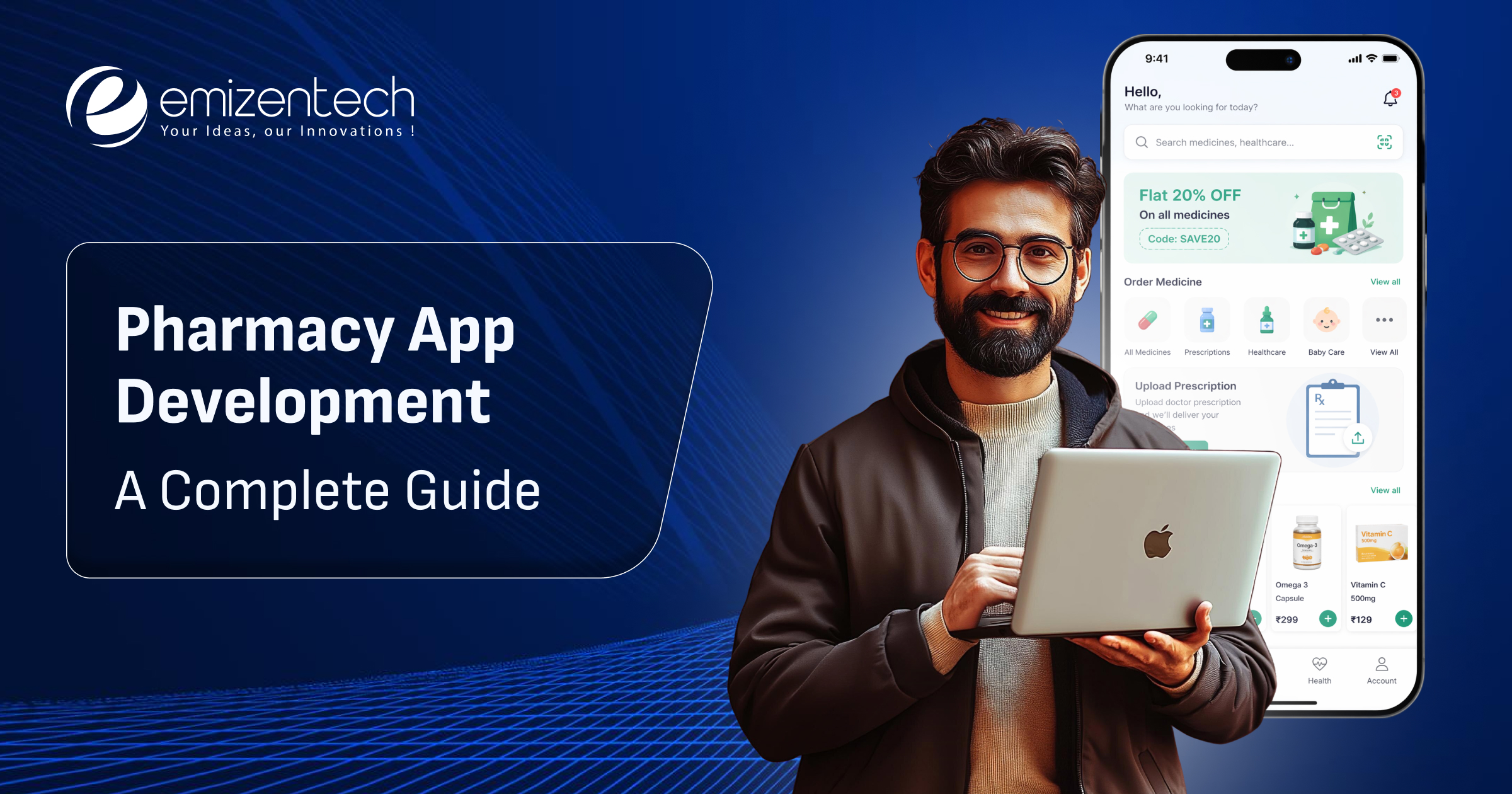
Pharmacy app development is the process of designing digital applications that help users access pharmacy services online. These apps enable individuals to order medications, upload prescriptions, consult with pharmacists, track deliveries, and manage their medication schedules.
The demand for online pharmacy app development is growing due to several key factors:
- Growth of Telemedicine: Patients can easily take consultations from online doctors and pharmacists to get quick prescriptions.
- Doorstep Delivery: The medicines are delivered directly to the homes, which is helpful for the elderly and busy people.
- Government Support: Many countries’ governments are promoting digital health, which has increased the number of pharmacy apps.
- Chronic Disease Management: These apps help patients track medicines and set reminders for long-term health conditions like diabetes
These are the main reasons why the pharmacy apps market is growing. According to Fortune Business Insights, the global online pharmacy market is projected to reach USD 177.79 billion in 2026, which shows the strong demand for digital healthcare solutions worldwide.
As this demand grows, businesses invest in scalable and secure solutions with the help of expert healthcare mobile app development services to build high-performing pharmacy platforms.
Types of Pharmacy Apps Businesses Can Build

The apps for pharmacy can be built in different ways that depend on the business goals. Before you develop online pharmacy app, it is crucial to choose the right type that fits the target users and services. Below, you will learn about some popular types of pharmacy apps:
E-Pharmacy Apps
These apps allow users to order medicines online from licensed pharmacies. They act like digital medical stores, through which customers can upload prescriptions, browse medicines, and get them delivered to their homes quickly and safely.
Telepharmacy Apps
The apps connect the patients with the pharmacists remotely for consultation and prescription guidance. The users can ask related questions about that medicine, get dosage advice, and manage minor health concerns without visiting a physical pharmacy.
Medicine Delivery Aggregator Apps
These aggregator apps bring together multiple pharmacies on one platform that lets users compare prices, availability, and delivery times. The customers can choose the best option for their medicine order to make the process more flexible.
Prescription Management Apps
The prescription management apps help users to organize and track their medical prescriptions digitally. They remind patients about the refills, dosage schedules, and doctor visits. This process makes for better medication adherence to reduce the risk of missed or incorrect doses.
Pharmacy Inventory Management Apps
These apps are designed for the pharmacy owners so that they can easily manage the stocks. They can track the availability of medicine, expiry dates, and demand patterns that help prevent shortages. It also reduces the overstocking of medicines.
Must-Have Features of a Successful Pharmacy App
A good pharmacy app must include simple and useful features that help users order medicines easily, manage prescriptions, and stay safe while using medicines. In the section below, you will learn about the crucial features for building a successful pharmacy app:
User Registration
The users should be able to create an account easily with the use of their phone number, email, or social login. This helps them save their details, such as their address and order history, for future use.
Prescription Management
The app should allow users to upload and store their prescriptions. It makes it easy to order medicines without carrying a paper prescription every time.
Medication Search & Filter
The app must quickly find medicines by typing the names. Filters, including brands, prices, dosage, or availability, help users choose the right product easily.
Secure Payment Processing
The app should offer safe payment methods for the users that can be UPI, debit/credit cards, net banking, and wallets. All the payments should be protected to keep the user data secure.
Drug Safety Alerts
A pharmacy app should show the crucial warnings about medicines that can have side effects and possible drug interactions. This helps the users to take medicines safely.
Family Care Management
Most of the users prefer to add their family members to the app. This helps them manage medicines and prescriptions for children, parents, or elderly family members in one place.
So, if you want to implement these features in your pharmacy app, then you can hire a mobile app developer who has great knowledge about healthcare workflows.
The Compliance Side of Pharmacy App Development You Can’t Ignore
When you are building a pharmacy app, following legal rules is very crucial because it protects the patients’ data, ensures safe medicine handling, and helps the app to work properly in different countries without facing legal problems
HIPAA and HITECH Compliance
HIPAA is a US law that protects patient health data. Through this compliance, the pharmacy apps secure all the medical information using strong encryption and strict access control. On the other hand, HITECH supports the use of digital security for quick reporting of data breaches.
Regional Data Privacy Laws
- GDPR (Europe): It asks for user consent before collecting their personal data and allows them to delete their data anytime.
- CCPA (California): The users can easily view the data that is collected and shared by the apps
- PIPEDA (Canada): The law requires consent, purpose limitation, and safeguards for patient data, as well as providing access and correction rights for users.
Drug Distribution Regulations (DSCSA, CSA)
The Drug Supply Chain Security (DSCSA) makes sure that the medicines are traceable and not fake by tracking them from manufacturer to customer. The Controlled Substances Act (CSA) controls the sale of strong or restricted drugs and allows their sale only with valid prescriptions.
NIST Security Frameworks
The National Institute of Standards and Technology (NIST) provides cybersecurity guidelines to protect healthcare apps from data breaches. It focuses on risk management, data protection, threat detection, and system recovery.
For the healthcare apps, compliance and security are the major parts. You have to make sure that the data of the users are safe in your apps. In such cases, you can also take help from HIPAA-Compliant app development services to secure your pharmacy application.
Tech Stacks of Pharmacy App Development
To build a pharmacy app, different technologies are used together so the app can work smoothly. In the table below, you will learn about those technologies that can handle all the users’ needs without any issues:
| Layer | Technologies Used | Purpose |
| Mobile App | Flutter, React Native, Swift & Kotlin | It builds the app for users to use on Android & iOS |
| Web App | React.js, Next.js & Angular | This is used for the admin dashboard and pharmacy control |
| Backend | Node.js, Django, Spring Boot & .NET | It handles the orders, prescriptions, and business logic for users. |
| Database | PostgreSQL, MySQL & MongoDB | This technology stores user data, medicines, orders, and records. |
| Cloud Hosting | AWS, Google Cloud & Azure | It keeps the app running, scalable, and secure |
| Authentication | JWT, OAuth & Firebase Auth | It manages secure login and user access. |
| Payment System | Razorpay, Stripe & PayPal | This helps in handling online payments and transactions. |
| File Storage | AWS S3 & Google Cloud Storage | Stores prescriptions, reports, and images |
| Notifications | Firebase Cloud Messaging & Twilio | These are used for recommendations, chatbots, and insights. |
| Health Data APIs | OpenFDA & MedlinePlus APIs | It provides drug information and medical data. |
So, using the right tech stack helps you to create a fast pharmacy app that supports users, pharmacists, and admins to manage the app effectively.
Step-by-step Process Of Pharmacy App Development

If you are planning to start building a pharmacy app, then first understand the process of pharmacy app development. Below you will see some steps that will guide you to develop your app step by step:
Market Research
Firstly, you have to begin with detailed market research to understand the user needs. It helps you to identify your target users, like patients, pharmacists, and caregivers, so that you can easily define the purpose and business model.
Compliance Requirements
In pharmacy app development, the most crucial part is following legal and healthcare regulations. This step includes understanding rules like patients’ data protection, prescription handling laws, and drug regulations.
Feature Set Planning
At this stage, you must set all the key and advanced features of the app that are defined based on the user’s needs. It includes functions like medicine ordering, prescription upload, delivery tracking, and payment systems.
UI/UX Design
The apps are also used by elderly patients, so the design must focus on making the app simpler and easier to use. Use a smooth navigation system to improve their experience; this will also help you to reduce confusion while using the app.
Prototyping & User Feedback
A working prototype of the app is created to show that the function works well before full development. This model is tested with real users so that they can provide feedback. On the basis of suggestions, make sure there is better usability and performance of the app.
Backend & Frontend Development
This is the core development phase in which frontend developers create the user interface, while backend developers handle the database, servers, and logic. Both parts are integrated to ensure smooth performance, security, and real-time functionality.
Testing and Quality Assurance
After the development process, you have to test the functions to find bugs and errors. This includes performance testing, usability testing, and compliance checks. It will help you ensure that the app works smoothly under different conditions before launch.
Launch & Maintenance
Once testing is complete, the app is launched on platforms like Android and iOS. After the launch, regular maintenance is crucial to resolve issues that occur while using the apps to improve performance.
How much does it cost to develop a pharmacy app?
The cost of building a pharmacy app depends on its features, design, and complexity. These are the main reasons that can directly affect development time, resources, and investment.
| App Complexity | Estimated Cost | Timeline |
| Basic Pharmacy App | $10,000 and $40,000 | 3 to 5 Months |
| Mid-Level Pharmacy App | $40,000 to $80,000 | 5 to 11 Months |
| Advanced Pharmacy App | $100,000 to $250,000 | 12+ Months |
So, if you understand them clearly, it will give you an idea so that you can budget for pharmacy app development without overspending.
Monetization Models for Pharmacy Apps
Businesses use different types of monetization models to earn revenue. These models balance the business growth with better access to medicines and improved digital healthcare services for users. In the section below, you can see the common earning models:
- Subscription Plans: The users have to pay a fixed monthly or yearly fee to access the extra benefits of the app.
- In-App Purchase: In this revenue model, the company pays to promote its products inside the app.
- Freemium Model: The pharmacy collects large amounts of data about medicine usage and buying trends.
- White Labeling: With the platform, it is sold to other businesses so they can use it under their brand name.
- Commission Revenue: The app earns money by taking a small percentage from every order placed through the platform.
So, these models allow the pharmacy apps to remain profitable while expanding healthcare access and creating value for both users and business partners.
Future Trends in Pharmacy App Development Every Business Should Know

Pharmacy apps are no longer used only for ordering medicines. They are slowly becoming the tools that help people manage their health in a simpler and more practical way. Below, you will learn about some future trends that you can add to your pharmacy apps to stand out in this marketplace:
AI Chatbots
The AI chatbots are not just simple FAQs; they assist users with basic symptom checking. They suggest to the users things they can do for quick help.
Blockchain for Supply Chain
These are used to secure the digital records to track medicines from manufacturers to customers. It helps remove counterfeit drugs under full transparency in the supply chain.
Voice-Activated Refills
This technology allows users to reorder medicines using smart assistants like Alexa or Google Home. It makes refills easier for elderly users who prefer hands-free access.
Personalized Medicine
It uses patient health or genetic data to suggest suitable drug types and correct dosages. It improves treatment accuracy and reduces the side effects.
So, these changes may seem small to you but together they make the app more helpful in daily life.
Why EmizenTech Is the Right Partner for Pharmacy App Development?
EmizenTech is a premier partner for pharmacy app development that offers secure healthcare solutions. We create smart systems with features like inventory control for pharmacies, auto-refill reminders, and secure payment options. These methods reduce manual work so that you can focus on your business growth. Our developers use these specialties:
- Smart Features: The app can scan prescriptions using AI to show live medicine stock and also remind users to refill medicines automatically.
- Modern Technology: We use strong tech stacks to predict the needs of the users and use IoT to connect with medical devices.
- User-Centric Design: Our developers create an interface that both pharmacists and patients can use for high engagement and navigation.
By choosing our specialized healthcare software development service, you are gaining a HIPAA-compliant digital ecosystem built to support your pharmacy’s daily operations
Conclusion
In the end, pharmacy app development is all about making healthcare easier and more convenient for people. With the help of modern technology, users can easily order their medicines from online shops without leaving their homes. This improves access to important healthcare services by focusing on the security of patient data. You should know that a well-developed pharmacy app benefits both customers and businesses if it is done in a correct way.
FAQs
What technologies are used in a pharmacy app development?
The common technologies that developers use in pharmacy app development are Flutter, React Native, Node.js, Django, AWS, and secure payment gateways.
What is the difference between a pharmacy app and a medicine delivery app?
A pharmacy app includes broader features like prescriptions, consultations, and inventory management. On the other hand, the medicine delivery app focuses on just ordering and delivering medicines for the users.
How long does it take to develop a pharmacy app?
To develop a pharmacy app, it takes 3 to 12 months, or it can also exceed that depending on the app's complexity or advanced features like AI, delivery tracking, or telemedicine integration.
Is it legal to develop an online pharmacy app?
Yes, it is legal, but the app must comply with healthcare regulations like HIPAA, GDPR, or local drug authority rules that depend on the target region.




 +1 (989) 535-9295
 info@emizentech.com
 emizentech


