 Add us as a preferred source on Google
If you’re looking into digital healthcare in 2026, there’s a good chance a telehealth app idea has crossed your mind. And one of the first things founders want clarity on is the telemedicine app development cost. It sounds simple at first, but once you dig in, it really isn’t.
The space is growing fast, too; the global telemedicine market is expected to hit around $123 billion in 2026, which reflects strong and steady demand. If you’re trying to figure out the telemedicine app development cost, you need real numbers and direction.
This guide covers the cost to develop a telemedicine app, its key factors, hidden costs, and must-have features. Additionally, it involves advanced features and proven strategies.
How Much Does It Cost to Develop a Telemedicine App?
In order to give you a general idea of what a custom telemedicine application would cost, it can be estimated between $40,000 to $30,000. The higher the complexity of the application, the higher the cost of development. Below is the breakdown of the costs based on the highest three levels of investments:
| App Type | Estimated Cost Range | Timeline | Best For |
| Basic/MVP | $25,000 – $80,000 | 3–5 months | Startups validating their concepts; Small clinics moving to digital-based medicine |
| Mid-Level/Standard | $60,000 – $150,000 | 5–9 months | Telemedicine firms in need of multi-disciplinary support |
| Advanced/Enterprise | $150,000 – $300,000+ | 9–18+ months | Hospital chains, insurance companies, and nationwide telemedicine networks |
Overall, the cost depends mainly on the scope, features, and scalability you plan for. So, when you choose the right model early, it makes a big difference. Now, it is time to consider how much does it cost to develop a telemedicine app , depending on the region you reside in.
Global Telemedicine App Development Cost by Region
The regional diversity considerably affects the telemedicine app development cost. Depending on the location of your team, pricing, professional competence, and the quality of work can considerably differ. Here is a breakdown of cost by region:
| Region | Estimated Hourly Rate(Senior Dev) | Best For |
| USA / Canada | $120 – $200/hr | Enterprise telehealth systems are used by hospitals, where compliance with HIPAA or FDA rules is non-negotiable. |
| Western Europe | $80 – $140/hr | GDPR-based healthcare apps that try to keep things secure but still easy for people to use. |
| Eastern Europe (Ukraine, Poland) | $40 – $80/hr | Mid to large projects that need decent engineering work without pushing costs too high. |
| South Asia (India, Pakistan) | $20 – $55/hr | Startup MVPs built fast, mainly to test an idea before investing more. |
| Southeast Asia (Philippines, Vietnam) | $25 – $60/hr | Low-budget healthcare apps for early-stage teams just getting started. |
| Latin America (Brazil, Argentina) | $35 – $70/hr | Nearshore teams working close to US hours, which makes coordination a bit smoother day to day. |
Telemedicine App Development Cost Breakdown at Each Stage
Below is a step-by-step breakdown of the telemedicine app development cost at each stage:
Planning and Discover
User research, feature definition, and roadmap creation. These are all things that happen in the planning and discovery phase and are often skipped, but will be very costly to go back to.
Cost Estimation: $3000.00 – $8000.00
UI/UX Design
Both doctors and patients need simple, easy-to-use interfaces. Healthcare has clearly shown time and again that good UX impacts how engaged users are and whether they continue using your application.
Cost Estimation: $5000.00 – $15000.00
Development
This will be the largest part of your budget to cover the following: front-end development, back-end development, database, real-time features, and APIs. The overall costs associated with iOS versus Android app development vary significantly, and a quality full-stack or Android agency will make a substantial difference in your project.
Cost Estimation: $20000.00 – $150,000.00+
Quality Assurance & Testing
Quality Assurance (QA) & testing of healthcare applications is vital because it incorporates security, performance, and compliance into testing. Most of the time, testing in these areas is overlooked, even though it is critical.
Cost Estimation: $5000.00 – $20000.00
Post-Launch Support
The work you do in your application will not end once it is launched. You will still need to maintain your application with updates, security patches, and bug fixes, and pay for servers.
Cost Estimate: $10,000.00 – $40,000.00+
Key Factors that Influence Telemedicine App Development Cost
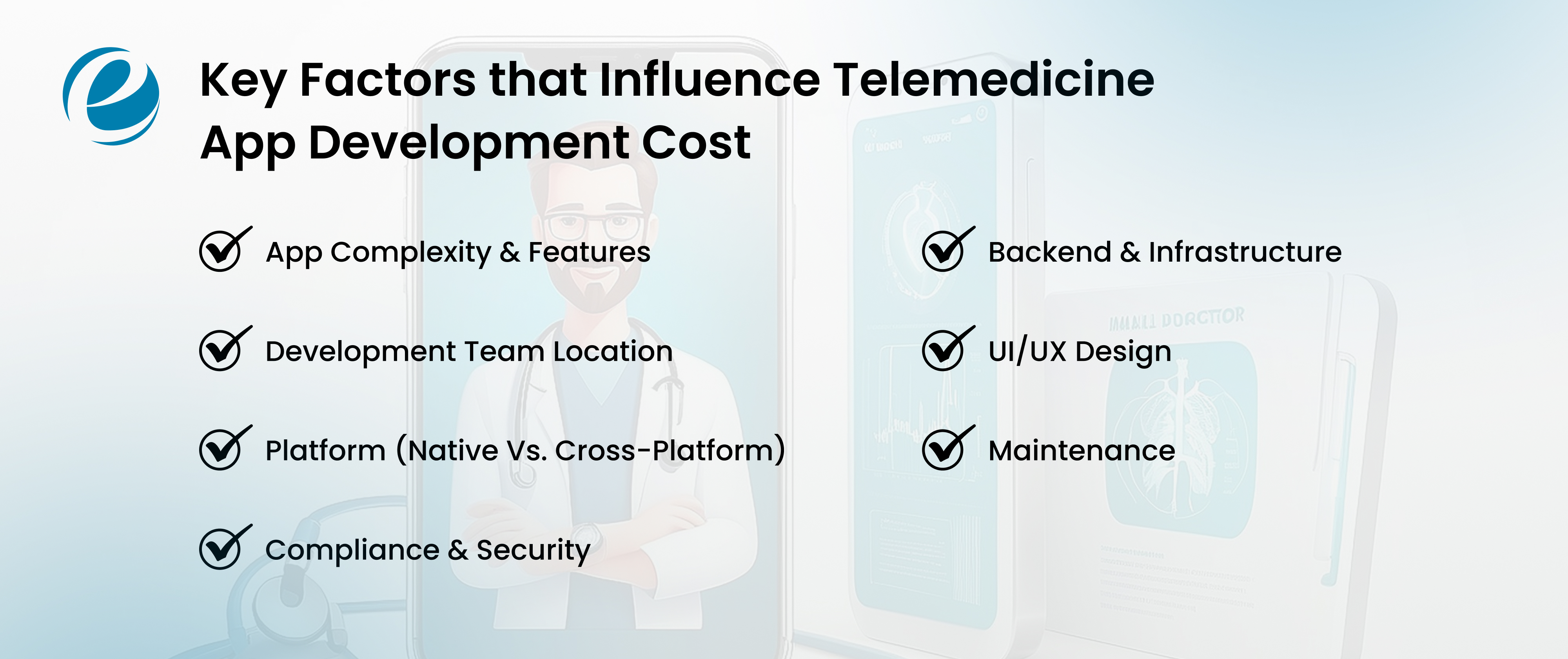
There is no definitive answer when it comes to how much does it cost to build a telemedicine app. A great number of factors can influence your spending, time frame, and eventual ROI. Below are some of them:
App Complexity & Features
Simple functions like booking appointments or video calls usually cost less. But once you add EHR integration, wearable tracking, AI chat, or e-prescriptions, the budget starts climbing pretty fast.
Development Team Location
Where your developers are based makes a big difference. North America is the most expensive, Eastern Europe sits in the middle, and Asia is generally the most budget-friendly.
Platform (Native vs. Cross-Platform)
Separate Android and iOS app development leads to higher expenses. Solutions such as Flutter or React Native can be used in order to lower these expenses.
Compliance & Security
HIPAA or GDPR compliance is not an option; it brings additional efforts in regard to encryption, security measures, and testing. Thus, expenses will rise accordingly.
Backend & Infrastructure
Video communications require reliable back-end systems to be developed. Higher numbers of users will inevitably lead to increased cloud expenses on AWS or Azure.
UI/UX Design
A clean, easy design for both patients and doctors takes time, and that adds to the overall budget.
Maintenance
After launch, you’ll still spend around 15–20% yearly on updates, fixes, and compatibility issues.
Hidden Costs in Telemedicine App Development You Must Consider
Creating a telemedicine application goes well beyond its first design and development stage. There are many indirect expenses incurred throughout its entire lifetime, which will greatly affect its overall financial burden. Let’s explore some of them below:
Continuous Maintenance and Updates
Even after launch, the app requires regular updates, security fixes, and minor feature enhancements. Tech changes, healthcare rules shift, and keeping things stable isn’t a one-time job; it slowly turns into an ongoing cost you can’t really avoid.
Cloud Services and Infrastructure Costs
A telemedicine application requires hosting services, and companies such as AWS or Google Cloud charge for video streaming and storage. The cost of hosting depends on the amount of traffic. Additional expenses can be incurred for backups and data protection.
Marketing and Promotion Expenses
It is not enough to develop a telemedicine application, as it must attract users who are willing to interact with it and engage in consultations. Thus, ongoing activities related to promotion and SEO should be conducted to attract more users.
Compliance and Regulatory Requirements
Rules like HIPAA or GDPR mean extra legal checks, audits, and certifications. Moreover, a telemedicine application may utilize third-party software that also requires paying fees.
Developer Certification and App Store Fees
Launching an application in the app store is associated with paying specific fees and obtaining developer certificates. These are some of the regular costs required for keeping the application up and running, as well as maintaining it.
Ongoing Maintenance Cost of a Telemedicine App After Launch
There are diverse key post launch ongoing maintenance costs of telemedicine. Let’s discover some of them below:
- Annual Maintenance Fee: It typically ranges between 15% to 20% of the overall development cost for security, performance, and updates.
- Infrastructure & Hosting: It costs for HIPAA-compliant cloud servers and storage typically cost $500 to $5,000+ per month.
- Regulatory & Security Compliance: Annually, regulatory compliance audits (including annual cybersecurity penetration tests) and then renewing business associate agreements (BAAs) usually cost about $5,000 to $20,000 each year.
- API Fees (for third-party APIs): Video APIs, such as Twilio or Agora, are typically priced between $0.01 and $0.04 per user, per minute, and payment gateways (like Stripe) typically charge about 2.9% + $0.30 per transaction.
- Technical Support: It covers ongoing maintenance, bug-fixes, and updates – costing between $1,000 and $10,000 per month depending on complexity.
Must-Have Features in a Telemedicine App
The telemedicine applications need key features that will guarantee security, efficiency, and effectiveness in providing health care services. Here is a breakdown of some of the must-have feature:
- HIPAA-Compliant Video & Audio: The ability to make secure video and audio consultations with a seamless experience, rather than the lagging and broken sessions that we currently get.
- EHR Integration: Consulting physicians have access to a patient’s history, lab results, and previous records without having to switch to other systems; this is much more convenient.
- Appointment Scheduling and Management: The system notifies patients about their upcoming appointments via SMS or email; fewer appointments will be missed this way.
- Secure Messaging/Chatting: A convenient way for patients and physicians to exchange any necessary information via messages and document sharing.
- E-Prescribing / Pharmacy Integration: The prescriptions can be digitized and sent to the pharmacy, thus speeding up the process and saving paper.
- Secure Payment Gateways: The payments can be done within the application without needing to use another service or platform for this purpose.
Advanced Features That Increase Telemedicine App Development Cost
Looking to develop a telemedicine application that provides more than just the basics in the competitive world of the healthcare market? The following advanced functionalities add to the cost of developing a telemedicine app:
- AI-Powered Features: AI capabilities add complexity to symptom checker features, AI-based diagnosis & automatic summarization of clinical documentation.
- EHR/EMR Integration: To integrate with third-party EHR/EMR systems, e.g. Epic and Cerner, significant API development and custom integration will drive costs.
- IoT and Wearable Device Integration: The development of an app that connects with external devices such as blood pressure meters, glucose meters, and watches will increase the time involved to build the app.
- Multi-Party Consultations: Enables patients, specialists, and family members to join a single video session is a far more complicated endeavor than an individual video session.
- Advanced Analytics and Reporting: Developing custom dashboards that allow healthcare providers to measure patient satisfaction, health-related trends, and operational efficiencies would involve the development of customized reports and analytics.
- Customization and Security: Customized UI/UX design, often increasing costs by 20-40% and developing complex and customized compliance solutions to adhere to HIPAA/GDPR regulations.
Proven Strategies to Reduce Telemedicine App Development Cost

It is not easy to build a healthcare app, but it is possible to plan everything well enough to reduce expenses. In order to do so, there are several strategies to consider.
Prioritize Features for MVP
Launch with a minimum viable product that includes only the most important features to validate with actual users. Use their feedback to help define what to expand into the application so you don’t waste money on anything but critical items.
Use Cross- Platform Development
Build your application once for both iOS and Android using cross-platform development tools so you can eliminate wasted development time and significantly reduce the cost of development.
Choose the Right Outsource Company
Finding a development team with a lot of experience developing healthcare applications will save your company considerable amounts of time, reduce your risk of non-compliance, and increase the chances of your application needing to be completely rebuilt.
Leverage Pre-Built APIs and Frameworks
Whenever possible, use pre-built APIs to access core functionality already available and to accelerate development, lower costs, and maintain consistent system performance.
Early Compliance Prioritization
Your company should develop backend technology right from the beginning to meet the demands of HIPAA and GDPR. Starting with the process of designing HIPAA compliant app development will not only save the company the trouble of having to make changes later on but will also reduce any associated costs.
How EmizenTech Delivers Telemedicine App Development Without Compromising Quality
In terms of balancing cost and quality, EmizenTech adopts an approach that can only be called straightforward. Instead of trying to sell you on unnecessary features, our experts work with you in order to make sure that the app that gets developed is exactly what will benefit your business and users.
This helps keep the telemedicine app development cost under control without exceeding any realistic limits as long as everything remains within reasonable boundaries. With our expertise in healthcare software development, EmizenTech knows how to create a highly-performing and secure app in accordance with the established requirements.
Conclusion
Knowing the telemedicine app development cost can be achieved through finding a balance between functionality, compliance, and scalability. A good strategy does not just guarantee that you won’t go over budget, but also guarantees that you will end up with a high-quality product.
If your goal is to create a highly competitive product, then you can hire mobile app developers. These professionals will be able to guide you through creating the best app.
FAQs
What is the Average Cost to Develop a Telemedicine App?
The average telemedicine app development cost can be anywhere between $30,000 and $250,000 based on the selected approach and its features, complexity, platform, and location.
How to Develop a Telemedicine App?
Developing telemedicine apps requires going through a series of steps such as requirement analysis, platform selection, design, development of MVP, feature integration, testing, and deployment.
Why Should I Start With MVP?
MVP will enable you to validate your idea, save money, test it, get valuable feedback, mitigate risks & release it fast before moving on to telemedicine app development.
What is the Most Expensive Feature in Telehealth Apps?
The most expensive features for telehealth applications involve live streaming, video consultations & electronic health record integration.
Is Telehealth a Profitable Business?
Yes, telehealth is a profitable venture since it can help you cut costs, generate income consistently, scale up operations, and meet customer needs.





 +1 (989) 535-9295
 info@emizentech.com
 emizentech


