
 Add us as a preferred source on Google
Today, in the age of digitalization, businesses are continuously trying to stay ahead of the game and outpace their competitors. One method to achieve this is by investing in Software as a Service (SaaS). SaaS app development has become increasingly sought-after in recent years. The world of software has completely changed with the arrival of the concept of SaaS, which offers a variety of affordable, efficient, and accessible solutions.
Software-as-a-Service is more than just a trend, it’s a revolution. It’s the backbone of modern business solutions. Contrary to traditional ways of using software, SaaS application development specializes in cloud-based applications, allowing users to connect to packages through an internet browser without the need for local installations.
Although SaaS app development offers cost and accessibility advantages to corporate customers and other users, it is growing significantly due to its simple method of development. A growing number of tech startups and product firms have jumped into SaaS mobile app development because they are aware of the advantages it offers.
Are you also looking forward to becoming part of this digital transformation and investing in SaaS app development, but don’t know where to begin? Don’t worry! In this SaaS development guide, we will explain everything about SaaS app development.
So, let’s get started.
Market Statistics For The SaaS Market
The SaaS market is seeing an exponential annual growth rate of 18%, making it the fastest-growing startup market that provides cloud-based products to companies and consumers.
Let’s review some interesting statistics:
- The SaaS app development market is undergoing rapid expansion and is expected to reach a global market size of $1.228 trillion by 2032. This marks an increase of 18.4%.
- The global Software as a Service (SaaS) market was estimated at $266.23 billion in 2024. It is expected to increase to $315.68 billion in 2025 and reach $1,131.52 billion by 2032, growing at an annual rate of 20% over the projection period.
- According to experts, by 2028, the rise of generative AI could result in a 30% reduction in the likelihood of non-compliance in cloud and software-based contracts.
- Every business is increasingly adopting cloud-based solutions, and companies are expected to transfer more than 60% of their workflows to cloud-based systems by 2025.
What is a SaaS App?
SaaS applications have experienced exponential growth due to their ability to provide a unique array of functions and services through cloud-based software delivery. A SaaS application is a type of program accessible via the internet. As opposed to installing programs on your servers or computers, SaaS applications run in a cloud environment. This allows them to be accessed from anywhere with an internet connection.
Installation and licensing of traditional software are no longer required, as SaaS applications leverage the power of cloud computing to allow access from any device or browser with an internet connection. SaaS products have become significantly more user-friendly, efficient, and widely adopted by various users, including entrepreneurs and companies alike.
A variety of benefits are available when developing software applications with the SaaS model. In particular, the ease of use of SaaS applications provides enterprises with numerous options to enhance business operations by adding innovative features. Cloud services facilitate easy and rapid deployment, making it possible for customers around the globe to benefit from the full functionality of the SaaS platform.
Benefits of SaaS App Development
SaaS mobile app development has numerous advantages over traditional software, including the ability to adapt and improve financial performance. We’ll look at the benefits SaaS app development offers businesses.
-
Easy Deployment
SaaS apps are easy to launch and don’t need a long setup. Businesses save time and money. Updates happen in the cloud, so users always get the newest version. Everything is secure and managed online, making it safer and easier for everyone.
-
Scalability
With SaaS mobile app development, businesses can grow easily. They can upgrade plans with a few clicks. There is no need for businesses to buy big servers. SaaS apps can connect with other tools using APIs. This lets businesses add new features fast. SaaS scales as companies grow, saving time and money every step.
-
Faster Time to Market
SaaS apps launch faster. Businesses test ideas quickly using MVPs. They collect feedback and improve early. Updates and bug fixes happen easily online, and companies stay ahead of the market and keep customers happy with constant, fast improvements and quick delivery.
-
Boost Client Productivity
If you build a SaaS app from scratch, you can make things easier for customers. It can perform tasks like managing finances, employees’ salaries, and calling customers regularly. So, your customers don’t waste time on simple, everyday tasks. Instead, they can focus on the larger, essential aspects of their company. Helping clients become more efficient makes your SaaS app highly valuable and tough to duplicate.
-
Cross-Device Compatibility
SaaS apps work on any device, including phones, tablets, or computers. Clients can switch between devices easily. They don’t lose any work. This helps them stay productive wherever they are. It makes the app more flexible, simple, and useful for daily life. People love tools that work anywhere.
-
Easy Customization
The best thing about SaaS app development is how simple they are to modify and upgrade. Each business is unique, so clients often require programs that suit them best. Through SaaS, you can quickly alter features to meet specific client needs. Because your application is hosted online, you can update it anytime without visiting the client’s office.
-
Simplified Management
Managing software is a challenge for many companies, but with SaaS, there’s no need to worry. The SaaS service takes care of all technical aspects, whether there’s a performance issue or system problem, it’s your responsibility to fix it. By managing everything behind the scenes, you make life easier for your clients and build long-term business relationships.
-
Enhancing Customer Service
SaaS applications often include helpful features like live chat, video tutorials, and guided support. Since they stay regularly updated, users rarely need assistance. But when help is needed, it’s easy to access. Providing reliable support builds trust, keeps users satisfied, and encourages them to recommend your app, helping your business grow.
-
Global Accessibility
One of the biggest benefits of SaaS app development is its ability to be accessed from anywhere. Whether your clients are in the office, at home, or traveling for business, they only need an internet connection to use your application. This is essential in today’s world, where many people work remotely or on the move.
Understanding The SaaS Architecture
An SaaS architecture model can be described as an approach to deliver software to customers through the internet. The SaaS application architecture allows organizations or companies to avoid installing and managing the software on their own. The framework is the foundation of infrastructure, strategy, and processes upon which SaaS products are developed, marketed, and then delivered to users.
The SaaS architecture platforms follow a set of principles. For instance, it must be based on cloud infrastructure, it should manage dynamic storage of data and management methods, it must have the ability to integrate various layers of security, and so on. Remember, when the app grows, the SaaS architecture should ensure its stability. The selection of the architectural style will determine the functionality, reliability, and cost-effectiveness throughout the SaaS mobile app development.
Different Types of SaaS Architecture
There are generally two primary criteria to categorize SaaS architecture. Let’s take a look:
1. Vertical SaaS
Vertical SaaS architecture has a defined, specific niche or standards for an industry, as an industry-specific vertical. A debate can be raised about the reason why the market of vertical SaaS appears to be restricted to one industry with the lowest profit margins, however, this isn’t the case. A variety of capabilities and solutions for the specific market could be a sign of solving a particular issue efficiently and cost-effectively. This is exactly what the vertical SaaS model is all about.
There is a chance that dependence on the vendor is present with this range of models for delivery However, the majority of it relies on the decision makers of a business to weigh the advantages and disadvantages of a SaaS solution based on their particular business needs, budget, and the market’s demands.
2. Horizontal SaaS
The horizontal SaaS structure focuses on features in the software type rather than being tied to industry standards. It is a solution that can be used by industry to target diverse verticals targeted by diverse sectors. Examples include applications to help with sales, marketing, and communications that fall within the scope of the horizontal SaaS architecture.
These applications have features that work well for different types of businesses, no matter the industry. When choosing a horizontal SaaS solution, companies should make sure it fits their needs. They may also want to use vertical SaaS tools that are designed for their specific industry.
Popular SaaS Product Types You Should Know
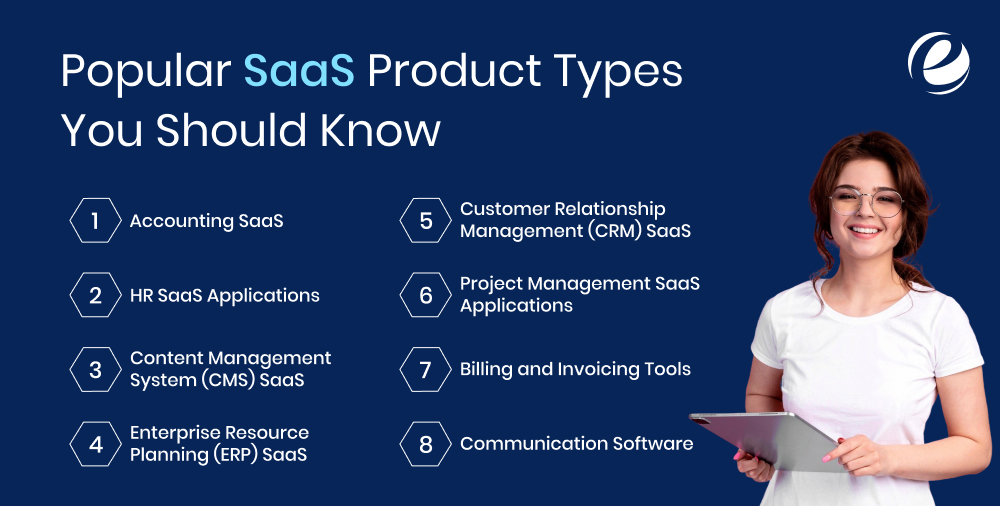
SaaS applications can be extremely diverse, offering both businesses and users solutions in many different areas. Let’s look at the top types of SaaS solutions, all of which are created to address different issues:
1. Accounting Saas
Accounting SaaS solutions provide a reliable and cost-effective method for medium and small-sized companies to control their accounting procedures. Businesses can store financial information securely and access their accounts via any device with internet connectivity.
In this way, companies can create automatic reminders for invoicing and link bank accounts for quick and easy bill payments. Automating accounting functions can lead to greater precision in bookkeeping and more efficient workflows, resulting in improved efficiency. SaaS solutions offer a variety of advantages, including better collaboration between departments, simpler compliance with federal regulations, improved customer relationship management, data insights, and many more.
2. HR SaaS Applications
HR (Human Resources) SaaS mobile app development solutions are becoming more popular in the corporate world. This is no surprise, considering how valuable these software solutions are for businesses. What kind of services does HR SaaS software provide?
First, they offer cloud-based solutions that allow companies to manage employee records efficiently and streamline HR processes, from recruiting through retirement. This reduces the time and administrative costs associated with traditional HR procedures. The apps are compatible with third-party payroll system integrations or other software vendors.
3. Content Management System (CMS) SaaS
CMS can be greatly used to manage the creation, revision, and modification of electronic content. CMS platforms can be utilized by anyone from bloggers to large companies to manage every kind of media, including video, text, images, and audio documents. CMS simplifies the process for users to build and manage web pages quickly and efficiently.
The main reason CMS is so well-liked is that it requires no computer skills or technical expertise, making it accessible to anyone with basic computer knowledge. In addition, CMS gives users multiple features that would otherwise require manual programming. These functions include permission controls, user access levels, automatic backups, analytics tracking, and more.
4. Enterprise Resource Planning (ERP) SaaS
Enterprise Resource Planning (ERP) software tools assist businesses in managing different tasks all in one location. They can combine accounting, HR, inventory, and customer management. They help businesses track everything from finances to employee details to products, making work more efficient and organized.
ERP solutions help save time, reduce errors, and improve decision-making efficiency by centralizing information. The most popular ERP providers, such as SAP and Oracle, offer powerful options for businesses of all sizes to remain effective and operate efficiently. Through ERP, companies can streamline processes and increase productivity.
5. Customer Relationship Management (CRM) SaaS
CRMs are essential for building meaningful relationships with customers and gaining insight into customer behavior. CRMs are a core part of any organization’s workflow. Businesses that utilize CRM can monitor customer information like buying habits and tailor their marketing strategies accordingly.
There are many big names in CRM, such as Salesforce, Microsoft Dynamics 365, HubSpot, Zoho CRM, and Pipedrive. These companies offer enterprise-level features that allow businesses to set up contact groups, share crucial documents, store customer data securely, and more.
Furthermore, it helps provide better customer service by keeping relevant data, including purchase histories, offering a detailed view of customer preferences and needs, and allowing quicker responses to questions and concerns. All in all, high-quality CRM software is an essential resource for managing customer relationships effectively. However, the outcome depends on how a company uses the information.
6. Project Management SaaS Applications
Simply put, project management software is an application that companies use to organize, manage, and track initiatives. It helps improve efficiency by establishing workflows and bringing accountability to employees.
Teams can use it to oversee various projects and tasks while ensuring clear communication for everyone involved. This greatly reduces the risk of errors and also miscommunications, saving time and minimizing risk. Top project management tools include Asana, Trello, Monday.com, Jira, and Microsoft Project. Each of them has its strengths and drawbacks, but they all help managers and business owners organize teams and workflows.
One of the main differences in these applications is the user interface, which depends on the preferences of the user or company. Furthermore, these tools provide performance metrics and also insights about individual contributions throughout the life cycle of a project.
7. Billing and Invoicing Tools
Billing and accounting software, such as Xero and QuickBooks, helps businesses control their finances effortlessly. They automatically generate invoices and bills, so you don’t need to create them manually. When customers pay their bills, the software tracks and updates the records automatically. This diminishes the chance of errors and also saves time.
You can also view an overview of all financial transactions in one place, making it easy to see how the business is performing. These tools make financial management less stressful and allow businesses to focus on more important and main tasks. They help companies stay organized and ensure payments are made on time.
8. Communication Software
Communication software such as Zoom, Slack, and Microsoft Teams is important for remote work. These apps let you hold video calls or group chats, even when everyone is in different locations. Zoom is ideal for video conferences, while Slack and Microsoft Teams are great for messaging, file sharing, and organizing work through channels.
They make it easy to work with clients, colleagues, or customers even from miles away. They help teams stay connected, collaborate better, and work faster. These tools improve communication, making remote work more efficient and organized.
Key Features Of a Successful SaaS App
In this section, we’ll look at what features are essential to the most successful SaaS app that can assist you in developing a profitable application.
| Feature | Description |
| User-Friendly Interface | Simple, clean design with easy navigation so app users can quickly understand how to use the SaaS app. |
| Multithreading | The app can perform multiple tasks at once, improving speed and efficiency. |
| Scalability | The app can handle more users and data without slowing down as the business grows. |
| Strong Security Features | Protects user data with encryption and secure login methods to prevent cyber threats. |
| Customization Options | Users can personalize dashboards, notifications, and settings to fit their needs. |
| Integrations with Other Tools | Connects easily with other business tools like CRM, email, and accounting software. |
| Analytics and Reporting Tools | Provides data insights and reports to help businesses make informed decisions. |
| Mobile Compatibility | The app works smoothly on smartphones or tablets for users to access it on the go. |
| Subscription and Billing Management | Allows users to manage payments, subscriptions, and billing history easily. |
| Customer Support and Training | Offers help via chat, email, and tutorials to assist users and ensure smooth use of the app. |

Choosing The Right Tech Stacks For a Successful SaaS App Development
SaaS applications require a solid technology architecture, particularly in components that are accessible to clients. This is why you’ll need to pick a technology stack for the SaaS development process with care, taking into account various technical and business factors.
Front-End Development:
| Tech Stack | Description |
| HTML + CSS | HTML structures the content, and CSS styles the layout. They are the building blocks for designing and structuring web pages. |
| React | A JavaScript framework for creating interactive and dynamic user interfaces, making it ideal for building fast and scalable web apps. |
| Flutter | A UI toolkit that enables the creation of mobile apps for both iOS and Android using a single codebase, offering fast development. |
| Vue.js | A flexible JavaScript framework for building modern web applications with an easy learning curve, making development smooth and fast. |
| Angular | A robust JavaScript framework for creating dynamic, complex, and scalable single-page applications with a wide range of built-in features. |
Back-End Development:
| Tech Stack | Description |
| JavaScript (Node.js) | A server-side JavaScript runtime, perfect for handling scalable, event-driven SaaS applications, allowing the use of JavaScript on both front-end and back-end. |
| Python | A versatile and modern language often paired with JavaScript for building SaaS apps with features like data analysis, task automation, and analytics. |
| Ruby on Rails | A web application framework that helps build SaaS apps quickly with minimal code, ideal for social features and third-party integrations. |
| Laravel (PHP) | A powerful PHP framework that simplifies building web applications, great for user authentication and integrating third-party services. |
Database & Cloud Services:
| Tech Stack | Description |
| MySQL | A relational database known for strong security, easy scaling, and handling large datasets, essential for maintaining a secure SaaS platform. |
| MongoDB | A NoSQL, document-based database that simplifies managing large, complex data, suitable for dynamic SaaS applications. |
| Amazon Web Services (AWS) | A comprehensive cloud platform providing scalable resources like computing, storage, and networking, critical for SaaS app infrastructure. |
| Microsoft Azure | A cloud service offering a variety of computing and networking solutions, tailored for scalable SaaS app development. |
| Google Cloud | A suite of cloud services providing scalable computing, storage, and data management capabilities, essential for SaaS applications. |
Step-by-Step Process of Developing a SaaS App
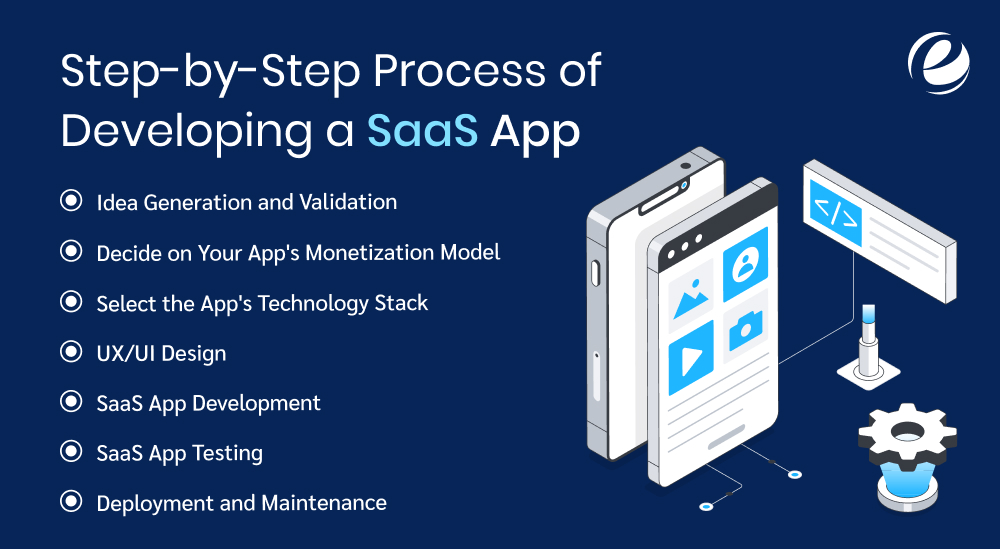
To guarantee the viability of the SaaS application, the SaaS development process must be conducted systematically, beginning with a road mapping process that addresses the foundations and needs of customers. It is essential to maintain a service-oriented mindset while also keeping scalability in mind throughout the entire process. We will walk you through the steps involved in creating a SaaS application.
1. Idea Generation and Validation
For a successful product to be noticed in the marketplace, the development process must combine idea generation with validation. By collaborating with customers during the analysis process and using their feedback to understand their vision for the product and business goals, businesses can create a personalized solution that meets the needs of customers who are interested in purchasing. Conducting thorough market research during the initial stages will ensure a successful outcome for the SaaS application.
2. Decide on Your App’s Monetization Model
Selecting a monetization strategy is crucial to your app’s growth. You can choose a subscription-based model, where customers are billed regularly (e.g., monthly or annually). A pay-as-you-go model charges users based on their usage, while the freemium model offers a free version with basic features and charges for additional options. Be aware of what your users are looking for and when they’ll be willing to pay. This will affect the design of your application, its user experience, and the frequency at which people use it.
3. Select the App’s Technology Stack
The technology stack consists of the frameworks and tools used in the creation of your application. When developing a SaaS application, use React.js or Angular for the front-end to build a dynamic user interface. For the back-end, you can use Node.js or Python (Django/Flask) to handle server-side logic. Use REST or GraphQL for APIs, and OAuth 2.0 or JWT to secure authentication. For databases, PostgreSQL or MySQL are excellent for structured data, while MongoDB works well for unstructured data.
For functions, choose a platform that supports that feature. A solid tech stack will ensure your application runs smoothly and scales with your growing user base. Consider factors such as ease of development, speed, and long-term support when making your choice.
4. UX/UI Design
Designing UX/UI plays a crucial role in developing an appealing and user-friendly app that meets the needs of various types of users. Consider how designs will work across different screen resolutions and devices. By focusing on both usability and aesthetics, companies can create a SaaS app that attracts their ideal customers while promoting customer engagement.
5. SaaS App Development
Start developing your SaaS application following the guidelines. Ensure that the entire team is aligned with the objectives. Begin coding based on the requirements you’ve outlined. If you’re a novice or face difficulties, consider seeking help from a freelancer. Stay focused on your vision and work closely with your team. Regularly check for issues to address early on and ensure everything is running smoothly. Improve your skills every day, and don’t hesitate to get help when needed.
6. SaaS App Testing
Testing your SaaS app development is essential to ensure it functions effectively. Begin by testing each feature individually to confirm it works as expected. Use unit tests to check smaller pieces of code and integration tests to ensure all components work together.
Be sure to conduct User Acceptance Testing (UAT), where actual users test the application. Look for errors, bugs, or performance issues. Test across a variety of platforms and devices to ensure compatibility. Address any issues you discover and test again until the application runs smoothly.
7. Deployment and Maintenance
Once the SaaS application has been tested and is ready to go live, maintenance becomes the top priority. This involves fixing bugs and providing client support to ensure the best user experience possible. These are key factors in creating a successful application.
Techniques like blue-green deployment ensure no interruptions during updates, allowing businesses to make changes without disrupting customer usage. Allocate budget funds specifically for maintenance and use user feedback to ensure ongoing success.
Cost and Timeline To Develop a SaaS App
The cost to build a SaaS app from scratch depends on various factors, such as the location of the developers and the level of sophistication of the application. On average, a simple app with basic functions can cost between $10,000 and $50,000. A more complex enterprise-level SaaS solution could easily exceed $100,000. Everyone involved in the design process must stay up-to-date regarding project information, goals, and scaling possibilities, so that budgeting decisions can be made promptly.
By adopting a service-oriented mindset, firms stand a better chance of creating a highly effective SaaS application tailored to their target audience, while keeping expenses within the set budget, provided they have a competent development team. A successful product will meet customer requirements without exceeding the spending limits set by decision-makers before launch.
If you’re wondering about the timeline for SaaS app development, it typically takes between 3 to 6 months, depending on the level of complexity. The process generally begins with design and planning (1-2 months), followed by the development phase (2-4 months), and then testing (1 month). Be prepared for iterations and changes. A regular feedback system and periodic adjustments can help keep your project on track.
Factors that impact SaaS app development cost are:
-
Complexity of Features
The more sophisticated features your app offers, the higher the cost of development. More complex features require more time and specialized expertise. Simple functions are less expensive and easier to create, while complex ones require more resources, increasing the overall cost.
-
Type of Solution
The type of SaaS application you create will impact the cost. A simple Micro SaaS app may be easier to build, while a more sophisticated, feature-rich platform will require more resources, tools, and time to develop. The size of your project will determine the number of developers and features you’ll need, which will increase the cost.
-
Team Structure
Hiring an in-house team gives you greater control over your project but comes with higher expenses, including wages, office space, and other benefits. Outsourcing to countries with lower costs can greatly reduce expenses, but may lead to communication issues and less control over speed and quality.
-
Technology Stack
The technology you use to build your SaaS app can significantly impact costs. Using cutting-edge technologies typically requires experienced developers, which can raise costs. These technologies may also require more time to set up and validate, leading to higher expenses. However, more popular, proven technologies can be more affordable due to a larger pool of developers and resources.
-
Location of the Development Team
The location of your SaaS app development team is a major factor in determining cost. Developers in North America and Western Europe generally have higher rates than those in Eastern Europe or Asia. Hourly rates can differ from $50 to $150 per hour in the former regions, while in the latter, prices may range from $20 to $80 per hour.
-
Hosting and Infrastructure Costs
Hosting and infrastructure costs depend on the scale of your application and the number of users. Smaller apps can benefit from shared hosting or affordable cloud services like AWS or Google Cloud. However, as your application grows and requires more storage, computing power, and security, the prices for cloud servers, bandwidth, and other services can increase significantly, impacting your overall budget.
-
Marketing and Sales Costs
Sales and marketing are essential for the growth of your SaaS application, but they are often overlooked during the budgeting process. In a competitive market, these costs can even surpass development costs. Marketing, SEO, content creation, and sales staff all contribute to client acquisition and retention. Without a strong marketing strategy, even the best app may fail to attract its intended audience.
Security Considerations To Keep In Mind When Developing a SaaS App
Do you have questions about what it takes to ensure that SaaS applications can keep data secure? This section will cover the basic principles of protecting SaaS applications. We will discuss the techniques for establishing a security foundation that includes keeping your data secure and making sure that only authorized individuals have access.
1. Encrypt Your Sensitive Data
Data encryption in SaaS applications requires more than just a standard approach; it demands a specific method. AES (Advanced Encryption Standard) with 256-bit keys is recommended for encrypting data in the background, as it provides a high level of protection against brute-force attacks. When data is in transit, it is crucial to ensure that all data transferred between servers and clients is secured using the most current and secure methods available.
2. Backup User Data in Multiple Locations
Many businesses aren’t prepared to protect their data from breaches, highlighting the importance of efficient data management. Storing backups in multiple locations protects against system malfunctions that could compromise security. While many cloud services provided by SaaS companies offer this feature, it is essential to follow proper backup procedures to safeguard against potentially massive data losses from customers.
3. Conduct Regular Audits and Compliance Checks
SaaS platforms must proactively conduct security audits and adhere to compliance regulations. Tools like automated compliance monitoring can streamline the process of continuously assessing for violations of standards, such as PCI, GDPR, or HIPAA. Security audits should be performed regularly using automated vulnerability scanners to easily identify and address security weaknesses.
4. Threat Detection and Management
Early detection of threats and effective threat management is essential for protection. Installing a Security Information and Event Management or SIEM system provides a platform for evaluation of security alerts generated by network hardware and applications. With the latest threat intelligence, SIEM systems can help identify emerging threats and weaknesses. Furthermore, having an Incident Resolution Plan (IRP) in place ensures that your team is ready to address security issues quickly and efficiently.
5. Multi-Factor Authentication (MFA)
Multi-factor authentication is crucial for SaaS applications as it enhances security, protects against attacks, meets compliance requirements, and provides a better user experience. It adapts to remote work environments and is cost-effective. MFA adds an extra layer of verification, reducing the risk of phishing attacks, helping comply with regulations like GDPR, and balancing security with user experience. It guarantees safe access to any device while providing robust security at a moderate cost.
Effective Ways To Generate Revenue From Your SaaS App
Now, let’s discuss the ways SaaS apps can generate revenue.
1. Subscription-Based Model
This is the most well-known method of earning money. Users pay on a consistent schedule, such as weekly, monthly, annually, and so on. The biggest drawback is that it requires significant effort to get potential buyers to subscribe to your service. This is why many companies adopt this method only once they have built up a sufficient user base.
2. Paid-for Services
Alternatively, you could offer users access to a basic set of features in your SaaS solution for free, but charge for higher-end features. This approach makes sense if your solution allows for a clear distinction between basic and premium features.
3. Freemium Model
Clients can access a limited version of your software at no cost, but you would charge for the full version. This is a popular model in the B2C market, where a significant amount of effort is required to convince customers to purchase the product after trying the free version.
4. Affiliate Model
Instead of using ads, you could place affiliate links on your site to help your business partners promote their products online. This model is useful for websites with high traffic. However, potential customers may hesitate if the affiliate links are not closely related to your SaaS solution.
5. Transaction-Based Model
Rather than requiring users to pay upfront for features they may not use, you can offer the option to pay later, specifically for features that are needed for a certain period. This is one of the most flexible models and works well for applications with many features and capabilities.
6. Ad-Based Model
This method involves offering ad space in your application or on the site that hosts it, allowing third-party businesses to place advertisements. This can be done directly by reaching out to advertisers and agreeing on a payment amount, or through an intermediary like Google AdSense, which automatically loads ads based on user preferences.
Why Choose EmizenTech For SaaS App Development?
EmizenTech is a leading SaaS app development company, specializing in creating reliable, safe, and scalable SaaS applications. Our highly skilled team collaborates to turn your SaaS application idea into a reality. We recognize that each SaaS application is distinct and has a specific set of needs. Therefore, we design customized SaaS mobile app development solutions that cater to your business requirements.
Our team is proficient in using cutting-edge tools and technologies to develop scalable, efficient, and customized SaaS applications. We follow industry-leading methods to ensure your app is secure, robust, and easy to use. EmizenTech’s team is available around the clock to respond to any questions you may have and to provide assistance whenever needed.
Get in touch with us now to discuss your SaaS app idea.
Conclusion
SaaS app development has grown significantly in recent years. With emerging technologies such as artificial intelligence (AI), machine learning, and blockchain, the future is even more exciting. Do you want to build a SaaS app from scratch? Creating the perfect SaaS app might seem daunting at first, but with a well-planned approach, you’re already on the path to success.
To bring a successful SaaS application to market, it’s essential to have a skilled team of developers who understand how to overcome the challenges of building such applications. You must plan your project carefully, pay attention to user needs, and choose the right technology. When done correctly, SaaS apps can boost your company’s growth, expand your customer base, and help you stay ahead of competitors. By fully embracing SaaS, you can achieve remarkable success and take your company to new heights.
You’ve now explored everything from the mobile SaaS market and its benefits to key factors, pitfalls, and development costs. The final step? Connect with a top SaaS development company like ours to kickstart your journey and turn your idea into a standout SaaS-based mobile app.
FAQs
What is a SaaS application?
A SaaS application is software that is accessible online, rather than downloaded. It's hosted in the cloud, and users pay to access the service, typically through a subscription.
How long will it take to build a SaaS app from scratch?
Developing a SaaS application can take anywhere from 4 to 6 months. However, the actual timeline depends on the size and capabilities of your SaaS product.
Which technology stack is most suitable for SaaS applications?
Popular options include React (frontend), Node.js or Django (backend), PostgreSQL (database), and AWS or Google Cloud (hosting). Choose based on your app's size and requirements.
How do I secure my SaaS app?
Use HTTPS, data encryption, secure authentication (like OAuth), regular updates, and backups. It's important to conduct security testing to protect user data and build trust.



 +1 (989) 535-9295
 info@emizentech.com
 emizentech


