
 Add us as a preferred source on Google
 In today’s fast-evolving digital landscape, the system development life cycle is not just a technical process, it’s a strategic necessity. Whether you’re building a new application or upgrading an existing one, following a structured development process is key to solving complex business challenges, enhancing productivity, and staying ahead of the competition.
Yet, did you know that a significant percentage of projects fail before completion? The reasons vary unclear goals, poor communication, lack of testing, limited user involvement, or weak project management. These challenges often result in delays, cost overruns, or products that miss the mark entirely.
So, how can you ensure your project stays on track and delivers the desired results?
The answer lies in adopting a well-defined system development life cycle (SDLC). This systematic process breaks down software development into manageable stages, helping teams stay focused, organized, and aligned with business goals.
In this blog, we’ll explore everything you need to know about the system development life cycle its stages, key methodologies, benefits, best practices, and why it’s essential for delivering successful software solutions.
Let’s dive in!
What Is the System Development Life Cycle (SDLC)?
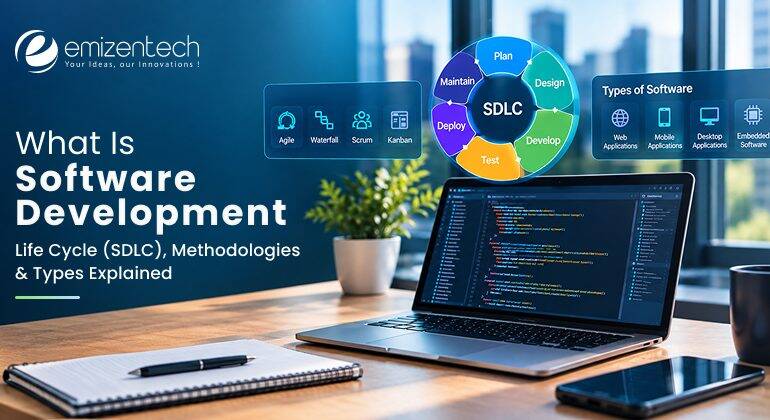
The System Development Life Cycle (SDLC) is a systematic process for planning, designing, developing, testing, deploying, and maintaining software applications. It provides a structured framework that guides teams through each stage of software creation, ensuring that the final product is high-quality, meets user requirements, and is delivered on time and within budget.
In simple terms, SDLC is like a roadmap for software development. It breaks down the complex task of building software into manageable, clearly defined steps, making the entire process more efficient, predictable, and transparent.
What Are The 7 Stages Of System Development Life Cycle?
The System Development Life Cycle (SDLC), a project management model, consists of seven stages, each demanding specialists from different departments and diverse proficiencies to achieve successful and best outcomes.
Tip*: Project managers should team up with dedicated software developers with the knowledge and expertise to roll out unique products aligning with every need, expectation, and objective.
Let’s unveil every phase of the system development life cycle with the associated tasks that should be attained.
1. Planning
The base of the entire SDLC, the planning stage, if conducted effectively, will pave a seamless pathway, ensuring flawless execution of the upcoming steps.
In this stage, the team lays the groundwork:
-
Address the issues the new software aims to target and resolve,
-
Identify stakeholders, including project managers, developers, executives, and end-users,
-
Check if the project is feasible, considering various factors like timelines, deliverables, and milestones, and
-
Point out the potential risks.
Thus, this stage defines the blueprint of software development. The project manager estimates time frames and deadlines for every SDLC phase, ensuring faster time to market.
2. Software Analysis
In this SDLC phase, the objective is to understand the existing software (if applicable) and define the new software’s requirements.
In this phase, the team members:
-
Accumulate information about the current software, business processes, and pain points using surveys, interviews, and document reviews,
-
Identify specific problems and requirements the new software will address, including functional and non-functional needs,
-
Prioritize the identified requirements based on feasibility and importance,
-
Document the entire analysis process in a Software Requirements Specification (SRS) document.
This way, developers gain a clear understanding of the system’s purpose and the problems to solve, helping reduce the chances of rework or misunderstandings in later stages.
3. Software Design
After gathering the necessary requirements, it’s time to bridge the gap between software needs and actual outcomes.
The team of UI designers:
-
Get a detailed understanding of technical aspects like software components, hardware, databases, and how they interact—essentially blueprinting the software,
-
Craft prototypes and mockups to present layouts, user flows, and menu structures,
-
Determine how data will be managed, accessed, and stored in the system, including database design, security protocols, and data structures.
These details are then documented through UI mockups, diagrams, and data flowcharts. This step enhances efficiency, ensures smoother development, and reduces potential errors.
4. Software Development
In the SDLC, the software development or implementation phase brings the plan to life, turning designs into a functioning product.
Now, developers translate UI mockups, prototypes, and data flow diagrams from the design phase into real code. The choice of programming languages and tools depends on the system’s specific requirements.
In this phase, developers:
-
Write code for different software components to ensure the expected functionality,
-
Create modules, classes, and functions according to software architecture,
-
Follow coding standards and best practices to maintain code quality, readability, and scalability,
-
Integrate third-party systems or APIs to enhance performance.
A well-executed development phase ensures a smooth transition to testing. The focus is to prevent issues that may arise in later stages.
Tip*: Developers should collaborate across different modules, use version control systems to avoid conflicts, and ensure everyone stays aligned.
5. Software Development Testing
Now it’s time to verify that the software performs as expected and meets defined user goals.
This testing process addresses glitches, defects, bugs, and vulnerabilities. It often takes more time than the development phase due to the depth of evaluation.
Next, developers fix the identified issues and prepare the software for deployment.
Through this phase, businesses ensure a bug-free, high-performing software product.
6. Deployment
In the deployment phase of the SDLC, the software is prepared for release and made available to the end-users.
In this stage, experienced developers:
-
Install the software along with required hardware and software on designated servers or user machines, and migrate existing data if necessary,
-
Provide user training through tutorials, manuals, or workshops to ensure proper adoption,
-
Conduct final validations in the real user environment to detect compatibility issues or last-minute bugs,
-
Launch the software either gradually or at once, depending on project complexity and organizational strategy.
This stage guarantees a smooth shift from the current software to the new one without disrupting business operations.
Tip*: Strong communication between developers, stakeholders, and users is crucial here to gather feedback, identify issues, and ensure successful rollout.
7. Maintenance
The final step of the System Development Life Cycle is maintenance, which ensures the software runs smoothly post-deployment.
The development team:
-
Responds to user-reported issues by analyzing and fixing bugs,
-
Releases software updates to improve functionality, strengthen security, and add new features as needed,
-
Continuously monitors software performance and tracks metrics to identify areas for improvement.
This post-launch phase is essential to ensure the software remains relevant, secure, and efficient over time.
How Is The System Development Life Cycle Different From The System Design Life Cycle?
The critical difference between the System Development Life Cycle and the System Design Life Cycle relies on their scope and objective.
System Development Life Cycle
SDLC is a big picture incorporating the complete lifecycle of a system/software, from its conception to deployment and beyond. It consists of 6-7 steps: planning, analysis, design, development, testing, deployment, and maintenance.
The goal is to offer a well-structured framework for the entire development process management, leading to a customer-centric and high-quality system.
System Design Life Cycle
The process aims to design factors that are a part of the system development life cycle. Its objective is the system’s creation and functionality. It incorporates phases like initial design, detailed design, coding, testing, and maintenance. The goal is to define the technical specifications and software’s architecture to ensure the functional and non-functional needs are met as identified in the SDLC.
| Feature | System Development Life Cycle (SDLC) | System Design Life Cycle (SDLC) |
| Focus | The entire lifecycle of an information system. | Design factors within the broader SDLC. |
| Scope | Broad – embrace every stage from conception to retirement. | Narrow – aims to determine how the software will be designed. |
| Stages | Generally, 6-7 stages (planning, analysis, design, development, testing, implementation, maintenance). | Often emphasizes various design stages (preliminary design, detailed design, implementation, testing, maintenance). |
| Goal | Offers a structured framework for handling the comprehensive development process. | Defines the software’s technical details and architecture. |
Here, we have showcased the differentiation between both in a tabular form for better understanding.
6 System Development Life Cycle (SDLC) Methodologies
Now, jump onto the core methodologies of the SDLC. Following these, you can ensure the delivery of a desirable model embracing unique features and characteristics. Most project managers and developers consider their project needs and expected outcomes while choosing one of such approaches.
1. Waterfall Model
This traditional method works on a linear sequence where every stage needs to be completed before jumping to the next one.
Key Characteristics
- Structured and Phased
- Extensive Documentation
- Limited Iteration
- Testing After Development
Best For:
- Clear and Stable Project Needs
- Simple Projects
- Aim at Documentation
Limitation:
- Inflexible for Evolving Needs
- Expect Potential Issues
- Delayed User Feedback
2. Agile Model
This iterative approach pays attention to adaptation and flexibility. Projects are segmented into short sprints (development phases), with constant testing, feedback accumulation, and enhancement throughout the development cycle.
Key Characteristics
- Iterative Development
- Cross-Functional Teams
- Continuous Improvement
- Aim at Customer Feedback
Best For
- Changing Project Needs
- Complex Projects
- Quick Prototypes
Limitations
- No Upfront Planning
- Scope Creep
- Heavy Dependency on Communication
- Challenging Documentation
3. Iterative Model
This software development model creates the software in increments, with every iteration including design, development, testing, and user feedback phases. It permits early feedback and correction but results in rework if changes occur later.
Key Characteristics
- Incremental Development
- Flexible and Adaptable
- Aim at Feedback
- Reduced Risk
Best For
- Early User Feedback
- Complex Projects
- Evolving or Unclear Requirements
- Risk Mitigation
Limitations
- Rework
- Scope Creep
- Not Good for Simple Projects
- No Clear or Up-to-Date Documentation
- No Proper Project Management
4. Spiral Model
The risk-driven model fuses the elements of iterative and waterfall models. The project advances through cycles including planning risk assessment, evaluation, and prototyping.
Key Characteristics
- Iterative and Phased
- Combines Agile and Waterfall Principles
- Risk-Driven
- Prototyping
Best For
- High-Risk Projects
- Evolving Project Needs
- Large and Complex Projects
- Combination of Planning and Adaptability
Limitations
- Costly
- Complexity
- Overly Repetitive
5. V-Shaped Model
This rigorous system development life cycle approach focuses on verification and validation. Development and testing progress in a synchronized V-shaped. Testing plans are crafted with development stages, ensuring a deep testing process.
Key Characteristics
- Verification and Validation
- Sequential Stages
- Strict Quality Control
- Documentation-Driven
Best For:
- Strict Regulatory Requirements
- Safety-Critical Systems
- Well-Defined Requirements
Limitations
- Time-Confusing
- Potential Rework
- Inflexible for Evolving Needs
- Limited User Input
6. Big Bang Model
It’s a high-risk, swift software development model with minimal planning or structure. Best for projects looking for reliability, quality, and scalability.
Key Characteristics
- Rapid Development
- Minimal Planning
- Uncertain Result
- Limited Structure
Best For
- Simple Projects with Clear Requirements
- Learning Exercises
- Proof of Prototypes or Concepts
Limitations
- Poor Quality
- Not Scalable
- High Risk of Failure
- Maintenance Challenges
As you have read, using different software development methodologies depends on specific project needs, vision, and characteristics. Knowing the structures and variations of every mode can help you choose the one that best suits your project.
Benefits of System Development Life Cycle (SDLC)
By following the SDLC methodology, businesses can significantly improve the efficiency, quality, and success of their software development projects.
Let’s explore some major advantages of using SDLC:
1. Clearer Communication and Collaboration
The SDLC framework establishes well-defined roles, responsibilities, and communication channels among stakeholders—developers, designers, testers, project managers, and clients. This fosters strong collaboration and ensures everyone remains aligned throughout the development process.
2. Enhanced Product Quality
A step-by-step and structured approach ensures the final product meets user expectations and functions as intended. The defined stages of SDLC help detect and eliminate bugs early, resulting in a more robust and reliable system.
3. Reduced Risk
By identifying and addressing potential risks during the planning and design stages, SDLC minimizes the likelihood of major issues down the line. This proactive approach results in fewer failures and a more stable software product.
4. Cost-Effectiveness
Although SDLC involves upfront planning and documentation costs, it ultimately reduces expenses by preventing costly errors, rework, and delays. It helps keep the project within budget by managing resources wisely.
5. Improved Project Management
SDLC provides a clear development roadmap by dividing the entire process into defined stages with measurable outcomes. This ensures better time management, resource allocation, task tracking, and risk mitigation—resulting in more efficient project execution.
In short, the SDLC offers a reliable framework that takes a software product from concept to launch—and beyond. It ensures high-quality, user-focused solutions that align with business goals.
Disadvantages of System Development Life Cycle (SDLC)
While the SDLC approach brings several benefits, it also comes with certain limitations, especially if not tailored correctly to the project’s nature and scale.
1. Time Consumption
The structured and sequential nature of SDLC can be time-consuming, particularly for large or complex projects. Initial stages like planning and analysis may prolong the development timeline.
2. Diminished Flexibility
Some SDLC models—especially Waterfall—are rigid and difficult to modify once the project is underway. Adapting to evolving requirements can be challenging and may result in delays or rework.
3. Limited User Involvement
In several SDLC stages, especially the initial ones, user feedback is minimal. This may lead to the final product missing essential user needs or preferences due to insufficient involvement.
4. High Upfront Costs
Extensive planning, documentation, and requirement analysis demand a considerable initial investment. For smaller businesses or projects with limited budgets, this can be a concern.
5. Not Suitable for All Projects
SDLC is often too detailed or resource-intensive for small-scale or fast-track projects. It’s best suited for medium to large projects where clear documentation, structure, and long-term scalability are required.
Tip*: To minimize these drawbacks, it’s essential to choose the right SDLC model—such as Agile, Iterative, or Spiral—based on your project’s size, complexity, timeline, and flexibility needs.
Best Practices And Considerations In SDLC
Consider best practices in the system development life cycle to avoid the challenges and relevant issues and make the best of this development process.
1. Project Management Techniques
You can acknowledge effective project management as the backbone of attaining a successful SDLC.
It includes the below techniques:
- Transparent project goals and scope
- Detained work breakdown
- Use of valuable tools for resource allocation
- Consistent project monitoring and risk handling
- Clear communication channels
Outcome: Successful project delivery within budget and timeline.
2. Quality Assurance And Testing Strategies
You should perform rigorous QA and testing to hand over the best-quality software.
It includes:
- Clearly defined testing criteria and objectives
- Better testing methodologies implementation
- Automating mundane tests to improve consistency and save time
- Track defects and offer resolutions
- Include testers in the early phases of the development process
Outcome: An efficient testing strategy assists in identifying bugs and fixing them, suppressing them so they get enlarged later.
3. Change Management And Version Control
In software development, you can’t block the road of changes; they are uncertain, and you must consider them. For seamless change management, you need version control:
- Create a transparent process for requesting, analyzing, and approving changes.
- Leverage the version control systems to track codebase modification.
- Convey every change to stakeholders effectively.
- Smoothly implement rollback process if caught up with unexpected issues.
Outcomes: Well-organized development and reduced risk of new errors.
4. Security Considerations In Development
While developing a system/software for your company, you should prioritize security.
It includes:
- Identify potential risks through security threat modeling.
- Implement secure development rules and coding practices.
- Routine security audits and penetration testing
- Creating security awareness among team members
- Follow secure data transmission and storage practices
Outcomes: A more secure software less exposed to vulnerabilities.
Why Choose EmizenTech For Software Development Services?
Partnering with a leading software development company will provide access to a team of skilled developers holding a proven track record of successful projects.
Finding the one that best fits your project needs and objectives would be challenging in the crowd of numerous reliable companies offering custom software development services.
You should opt for EmizenTech, one of the trusted software development firms with a decade of experience and an engaging portfolio.
Why choose EmizenTech?
The company properly follows SDLC to build a high-quality software product that meets customers’ expectations and objectives. In turn, businesses can catch up with increased sales and revenue by launching such software.
Here, we have listed some captivating points about the company that can convince you of your decision to pick it.
Key Highlights of EmizenTech
- Competitive Pricing
- Clutch Awarded
- On-time Delivery
- Faster-time-to-market
- Ongoing Support and Maintenance
- Proven Track Record
Conclusion
While wrapping up, let’s briefly talk about what we have learned. SDLC provides a helpful framework for software development, but you can accept it as a one-size-fits-all solution. By understanding the advantages and disadvantages of the System Development Life Cycle, you can make a well-informed decision about how to reap the benefits of this development process, choosing the suitable model and considering the best practices on your way to building a successful system.
Still, finding yourself in a muddle?
No to fret.
Hire a software development company, put forth your budget, requirements, scope, and every relevant information, and sit back and witness the progress of the development process to a successful system.
Connect with us and start your software development project now!
Frequently Asked Questions
The SDLC (System Development Life Cycle) is crucial because it provides a structured approach for planning, creating, testing, and deploying software. This helps ensure high-quality, efficient, and cost-effective software production.
The main 7 phases of the SDLC are:
1. Planning
2. Requirements Analysis
3. Design
4. Development
5. Testing
6. Deployment
7. Maintenance
Typically, developing a system/software can take between 12 to 20 weeks, depending on the project’s complexity and scope.
The cost to build a system/software can range from $10,000 to $300,000, influenced by factors like project size, features, technology stack, and development team.
Choosing the right SDLC model depends on project requirements, team size, client involvement, project complexity, and flexibility needed. Consider models like Waterfall for linear projects and Agile for iterative, adaptive projects.



 +1 (989) 535-9295
 info@emizentech.com
 emizentech


