
 Add us as a preferred source on Google
 Hiring in tech looks different than it did even two or three years ago. Job boards alone don’t get you good candidates anymore, and old-school recruiting cycles are too slow for how fast tech teams need to move. Tech leaders today are competing on speed, on how good the hiring experience actually feels to a candidate, and increasingly across borders and time zones too.
Talent acquisition trends 2026 data backs this up: openings are picking up again, hiring is getting pickier, and AI has quietly gone from “something we’re testing” to just how recruiting works now.
This piece walks through the talent acquisition trends actually reshaping tech hiring this year, why the old playbook keeps falling short, and where dedicated development teams fit into the picture. If you’re hiring or scaling a tech team right now, this should be useful.
The 6 Major Talent Acquisition Trends Reshaping Tech Hiring
Six things are driving the talent acquisition trends tech leaders can’t really ignore this year. Recruiting in 2026 just doesn’t look like recruiting in 2021, and here’s why.
Trend 1: AI-Driven Sourcing & Autonomous Candidate Screening
AI in talent acquisition has gone way past the old resume-scanning chatbots. There are AI-powered interview platforms now that run agents that source passive candidates, rank them, book interviews, and flag concerns, mostly without a human touching each step. Korn Ferry’s 2026 research found 52% of talent leaders plan to add AI agents to their teams this year. Worth a caveat, though: lean on it too hard and you’ll filter out good people whose resumes just don’t match the pattern a model learned. Treat it as a first pass, not the final word.
Trend 2: The Shift to Skills-Based Hiring Over Degrees & Credentials
Degree requirements are quietly vanishing from technical postings, and honestly, it makes sense. A CS degree doesn’t tell you whether someone can actually debug a production issue at 2 a.m. Skills-based hiring leans on portfolios, take-home tasks, live coding, and real proof instead of a transcript. It also opens the door wider; self-taught developers and career-switchers now compete on equal footing with traditional grads, as long as they can show the work. Job descriptions are following suit, built around tasks, not checklists.
Trend 3: The Surge of Global Sourcing & Dedicated Remote Teams
Remote hiring trends have basically torn up the old map. Companies aren’t limiting a search to whoever can commute to the office anymore; they’re sourcing from India, Eastern Europe, and Latin America, often through a dedicated team rather than a scattered pile of freelancers. It’s not purely a cost play either; it’s about reaching specialized skills that are just scarce in saturated markets like the US. Teams exploring this option often start by looking to hire mobile app developers from an already-vetted team instead of running a six-month solo search.
Trend 4: Employer Branding & Candidate Experience as Core Differentiators
If two companies offer similar pay, the one with a faster, less painful hiring process wins the candidate, every time. Ghosting people, dragging interview loops out for weeks, and vague job posts; it all quietly costs you good hires. Employer branding, honest salary ranges, and just being consistent about communication have turned into a real competitive edge, not some side HR project. Candidates now vet a company’s engineering culture the same way they’d check reviews before buying something, and word travels fast in small technical circles.
Trend 5: Internal Talent Mobility & Upskilling Pipelines
Sometimes the fastest hire isn’t external at all. More tech companies are building mobility programs so existing employees can move into open technical roles after some structured upskilling, instead of starting from zero on the outside. It makes sense; they already know the codebase and the culture, so onboarding risk drops. There’s a retention angle too: engineers who see an actual growth path stick around longer. Posting internal roles alongside external ones, rather than filling things quietly behind the scenes, tends to boost engagement across the whole team.
Trend 6: Data-Driven Recruitment Analytics & Predictive Hiring
Talent acquisition technology trends increasingly come down to the numbers: time-to-fill, source quality, offer-acceptance rate, and predictive models that guess whether someone will actually take the job or stick around past year one. Recruiting isn’t a gut-feel job anymore; it runs on dashboards, and TA leaders who can’t back up their pipeline with data tend to lose budget fights to those who can. This feedback loop matters more than it sounds; without it, teams just keep repeating the same sourcing mistakes and never quite know why.
So, these are some of the top talent acquisition trends that tech leaders choose for hiring. Now let’s learn the main reasons that the leaders are losing interest in traditional hiring.
The Tech Talent Crunch: Why Traditional Hiring Models Are Failing
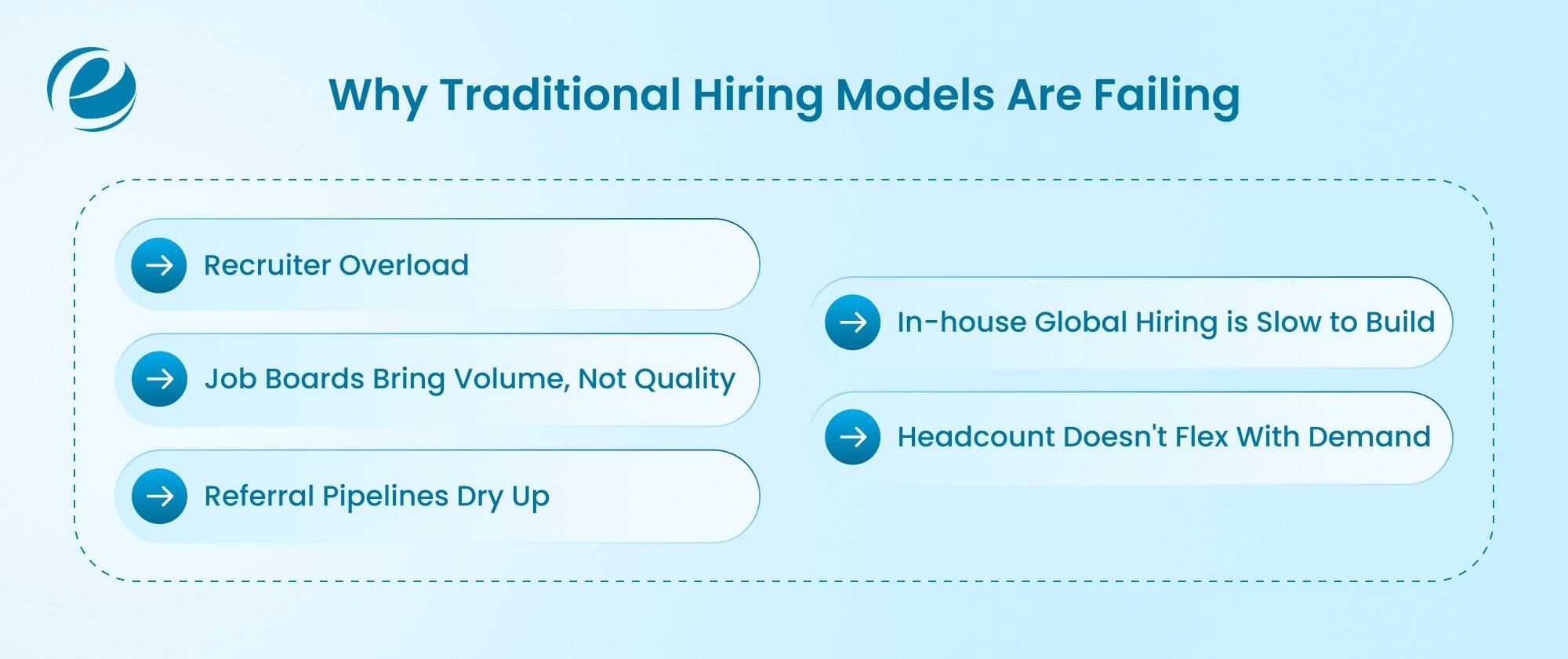
Here’s the thing about traditional hiring: it’s not really a candidate shortage problem. It’s a speed mismatch. Companies need to fill harder, more specialized roles, and old-school processes just weren’t built to move that fast. Job openings and hires have both ticked up in early 2026, but overall payroll growth has slowed to less than half of last year’s pace, meaning companies are being choosier about who they bring on.
A few things are going wrong at once, and it’s worth spelling them out:
- Recruiter overload: One person juggling ten open technical roles can’t realistically source, screen, and manage a decent candidate experience for all of them at the same time; something always slips.
- Job boards bring volume, not quality: Posting and hoping mostly gets you a pile of resumes to sort through, not the right fit.
- Referral pipelines dry up: Once a company outgrows its founders’ immediate network, that “easy hire” channel basically stops producing.
- In-house global hiring is slow to build: Payroll, compliance, and legal can eat a year and six figures before a single engineer even starts.
- Headcount doesn’t flex with demand: A launch might need six extra engineers for four months, or a compliance deadline needs a specialist for one quarter, and permanent hiring just isn’t built to move that fast in either direction.
That combination is exactly why flexible models, dedicated teams, staff augmentation, and fractional specialists have stopped being a stopgap and become a normal part of how mature tech companies plan headcount.
Traditional hiring assumes a fairly steady job market: a role opens, the search runs its course, and someone gets hired. Done. Most tech companies today just don’t operate on that rhythm anymore.
How Tech Leaders Adapt: Traditional Recruitment vs. Dedicated Teams
Picking the right hiring model matters almost as much as picking the right candidate these days. Here’s how the three common approaches stack up for technical hiring in 2026:
| Factor | Traditional local hiring | Freelance Portals | Dedicated Developer Teams |
| Time to hire | 6 to 12 weeks per role | 1 to 2 weeks but variable quality | 1 to 3 weeks |
| Cost structure | High: salary, benefits, recruiter fees | Low upfront, unpredictable long-term | Mid-range, fixed monthly cost |
| Skill verification | Interview-based, inconsistent | Ratings/reviews only, hard to verify | Pre-screened, technically tested |
| Scalability | Slow, one role at a time | Fast but fragmented across freelancers | Fast, add/remove team members on demand |
| Management overhead | Full HR and payroll burden | Contract and IP risk on the company | Managed by the provider |
| Long-term reliability | High once hired, but slow to build | Low, freelancers move between clients | High, dedicated to one client relationship |
| Best Fit For | Core, long-term strategic roles | Small, one-off tasks | Ongoing product development, scaling teams |
The trade-off is pretty clear once it’s laid out: traditional hiring wins on loyalty but loses on speed, freelance portals are flexible but inconsistent, and dedicated teams end up as the pragmatic middle ground for companies that need to scale without a twelve-week hiring cycle hanging over them.
None of these options are universally “right,” just to be clear. You wouldn’t outsource a VP of Engineering search to a freelance portal. But if you need three backend engineers for a six-month migration, a dedicated team usually beats restarting a whole local recruiting cycle for something temporary. The tech leaders doing this task well aren’t loyal to one model; they’re matching the model to how long the role actually needs to exist.
How Sourcing Dedicated Developers Aligns with Modern Talent Trends
Dedicated development teams line up with basically every trend covered so far. They solve the skills-based hiring problem by handing you engineers who’ve already been tested on real work, not resumes. They solve the global sourcing angle by opening up talent pools outside your local market instantly.
And they solve the speed problem crushing traditional recruiting. Right now, a dedicated team can usually be onboard in one to three weeks, versus the two or three months a full-cycle hire typically takes. For CTOs who need to move without cutting corners on quality, the option to hire dedicated developers through a dedicated team has become one of the more dependable ways to keep a roadmap on track while the labor market stays tight.
In the next section you will learn about the steps you can follow to implement a modern talent acquisition strategy, but before that it’s worth checking the cost to hire dedicated developers to seek the talent pool.
How to Implement a Modern Talent Acquisition Strategy in 4 Steps?
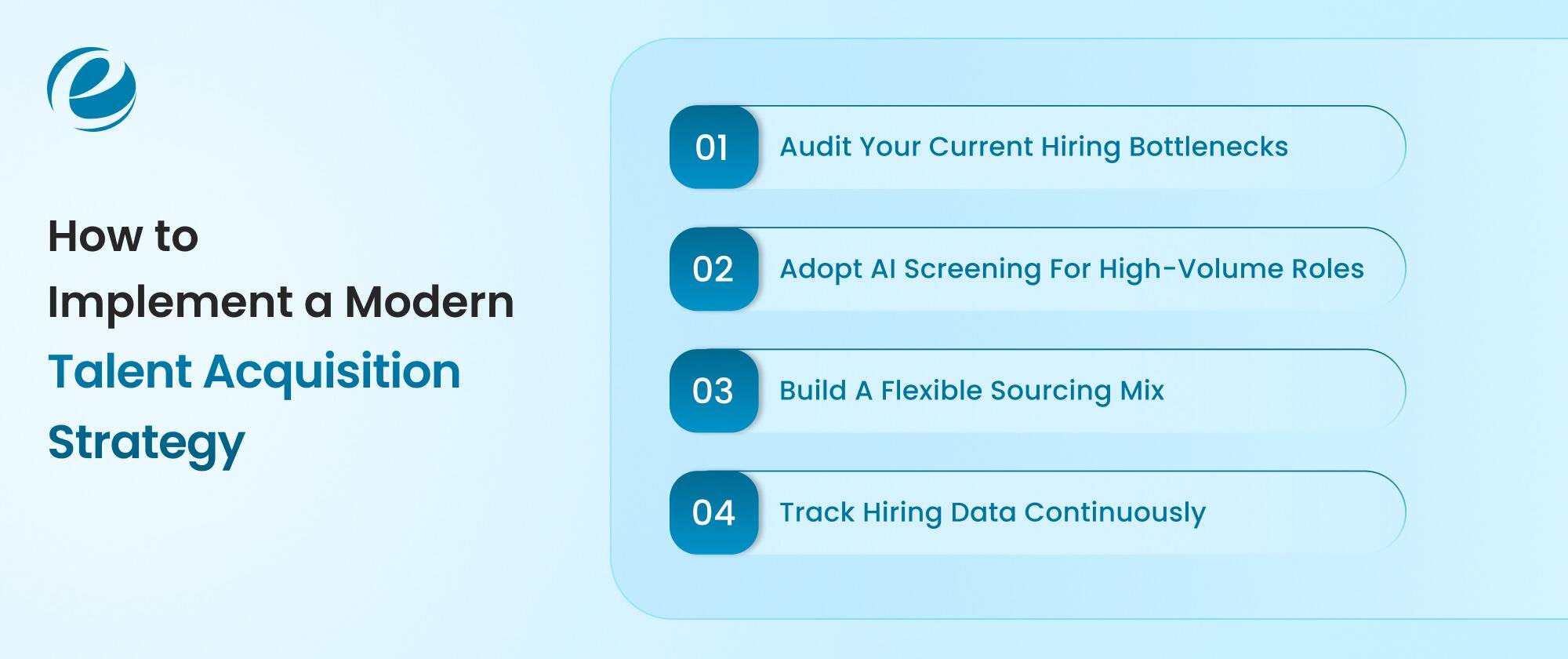
If you want to turn these talent acquisition trends into something that you can actually act on. Here are four moves that you should implement the strategies with:
- Audit your current hiring bottlenecks: Figure out where roles actually stall, sourcing, screening, scheduling, and offer negotiation, before you throw new tools or headcount at the problem.
- Adopt AI screening for high-volume roles: Use automated assessments and AI-assisted sourcing where applicant pools are huge, so recruiters can spend their time on the senior, high-stakes conversations instead.
- Build a flexible sourcing mix: Blend internal mobility, direct hires for the core strategic roles, and dedicated or augmented teams for anything specialized or short-term.
- Track hiring data continuously: Monitor time-to-fill, offer-acceptance, and quality-of-hire so decisions are based on actual numbers, not a hunch.
So, these are the four steps that are basically the strategic trends in talent acquisition that can separate companies stuck reacting to openings from ones running a repeatable pipeline to easily hire dedicated development team.
Why Tech Leaders Partner with Emizentech to Build High-Performing Teams?
Emizentech works with tech leaders who need engineering capacity without dragging out a traditional hiring cycle. Instead of a months-long hunt for one hard-to-find specialist, companies can plug into a pre-vetted pool of developers, mobile engineers, and full-stack teams ready to start in days.
Our developers offer a middle path for anyone considering IT staff augmentation trends instead of building an in-house team from scratch, providing dedicated talent and flexible contracts with direct oversight, all without the payroll and compliance burdens of hiring full-time in a new market. Teams scaling quickly can read more on staff augmentation and how it closes gaps traditional hiring just can’t move fast enough for.
What tech leaders bring up most is the drop in hiring risk. Instead of betting a whole quarter on one candidate search that might not even close, they can bring in a working developer or team within days, judge them on real deliverables, and scale up or down as the project actually needs.
Conclusion
The talent acquisition trends shaping 2026 all point in the same direction: hiring is getting more selective, more automated, and a lot more global, and the global companies building remote development teams are the ones actually changing how they source, not just rewriting job descriptions.
Whether that’s AI-driven screening, skills-based evaluation, or leaning on dedicated developers to fill gaps in-house teams can’t, the goal stays the same, filling critical roles fast without settling on quality. For tech leaders trying to keep up, treating talent acquisition trends as a real strategic input, not an HR afterthought, isn’t optional anymore.
FAQs
What are the top talent acquisition trends in software engineering?
The leading trends are AI sourcing and screening, skills-based hiring over degree requirements, global and remote team sourcing, stronger employer branding, internal upskilling pipelines, and predictive recruitment analytics guiding hiring decisions.
How does hiring a dedicated development team solve talent acquisition challenges?
The dedicated teams provide technically tested engineers who can onboard within weeks instead of months, solving the speed, skill-verification, and global access problems that slow down traditional in-house technical hiring.
What is skills-based hiring in technical recruitment?
Skills-based hiring evaluates candidates through coding tests, portfolios, and practical assessments instead of degrees or certifications, giving hiring managers direct proof of a candidate's actual technical ability before making an offer.
How fast can Emizentech deploy dedicated developers to augment our team?
Emizentech typically onboards pre-vetted developers within one to three weeks, depending on the technical stack and role complexity, allowing engineering teams to scale capacity without running a full external hiring cycle.




 +1 (989) 535-9295
 info@emizentech.com
 emizentech


