
 Add us as a preferred source on Google
 With the increasing pace of life in the healthcare sector, telemedicine app development has become a vital tool that facilitates interaction between patients and physicians at any time and from any place.
It has become the most demanded service among hospitals, medical clinics, and startup companies because of the growing popularity of remote treatment solutions.
Besides, developing a telemedicine application can save a lot of time, increase the quality of treatment, and make medical services available to many areas.
This comprehensive guide will walk you through everything you need to know about telemedicine app development, from features and costs to future trends and monetization strategies.
What Is Telemedicine App Development & Why Is It Important in 2026?
Telemedicine application development includes all facets involved in designing, building, and managing mobile and web applications that allow patients to interact with healthcare professionals from afar. These apps are a way for healthcare providers and patients to communicate better. They allow patients to receive healthcare more easily.
The importance of telemedicine will be undeniable. Here are some of the reasons:
- Widespread Adoption: The rising Popularity of Telemedicine Makes Blending In-Person Care and Virtual Care Easier Than Ever
- AI & Efficiency: Smart tools to enhance efficiency for doctors via documenting notes, analyzing data, and making fast diagnoses for patients.
- IoT Monitoring: Enable Remote Monitoring of Patients via Wearable Technology. Provide the ability to receive up-to-date patient data for proactive patient care with ease.
- Better Access & Savings: Patients get care anywhere, reducing costs and improving outcomes.
- Patient-Focused UX: Easy-to-use apps keep appointments, messaging, and data secure.
With increasing healthcare costs and changing populations of patients requiring new expectations, telemedicine apps have transitioned to a needed part of modern healthcare delivery. The global telemedicine market continues to grow rapidly, reaching USD 156.31 billion in 2026, which clearly shows how quickly virtual healthcare is becoming a core part of modern medical systems.
Types of Telemedicine Apps & their Use Cases
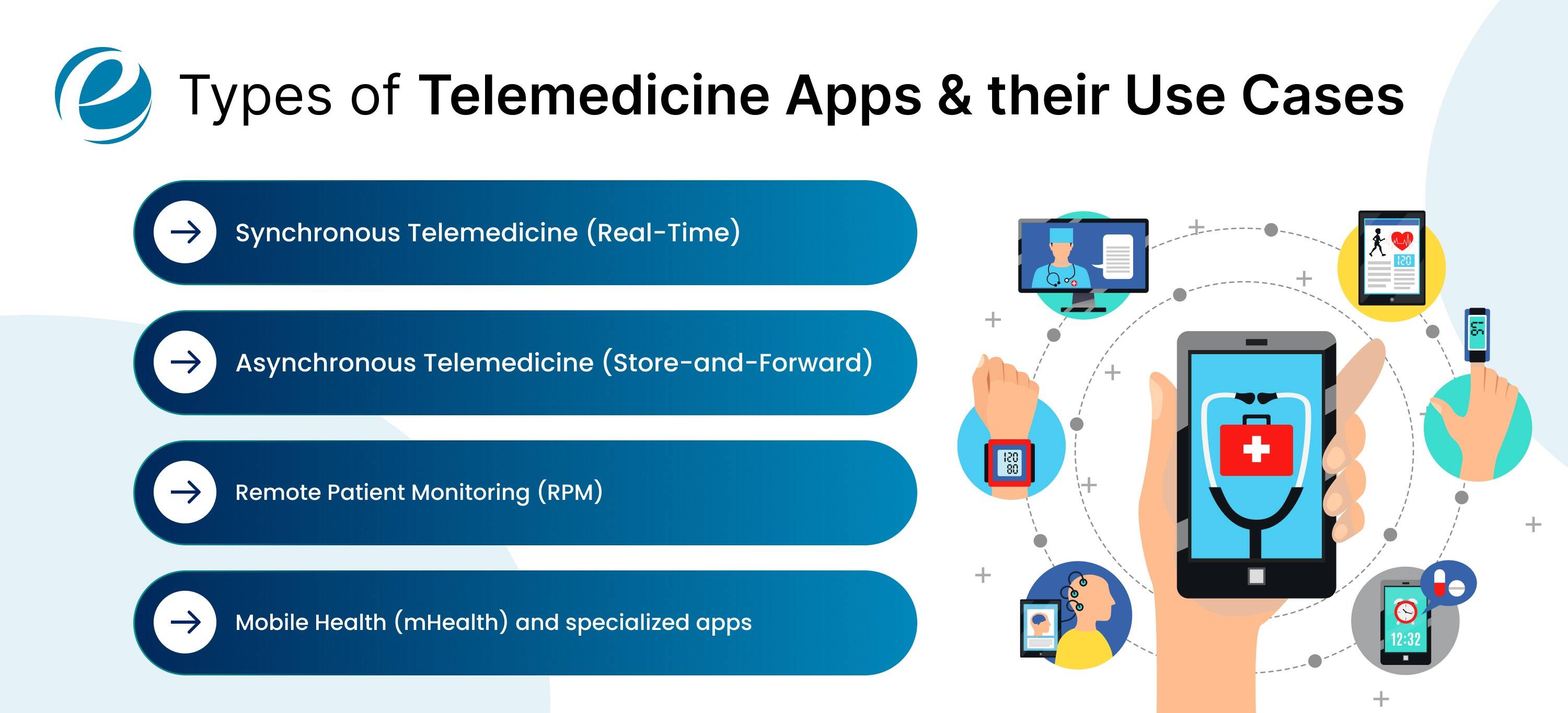
Different types of telemedicine apps exist, each serving its specific purpose. Familiarity with these app types will help you decide which to use based on your target group. Here is a general breakdown:
Synchronous Telemedicine (Real-Time)
This type of telemedicine enables real-time audio/video communication between patients and doctors.
Use cases: For instant medical consultation in urgent but non-emergency situations.
Asynchronous Telemedicine (Store-and-Forward)
This process involves uploading patient information to be reviewed by their physician at a later time.
Use cases: For remote dermatology or radiology consultations.
Remote Patient Monitoring (RPM)
These allow for monitoring of vital signs such as blood pressure, glucose, and heart rate.
Use cases: include management of chronic diseases and post-operative observation.
Mobile Health (mHealth) and specialized apps
These include apps that offer other wellness-related services such as therapy and mental well-being.
Use cases: For meditation and exercise purposes.
To understand how these categories fit into real-world solutions, you can explore a more detailed breakdown of healthcare app development.
Must-Have Features of a Telemedicine App
Telemedicine apps only really work when the core features are done right. That’s what keeps things smooth, secure, and easy for both patients and doctors. Here’s what most solid telemedicine apps include:
- User Registration & Profiles: The registration process should not be difficult at all. Simple and secure patient profiles can hold necessary medical data easily.
- Doctor Search & Filters: People don’t want to scroll endlessly. Filters like specialty, availability, and ratings make finding the right doctor much easier.
- Appointment Scheduling: Booking an appointment should take a few taps. Rescheduling or cancelling should be just as simple.
- HIPAA-Compliant Messaging & Chat: Doctor-patient chats need to stay private. Secure messaging isn’t a bonus feature—it’s expected.
- EHR Integration: When doctors can quickly see records, consultations feel more informed and less repetitive.
- E-Prescriptions: No one likes dealing with paper prescriptions anymore. Digital ones just make life easier.
- Payment Gateway Integration: It is important that transactions be efficient and secure without any additional barriers being placed in the way of the transaction.
- Notification and Reminder Services: Sometimes, a little push is all that is needed to encourage an individual to adhere to their schedule or medication regimen.
- User-Friendly User Interface (UI/UX): Ultimately, when the application is intuitive, individuals will have no problem continuing to use it.
For a more structured breakdown of planning, features, and execution, a telemedicine app development guide can be very helpful in understanding how these features come together in a real product.
Advanced Features That Separate Good Apps from Great Ones
- Wearable Device Integration: When apps connect with wearables, health tracking becomes more continuous. It’s not just one-time data; doctors can actually see patterns over time.
- Multi-language Support: Not everyone is comfortable with one language. Adding multiple options just makes the app easier to use for a wider group of people.
- Blockchain for Data Security: Blockchain isn’t used everywhere yet, but it does add a stronger sense of data security. It makes manipulation of records more difficult.
- AR/VR in Remote Diagnostics: With the use of AR/VR technology, doctors can have visual representations of medical conditions either through overlays or via virtual environment simulation.
HIPAA and Healthcare Compliance in Telemedicine App Development
Compliance with healthcare regulations is essential when developing a telemedicine application. This is more than just following regulatory guidelines. Instead, it influences how secure patients perceive the telemedicine platform.
Key Regulations to Consider
- HIPAA (USA): It is mainly concerned with the protection of the privacy of patients’ information.
- GDPR (Europe): It deals with the use of personal data by ensuring consent for its usage.
- HL7 & FHIR Standards: Facilitate the sharing of data between various healthcare systems without data being lost or stuck between systems.
Best Practices
- End-to-end encryption: Keeps data protected while it moves between users and systems.
- Secure data storage: Helps reduce the chances of data leaks or unauthorized access.
- Role-based access control: Ensures that only authorized personnel have access to confidential data.
- Regular security audits: Just a simple review process to help identify potential issues that might arise in the future.
Tech Stack for Telemedicine App Development
Selecting the appropriate technology stack is an important decision that influences how your application will perform, scale, and impact users. In terms of custom telemedicine app development, choosing the right stack is especially significant when customizing the product to meet certain requirements. Here is an overview of commonly used technologies:
Front-end Development (User Interface)
React Native and Flutter are two of the most popular choices when developing applications that work on multiple platforms. Developers prefer Kotlin for Android, while Swift is used for better optimization and control on iOS.
Back-end Development (Server-side)
Developers frequently use Node.js, Django, and Ruby on Rails to implement business logic and manage request processing.
Databases and Storage
PostgreSQL and MongoDB handle different types of healthcare data well, whether it’s structured records or flexible datasets.
Critical Telemedicine Integrations
Tools like Twilio and Agora are widely used for real-time video calls. They basically power the consultation experience.
Infrastructure and Security
Platforms like AWS HealthOmics and Microsoft Azure help with secure hosting and scaling as the app grows.
Development Tools & DevOps
Docker and Kubernetes make scaling easier, while Jenkins and GitHub Actions help automate testing and deployment.
To build a scalable and future-ready solution, it’s important to align these technologies with proven mobile app development practices that ensure performance, security, and seamless user experience.
Step-by-Step Telemedicine App Development Process
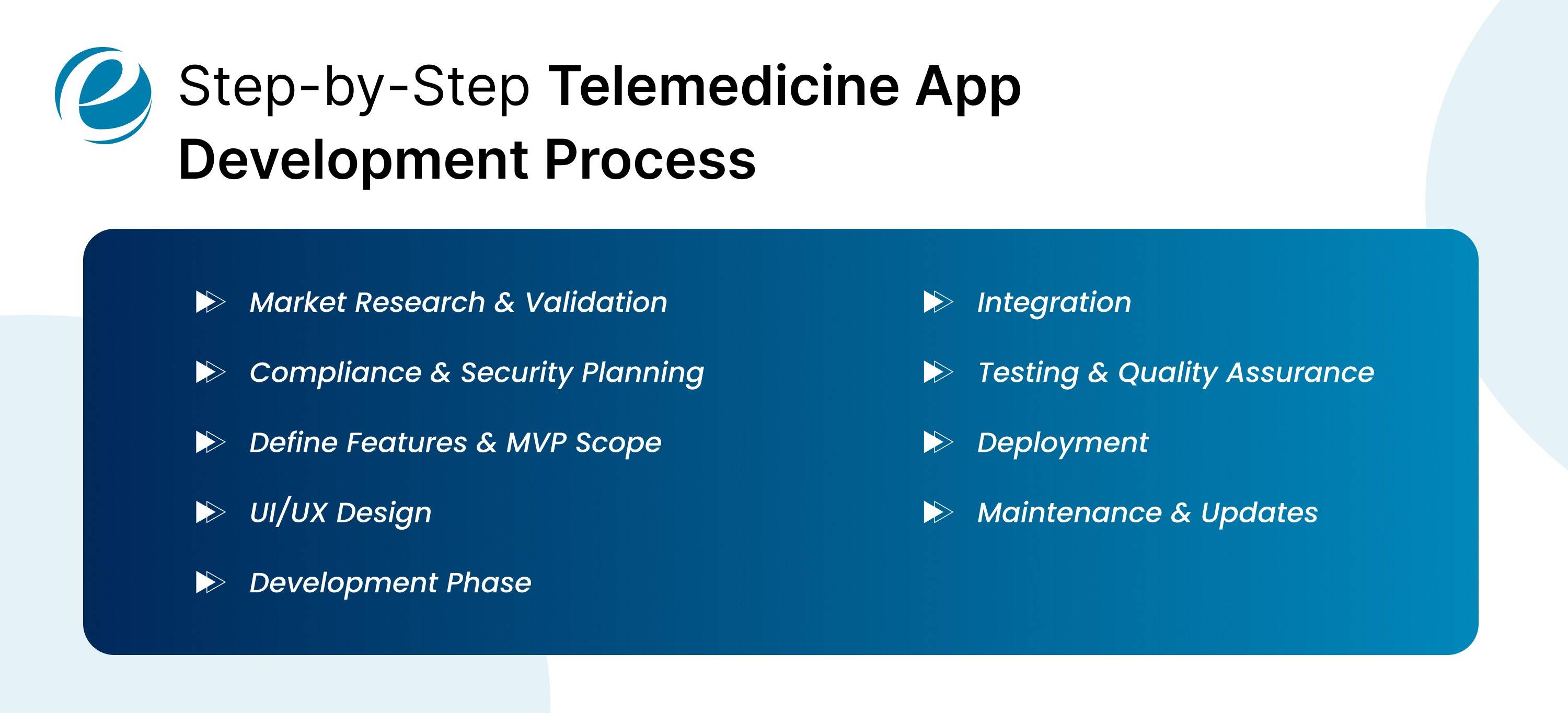
Creation of a telemedicine app requires adherence to a systematic process, which is bound to ensure the success of the software development. In case you wonder how to develop a telemedicine app, you should consider taking a certain approach, and there will be several phases in it. Below is a list of a few of the stages of telemedicine app development:
- Market Research & Validation: Understanding users’ needs, competitors, and gaps in the current market will help you validate your idea before committing to building it.
- Compliance & Security Planning: Ensure HIPAA/GDPR alignment and end-to-end encryption for data safety.
- Define Features & MVP Scope: Defining the essential features and determining what will constitute the first iteration of the app will keep you on track.
- UI/UX Design: Creating easy-to-use patient and doctor interfaces for the app is key to adoption and usability.
- Development Phase: This is where the app is built, including the frontend and backend. The focus stays on performance, security, and scalability.
- Integration: Connect with third-party systems like payment gateways, EHRs, or APIs. This ensures the app functions smoothly in real scenarios.
- Testing & Quality Assurance: Adequate testing will go a long way to ensure that all errors, security flaws, and user interface problems are detected before deployment.
- Deployment: After preparation, the application is released across chosen platforms.
- Maintenance & Updates: Post-launch updates, bug fixes, and updates will ensure the continued relevance and functionality of the app.
Telemedicine App Development Cost
Telemedicine app development cost in 2026 will vary according to the complexity of its development. The following is the pricing of different kinds of telemedicine apps, with the features you get:
The more advanced your application is, the higher the cost will be.
| App Type | Estimated Cost | Features |
| Basic Application | $25,000 – $50,000 | It involves user registration, appointment management, basic video consultation, and dashboard functionality. |
| Mid-Level App | $50,000 – $120,000 | Combines some of the following elements: e-prescriptions, transactions, chats, a better user interface, and improved UX. |
| Advanced App | $120,000 to $300,000+ | Features like artificial intelligence-driven insights, patient monitoring from afar, EHR integration, & analytics. |
How Telemedicine Apps Make Money: Proven Monetization Models
The telemedicine apps leverage realistic financial strategies that make it possible for them to continue with operations while providing easy-to-access healthcare services. Below are ways in which these applications are generating income:
- Subscription-Based Model: The user pays a subscription cost periodically to avail services like consultation, follow-up, and more.
- Pay-Per-Consultation: Charges are levied per consultation, which helps accommodate people looking to consult doctors occasionally or at times.
- Freemium Model: While there will be free features, there will also be paid premium features for customers who want more advanced services.
- Commission-Based Model: This model is based on a commission earned by the platform when doctors consult with patients.
- In-App Pharmacy Sales: Sales of medicines can contribute to revenue generation within the application itself.
- B2B Licensing (SaaS): Doctors can use the application in return for licensing charges.
Future Trends of Telemedicine App Development
Some trends in the use of telemedicine can be found that keep influencing the healthcare delivery process. Telemedicine mobile app development continues to move on, and it is time to look into some of the trends that will influence the future of telemedicine. Here are some of these trends:
AI-Driven Diagnostics
AI is helping doctors spot issues earlier and sort through reports faster, making everyday decision-making a bit more efficient.
5G-Enabled Real-Time Care
With faster connections, video calls will work better than ever before.
Integration with IoT Devices
Health data is constantly collected by devices such as smartwatches, thus giving doctors a more precise idea about the patient’s condition.
Personalized Healthcare
Doctors can now offer personalized treatment plans according to each person’s health records.
Virtual Hospitals
Many services are now handled online, which reduces the need for physical visits without cutting corners on care.
Digital Therapeutics (DTx)
Software-based treatments are supporting patients, especially for long-term conditions.
Voice & Conversational Interfaces
Using voice technology in applications will make things easier, especially when making small changes or giving some help.
Why Choose EmizenTech for Telemedicine App Development
EmizenTech stands out in telemedicine app development because our experts really understand what modern healthcare needs. They build secure, scalable healthcare software solutions that actually make life easier for doctors and patients alike. With our experience in healthcare software development, we focus on creating HIPAA-compliant apps that are easy to use and packed with useful features.
Our team of experts knows how to combine mobile and web solutions with smart tools like analytics to help medical teams work more efficiently. Choosing EmizenTech means working with people who care about making telemedicine apps reliable, practical, and genuinely helpful.
Conclusion
Telemedicine app development has really changed the way healthcare reaches people: faster, safer, and more convenient for both patients and providers. This guide walks you through different app types, must-have features, compliance tips, costs, and even what’s coming next in the field.
Picking the right development partner isn’t something to take lightly, and if you need skilled help, you can hire mobile app developers to make your idea a reality. Building a solid, user-friendly telemedicine app now isn’t just smart; it’s a step toward better care and real growth down the line.
FAQs
What Kind of Telemedicine Applications Exist, and Who Uses Them?
There are patient-to-doctor, doctor-to-doctor, and hospital management telemedicine applications used by patients, doctors, and healthcare organizations.
What Advanced Features Can Set a Telemedicine Application Apart From the Competition?
Advanced features such as AI symptom checkers, EHR integration, multilingual support, remote monitoring, and personal health analytics can make a telemedicine application exceptional.
Do Telemedicine Applications Enhance Patient Engagement and Treatment Effectiveness?
Yes, telemedicine applications help consults be more streamlined, offer timely reminders, monitor health, and communicate effectively, thereby increasing patient compliance and satisfaction.
What Tech Stack Should a Developer Use to Create a Telemedicine Application?
The most reliable tech stack is React Native/Flutter, Node.js, Python, cloud-based hosting services, video communication APIs, and payment gateway integration.



 +1 (989) 535-9295
 info@emizentech.com
 emizentech


