 Add us as a preferred source on Google
 Wholesale website design has become a business imperative for B2B companies that want to modernize their sales capabilities and remain competitive. This is especially important as global eCommerce sales are projected to reach $8.5 trillion by 2026, showing a 56% increase from 2018, highlighting the rapid growth of digital commerce and the increasing expectations of buyers.
This means that if companies do not optimize their online presence, they run the risk of losing customers to those that have a better user experience and digital self-service capabilities. A wholesale website helps companies simplify the process of bulk purchases, tiered pricing, and complex business operations.
This blog will walk you through wholesale website design, its essential features, compare B2B versus traditional ecommerce, examine costs and tech stacks, for designing high‑performing wholesale sites.
What Is Wholesale Website Design and Why Do Businesses Need a Purpose-Built Website?
Wholesale web design is concerned with creating websites dedicated to companies that deal with the bulk selling of goods or products to other organizations, such as distributors or retailers. stores rather than individuals. This type of web design is geared towards managing large amounts of orders and providing solutions for the bulk sale of goods. It takes into account several issues, including minimum order quantities, tiered pricing, and account management capabilities for registered buyers. In addition, it provides an easy way of ordering and reordering the desired products.
Here’s why businesses need a purpose-built website:
- Professional and tailored websites make a strong first impression, as 84% of consumers believe that a website makes a business appear more credible compared to social media alone.
- Companies can use their website to encourage customers to complete specific tasks or achieve particular goals, eliminating confusion.
- Having a website that’s built from the ground up means that businesses can ensure that their website loads quickly and that it’s optimized for SEO.
- Businesses can have a unique identity that differentiates them from their competition, as opposed to having a “lifeless” look that comes with templates.
Key Features Every Wholesale Website Should Have
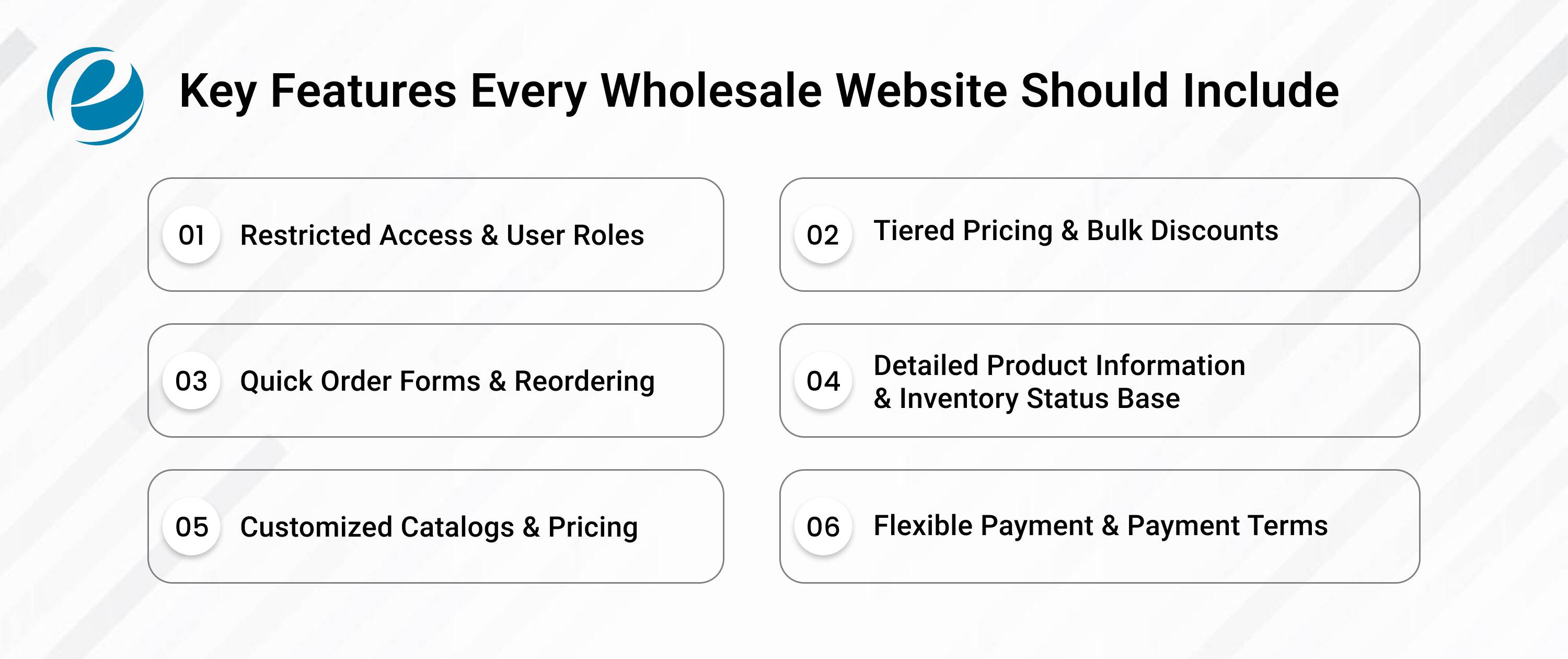
Using the best website builder for wholesale can make it much easier to implement essential features. Below are the basic features that should be incorporated in a wholesale website design.
- Restricted Access & User Roles: This feature ensures that information, e.g., prices, stock, and account information, is not accessible to just anyone but to authorized wholesale customers and business clients.
- Tiered Pricing & Bulk Discounts: The website can have tier pricing, which helps businesses manage bulk discounts and negotiated pricing for their customers.
- Quick Order Forms & Reordering: Features such as CSV uploads or quick SKU entry fields enable buyers to add multiple items to their cart at once and reorder items quickly.
- Detailed Product Information & Inventory Status: Clear SKU numbers, accurate inventory levels, and good product image quality enable the buyer to make a purchase while at the same time reducing unnecessary sales calls.
- Customized Catalogs & Pricing: Buyers have the option to have their own dashboard, which helps them view their pricing, past purchases, and saved items, making it easier for them to reorder items.
- Flexible Payment & Payment Terms: Payment systems such as credit cards, purchase orders, wire transfers, and Net 30 enable B2B commerce.
Overall, these features are normally included in the enterprise eCommerce platforms designed for scalability, complex B2B operations and automation.
Wholesale Website Design vs Traditional eCommerce Website Design
Wholesale website design focuses on efficiency, bulk ordering, and long-term connections. On the other hand, traditional e-commerce, which is a B2C design, focuses on emotional appeal and quick checkout. Let’s investigate the key distinction and expand your knowledge in the section below.
| Feature | Wholesale Website Design (B2B) | Traditional E-commerce Design (B2C) |
| Primary Goal | Efficiency, volume, and reordering | Conversion, speed, impulse buying |
| User Experience | Clean, professional, built to work, not impress | Visual, engaging, lifestyle-driven |
| Pricing Display | Hidden, custom, tiered, visible only after login | Public, fixed, and the same for everyone |
| Ordering Process | Bulk orders, quick order forms, SKUs | Individual items, shopping cart, kept simple |
| Product Data | Technical specs: data-heavy buyers need the details | Emotional, lifestyle-led descriptions |
| Navigation | Search-first, filter-heavy, fast | Visual, intuitive, built for browsing |
| Security/Access | Password-protected, role-based, and not open to everyone | Open access and guest checkout available |
| Payment Methods | Net terms (Net 30/60), PO numbers, ACH | Credit cards, digital wallets, pay now |
| Backend Integration | Deep-ERP, CRM, inventory systems | Moderate- marketing tools, Shopify/Woo |
Factors That Affect Wholesale Website Development Cost
The website development cost depends on multiple factors, which range from design complexity to the development approach. Below are some of the key elements that can affect the pricing of a website.
- Website Type & Complexity: Informational websites will differ from $1,500 to $5,000, while eCommerce websites will vary from $5,000 to $50,000+, and web apps will vary from $20,000.
- Design & UI/UX: Designing completely new UI/UX, including animations and interactive features, can also require higher investments, which can vary from $5,000 to $20,000.
- Technology Stack: Creating a website using WordPress will require investments ranging from $1,500 to $30,000, while creating a website using Shopify or WooCommerce will require investments ranging from $5,000 to $20,000. Creating a completely new technology stack using React or Laravel will require investments ranging from $10,000 to $1M+.
- Development Team & Location: It will require fewer investments to hire a freelancer instead of an agency. It will also require fewer investments to hire a developer from an offshore location instead of the US.
- Additional Features & Integrations: Additional features like payment gateways, CRMs, APIs, or ERP integrations will require investments ranging from $2,000 to $ to $15,000+.
How to Build a Wholesale Website for B2B eCommerce
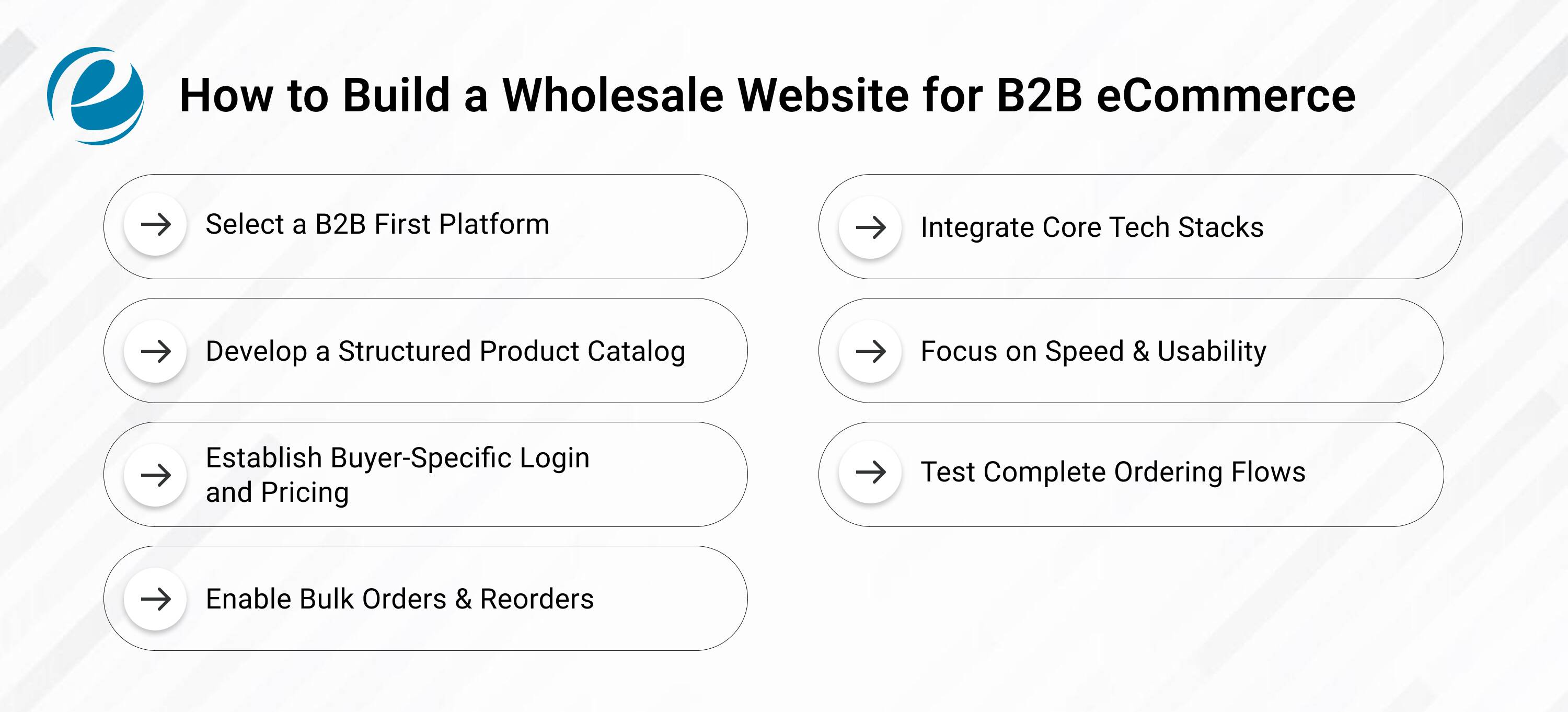
Wholesale buyers want the speed of B2C without sacrificing negotiated terms. Here’s a step-by-step guide on how to build a wholesale website that meets modern B2B needs:
- Select a B2B First Platform: Pick a solution that was built to meet B2B requirements, like personalized price lists, bulk SKUs, and buyer-specific catalogs. If your team doesn’t have the technical bandwidth, a practical guide on how to hire an eCommerce developer can help you bring in the right expertise.
- Develop a Structured Product Catalog: Develop a catalog that includes attributes, variants, case packs, and filters to make buying in bulk easy and efficient.
- Establish Buyer-Specific Login and Pricing: Use account-based access to provide negotiated prices and contracts to each buyer after login.
- Enable Bulk Orders & Reorders: Allow for rapid order entry, bulk file uploads, and one-click reorders that align with actual wholesale purchasing processes.
- Integrate Core Tech Stacks: Integrate with ERP/CRM systems for real-time inventory, correct pricing, and smooth business processes.
- Focus on Speed & Usability: Design for mobile, rapid search, simple navigation, and pain-free checkout.
- Test Complete Ordering Flows: This will simulate complete B2B ordering flows before launch to ensure that there are no issues, providing a hassle-free buyer experience.
An effective wholesale site should have speed, architecture, and business-to-business (B2B) characteristics. It is crucial to hire eCommerce developers who can create an efficient and scalable eCommerce website solution.
Common Mistakes to Avoid in Wholesale Website Design
When designing a wholesale website, there are some common mistakes to avoid to make sure that the wholesale website design is one that will ensure growth and efficiency in the wholesale business. The common mistakes to be avoided are as follows:
- Using B2C Platforms: Avoid the use of consumer-focused platforms, which are not designed to handle the complexities of wholesale.
- Hardcoding Pricing: Don’t hardcode prices for all users. Wholesale customers should see their negotiated rates after they log in.
- Neglecting Self-Service Features: Do not force your customers to use phone calls or emails to place orders. You should have a site that offers 24/7 self-service capabilities.
- Poorly Structured Product Catalog: Avoid having a flat, endless list of products. Instead, you should have a highly structured product catalog with variant grids, including grids for sizes and colors.
- Ignoring Mobile and UX: Avoid having a site that is difficult to use and not mobile-friendly. Make sure that your site has a clean and easy design, including easy access to your contact information and professional product images.
- Lack of Sales Rep Integration: Ensure that you are not denying your sales reps the ability to order your products on behalf of your customers.
Avoiding such errors will guarantee that you have an efficient and scalable wholesale website design that will increase your conversions and performance. To implement these practices effectively, you can also explore eCommerce development services.
How to Choose the Right Wholesale Website Design Company
Selecting the right wholesale website design company is very important for developing your B2B business. Here are some key factors that you should consider before choosing the right wholesale website builders.
Define Your Needs First
The first step is to discover what your firm really needs. This could include different pricing structures, password-protected catalogs, inventory syncing, and bulk quantity ordering for a wholesale website.
Verify Industry Experience
It is always a good idea to choose a web agency that already has experience in creating similar websites, such as wholesale websites and ecommerce websites.
Evaluate Technical Capabilities
It is very important that the agency can help connect your website with your existing systems such as ERP, CRM, and inventory systems. You can learn more about typical approaches to web development for B2B platforms to understand what integrations are possible.
Assess their approach to communication and process
Pay particular attention to their approach to the first conversation. A good team will want to know about your business goals, not just the colors and layout.
Assess Reviews and Reliability
Look at reviews and past experiences of previous clients. Websites like Clutch or DesignRush can help you get a better sense of their reliability.
Budget and Ownership
Discuss budget early in the process and make sure you own everything once it’s done.
Pro tip: Gartner states that 67% of B2B buyers today prefer self-service (rep-free) buying experiences, and many buyers do most of their journey digitally even before interacting with any sales team.
Why Businesses Trust EmizenTech for Wholesale Website Design
EmizenTech has become a reliable name for businesses that need wholesale website design with actual B2B logic behind them. We specialize in platforms where bulk ordering, tiered pricing, and layered workflows are the baseline.
Our experts can offer you customized and scalable solutions that fit your needs, thus providing distributors and wholesale customers with a seamless buying experience. We have enough experience in providing this service, and our track record is worth trusting, especially when your wholesale website has to withstand constant and heavy business demands.
Businesses can also hire web developers to get dedicated expertise for building robust, high-performing wholesale websites.
Conclusion
Having a professional wholesale website design for businesses is critical in creating a high-performing website that can meet all the requirements of B2B businesses. Companies can use professional eCommerce development services to ensure that they have the best technology stack and functionality. By investing in the best website design and development strategies, businesses can stay ahead in the market and make the best out of the growing online market.
FAQs
Which Platforms Are Best for Creating a Wholesale Website?
Some platforms that are best when it comes to creating a wholesale website are Shopify Plus, BigCommerce B2B Edition, WooCommerce (WordPress), and Magento. All these platforms are best for creating a wholesale website because they support B2B features.
How Long Does It Take to Create a Wholesale eCommerce Website?
It takes around 6 to 12 weeks to create a wholesale eCommerce website. It may take more than 6 months to create a wholesale eCommerce website with complex features.
What Are the Costs for Wholesale Website Design?
The costs for wholesale website design may range from around $10,000 to $25,000. However, it may take more than $50,000 to create a wholesale website with B2B features.
Should a Wholesale Website Display Prices Without a Login?
It is recommended that wholesale prices should be hidden from competitors. Therefore, it is recommended that a wholesale website should not display prices without a login. However, a website can display products without prices.
Can a Retail Website be Converted to a Wholesale Website?
Yes, it is possible to convert a retail website to a wholesale website. The platforms allow users to add wholesale features to an existing B2C website.




 +1 (989) 535-9295
 info@emizentech.com
 emizentech


